



Understanding DTF technology: Key benefits for UK printers
Screen printing has long been considered the gold standard for custom apparel, but that assumption is costing many UK and Ireland printing businesses real money on short runs and complex designs. Direct-to-Film printing, known as DTF, has quietly become one of the most versatile and cost-effective methods available to trade printers today. Whether you run a small custom apparel shop or a busy fulfilment operation, understanding how DTF works and where it fits into your workflow could genuinely change how you price and deliver jobs.
Table of Contents
- What is DTF technology? The basics explained
- How the DTF process works: Step-by-step overview
- DTF vs traditional printing: Comparing key features and costs
- DTF in practice: Applications for UK and Ireland businesses
- Making the switch: Tips for introducing DTF into your workflow
- Find reliable supplies and support for DTF printing
- Frequently asked questions
Key Takeaways
| Point | Details |
|---|---|
| DTF definition | Direct-to-Film lets you print onto film then transfer designs onto apparel and products. |
| Small order flexibility | DTF is ideal for short runs and complex designs, making it cost effective for personalised items. |
| Durable prints | DTF prints can handle up to 100 washes on cotton and maintain vibrant colours. |
| Practical adoption | Switching to DTF requires careful setup, curing control, and quality equipment. |
What is DTF technology? The basics explained
DTF stands for Direct-to-Film, a printing method where designs are printed onto a special PET film before being transferred onto fabric or other surfaces using heat and adhesive powder. Unlike screen printing, there are no screens to prepare, and unlike Direct-to-Garment (DTG), the garment does not need to be pre-treated before printing. The result is a full-colour transfer that bonds directly to the material.
The process uses specialist DTF inks, including white ink as a base layer, which means it works on dark and light fabrics alike. Films come in cold-peel and hot-peel varieties, each suited to different production speeds and finish preferences. For a thorough grounding in the method, our DTF printing guide covers the essentials in detail.
Here is why DTF matters for custom printing businesses:
- No minimum order quantities: You can print a single item as cost-effectively as a batch of ten.
- Full-colour complexity: Gradients, photographic images, and fine detail all reproduce cleanly.
- Fabric flexibility: Cotton, polyester, blends, nylon, and even leather accept DTF transfers.
- No setup fees: As small runs of 1 to 100 units carry no screen or plate costs, margins on short jobs improve significantly.
- Faster turnaround: Transfers can be pre-printed and stored, then applied on demand.
How the DTF process works: Step-by-step overview
With the basics understood, let’s walk through the step-by-step process that makes DTF so effective. Each stage has a direct impact on the final quality of the print, so understanding them helps you troubleshoot and optimise your output.
- Design preparation: Your artwork is prepared digitally, typically in a RIP (Raster Image Processor) software that separates colours and adds the white underbase layer automatically.
- Printing onto film: The DTF printer lays down colour inks first, then white ink on top, directly onto the PET film. This reverse-layer approach ensures the white base sits between the design and the fabric.
- Powder application: While the ink is still wet, hot-melt adhesive powder is applied evenly across the printed surface. Excess powder is shaken off, leaving adhesive only where ink is present.
- Curing the powder: The film passes through a curing oven or under a heat source, melting the powder into a smooth, flexible adhesive layer. This stage is critical: proper curing is the single most important factor in preventing cracking and peeling down the line.
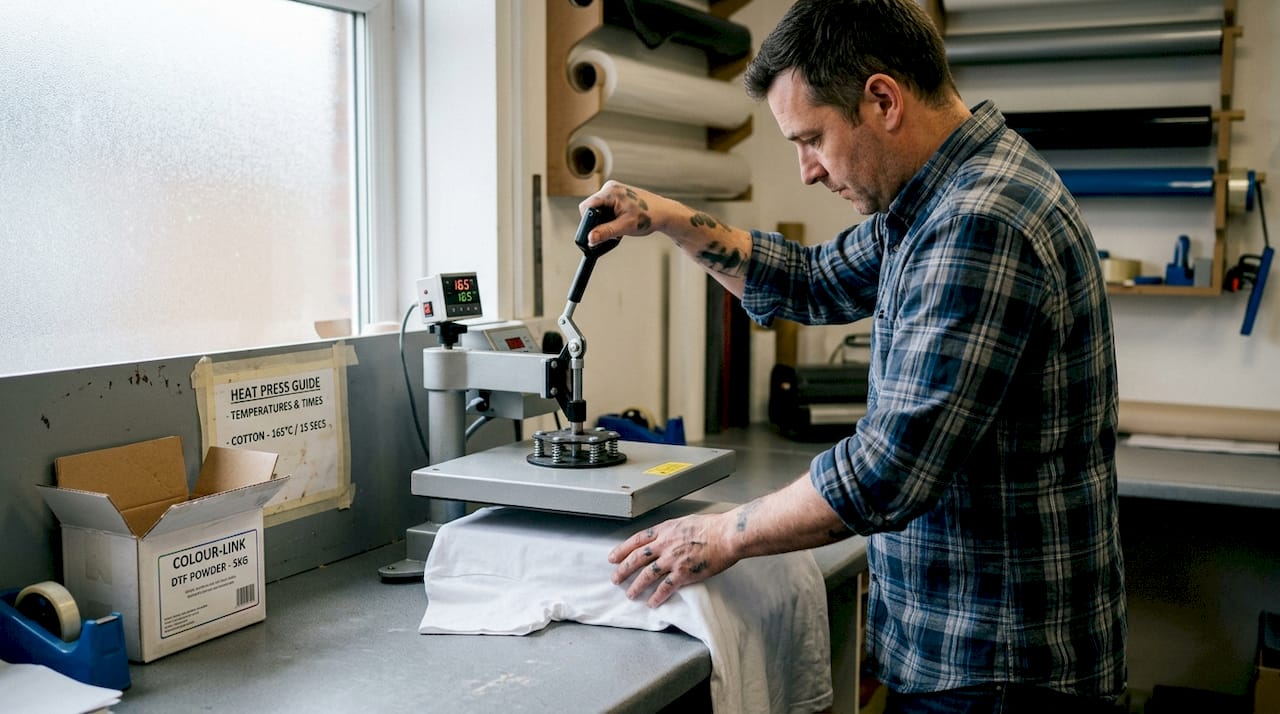
- Heat transfer: The cured film is placed face-down on the garment and pressed with a heat press at the correct temperature and pressure. The adhesive bonds the design permanently to the fabric.
- Peeling and finishing: Once pressed, the film is peeled away (hot or cold depending on film type), leaving a vibrant, flexible print on the garment.
Pro Tip: Always test your curing temperature with a small batch before committing to a full production run. Under-cured powder leads to poor adhesion, while over-curing can make the print brittle. Our guides on personalised goods printing steps and equipment setup offer useful reference points for calibrating your process.
DTF vs traditional printing: Comparing key features and costs
Understanding each step, it’s important to compare DTF to the other major print methods. The table below gives a practical overview for trade printers weighing up their options.
| Feature | DTF | Screen printing | DTG | Sublimation |
|---|---|---|---|---|
| Setup cost | None | High (screens) | Low | Low |
| Minimum run | 1 unit | 12 to 24 units | 1 unit | 1 unit |
| Fabric range | Broad | Broad | Cotton-heavy | Polyester only |
| Full-colour detail | Excellent | Limited | Excellent | Excellent |
| Wash durability | 50 to 100+ washes | 50 to 100+ washes | 20 to 50 washes | Permanent |
| Cost per unit (low volume) | Low | High | Medium | Low |
DTF is cheaper than screen printing and DTG for low-volume jobs, though screen printing becomes more economical for bulk orders of 100 or more simple designs.
DTF’s durability is one of its strongest selling points. Wash benchmarks of 50 to 100+ on cotton put it on a par with screen printing, while on polyester blends it typically achieves 30 to 50 washes before any visible degradation. That is considerably better than standard DTG on the same fabrics.
Key advantages of DTF over alternatives:
- Versus screen printing: No screens, no minimum runs, no colour separation surcharges for complex artwork.
- Versus DTG: Works on polyester and blends without pre-treatment; more consistent on dark fabrics.
- Versus sublimation: Applies to cotton and dark garments, where sublimation for textiles is limited to light polyester. For a broader look at where sublimation excels, see our article on sublimation printing benefits.
The heat press role is central to all transfer-based methods, and investing in a quality press pays dividends across DTF, sublimation, and vinyl work alike.
DTF in practice: Applications for UK and Ireland businesses
Having compared DTF to alternatives, let’s see how these features translate to real-world applications for printing businesses across the UK and Ireland.
Custom t-shirts and apparel remain the most common use case. Sports clubs, corporate clients, and event organisers regularly need small runs of branded garments with detailed logos or photographic prints. DTF handles all of these without the cost penalties that screen printing imposes on short orders.
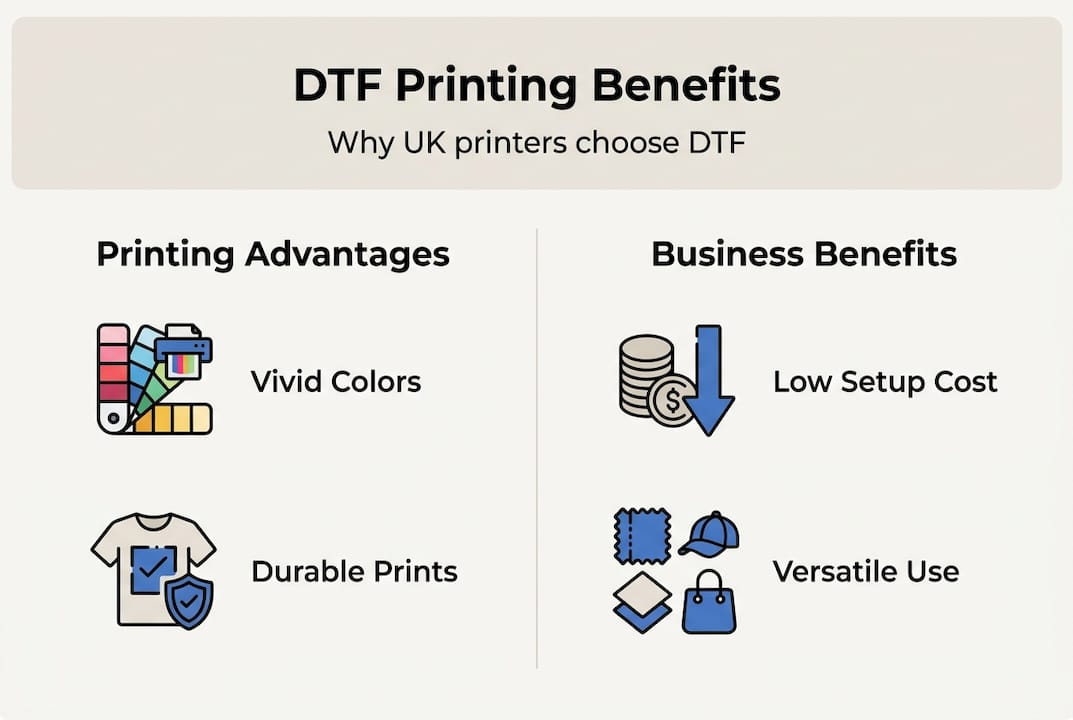
Branded merchandise is another strong area. Tote bags, caps, and even rigid items like badges can accept DTF transfers, giving you a single workflow for diverse product types. Because full-colour complex designs carry no setup fees, you can offer genuinely competitive pricing on one-off or low-quantity branded goods.
Practical applications for UK and Ireland printing businesses include:
- Workwear and uniforms: Small businesses often need fewer than 20 items per order, a quantity where DTF is far more economical than screen printing.
- Event merchandise: Festivals, charity runs, and corporate away-days all generate demand for short-run, high-detail prints.
- Personalised gifts: Names, numbers, and bespoke artwork on garments and accessories.
- Promotional goods: Branded bags, hats, and accessories for marketing campaigns.
- Reseller and fulfilment services: Pre-print transfers in bulk and apply them on demand as orders come in.
Pro Tip: Pre-printing a library of popular designs as DTF transfers lets you fulfil single-item orders in minutes rather than hours. Our article on DTF garment business benefits explores this model in more detail, and our roundup of top printers for 2026 can help you identify the right hardware for your volume.
Making the switch: Tips for introducing DTF into your workflow
With practical examples covered, here’s how to successfully implement DTF in your business without disrupting existing operations.
Start by assessing your current order mix. If you regularly turn away or outsource short-run, full-colour jobs, DTF will pay for itself quickly. If your business is built on bulk screen printing of simple designs, the return on investment will be slower.
Essential equipment for a DTF setup:
- DTF printer: Modified inkjet printers or purpose-built DTF units. Entry-level machines suit low to medium volumes; industrial units handle high throughput.
- DTF inks and films: Quality matters enormously here. Cheap inks produce dull colours and poor adhesion. Invest in reputable supplies from the outset.
- Hot-melt adhesive powder: Available in fine and coarse grades; fine powder suits detailed designs and thinner fabrics.
- Curing oven or heat source: A dedicated curing oven gives the most consistent results, though a heat press can work for smaller operations.
- Heat press: A quality flat-bed press with accurate temperature and pressure control is non-negotiable. Our equipment setup guide walks through the key specifications to look for.
Quality control is where many new DTF operations stumble. Proper curing is the most common failure point, so build a curing check into every production run. Wash-test samples from each new batch of ink or film before committing to client orders. Regular maintenance of your printer heads and powder shaker will also prevent costly downtime. Our equipment maintenance tips are worth bookmarking for ongoing reference.
Cost-saving strategies worth considering include buying films and powders in bulk, standardising on two or three film types to simplify stock management, and training staff on RIP software to reduce artwork preparation time.
Find reliable supplies and support for DTF printing
If you’re ready to add DTF to your production capabilities, having a reliable supply chain in place from day one makes a significant difference to consistency and profitability. We stock a broad range of DTF supplies, sublimation equipment, and complementary products to support printing businesses across the UK and Ireland.
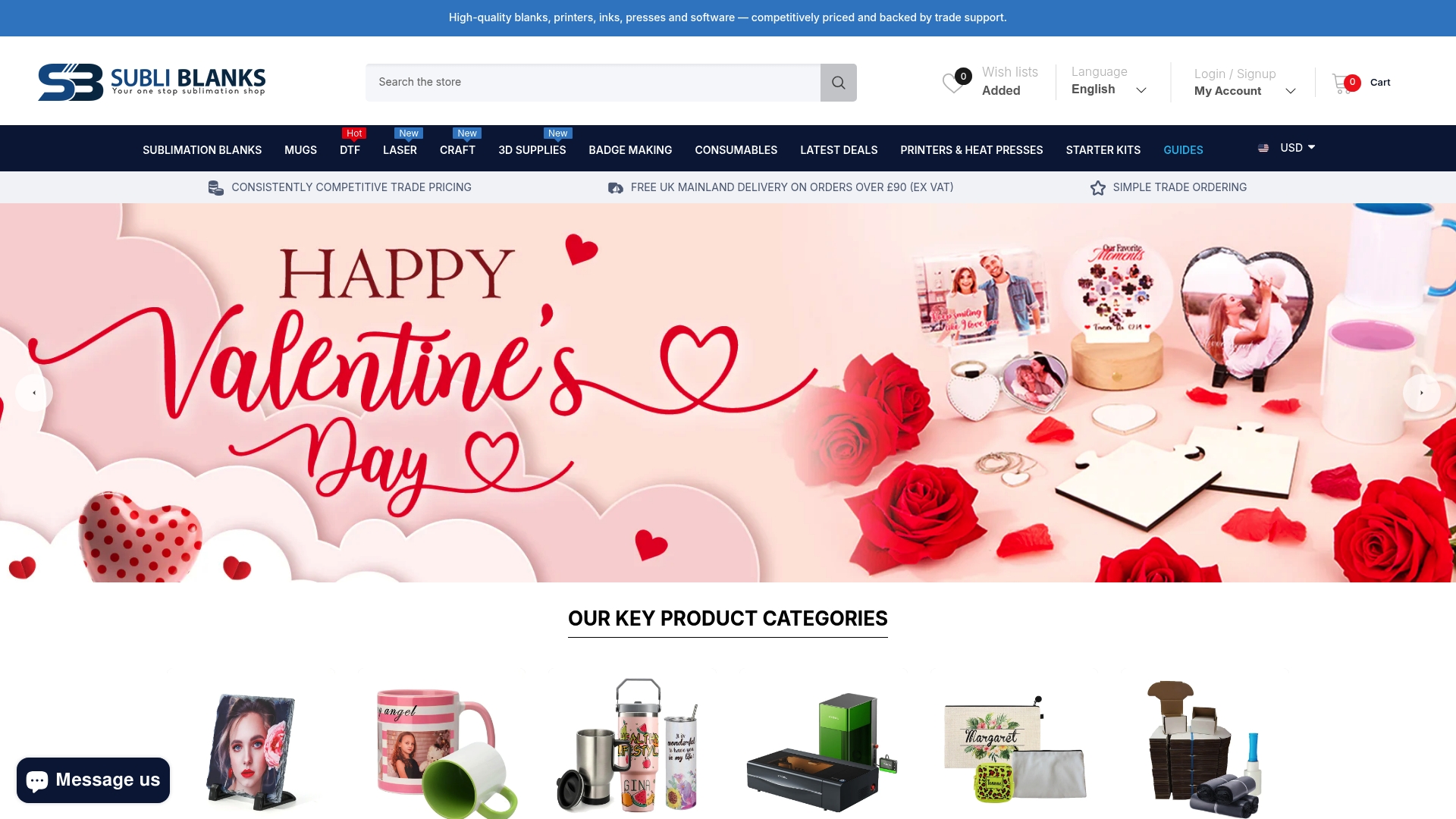
From sublimation paper to laser-engraveable blanks and badge-making supplies such as the round MDF namebadge pin, our range is designed for trade professionals who need quality and consistency without minimum order commitments. Browse our full catalogue of wholesale printing supplies to find everything from entry-level DTF starter kits to high-volume production consumables. No minimum orders, competitive trade pricing, and a product range built around the real needs of UK and Ireland printing businesses.
Frequently asked questions
Is DTF printing more durable than screen printing or DTG?
DTF prints last 50 to 100+ washes on cotton, putting them on a par with screen printing and well ahead of DTG on polyester blends. Durability depends heavily on correct curing and transfer technique.
What type of designs is DTF best suited for?
DTF excels with full-colour complex designs and small runs where screen printing setup costs would make the job uneconomical. Photographic images, gradients, and fine detail all reproduce well.
How do you avoid cracking or peeling in DTF prints?
Proper curing of the powder before transfer is the most critical step. Consistent heat press temperature and pressure during application also prevent adhesion failures over time.
Can DTF be used for products other than garments?
Yes. DTF transfers apply to bags, caps, badges, and a range of promotional goods. Because small runs carry no setup fees, it is practical for one-off branded merchandise as well as repeat orders.
Recommended
- What does DTF mean? A complete guide to direct-to-film printing – SubliBlanks Ltd
- DTF Printing: Transforming Garment Businesses Today – SubliBlanks Ltd
- Cut Sublimation Ink Costs 90%: Best Printers 2026 UK Guide – SubliBlanks Ltd
- What Is Heat Transfer Printing? 30% Better Colour UK SMEs – SubliBlanks Ltd


