



How to package sublimation products to impress customers
Poor packaging is one of the fastest ways to undo all the effort you put into creating a beautiful sublimation product. A scratched mug, a bent print, or a damp parcel arriving at a customer’s door can destroy trust instantly, and in a competitive market, that trust is hard to rebuild. Branded packaging boosts perceived value and encourages customers to share their purchases on social media, turning every delivery into a marketing moment. This guide walks UK and Ireland small businesses through everything needed to package sublimation products safely, professionally, and memorably.
Table of Contents
- Understanding packaging needs for sublimation products
- Essential tools and materials for safe, branded packaging
- Step-by-step guide: how to package sublimation products
- Testing, troubleshooting, and shipping tips
- Maximising customer delight and brand value
- Get the best sublimation packaging and blanks
- Frequently asked questions
Key Takeaways
| Point | Details |
|---|---|
| Choose packaging by item type | Flat and soft items need poly mailers; fragile products require rigid boxes and protective layers. |
| Waterproofing is essential | UK and Ireland’s climate demands waterproof mailers or outer layers for reliable shipping. |
| Branding adds value | Branded stickers, custom wrapping, and thoughtful extras increase perceived value and foster loyalty. |
| Always test your packaging | A quick shake test before posting ensures your product arrives safely and professionally. |
Understanding packaging needs for sublimation products
Not all sublimation products are created equal, and neither are their packaging requirements. A flat sublimation print has very different needs compared to a ceramic mug or a curved tumbler. Getting this wrong means damaged goods, unhappy customers, and costly replacements.
Flat items such as prints, mouse mats, and fabric panels are vulnerable to bending and moisture. Soft items like sublimated cushion covers or tote bags need protection from compression and dirt. Curved or fragile items, including mugs, tumblers, and ornaments, require rigid, protective packaging to prevent cracking or chipping during transit.
The UK and Ireland climate adds another layer of complexity. Rain, humidity, and temperature swings are a constant reality for postal deliveries. Waterproof outer layers such as poly mailers over boxes are strongly recommended for shipments in these conditions. Moisture damage is one of the most common complaints in e-commerce returns, and it is entirely preventable.
Understanding your sublimation blanks and customer value starts with knowing how each product behaves in transit. Here is a quick overview of product types and their packaging priorities:
| Product type | Key risk | Recommended packaging |
|---|---|---|
| Flat prints and panels | Bending, moisture | Rigid mailer, poly outer |
| Mugs and ceramics | Cracking, chipping | Foam-lined rigid box |
| Tumblers and bottles | Denting, scratching | Bubble wrap, rigid box |
| Cushion covers and fabric | Compression, dirt | Poly mailer, tissue wrap |
| Keyrings and small items | Scratching, loss | Padded envelope, zip bag |
Key risks to account for in every shipment:
- Scratches from items shifting inside loose packaging
- Moisture ingress through unsealed or thin outer layers
- Bending of flat items in undersized envelopes
- Impact damage to fragile ceramics without adequate padding
Proper planning at this stage also helps with reducing waste with proper blanks, since fewer damaged items means fewer reprints and less material waste overall.
Essential tools and materials for safe, branded packaging
Once you know what each product needs, sourcing the right materials becomes straightforward. The good news for start-ups is that you do not need to buy in bulk to get started. Many suppliers, including trade wholesalers with no minimum order quantities, make it easy to test different options without committing to large stock.
Core packaging materials every sublimation seller should have:
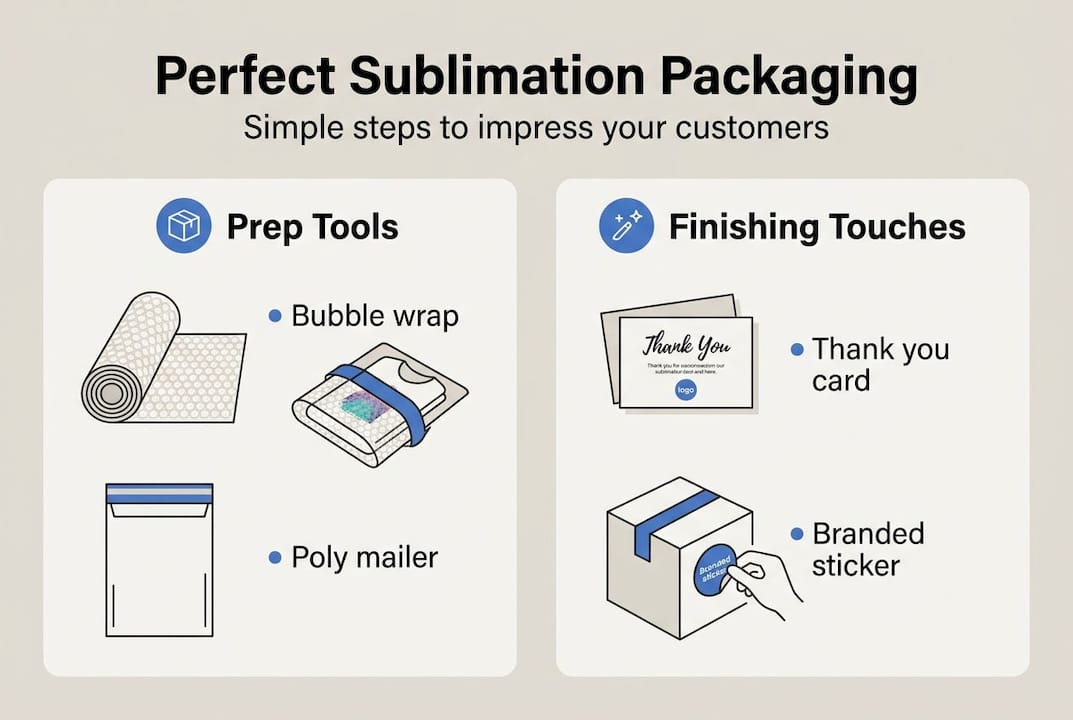
- Poly mailers for flat and soft items. Poly mailers are waterproof and tear-proof, making them cost-effective for stickers, prints, and fabric goods. Choose patterned or coloured versions for an instant branding boost.
- Rigid cardboard boxes in various sizes for ceramics and fragile items
- Bubble wrap and foam inserts for internal cushioning
- Tissue paper in brand colours for a premium feel
- Branded stickers and thank you cards to personalise every order
- Kraft paper or crinkle fill for void filling inside boxes
- Resealable zip bags for small items like keyrings or badges
Branded packaging raises perceived value and encourages customers to share their unboxing experience online. Even a simple sticker with your logo on a poly mailer signals professionalism and care.

Here is a comparison of the most common packaging materials to help you choose:
| Material | Best for | Cost level | Branding potential |
|---|---|---|---|
| Poly mailer | Flat, soft items | Low | Medium (coloured options) |
| Rigid cardboard box | Fragile, curved items | Medium | High (custom print) |
| Padded envelope | Small, lightweight items | Low | Low |
| Foam-lined box | Ceramics, glass | Medium-high | Medium |
| Tissue paper | All items (inner wrap) | Low | High (coloured, branded) |
Pro Tip: Order a small selection of packaging sizes before committing to bulk. Test each one with your actual products to check fit, protection, and presentation before scaling up.
For guidance on getting the most from your products before they even reach the packaging stage, the sublimation transfer guides and benefits of quality blanks are worth reviewing.
Step-by-step guide: how to package sublimation products
With your materials ready, here is a clear process to follow for every order. Consistency is key. A repeatable routine means fewer mistakes and a more professional result every time.
- Prepare your workspace. Clear a clean, dry surface. Dust and moisture are the enemies of sublimation products, so keep your packaging area tidy and away from direct sunlight or damp.
- Inspect the item. Check for any print defects, scratches, or imperfections before packaging. It is far better to catch issues now than after the customer opens the parcel.
- Wrap the item in tissue paper. This protects the surface and adds a premium touch. Use your brand colour if possible.
- Add protective padding. For fragile items, wrap in bubble wrap and place inside a foam-lined or padded box. For flat items, use a rigid mailer or cardboard backing to prevent bending.
- Include branding elements. Place a thank you card, a discount code card, or care instructions inside the package before sealing. This is your chance to make a lasting impression.
- Seal securely. Use strong packing tape on all box seams. For poly mailers, press the self-seal strip firmly along the full width.
- Shake-test the package. Test for shake-proof security before sealing completely. If you hear or feel movement, add more padding.
- Label clearly. Print or write the address legibly. Include your return address. Consider a fragile sticker for ceramic or glass items.
Pro Tip: Personalisation does not have to be expensive. A handwritten note or a small branded sticker costs almost nothing but creates a memorable moment that customers remember and talk about.
“The unboxing experience is part of the product. Customers who feel valued are far more likely to return and recommend your business to others.”
For more detail on the production side before packaging begins, the step-by-step sublimation printing guide and advice on using blanks for merchandise are excellent starting points.
Testing, troubleshooting, and shipping tips
Even the best packaging routine can have weak points. Building a quick testing habit into your dispatch process catches problems before they reach the customer.
Shake testing prevents damage and maintains professional presentation. Do it every time, without exception. Also run a quick moisture check: press gently on the outer layer to confirm there are no gaps where water could enter.
Common packaging mistakes to avoid:
- Overfilling boxes so lids bow or seams split under pressure
- Under-padding fragile items, leaving them free to move inside the box
- Skipping branding and sending plain, anonymous parcels that miss a marketing opportunity
- Weak seals on poly mailers that can open in transit
- Wrong box size leading to excessive void fill or a crushed product
| Mistake | Consequence | Fix |
|---|---|---|
| Overfilling | Split seams, damaged goods | Use the next size up |
| Under-padding | Breakage, scratches | Add bubble wrap or foam |
| Weak seal | Parcel opens in transit | Double-tape all seams |
| No branding | Missed marketing chance | Add sticker or card |
| No moisture barrier | Water damage | Use poly mailer outer |
For UK and Ireland shipping, always account for the possibility of parcels sitting in a damp sorting facility or being left on a doorstep in the rain. A waterproof outer layer is not optional; it is standard practice.
Pro Tip: Keep a small stock of replacement items for your most popular products. If a damaged parcel is reported, a fast replacement with a personal apology note turns a negative experience into a loyalty-building moment.
The sublimation business gear checklist is a useful resource for making sure your full setup, from production to dispatch, is properly equipped.
Maximising customer delight and brand value
Safe delivery is the baseline. What separates memorable brands from forgettable ones is what happens when the customer opens the parcel. Packaging is a brand story, and every element inside the box is a chapter.
Branded packaging boosts perceived value and actively encourages customers to share their purchases on social media. An unboxing video or a tagged Instagram post from a happy customer is free advertising that reaches their entire network.
Ways to elevate the unboxing experience:
- Thank you cards with a personal message or the customer’s first name
- Care instruction cards that show you stand behind your product quality
- Exclusive discount codes for the next order, printed on a small card
- Branded tissue paper in your signature colour scheme
- A QR code linking to your social media or a review page
Encouraging reviews does not need to be pushy. A simple line on your thank you card, such as “We would love to hear what you think,” is enough to prompt many customers to leave feedback. Monitor your reviews and returns data regularly. A spike in damage complaints points to a packaging issue. A pattern of positive unboxing comments tells you what is working.
For inspiration on how sublimation products can double as promotional tools, the guide on using sublimation for promotion offers practical ideas for small businesses looking to grow their reach.
Get the best sublimation packaging and blanks
With expert packaging knowledge in hand, the next step is making sure your supplies are reliable, affordable, and ready when you need them.
At SubliBlanks, we supply everything a UK or Ireland sublimation business needs, from sublimation blanks and printing equipment to packaging supplies, all with no minimum order quantities. Whether you are just starting out or scaling up, you can order exactly what you need without committing to large volumes. Browse our range including the sublimation name badge with pin for personalised products and A4 sublimation paper for consistent, professional prints. One trusted supplier for production and packaging means less time sourcing and more time creating.
Frequently asked questions
What is the safest packaging for fragile sublimation items?
Use rigid boxes with inner padding and a waterproof poly mailer as the outer layer for maximum protection against impact and moisture during transit.
How can I make my packaging stand out for branding?
Add branded stickers, custom tissue paper, or a thank you card, and choose distinctive packaging colours. Branded packaging encourages social sharing and builds recognition with every delivery.
Should I test my packaging before posting?
Yes, always shake-test before sealing and check for any gaps that could let moisture in. This simple step prevents the majority of transit damage complaints.
What is the best low-cost option for shipping flat items?
Poly mailers are waterproof and tear-proof, making them the most cost-effective choice for lightweight flat items such as prints, fabric panels, and stickers.
Recommended
- How to Use Sublimation Blanks for Custom Merchandise – SubliBlanks Ltd
- Sublimation Transfer Process: Achieve Professional Prints Easily – SubliBlanks Ltd
- Sublimation Equipment Setup Guide for Business Success – SubliBlanks Ltd
- Sublimation Printing Step by Step for Personalised Goods – SubliBlanks Ltd


