



Thermal transfer explained: Durable printing for UK creators
Not all printed labels are created equal. Walk into any busy warehouse, food production facility, or retail stockroom and you will find labels that have survived years of handling, moisture, and temperature swings without a single smudge. That is not luck. It is the result of choosing the right printing technology from the start. Thermal transfer printing creates highly durable images, text, and barcodes that outlast most alternatives, making it the go-to choice for UK and Ireland businesses that cannot afford labels to fail. This guide breaks down exactly how the technology works, what sets it apart, and how you can put it to work for your operation.
Table of Contents
- What is thermal transfer printing?
- How does thermal transfer printing work?
- Thermal transfer vs direct thermal: What’s the difference?
- Applications of thermal transfer: Business use cases in the UK and Ireland
- Key factors for reliable results: Maintenance and best practice
- Get started: Solutions and supplies for thermal transfer printing
- Frequently asked questions
Key Takeaways
| Point | Details |
|---|---|
| Long-lasting labels | Thermal transfer printing produces labels and barcodes that stay clear and readable for years. |
| Versatile ribbon options | Choose between wax, wax-resin, or resin ribbons for the best match of durability and cost. |
| Outperforms direct thermal | Thermal transfer resists fading, moisture, and friction unlike short-lived direct thermal prints. |
| Broad business applications | Ideal for compliance, product, and shipping labels in industries needing robust results. |
| Maintenance prevents problems | Proper equipment care and matching of media and ribbon avoid quality issues and downtime. |
What is thermal transfer printing?
Thermal transfer printing is a method that uses heat to bond ink from a ribbon onto a surface, whether that is a label, tag, or piece of packaging. The result is a sharp, permanent image that does not rely on special paper to hold the print. Unlike inkjet or laser methods, the image is physically fused to the substrate, which is why it holds up so well in demanding environments.
It is worth distinguishing this from direct thermal printing, which uses heat-sensitive paper and no ribbon at all. Direct thermal is cheaper upfront but the prints fade quickly, especially when exposed to light or warmth. Thermal transfer, by contrast, uses a printhead to melt ink from a ribbon onto labels, tags, or packaging, resulting in lasting images that stay legible for years.
Thermal transfer is the preferred choice whenever a label needs to survive beyond a few months, whether that is on a product sitting in a warehouse or a compliance tag on industrial equipment.
Here is a quick summary of what thermal transfer printing is suited for:
- Product labels that need to withstand handling, moisture, and abrasion
- Barcodes and QR codes requiring long-term scannability
- Compliance and safety labels in manufacturing environments
- Retail tags that must look sharp throughout a product’s shelf life
- Packaging for food, pharmaceuticals, and logistics
For businesses exploring durable product labels or those interested in the lasting impact of textile printing, understanding thermal transfer is a strong foundation.
How does thermal transfer printing work?
Now that you know the concept, let us explore the inner workings and what makes thermal transfer so robust.
The process begins when your print file is sent to the printer. A thermal printhead, made up of tiny heating elements, presses against a ribbon. The ribbon sits between the printhead and the label media. When the elements heat up, they melt the ink coating on the ribbon and transfer it directly onto the label surface. The ink cools almost instantly, bonding permanently to the material.
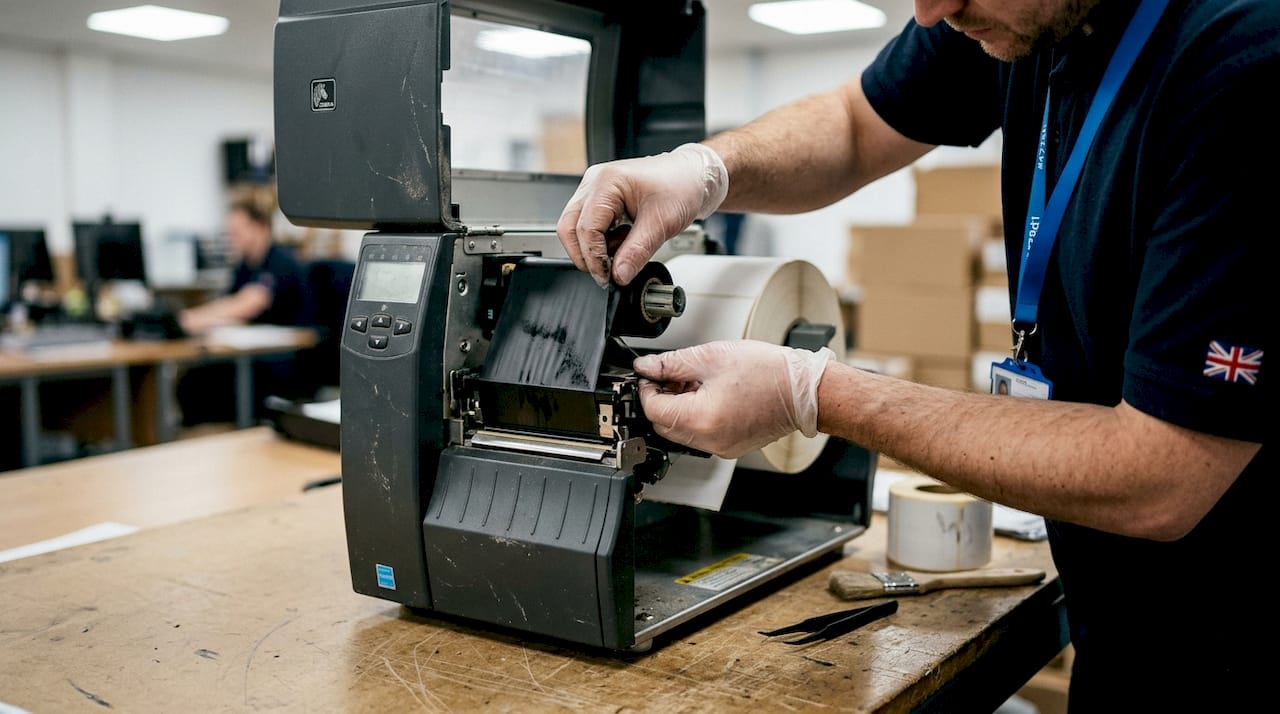
Key components include the printhead, ribbon supplies, rollers, and sensors, all working in precise coordination to produce consistent output at speed. The printhead is the most critical and most expensive part, which is why maintenance matters so much.
Here is the step-by-step process:
- The print file is sent to the thermal transfer printer via software or a connected system.
- The printhead heats specific elements according to the image data.
- Heat melts the ink from the ribbon onto the label or tag surface.
- The ribbon advances as the label moves through the printer.
- The finished label exits with a sharp, permanent print ready for use.
Ribbon choice is where many businesses get tripped up. Different ribbon types offer varying durability and costs, so matching the ribbon to your media and environment is essential.
| Ribbon type | Best for | Durability | Relative cost |
|---|---|---|---|
| Wax | Indoor paper labels | Moderate | Low |
| Wax-resin | Coated or synthetic labels | High | Medium |
| Resin | Outdoor, chemical, or heat exposure | Very high | Higher |
Pro Tip: If you are printing on synthetic or polyester labels, always use a resin ribbon. Wax ribbons will smear on non-paper surfaces and your prints will not last.
For those new to setting up equipment, our printer setup guidance and overview of essential equipment for print shops are useful starting points.
Thermal transfer vs direct thermal: What’s the difference?
Understanding how thermal transfer compares is vital before investing in new technology.
Thermal transfer uses ribbon and plain media for lasting results; direct thermal uses special paper but fades after months, especially in sunlight or heat. That single distinction drives most purchasing decisions for businesses that need reliable, long-life labelling.
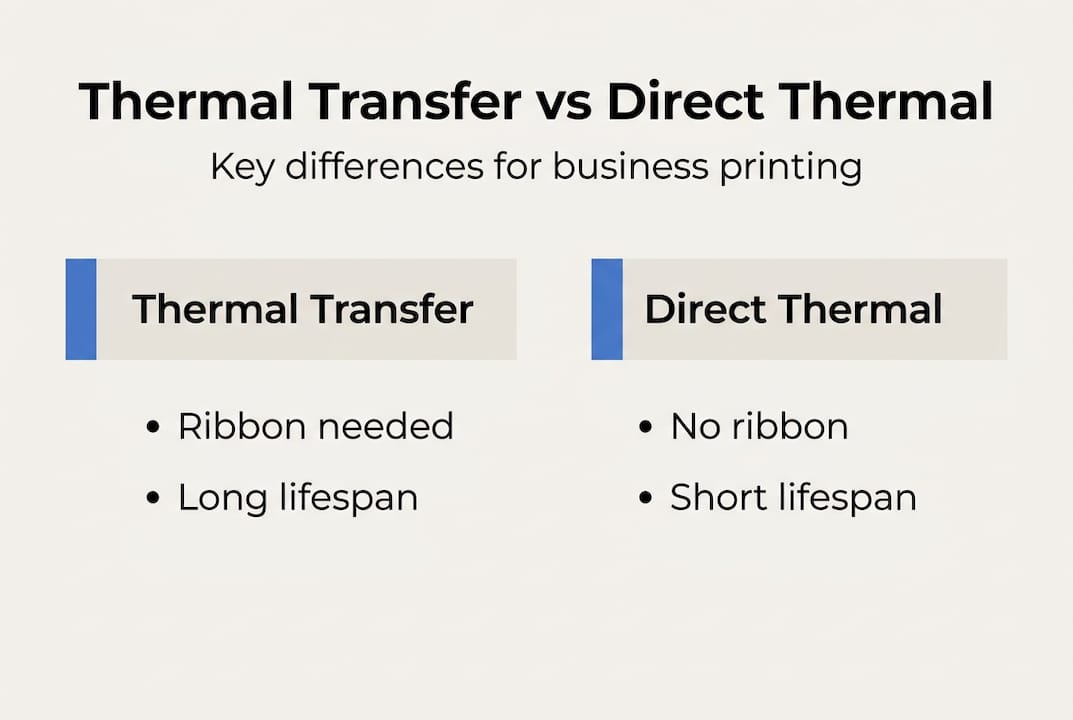
Ribbon cost and waste are key differences; thermal transfer is best for compliance and long-term labels. Direct thermal suits short-life applications like receipts or same-day shipping labels, but it simply cannot compete when permanence is required.
| Feature | Thermal transfer | Direct thermal |
|---|---|---|
| Ribbon required | Yes | No |
| Label lifespan | Several years | Months |
| Resistance to heat/light | Excellent | Poor |
| Media cost | Standard | Higher (heat-sensitive) |
| Best use case | Compliance, asset, product labels | Receipts, short-term shipping |
| Environmental waste | Ribbon waste | Less waste |
Pro Tip: For any label that needs to stay legible for more than six months, thermal transfer is the safer investment. The ribbon cost is offset by the reliability you gain, especially for compliance or traceability applications.
A useful accessory to support your thermal printing workflow is a reliable thermal tape accessory, which helps keep your process tidy and efficient.
Applications of thermal transfer: Business use cases in the UK and Ireland
Knowing the hardware is half the story. Now, see how businesses like yours put it into practice.
Thermal transfer printing is preferred for custom product, shipping, and compliance labels over long timeframes, and the range of industries using it in the UK and Ireland is broader than most people realise.
Here is where thermal transfer delivers real value across different sectors:
- Retail: Product tags that survive the full journey from warehouse to shop floor to customer hands, without fading or peeling.
- Warehousing and logistics: Long-life barcodes and asset ID labels that remain scannable after months of handling, temperature changes, and exposure to dust.
- Manufacturing: Compliance labels, safety warnings, and equipment tags that must meet regulatory standards and stay legible for the life of the product.
- Food and pharmaceuticals: Date coding and ingredient labels that hold up in cold storage, humid environments, and through repeated handling.
- SMEs and creators: Businesses scaling up their customisation offering, from branded packaging to personalised product tags, benefit from the consistency thermal transfer delivers.
The technology is particularly valuable for any business operating under traceability requirements. Whether you are labelling medical devices, electrical components, or food products, a label that fades is a compliance risk. Thermal transfer removes that risk entirely.
For businesses looking at high-performing label printers to support these applications, understanding the technology behind the output helps you make a more informed purchase.
Key factors for reliable results: Maintenance and best practice
With so many use cases, reliability matters. Here is how to make your print process seamless.
Ribbon-printer and media mismatch can cause wrinkling or fading; regular printhead cleaning is crucial to maintaining consistent output. Most print quality problems are avoidable with a few straightforward habits.
Follow these steps to keep your thermal transfer printer performing at its best:
- Match your ribbon to your media. Always confirm that your ribbon type is compatible with the label material you are using. Wax on synthetic media is a common and costly mistake.
- Clean the printhead regularly. Use isopropyl alcohol and a lint-free cloth or a dedicated cleaning card. Dust and ink residue build up quickly and degrade print quality.
- Check ribbon tension before each run. Loose ribbon causes wrinkles and voids in the print. A quick visual check takes seconds and saves wasted stock.
- Store media and ribbons correctly. Keep both away from direct sunlight, humidity, and extreme temperatures. Poor storage degrades materials before they even reach the printer.
- Run test prints after any media or ribbon change. Do not assume compatibility. A short test run catches problems before they affect a full batch.
Pro Tip: Set a weekly cleaning schedule for your printhead rather than waiting for quality to drop. Proactive maintenance extends printhead life significantly and reduces the cost of replacements over time.
For a broader look at keeping your equipment in top condition, our printer maintenance guide covers the essentials. If you are thinking about how thermal printing fits into a wider production setup, the guide on efficient production workflow is worth a read.
Get started: Solutions and supplies for thermal transfer printing
Armed with best practices, you are ready to take your customisation or labelling to the next level.
At Subliblanks, we supply trade customers across the UK and Ireland with the consumables and equipment needed to run a reliable, professional print operation. There is no minimum order quantity, so whether you are testing a new process or restocking at scale, we have you covered.
For heat transfer applications, our Teflon heat press sheets protect both your media and your equipment during production. If you are working with sublimation alongside thermal transfer, our A4 sublimation paper delivers consistent, vibrant results. Browse our full range of wholesale printing supplies to find everything from ribbons and blanks to printers and accessories. Our team is on hand to help you choose the right setup for your specific application.
Frequently asked questions
Which ribbon type should I use for outdoor product labels?
Resin ribbons offer high resistance to chemicals and weathering, making them the correct choice for any label exposed to outdoor conditions, UV light, or harsh environments. Wax or wax-resin ribbons will not hold up reliably in these situations.
How long do thermal transfer prints last?
Thermal transfer prints last years and withstand tough environments including moisture, abrasion, and temperature extremes. The exact lifespan depends on ribbon type, media quality, and the conditions the label is exposed to.
Can thermal transfer be used on flexible packaging materials?
Yes. TTO is a popular method for flexible packaging, allowing variable data such as dates and batch codes to be printed directly onto film and foil materials with minimal downtime.
What causes common print quality issues in thermal transfer?
Compatibility and maintenance are key to print quality. Fading, wrinkling, and voids are almost always caused by ribbon-media mismatches or infrequent printhead cleaning rather than printer faults.
Is thermal transfer suitable for food packaging?
Yes. Thermal transfer is used in packaging including the food sector, where clear, durable date coding and ingredient labelling are essential for compliance and consumer safety.
Recommended
- What Is Heat Transfer Printing? 30% Better Colour UK SMEs – SubliBlanks Ltd
- Cut Sublimation Ink Costs 90%: Best Printers 2026 UK Guide – SubliBlanks Ltd
- Why use sublimation printers for cost-effective custom merchandise – SubliBlanks Ltd
- Role of Heat Press in Production: Boosting Efficiency and Quality – SubliBlanks Ltd


