



Cut Sublimation Ink Costs 90%: Best Printers 2026 UK Guide
Sublimation prints retain 95% colour vibrancy after 100 washes, yet many UK and Ireland business owners struggle to select printers that balance quality with cost efficiency. This guide walks you through sublimation printer technology, leading models, and practical strategies to maximise durability and profitability in 2026. You’ll discover how modern systems slash ink expenses while expanding your product range across textiles, ceramics, and metals.
Table of Contents
- Understanding Sublimation Printing Technology In 2026
- Advantages Of Sublimation Printers For UK And Ireland Businesses
- Recommended Sublimation Printers For UK And Ireland Businesses
- Cost Efficiency And Operational Benefits
- Common Misconceptions About Sublimation Printing
- Maintaining Print Quality And Printer Performance
- Sustainability Trends And Industry Outlook In 2026
- Bridging Technology To Business Growth: Practical Next Steps
- Discover Sublimation Blanks & Supplies At SubliBlanks Ltd
- Frequently Asked Questions About Choosing Sublimation Printers In 2026
Key Takeaways
| Point | Details |
|---|---|
| Exceptional Durability | Sublimation prints maintain 95% vibrancy after 100 washes on compatible substrates. |
| Dramatic Cost Savings | EcoTank systems reduce ink costs by up to 90% compared to traditional cartridges. |
| Versatile Substrate Range | Works on polyester fabrics, coated metals, ceramics, and plastics beyond textiles. |
| Leading UK Models | Epson SureColor F570, Brother SP1, and EcoTank ET-4800 suit varied business needs. |
| Quality Maintenance | Monthly calibration and routine cleaning sustain consistent output and extend printer lifespan. |
Understanding Sublimation Printing Technology in 2026
Sublimation printing converts ink into gas under heat, embedding it permanently into specially coated substrates. This process creates vibrant, durable images that resist fading and cracking. Unlike surface printing methods, sublimation bonds at the molecular level with polyester fibres or coated materials.
Common substrates extend far beyond fabrics. You can print on coated ceramics for mugs and tiles, treated metals for signage and awards, and specialised plastics for phone cases. This versatility lets you diversify product offerings without investing in multiple printing systems. Understanding substrate compatibility prevents costly mistakes and material waste.
Technological improvements in 2026 deliver faster print speeds and enhanced colour fidelity. Modern printheads produce finer droplets, resulting in sharper details and smoother gradients. These advancements boost productivity for UK businesses handling high-volume orders or tight deadlines.
Key substrate categories include:
- Polyester fabrics for apparel, bags, and soft furnishings
- Coated ceramics for drinkware and decorative tiles
- Treated metals for promotional products and awards
- Specialised plastics for accessories and tech cases
Mastering these substrate types positions your business to capture diverse market segments. The permanent bond ensures prints withstand repeated washing and daily wear, building customer loyalty through lasting quality.
Advantages of Sublimation Printers for UK and Ireland Businesses
Sublimation printing delivers exceptional durability that traditional methods cannot match. Prints retain 95% colour vibrancy after 100 washes on suitable substrates, making them ideal for activewear, home textiles, and frequently handled products. This longevity reduces customer complaints and strengthens brand reputation.
Cost efficiency transforms your bottom line. Bulk production costs can drop to £0.40 per print, dramatically improving profit margins on custom orders. Modern supertank systems eliminate expensive cartridge replacements, letting you reinvest savings into marketing or inventory expansion.
Product versatility opens revenue streams across multiple categories. You can offer personalised mugs, custom sportswear, metal signage, and promotional items from a single printing setup. This flexibility appeals to diverse customer segments without requiring specialised equipment for each product type. The advantages of sublimation printing become clear when you calculate reduced setup costs and faster turnaround times.
Operational benefits include:
- Fast production cycles with minimal drying time
- No pretreatment required for compatible substrates
- Vibrant full-colour prints without colour mixing complexity
- Scalable output from small batches to high-volume runs
Key Statistic: Businesses using sublimation printing report 15-20% higher customer satisfaction scores due to product durability and colour accuracy.
The combination of durability, low unit costs, and product range positions sublimation as a strategic investment. You gain competitive advantages through superior quality while maintaining healthy margins that support business growth.
Recommended Sublimation Printers for UK and Ireland Businesses
Selecting the right printer depends on your workspace, production volume, and product mix. Leading sublimation printers balance print quality, running costs, and footprint to match diverse business needs across UK and Ireland markets.
The Epson SureColor F570 excels for small businesses requiring high-quality output in limited workspace. It handles A4 and A3 formats efficiently, making it suitable for personalised textiles, small metal products, and custom ceramics. The integrated ink system reduces cartridge waste whilst maintaining consistent colour accuracy.
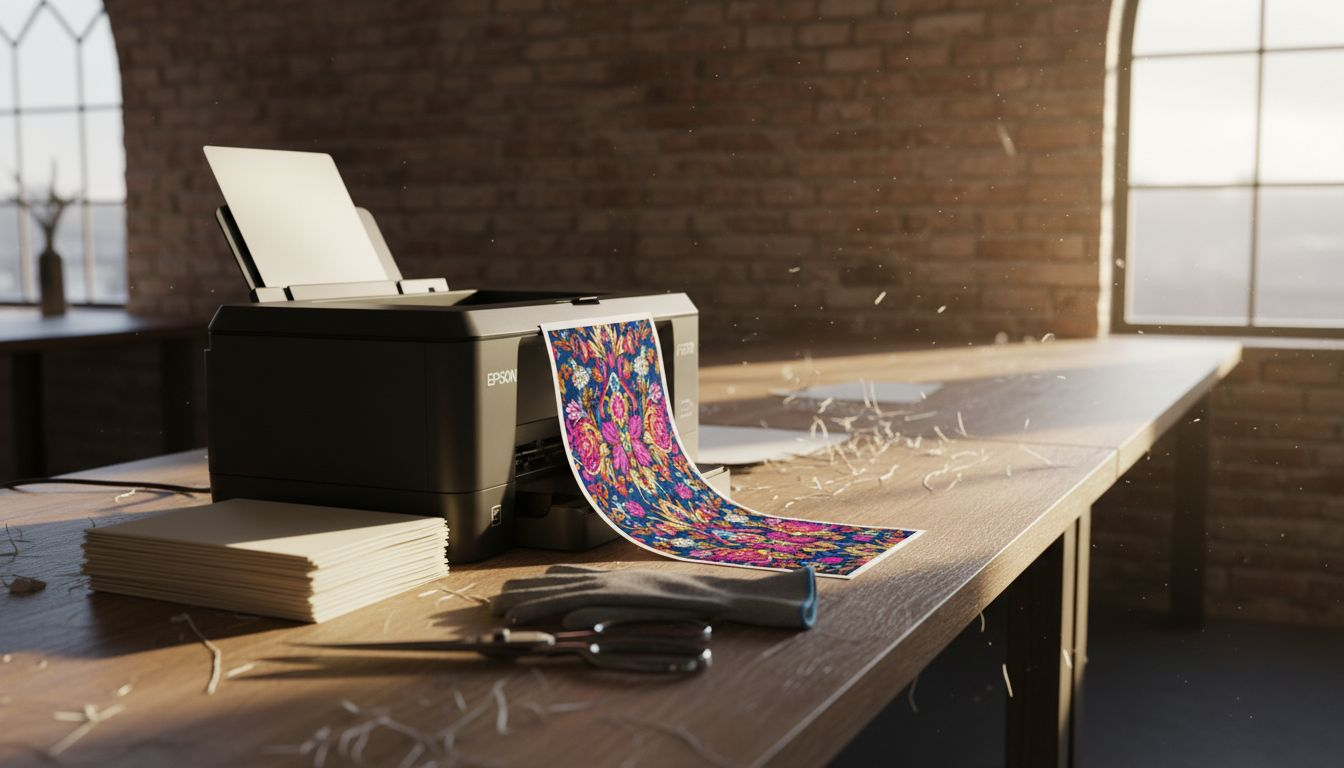
Brother SP1 offers compact desktop convenience with wireless capabilities. This model suits creative entrepreneurs and home-based businesses focusing on personalised products. Its small footprint fits standard desks, yet delivers professional results for custom mugs, coasters, and small textile items.
Epson EcoTank ET-4800 provides cartridge-free operation through its supertank system. This printer reduces ink costs by up to 90% compared to traditional cartridges, making it ideal for high-volume production. The large ink reservoirs minimise refill interruptions during busy production periods.
| Printer Model | Max Print Size | Print Speed | Cost Efficiency | Best For |
|---|---|---|---|---|
| Epson SureColor F570 | A3+ | 12 pages/hour | High | Small businesses needing quality |
| Brother SP1 | A4 | 8 pages/hour | Medium | Desktop personalisation |
| Epson EcoTank ET-4800 | A4 | 15 pages/hour | Very High | High-volume production |
Pro Tip: Evaluate your typical order size and product range before committing to a model. Overestimating capacity leads to unnecessary expense, whilst underestimating causes production bottlenecks and missed deadlines.
These printer model comparisons highlight how different features serve specific business scenarios. Match your selection to realistic production forecasts rather than aspirational volumes to optimise return on investment.
Cost Efficiency and Operational Benefits
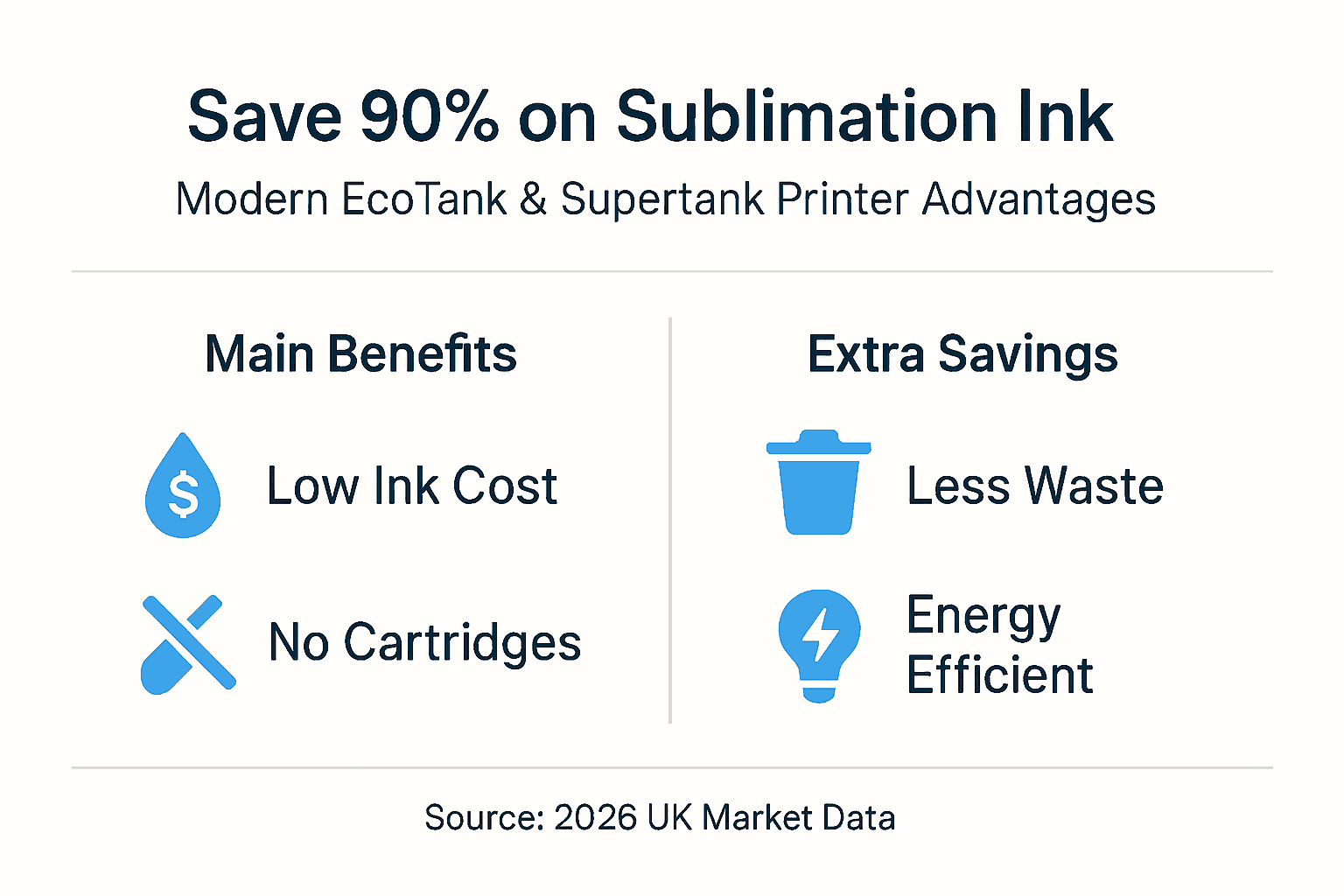
Modern sublimation printers slash operational costs through innovative ink delivery systems. EcoTank and supertank systems reduce ink expenditure by up to 90% by eliminating disposable cartridges. You purchase bottles of ink that refill internal reservoirs, lowering cost per print whilst reducing plastic waste.
Material testing protocols prevent expensive mistakes. Testing reduces substrate waste by approximately 25% by confirming colour accuracy and adhesion before production runs. You avoid reprinting entire batches due to incorrect settings or incompatible materials.
Regular printer calibration maintains colour consistency across orders. Calibration improves print accuracy by 15-20%, reducing customer returns and reprint requests. This consistency builds trust with repeat clients who expect identical results for reorders.
Maintenance fundamentals that control costs include:
- Cleaning print heads weekly to prevent clogs
- Monitoring ink levels to avoid running dry mid-print
- Using manufacturer-recommended cleaning solutions
- Storing unopened ink bottles in cool, dark conditions
Pro Tip: Schedule monthly calibration sessions and train all staff on proper media handling. This routine extends printer lifespan whilst maintaining quality standards that justify premium pricing.
Operational cost savings compound over time as you eliminate cartridge purchases and reduce material waste. The initial investment in a quality sublimation printer pays back through lower consumable costs and higher production efficiency. Calculate total cost of ownership over three years rather than focusing solely on purchase price.
Energy-efficient models further reduce running costs. Look for printers with automatic sleep modes and efficient heat management that lower electricity consumption during idle periods.
Common Misconceptions about Sublimation Printing
Myth: Sublimation printing only works on fabrics. Truth: It works brilliantly on coated metals, plastics, and ceramics with correct substrate preparation. This versatility lets you offer metal awards, ceramic drinkware, and plastic phone cases alongside textile products.
Myth: Sublimation inks are expensive and less cost-effective. Truth: EcoTank systems reduce ink costs by up to 90% compared to traditional cartridge printers. The higher initial investment recovers quickly through lower consumable expenses.
Myth: Sublimation prints fade quickly after washes. Truth: Prints retain up to 95% vibrancy even after 100 washes when using compatible substrates. This durability exceeds screen printing and direct-to-garment methods for polyester materials.
Understanding these clarifications prevents costly equipment choices based on outdated information. Modern sublimation inks deliver superior colour fidelity and operational savings that counter beliefs about limited applications or high running costs.
Key clarifications include:
- Sublimation requires polyester content or special coatings, not cotton compatibility
- Initial equipment costs offset by dramatically lower consumable expenses
- Proper substrate selection ensures durability comparable to industrial methods
- Colour management tools maintain consistency across production runs
Applying correct knowledge enables optimal printer and substrate choices for profitability. You avoid purchasing incompatible materials or underestimating production capacity. The debunking of sublimation myths clarifies that this technology suits businesses from home-based startups to established enterprises seeking product diversification.
Maintaining Print Quality and Printer Performance
Regular calibration sustains consistent colour output and print quality. Schedule monthly calibration sessions using manufacturer-provided tools or colour management software. This routine catches drift before it affects customer orders, maintaining the accuracy that justifies premium pricing.
Handle substrates according to media settings to minimise waste and defects. Store materials flat in climate-controlled conditions to prevent warping or moisture absorption. Clean substrates before printing to remove dust and oils that interfere with ink transfer.
Implement these maintenance steps for optimal performance:
- Clean print heads after every 50 prints or weekly, whichever comes first
- Run nozzle checks before starting each production session
- Replace maintenance tanks when prompted by printer alerts
- Update printer firmware quarterly to access performance improvements
- Schedule deep cleaning every 500-1000 prints based on usage intensity
Pro Tip: Request demonstrations from suppliers before purchase to confirm printer suitability and ease of maintenance. Test actual substrates you plan to use rather than relying on generic samples.
Routine cleaning prevents clogs that cause banding or colour inconsistencies. Use only manufacturer-recommended cleaning solutions to avoid damaging delicate print heads. The modest cost of proper maintenance products prevents expensive head replacements that can exceed £200.
Maintaining print quality requires systematic approaches rather than reactive fixes. Create a maintenance log tracking cleaning dates, calibration results, and any quality issues. This documentation helps identify patterns and optimise your maintenance schedule.
Environmental factors affect print quality. Maintain workshop temperatures between 18-24°C and relative humidity around 45-55% for consistent results. Extreme conditions cause ink flow problems and substrate distortion.
Sustainability Trends and Industry Outlook in 2026
Eco-friendly inks and recycled blanks gain traction among UK sublimation businesses. Water-based sublimation inks reduce volatile organic compound emissions whilst maintaining colour performance. These formulations appeal to environmentally conscious consumers and help businesses meet emerging regulations.
Energy-efficient heat presses reduce carbon footprint and operational costs. Modern presses incorporate better insulation and precise temperature control, cutting electricity consumption by 20-30% compared to older models. This efficiency supports sustainability goals whilst lowering utility bills.
Growth in personalised home décor and apparel markets drives innovation. UK consumers increasingly seek unique, customised products rather than mass-produced alternatives. This trend favours small businesses using sublimation printing to offer personalisation at scale.
Key sustainability trends reshaping the industry include:
- Adoption of recycled polyester fabrics for sublimation printing
- Carbon-neutral shipping options for finished products
- Closed-loop ink recycling programmes from major manufacturers
- Digital workflow optimisation reducing paper waste
Sustainability efforts improve brand image and appeal to environmentally aware consumers. Marketing your eco-friendly practices differentiates you from competitors whilst attracting customers willing to pay premiums for responsible production. Staying informed about regulatory changes prevents costly compliance issues as environmental standards tighten.
The shift towards on-demand production reduces inventory waste. Sublimation’s suitability for small batch production aligns perfectly with this trend, letting you offer extensive product ranges without stockpiling finished goods.
Bridging Technology to Business Growth: Practical Next Steps
Transform knowledge into action through systematic decision-making. Your printer selection directly impacts production capacity, product quality, and profitability. Follow these steps to align technology with business objectives:
- Assess your typical monthly production volume and peak demand periods to determine required capacity
- Test substrate compatibility with sample packs before committing to bulk purchases
- Calculate total cost factors including ink consumption, maintenance schedules, and substrate costs
- Compare recommended printer models against realistic production forecasts, not aspirational volumes
- Establish routine maintenance and calibration schedules before receiving your first customer orders
Start with a single product category to master techniques before expanding. This focused approach builds expertise whilst minimising initial investment risk. Once you achieve consistent quality and efficient workflows, add complementary products that leverage existing equipment.
Applying sublimation technology successfully requires balancing technical capabilities with market demand. Research local competitors to identify underserved niches where sublimation’s advantages deliver clear differentiation. Custom sportswear, personalised homeware, and corporate promotional products represent strong opportunities in UK and Ireland markets.
Document your processes from order receipt through final quality checks. This documentation streamlines staff training and ensures consistent output as you scale. Standard operating procedures prevent quality variations that damage customer relationships.
Network with other sublimation businesses through online communities and trade shows. Sharing experiences accelerates your learning curve whilst building relationships that support long-term success.
Discover Sublimation Blanks & Supplies at SubliBlanks Ltd
Ready to transform your sublimation printing results? SubliBlanks Ltd supplies everything UK and Ireland businesses need to maximise printer performance and product quality. We stock an extensive range of sublimation blanks for custom products from mugs and textiles to metal awards and phone cases.
Our expert guides help you select compatible substrates and optimise settings for your specific printer model. Explore detailed comparisons of top sublimation printers 2026 alongside comprehensive printer setup guides that eliminate guesswork. We support businesses at every stage, from startup ventures to established enterprises expanding product ranges. With no minimum order quantities, you can test new products without financial risk whilst accessing trade wholesale pricing that protects your margins.
Frequently Asked Questions About Choosing Sublimation Printers in 2026
What substrates can I use with sublimation printers besides fabrics?
Sublimation works on coated ceramics, treated metals, and specialised plastics alongside polyester textiles. Each substrate requires specific coatings that bond with sublimation inks under heat. Test samples before bulk purchasing to confirm compatibility and colour accuracy.
How much can I expect to save on ink costs with modern sublimation printers?
EcoTank and supertank systems reduce ink costs by up to 90% compared to traditional cartridge printers. Your actual savings depend on production volume, but most businesses recover the higher initial equipment cost within 12-18 months through lower consumable expenses.
How often should I calibrate my sublimation printer for best results?
Calibrate monthly for consistent colour accuracy, or more frequently if you notice colour drift. Always calibrate after replacing ink, updating firmware, or experiencing significant temperature changes in your workspace. This routine prevents costly reprints due to colour inconsistencies.
Can small businesses afford sublimation printing technology in 2026?
Yes, entry-level systems like the Brother SP1 start around £300-400, making sublimation accessible for home-based businesses. Focus on total cost of ownership including inks and substrates rather than just purchase price. Starting with a compact model lets you test markets before scaling up.
Are sublimation prints durable enough for consumer products washed frequently?
Sublimation prints retain 95% colour vibrancy after 100 washes on compatible polyester substrates. This durability exceeds many traditional printing methods, making it ideal for activewear, towels, and frequently used promotional items. Proper substrate selection ensures commercial-grade longevity.


