



Sublimation Blanks: Powering Custom Product Success
Finding reliable ways to stand out in crowded markets can feel tough for small and medium-sized business owners in the UK and Ireland. Sublimation blanks offer a smart route to creating vibrant, fade-resistant customised products without heavy upfront costs. This guide breaks down the essentials of sublimation blanks, helping you understand the key materials, printing methods, and practical steps needed to turn everyday items into high-value merchandise that attracts customers and supports profitable growth.
Table of Contents
- Defining Sublimation Blanks For Business Use
- Key Types And Material Variations Explained
- How Sublimation Printing Transforms Product Value
- Profitability And Growth Opportunities For Smes
- Avoiding Costly Mistakes And Ensuring Quality
Key Takeaways
| Point | Details |
|---|---|
| Understanding Sublimation Blanks | Sublimation blanks are made from polyester or polymer-coated materials designed for vibrant, durable custom products. They require specific printing technologies for optimal outcomes. |
| Material Selection is Crucial | Different sublimation blanks, including fabric and hard surfaces, have unique properties that affect print quality; testing samples is essential before large orders. |
| Enhancing Product Value | Sublimation printing allows for photorealistic designs and robust durability, enabling businesses to elevate the perceived value of products efficiently. |
| Quality Control is Essential | Attention to detail in equipment settings and design preparation can prevent costly mistakes and ensure high-quality outputs in sublimation printing. |
Defining Sublimation Blanks for Business Use
Sublimation blanks represent specialised products designed for digital printing using heat transfer techniques. These unique substrates are specifically engineered to enable businesses to create vibrant, durable custom products through a precise thermal printing process. Specialised polyester surfaces allow ink to permanently bond beneath the material’s surface, creating long-lasting designs.
The core characteristics of sublimation blanks include:
- Made from polyester or polymer-coated materials
- Optimised for high-temperature heat press applications
- Capable of absorbing specialised sublimation inks
- Designed to produce crisp, fade-resistant images
- Available across multiple product categories like apparel, accessories, and promotional items
Businesses considering sublimation printing must understand the technical requirements for successful product creation. Compatible printing technologies demand precise equipment settings, including specialised printers, transfer papers, and heat press configurations. Selecting appropriate sublimation blanks requires careful consideration of material composition, intended product use, and target market expectations.
Pro tip: Always test sample sublimation blanks before committing to large-scale production to ensure colour vibrancy and design durability.
Key Types and Material Variations Explained
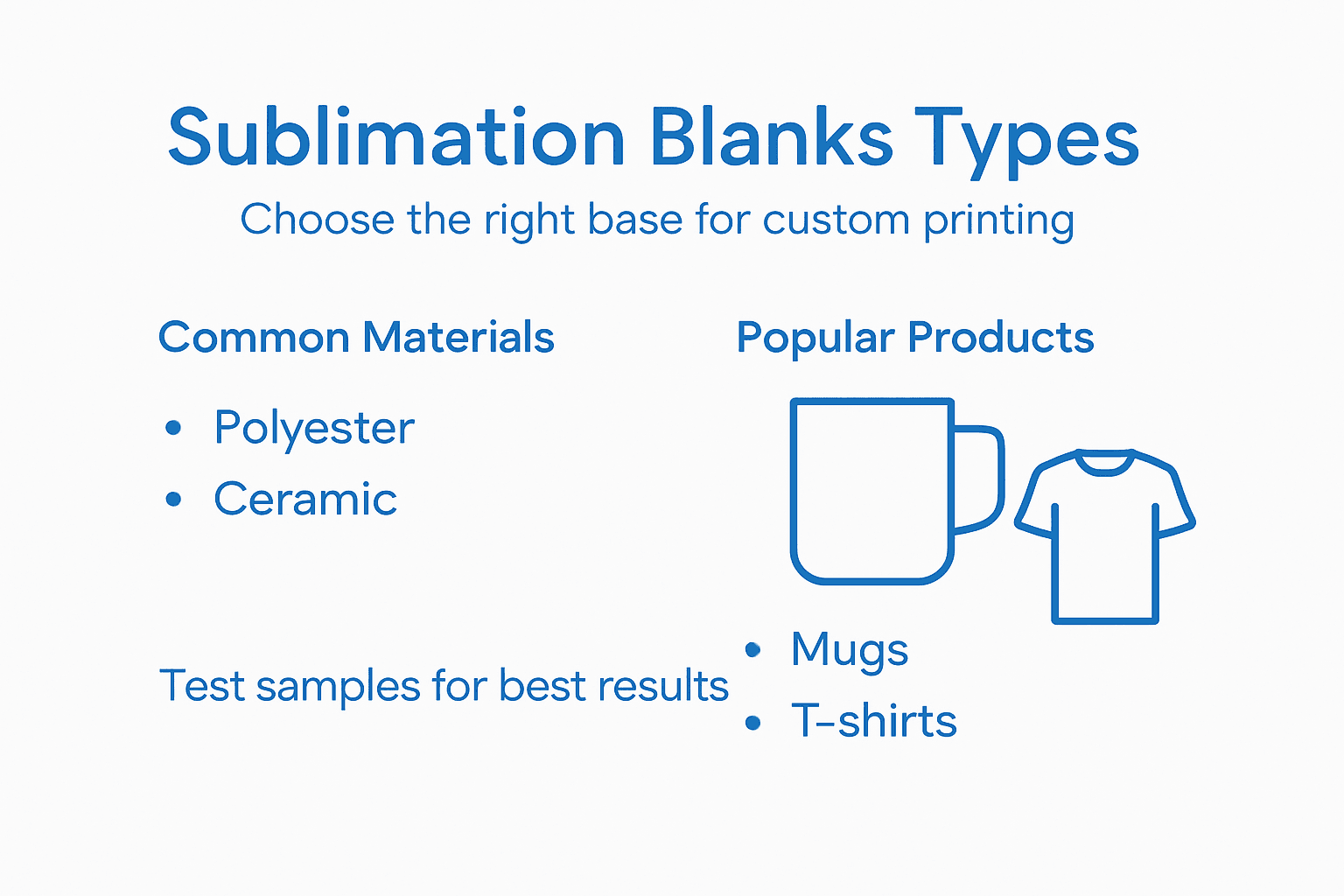
Sublimation blanks encompass a diverse range of materials engineered for specialised thermal printing applications. Polyester and polymer-coated surfaces represent the primary substrate categories, each offering unique characteristics for different product types and business needs.
The primary material variations include:
-
Fabric Blanks
- 100% polyester textiles
- Polyester blend materials
- Lightweight and heavyweight fabric options
-
Hard Surface Blanks
- Ceramic substrates
- Metal-coated surfaces
- Plastic and polymer-based items
- Glass and specialised composite materials
Coating quality and material composition significantly impact printing outcomes. Businesses must consider factors like coating thickness, surface uniformity, and heat transfer compatibility when selecting sublimation blanks. Different materials require specific temperature ranges, ink formulations, and pressing techniques to achieve optimal print quality and durability.
Pro tip: Invest in sample packs from different manufacturers to test material performance and compatibility before committing to bulk purchases.
Below is a comparison of key sublimation blank types and their advantages for various business applications:
| Blank Type | Ideal Use Cases | Durability |
|---|---|---|
| Polyester fabrics | Apparel, soft signage | High, washable prints |
| Ceramic substrates | Mugs, tiles, ornaments | Very resistant to heat |
| Metal-coated surfaces | Plaques, tags, awards | Scratch resistant |
| Polymer plastics | Keyrings, phone cases | Lightweight, robust |
| Glass composites | Awards, display items | Elegant, long-lasting |
How Sublimation Printing Transforms Product Value
Sublimation printing represents a revolutionary approach to product customisation, enabling businesses to dramatically enhance the perceived and actual value of everyday items. Digital manufacturing technologies empower entrepreneurs to create unique, personalised products that stand out in competitive markets.
Key value transformation mechanisms include:
-
Photorealistic Design Capabilities
- Full-colour image reproduction
- High-resolution print quality
- Ability to capture intricate design details
-
Enhanced Product Durability
- Prints that penetrate material fibres
- Resistance to washing and fading
- Long-lasting customisation options
Sublimation printing processes elevate basic blanks into premium, personalised merchandise by enabling deep ink penetration and permanent design transfer. This technique allows businesses to create high-value products with minimal additional manufacturing costs, transforming simple substrates into unique, marketable items with significantly increased customer appeal.

Pro tip: Develop a portfolio of sample products showcasing your sublimation printing capabilities to demonstrate the transformative potential to potential clients.
Profitability and Growth Opportunities for SMEs
Sublimation printing presents a strategic pathway for small and medium-sized enterprises (SMEs) to diversify product offerings and create new revenue streams with minimal upfront investment. Small business technology resources provide critical support for entrepreneurs looking to leverage digital customisation techniques.
Key growth opportunities for SMEs include:
-
Low-Cost Market Entry
- Minimal equipment investment
- Reduced inventory risk
- On-demand production capabilities
-
Product Diversification
- Custom merchandise creation
- Personalised product lines
- Rapid prototyping options
-
Niche Market Targeting
- Localised product offerings
- Unique design capabilities
- Flexible manufacturing approach
Sublimation blank technologies enable SMEs to produce high-value customised products with efficient production cycles. The ability to create small batch runs and personalised merchandise allows businesses to compete effectively against larger manufacturers, offering unique value propositions that distinguish them in competitive markets.
Pro tip: Start by targeting local businesses and events with personalised merchandise to build your sublimation printing portfolio and gain initial market traction.
Avoiding Costly Mistakes and Ensuring Quality
Sublimation printing demands precision and careful attention to technical details to prevent expensive errors that could compromise product quality and business reputation. Quality control standards play a critical role in maintaining consistent, professional output for custom product manufacturing.
Common mistakes and mitigation strategies include:
-
Design Preparation Errors
- Use minimum 300 DPI resolution
- Check file format compatibility
- Verify colour profile accuracy
-
Equipment Configuration Issues
- Calibrate heat press settings
- Maintain consistent pressure
- Follow manufacturer substrate guidelines
-
Material Selection Problems
- Match substrate to intended design
- Test blank compatibility
- Understand material heat tolerance
Sublimation printing techniques require meticulous attention to temperature, pressure, and timing. Improper settings can result in poor image transfer, colour distortion, or incomplete bonding, leading to wasted materials and potential customer dissatisfaction. Implementing rigorous quality control processes helps businesses minimise costly production errors and maintain professional standards.
Pro tip: Create a comprehensive equipment calibration and testing checklist to systematically verify print quality before full production runs.
The following table summarises major pitfalls in sublimation printing and effective ways to prevent them:
| Common Pitfall | Possible Impact | Prevention Tip |
|---|---|---|
| Incorrect temperature | Faded or blurry prints | Regularly calibrate equipment |
| Low-res artwork | Pixelated output | Design at high DPI, min 300 DPI |
| Unsuitable substrate | Poor ink absorption | Test all blanks before bulk use |
| Uneven pressure | Incomplete transfer | Monitor heat press consistency |
Elevate Your Custom Product Success with Trusted Sublimation Solutions
Understanding the challenges of selecting the right sublimation blanks and achieving flawless print quality is crucial for any business aiming to grow in personalised merchandise. This article highlights the importance of choosing materials engineered for heat transfer, maintaining precise equipment settings, and preventing costly mistakes—all essential for producing vibrant, durable designs that truly stand out.
At SubliBlanks, we address these pain points directly by offering a comprehensive range of sublimation blanks with no minimum order quantities. Whether you need polyester fabric blanks, ceramic mugs, or polymer plastics, our expertly curated selection supports every stage of your creative process. Paired with our high-quality sublimation printers and equipment, you gain the confidence to produce photorealistic, long-lasting custom products that increase your business’s value and customer appeal.
Ready to transform your custom product offerings and avoid production pitfalls? Explore our full product catalogue now at SubliBlanks and take the first step toward enhancing your manufacturing precision and profitability. Discover how our trusted sublimation solutions can empower your creative vision and business growth today.
Frequently Asked Questions
What are sublimation blanks?
Sublimation blanks are specialised products made from polyester or polymer-coated materials designed for digital printing using heat transfer techniques, allowing businesses to create vibrant, durable custom products.
How do I choose the right sublimation blanks for my business?
Selecting the right sublimation blanks involves considering factors such as material composition, intended product use, target market expectations, and compatibility with your printing technology and techniques.
What are the different types of sublimation blanks available?
Sublimation blanks come in various types, including fabric blanks (100% polyester and blends), hard surface blanks (ceramic, metal, plastic, and glass), each tailored for specific applications in sublimation printing.
How can I ensure quality in sublimation printing?
To ensure quality in sublimation printing, focus on proper design preparation, accurate equipment configuration, and careful material selection. Implementing a quality control checklist can help prevent costly mistakes and maintain professional output.


