



What does DTF mean? A complete guide to direct-to-film printing
You’ve probably encountered the acronym DTF in printing circles and wondered what it actually means. Many people confuse it with other textile printing methods or misunderstand its applications entirely. DTF stands for Direct-to-Film printing, a versatile technique that’s revolutionising how hobbyists and professionals create vibrant designs on fabric. This guide clarifies what DTF means, explains the complete process from design to finished garment, and shows you how to leverage this technology for your creative projects in the UK and Ireland.
Table of Contents
- What Is DTF Printing And How Does It Work?
- The Step-By-Step DTF Printing Process Explained
- Advantages Of DTF Printing Compared To Traditional Methods
- Practical Tips For Successful DTF Printing Projects
- Explore DTF Printing Supplies At SubliBlanks
- What Does DTF Mean? Common Questions Answered
Key takeaways
| Point | Details |
|---|---|
| DTF definition | Direct-to-Film printing transfers designs from special film to fabric using heat and pressure |
| Fabric versatility | Works brilliantly on cotton, polyester, blends, and dark textiles with consistent results |
| Process steps | Involves printing, powder application, curing, and heat pressing for durable transfers |
| Cost efficiency | Lower setup costs than screen printing make it ideal for small to mid-size runs |
| Quality factors | Proper curing and temperature control ensure vibrant colours and long-lasting prints |
What is DTF printing and how does it work?
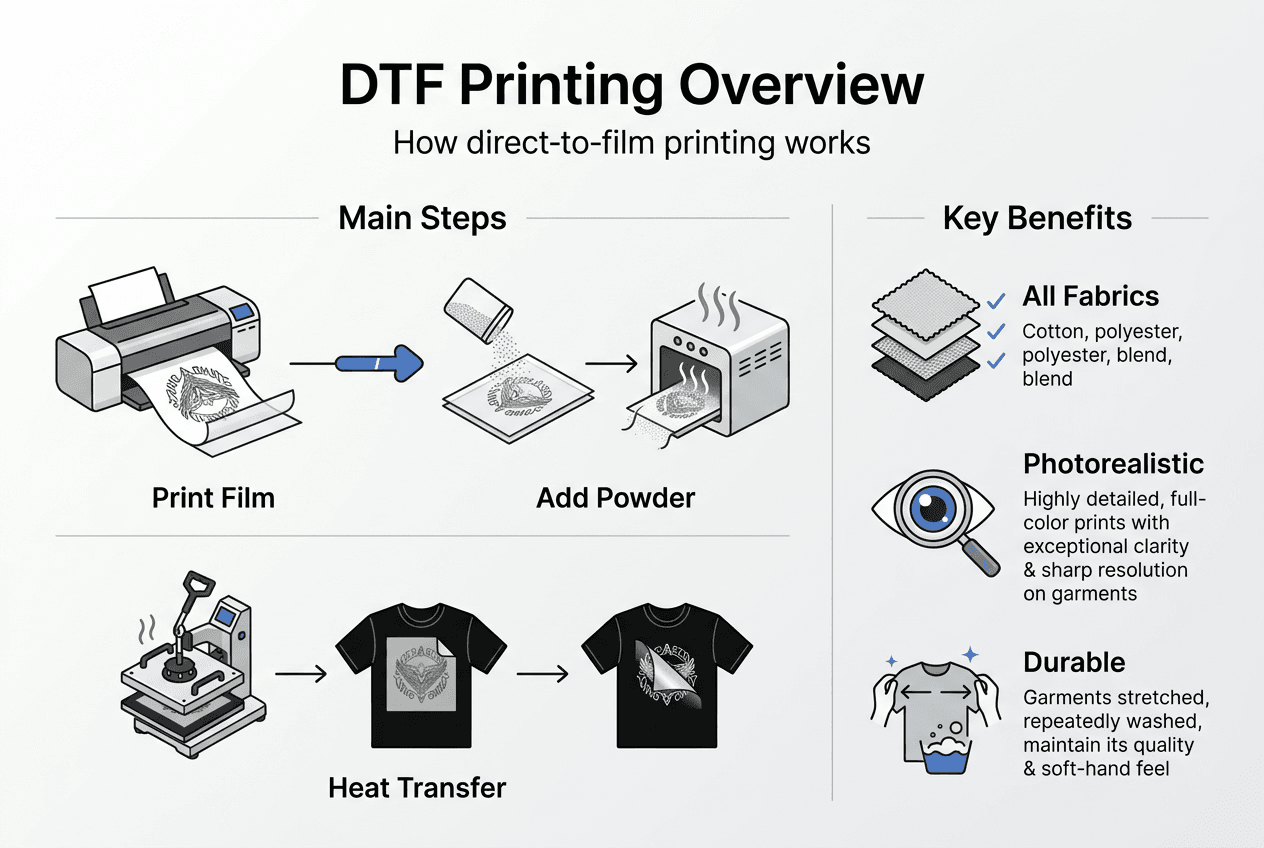
DTF stands for Direct-to-Film printing, a method where designs are printed onto special film and transferred to fabric using heat. Unlike direct-to-garment printing that applies ink straight onto textiles, DTF creates an intermediate transfer that bonds to fabric through controlled heat and pressure. This distinction gives DTF unique advantages in colour vibrancy and material compatibility.
The core mechanism involves printing your artwork onto PET film using specialised CMYK inks plus white ink for opacity. After printing, you apply a hot-melt adhesive powder that clings to the wet ink. The powder gets cured in a heat tunnel or oven, creating a stable transfer ready for application. Finally, you heat press the film onto your chosen fabric, where the adhesive bonds permanently to the textile fibres.
What makes DTF particularly valuable is its ability to produce full-colour, photorealistic designs without the complexity of screen printing setups. You can achieve intricate details, gradients, and unlimited colours in a single pass. The process works equally well on light and dark fabrics because the white ink layer provides a bright base for colours to pop. This versatility has made DTF increasingly popular for custom apparel businesses and creative projects across the UK.
Pro Tip: Always check your printer’s white ink settings before starting a DTF job, as proper white ink coverage determines how vibrant your final colours appear on dark fabrics.
The finished prints exhibit excellent wash fastness and a soft hand feel that customers appreciate. Unlike some heat transfer methods that create stiff, plasticky results, properly executed DTF printing for garment businesses delivers professional quality that withstands repeated washing and wear. The adhesive powder creates a flexible bond that moves naturally with the fabric rather than cracking or peeling.
The step-by-step DTF printing process explained
Mastering DTF printing requires understanding each stage of the workflow and how they interconnect to produce quality results. The DTF process involves several key steps that must be executed with precision for optimal outcomes. Here’s exactly how to transform your digital artwork into a durable fabric print.
-
Design preparation: Create your artwork in design software, ensuring it’s high resolution (300 DPI minimum) with proper colour profiles. Set up your file with CMYK colour channels plus a separate white ink layer that provides opacity and brightness. The white layer typically sits beneath your colour design to create a bright foundation, especially crucial for dark fabrics.
-
Film printing: Load PET film into your DTF printer and print the design using water-based pigment inks. The printer deposits CMYK colours first, then applies white ink either as an underbase or overprint depending on your setup. Print quality directly affects your final result, so calibrate your printer regularly and use quality inks designed for DTF applications.
-
Powder application: Immediately after printing, whilst the ink remains wet, apply hot-melt adhesive powder evenly across the entire printed area. Shake off excess powder to avoid clumping or uneven adhesion. The powder particles stick only to the wet ink areas, creating the adhesive layer that will bond your design to fabric.
-
Powder curing: Pass the powdered film through a heat tunnel or curing oven at the manufacturer’s recommended temperature (typically 160-170°C). This melts and sets the adhesive powder, transforming it from loose particles into a stable, tacky layer ready for transfer. Proper curing prevents powder from brushing off and ensures strong fabric adhesion.
-
Heat pressing: Position your cured film onto the fabric with the printed side facing down. Apply heat and pressure using a heat press at the specified temperature (usually 150-165°C) for the recommended duration (10-15 seconds typically). The heat reactivates the adhesive, bonding it permanently to the textile fibres.
-
Film removal: After pressing, allow the transfer to cool briefly (hot peel) or completely (cold peel) depending on your film type. Peel away the carrier film smoothly to reveal your finished print bonded to the fabric. The design should transfer completely with no residue left on the film.
| Process stage | Temperature | Duration | Critical factor |
|---|---|---|---|
| Powder curing | 160-170°C | 2-3 minutes | Even heat distribution |
| Heat pressing | 150-165°C | 10-15 seconds | Consistent pressure |
| Cooling | Room temp | 5-30 seconds | Film type specification |
Pro Tip: Keep detailed records of temperature, pressure, and time settings for different fabric types, as you’ll need to adjust parameters based on material thickness and fibre content for consistent results.
Each stage influences the next, so shortcuts or inconsistencies compound into quality issues. Testing your workflow with scrap fabric before production runs saves materials and helps you dial in perfect settings for your specific equipment and materials. Successful DTF printing for garment businesses relies on this systematic approach and attention to detail at every step.
Advantages of DTF printing compared to traditional methods
DTF printing has gained remarkable traction because it solves several limitations inherent in traditional textile printing methods. When you compare DTF to screen printing or standard heat transfers, the benefits become immediately apparent for small businesses and creative professionals working in the UK and Ireland market.
The setup requirements present the first major advantage. Screen printing demands creating separate screens for each colour in your design, which becomes time-consuming and expensive for complex, multicolour artwork. DTF offers lower setup costs because you simply print your design digitally without physical screens or colour separations. This makes DTF economically viable for small runs, custom orders, and on-demand printing where screen printing’s setup costs would be prohibitive.
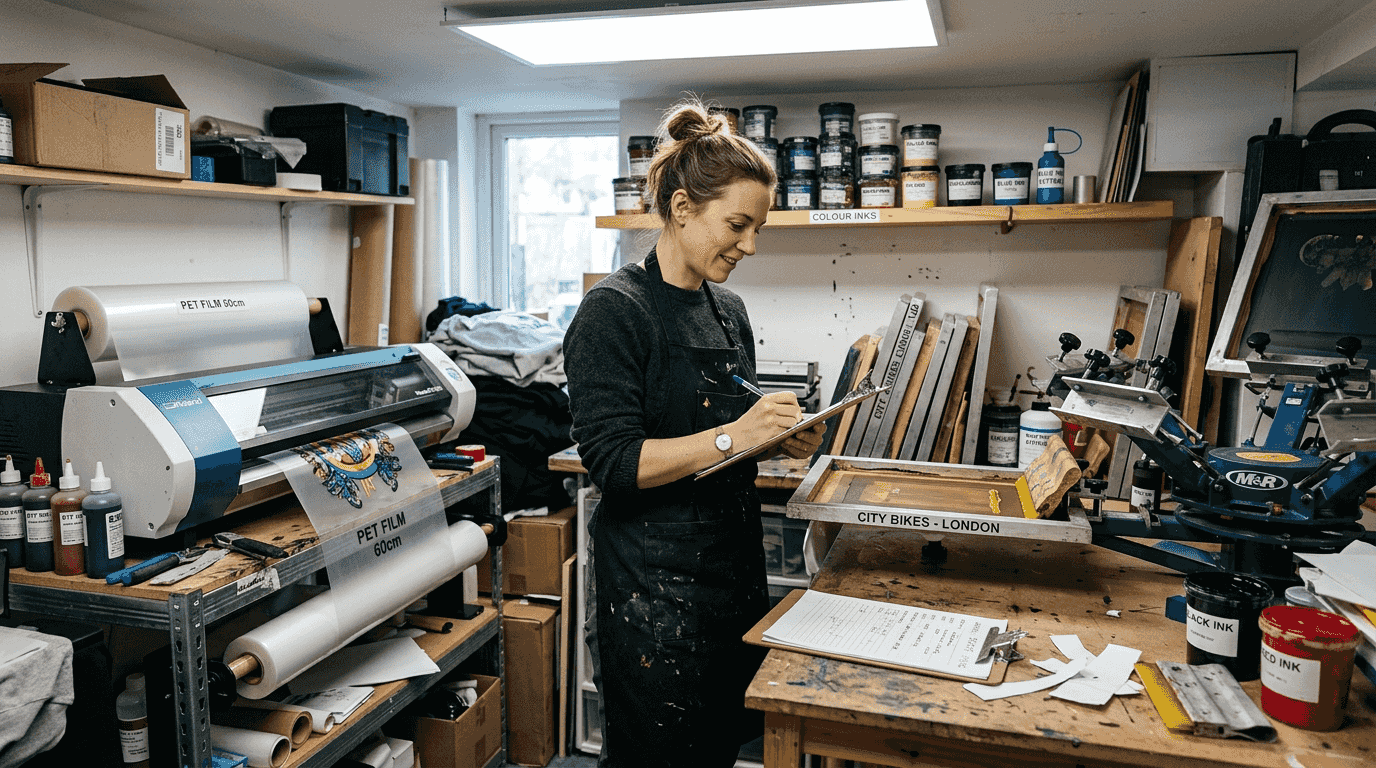
Colour capabilities represent another significant strength. DTF handles unlimited colours, gradients, and photorealistic images in a single print pass. You’re not constrained by colour counts or registration issues that complicate screen printing. This freedom allows you to accept more diverse design requests and produce visually striking results that would be impractical with traditional methods.
Fabric versatility gives DTF a competitive edge over direct-to-garment printing, which works best on 100% cotton. DTF transfers bond successfully to cotton, polyester, cotton-polyester blends, and even some synthetic materials. The white ink underbase ensures your designs appear vibrant on both light and dark fabrics without colour shifting or dullness. This broad compatibility means you can offer DTF printing for garment businesses across diverse product ranges without maintaining multiple printing systems.
| Feature | DTF printing | Screen printing | Heat transfer vinyl |
|---|---|---|---|
| Setup cost | Low | High | Medium |
| Colour options | Unlimited | Limited by screens | Limited by layers |
| Fabric types | Most textiles | Most textiles | Most textiles |
| Detail level | Photorealistic | Good | Limited |
| Minimum quantity | 1 piece | 50+ economical | 1 piece |
Durability and hand feel matter enormously to end customers. DTF prints withstand repeated washing without significant fading or cracking when properly cured and applied. The adhesive creates a flexible bond that moves with the fabric rather than sitting stiffly on top like some vinyl transfers. Customers appreciate the soft feel that doesn’t compromise comfort or breathability.
The on-demand production model suits modern e-commerce and boutique businesses perfectly. You can print single items economically, test designs without inventory risk, and respond quickly to customer requests. This agility has made DTF particularly popular for custom merchandise, personalised gifts, and small-batch fashion collections where traditional methods would require prohibitive minimum orders.
Practical tips for successful DTF printing projects
Achieving consistently excellent DTF results requires attention to technical details and best practices that separate amateur attempts from professional outcomes. These actionable strategies help you avoid common pitfalls and maximise the quality of your printed textiles.
Start with high-resolution artwork optimised for DTF printing. Your designs should be at least 300 DPI with clean edges and proper colour profiles. Set up your white ink layer carefully, as it provides the foundation for colour vibrancy. On dark fabrics, a solid white underbase is essential. On light fabrics, you might use a lighter white layer or skip it entirely for certain designs. Test different white ink densities to find the sweet spot between opacity and print thickness.
Adhesive powder application demands consistency and precision. Apply powder immediately after printing whilst ink remains wet, ensuring complete coverage across all printed areas. Shake off excess powder thoroughly to prevent clumping or rough texture in your final print. Uneven powder distribution creates weak spots where the transfer may fail or peel prematurely. Some printers prefer automatic powder shakers for consistent results, whilst others achieve excellent outcomes with manual application and careful technique.
Curing parameters critically affect transfer quality and durability. Follow DTF transfer tips like proper powder curing with precise temperature and time to ensure the adhesive fully melts and sets. Undercured powder won’t bond properly to fabric, leading to peeling or washing failures. Overcuring can scorch the film or degrade ink colours. Use a reliable thermometer to verify your curing equipment maintains consistent temperature throughout the curing zone.
Heat press settings vary by fabric type, so testing is non-negotiable. Cotton typically requires higher temperatures than polyester, which can scorch or melt at excessive heat. Thick fabrics need longer press times or higher pressure to ensure complete adhesive activation. Always test transfers on fabric scraps that match your production material before committing to large runs. Record successful settings for different fabric types to build a reference library for future projects.
Pro Tip: Pre-press your fabrics for 2-3 seconds before applying DTF transfers to remove moisture and wrinkles, which improves adhesion and prevents steam bubbles that can ruin your print.
Fabric preparation influences results more than many beginners realise. Wash new garments to remove sizing chemicals that interfere with adhesion. Pre-press fabrics to eliminate moisture that creates steam during transfer, potentially causing bubbles or incomplete bonding. Position your transfer carefully on the fabric, ensuring it sits flat without wrinkles or folds that create uneven pressure distribution.
Storage conditions protect your materials and maintain quality over time. Keep DTF films in cool, dry environments away from direct sunlight, which can degrade inks and adhesives. Store adhesive powder in sealed containers to prevent moisture absorption that affects its melting properties. Cured transfers can be stored for weeks or months if kept flat and protected from heat and humidity.
Experiment with sublimation textiles alongside DTF to understand when each method offers advantages. Learning multiple techniques expands your capabilities and helps you choose the optimal approach for each project. Similarly, proper sublimation printer setup knowledge complements your DTF skills and broadens your service offerings.
Explore DTF printing supplies at SubliBlanks
Now that you understand what DTF means and how to execute successful printing projects, having reliable supplies makes all the difference in your results. SubliBlanks serves as a comprehensive UK wholesale supplier offering DTF materials, sublimation supplies, and heat press accessories without minimum order requirements. Whether you’re a hobbyist exploring DTF printing or a professional running a garment business, quality materials ensure consistent, vibrant outcomes.
Their product range includes essential items like teflon sheets for heat presses that protect your equipment whilst ensuring even pressure distribution during transfers. Quality transfer papers such as A4 SubliFlex sublimation paper complement your DTF workflow when projects call for sublimation techniques on polyester fabrics. Having a trusted supplier streamlines your creative process and eliminates the frustration of inconsistent materials that compromise print quality.
What does DTF mean? common questions answered
What types of fabrics work best with DTF?
DTF printing performs excellently on cotton, polyester, and cotton-polyester blends, making it remarkably versatile for garment decoration. The method also works on some synthetic materials and even certain treated leather products. Dark fabrics benefit particularly from DTF because the white ink underbase ensures colours remain vibrant and true to your design.
How does DTF printing differ from heat transfer or screen printing?
DTF creates transfers on special film that bond to fabric through heat-activated adhesive powder, whilst heat transfer vinyl involves cutting and layering pre-coloured materials. Screen printing applies ink directly through mesh screens onto fabric. DTF offers unlimited colours and photorealistic detail without the setup costs of screen printing or the colour limitations of vinyl transfers, making it ideal for complex designs and small production runs.
Can I use DTF printing for small or custom runs?
Absolutely, DTF excels at small batch and single-item production because it requires minimal setup compared to traditional methods. You can economically print one custom t-shirt or a dozen personalised hoodies without the prohibitive setup costs that make screen printing impractical for small quantities. This flexibility has made DTF popular for on-demand printing, custom merchandise, and testing new designs before committing to larger production.
Is DTF printing durable after multiple washes?
Properly executed DTF prints demonstrate excellent wash fastness and maintain colour vibrancy through dozens of wash cycles. The key factors are correct powder curing, appropriate heat press temperature and time, and quality materials. Prints should be washed inside out in cool to warm water and air dried or tumble dried on low heat to maximise longevity. Well-applied DTF transfers often outlast the garment itself.
Do I need special equipment to start DTF printing?
You’ll need a DTF printer (or modified inkjet printer with DTF inks), PET film, adhesive powder, a curing method (heat tunnel or oven), and a heat press. Whilst the initial investment is higher than basic heat transfer vinyl, it’s considerably lower than screen printing setups. Many UK hobbyists start with entry-level DTF printers and expand their equipment as their business grows, making it accessible for various budget levels.


