



DTF Printing: Transforming Garment Businesses Today
Growing demand for custom apparel leaves many British and Irish print shops weighed down by outdated methods and rising setup costs. DTF printing stands out as the flexible solution, debunking myths about quality and expense while enabling vibrant, durable prints for small runs and diverse fabrics. This guide clarifies the process, equipment, and business benefits, helping garment businesses reach new markets with minimal waste and scalable costs.
Table of Contents
- Defining DTF Printing And Debunking Myths
- DTF Printing Process And Required Equipment
- DTF Film, Inks, And Transfer Powders Explained
- Comparing DTF With DTG And Other Methods
- Costs, Common Issues, And Real-World Applications
Key Takeaways
| Point | Details |
|---|---|
| DTF Printing Offers Flexibility | DTF printing allows for unique designs and small batches without the high setup costs associated with traditional methods. |
| Durability and Quality of Prints | When executed correctly, DTF prints rival screen printing in vibrancy and durability while being suitable for various fabric types. |
| Cost-Effectiveness for Small Runs | DTF printing is ideal for small orders, making it economical as production costs remain consistent regardless of quantity. |
| Essential Equipment and Setup Matters | A proper setup with high-quality printers, heat sources, and consumables significantly impacts final print results and operational efficiency. |
Defining DTF Printing And Debunking Myths
Direct-to-Film (DTF) printing represents a fundamentally different approach to garment decoration than traditional methods. Rather than screen printing or direct-to-garment technology, DTF transfers digital designs onto a special film before applying them to fabric using heat and pressure.
The process works in four distinct stages:
- Design your artwork in your preferred software and print it onto special DTF film using a compatible printer
- Apply a powder adhesive to the wet ink whilst it remains wet on the film
- Cure the powder using a heat source to create a stable transfer
- Heat press the film onto your chosen garment to permanently bond the design
What makes DTF genuinely different from screen printing is the flexibility it offers. You can print full-colour photographs, gradients, and intricate details without setting up separate screens for each colour. The innovative DTF technology handles complexity that would require multiple screens in traditional methods.
Common Myths About DTF Printing
Printers often avoid DTF because they believe false claims about the technology. Let’s address what actually holds water and what doesn’t.
Myth 1: DTF produces poor quality prints
False. Modern DTF equipment delivers vibrant, sharp prints with excellent colour saturation. The design quality rivals screen printing and beats most direct-to-garment methods for durability.
Myth 2: DTF is too expensive for small runs
Actually, DTF shines for low-volume orders. You avoid the setup costs of screen printing (which require separations and screens). A single bespoke t-shirt costs roughly the same to produce as a batch of 50.
Myth 3: DTF only works on cotton
Not true. DTF transfers adhere to cotton, polyester, cotton-blend fabrics, leather, and even silk. The powder adhesive creates a mechanical bond that works across material types.
Myth 4: DTF transfers crack and peel easily
When done correctly, DTF prints last through dozens of washes. The powder cure process creates durability comparable to screen printing when you follow proper heat-press parameters.
Myth 5: You need advanced technical skills
The process becomes routine once you nail your settings. Most operators reach competence within 2-3 weeks of regular practice.
DTF technology is flexible and cost-effective, suited for everything from single-piece orders to bulk production runs.
Your business gains genuine competitive advantage by offering something local screen printers cannot: small-batch, full-colour customisation without setup fees.
Pro tip: Start with test prints on similar fabrics you currently handle to understand how your specific heat-press settings affect transfer adhesion and colour vibrancy.
DTF Printing Process And Required Equipment
The DTF process might seem complex at first, but breaking it into stages reveals how straightforward it actually is. Understanding each step helps you identify where equipment quality matters most.
The DTF Printing Workflow
Your design journey begins with artwork creation. You design or source your image, then convert it to a format your DTF printer accepts (typically PNG with transparency or PDF).
Next comes film printing. You load special DTF film into your compatible inkjet printer and print your design directly onto the film. The ink sits wet on the surface at this stage.
Whilst the ink remains wet, you apply powder adhesive. This fine powder sticks to the wet ink and creates the bond that will transfer to fabric. Excess powder falls away, leaving only what adheres to your design.
Then comes powder curing. A heat source (typically an oven or conveyor dryer) melts the powder slightly, creating a stable, durable transfer. This step is critical for longevity.
Finally, heat pressing transfers your design to the garment. You place the film face-down on your fabric and apply heat and pressure for a set duration. The design permanently bonds to the material.
The entire process from design to finished garment takes roughly 10-15 minutes per item once you master your settings.
Essential Equipment For DTF Printing
You need specific machinery to operate a DTF line. Here’s what actually matters:
DTF-compatible printer – This is your primary investment. You need an inkjet printer designed for DTF film, typically using pigment-based inks. Standard office printers won’t work. Expect to invest £1,500 to £4,000 depending on print width and speed.
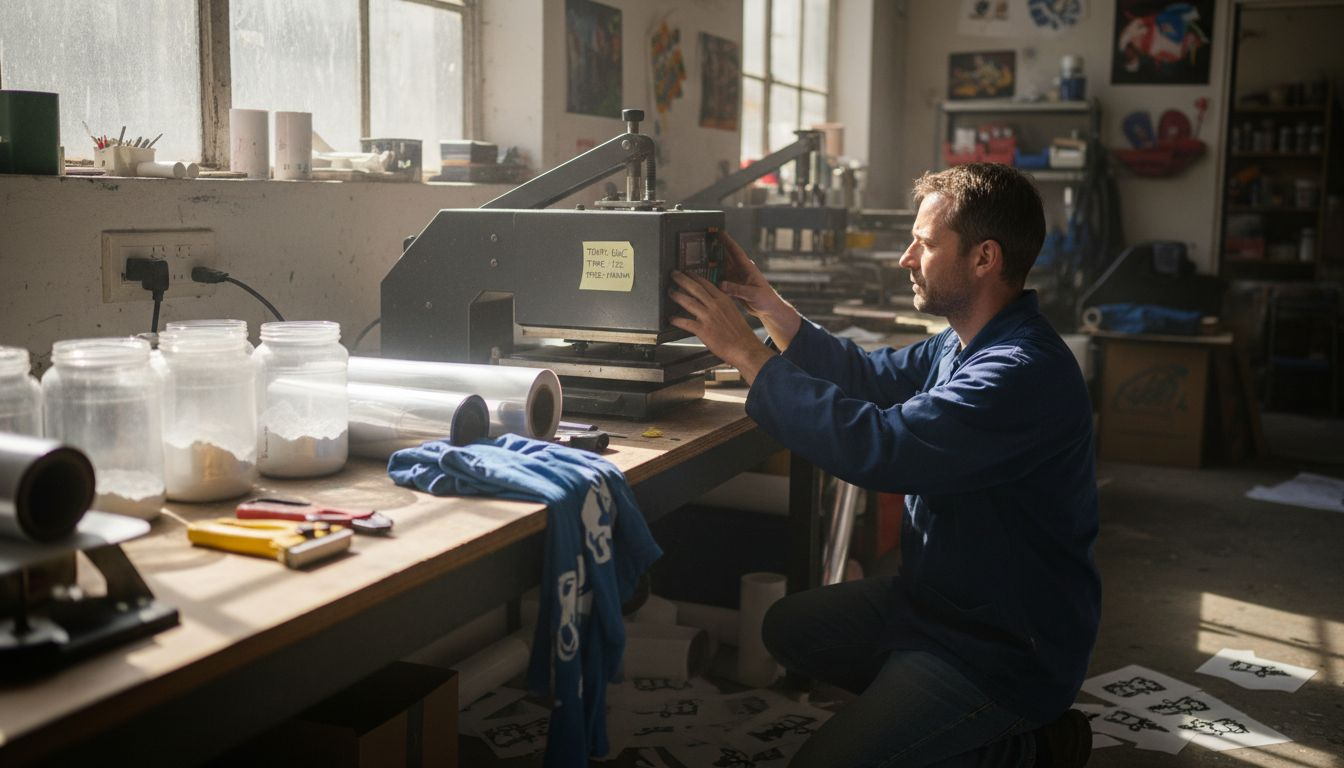
Heat source for powder curing – Either a dedicated powder oven or a conveyor-style dryer. This cures the adhesive powder before heat pressing. Budget £800 to £2,000.
Heat press – A professional-grade heat press ensures consistent pressure and temperature across every transfer. Swing-away or clamshell designs work well. Expect £400 to £1,500.
DTF film and powder – Consumables you’ll purchase regularly. High-quality film and powder affect your final results significantly.
Design software – Adobe Illustrator, Corel Draw, or even free options like Inkscape. You’ll manipulate artwork and prepare files for printing.
Optional but valuable equipment includes:
- Film roll holders and cutters for bulk production
- Humidity control (DTF works best in 45-55% humidity ranges)
- Temperature-controlled workspace
Your initial setup typically costs £4,000 to £8,000 for a complete operation. This varies based on print width and automation level.
To clarify the unique strengths and business benefits of essential DTF equipment, here’s a summary table:
| Equipment Type | Role in Production | Impact on Business |
|---|---|---|
| DTF Printer | Prints artwork onto film | Enables full-colour customisation |
| Powder Curing Oven | Bonds adhesive to ink | Ensures print durability and quality |
| Professional Heat Press | Transfers film to garment | Guarantees consistency and longevity |
| High-Quality Film & Powder | Delivers clean, stable transfers | Minimises waste and maximises reliability |
| Design Software | Prepares and edits artwork | Streamlines workflow, reduces design errors |
Pro tip: Before purchasing equipment, print test transfers on scraps of your actual garment fabrics using different heat-press temperatures and timings to dial in the exact settings your specific setup requires.
DTF Film, Inks, And Transfer Powders Explained
Three materials work together to create durable DTF transfers: the film, the inks, and the adhesive powder. Each one plays a specific role, and understanding their functions helps you troubleshoot quality issues and optimise your results.
Understanding DTF Film
PET film serves as your temporary canvas. This polyester-based material provides a stable surface for printing and features a special release layer underneath. The release layer ensures your finished transfer separates cleanly from the film during heat pressing.
Film thickness matters more than most operators realise. Standard DTF film runs between 0.1mm and 0.15mm thick. Too thin and it tears during handling; too thick and it doesn’t transfer cleanly to fabric.
Quality film has consistent coating across the entire surface. Cheap alternatives create patchy transfers because the release layer applies unevenly.
DTF Inks Explained
Water-based pigment inks form the colour foundation of every DTF print. DTF printers use CMYK inks (cyan, magenta, yellow, black) plus white ink for opacity and vibrancy. The precise interaction between water-based pigment inks and powder adhesive creates the colour accuracy and wash resistance your customers expect.
White ink deserves special attention. It acts as an underbase, sitting beneath your colour layers to boost opacity on dark fabrics. Without adequate white ink, prints on black cotton appear dull and muddy.
Ink quality directly affects longevity. Premium inks resist fading through dozens of washes. Budget inks often fade noticeably after 5-10 washes.
Key ink characteristics:
- Water-based formulation (not solvent-based)
- High pigment concentration for colour saturation
- Compatible with your specific printer model
- Consistent viscosity for even coverage
Transfer Powder: The Critical Component
Hot-melt adhesive powder bonds your design to fabric permanently. This fine powder sticks to the wet ink immediately after printing, then melts slightly during the cure stage.
Powder particle size matters significantly. Fine particles adhere evenly to your design; coarse particles create uneven adhesion and a gritty texture. Professional-grade powder provides consistent particle size throughout.
The amount you apply affects durability. Too little powder weakens adhesion; too much creates stiffness customers can feel. Most operators apply 1-2 grams of powder per transfer through experience and feel.
The triad of PET film, water-based inks, and hot-melt adhesive powder works together; weakness in any component compromises your entire transfer quality.
Choosing Quality Materials
Don’t skimp on consumables. Premium film costs slightly more but delivers cleaner separations. Quality inks produce richer colours that last longer. Professional powder ensures consistent results batch after batch.
Build relationships with reliable suppliers. Switching between brands creates inconsistency because each has slightly different coating densities and ink compatibility profiles.
Pro tip: Order sample packs of film, ink sets, and powder from different suppliers and run identical test transfers to compare colour saturation, transfer adhesion, and wash durability before committing to bulk purchases.
Comparing DTF With DTG And Other Methods
You’ve got options for garment printing, and each method has distinct strengths. Understanding how DTF stacks against Direct-to-Garment (DTG) and screen printing helps you choose the right technology for your business model.
DTF Versus DTG Printing
DTG (Direct-to-Garment) prints directly onto fabric using inkjet technology. No film or transfers involved—the design goes straight to the garment.
DTG excels with detailed photographic prints on light-coloured cotton. The prints feel soft and natural against skin. However, DTG requires pre-treatment chemicals before printing, limiting flexibility. Dark fabrics pose problems because DTG inks lack opacity without multiple passes.
DTF avoids these limitations. You print onto film first, then transfer, which works on any fabric colour without pre-treatment. DTF provides a versatile printing method suitable for both small batch custom prints and larger volumes across multiple fabric types.
DTG also struggles with durability on polyester blends. DTF transfers maintain colour vibrancy through many more wash cycles.
DTF Versus Screen Printing
Screen printing remains the industry standard for high-volume runs. You create separate screens for each colour, then print each layer sequentially.
Screen printing delivers superior durability and cost-per-unit on large orders. If you’re printing 500 identical t-shirts, screen printing wins financially because setup costs spread across many units.
But screen printing has severe limitations for custom work. Each design requires new screens—a significant investment. Complex multi-colour designs become expensive. You can’t efficiently produce small batches without losing money to setup costs.
DTF handles small runs beautifully. One bespoke shirt costs the same to produce as fifty, making it ideal for personalised orders and custom requests.
Quick Comparison Table
| Factor | DTF | DTG | Screen Printing |
|---|---|---|---|
| Setup cost | Low | Moderate | High |
| Colour complexity | Unlimited | Excellent | Limited |
| Dark fabrics | Excellent | Poor | Good |
| Durability | Excellent | Moderate | Superior |
| Small runs | Ideal | Viable | Expensive |
| Large runs | Viable | Expensive | Ideal |
| Fabric variety | Excellent | Limited | Good |
When To Choose Each Method
Choose DTF when your customers want custom designs, small quantities, or mixed colours. You’ll offer something local screen printers cannot.
Choose DTG if you focus exclusively on light-coloured cotton with photographic-quality artwork and minimal colour variation.
Choose screen printing when clients order 200+ identical items with simple, bold designs and you already have the infrastructure.
DTF emerges as the flexible middle ground—combining vibrant quality, reasonable setup costs, and versatility across fabric types and order sizes.
Most UK garment businesses thrive by offering DTF alongside existing services. You capture orders that screen printing can’t handle profitably whilst maintaining screen printing for bulk orders.
Pro tip: Calculate your actual cost-per-item for a 10-piece order versus a 100-piece order using DTF, DTG, and screen printing to determine which methods suit your current customer base and profit margins.
Costs, Common Issues, And Real-World Applications
DTF printing requires upfront investment, but the economics improve significantly once you understand the cost structure and avoid common pitfalls. Real-world success comes from knowing what works and what doesn’t.
Initial Equipment Costs And Ongoing Expenses
Your first DTF setup typically costs £4,000 to £8,000 depending on printer width and automation level. This includes the DTF printer, powder curing oven, heat press, and basic accessories.
Consumable costs run low compared to other methods. Film costs roughly £0.50 to £1.00 per A3-sized sheet. Ink cartridges vary by printer but average £100 to £200 monthly for moderate production. Powder costs approximately £0.10 to £0.20 per transfer.
DTF printing offers economic advantages including minimal waste and scalable consumable costs, making pricing predictable whether you’re producing single custom items or bulk orders. Unlike screen printing, you avoid setup fees for each new design.
Maintenance costs stay reasonable. Printheads need occasional cleaning, and you’ll replace them every 12-18 months depending on usage. Budget £200 to £400 annually for maintenance supplies.
Common Issues And Solutions
New DTF operators encounter predictable problems. Understanding these saves time and frustration.
Poor powder adhesion – Usually caused by insufficient white ink underbase or powder applied too thin. Increase white ink layers and apply powder more generously whilst ink remains wet.
Transfers sticking to heat press – The release layer on your film isn’t working properly. Check film expiration dates and ensure your heat press temperature doesn’t exceed 170°C.
Colour fading after washes – Indicates cheap consumables or improper curing. Upgrade to premium powder and extend your oven cure time by 10-15 seconds.
Uneven powder coverage – Caused by poor film surface quality or applying powder too quickly. Use professional-grade film and apply powder in slow, controlled passes.
To help operators quickly troubleshoot DTF printing issues, review this common problem-solving reference:
| Issue | Likely Cause | Recommended Solution |
|---|---|---|
| Poor powder adhesion | Insufficient white ink, thin powder | Increase underbase, apply more powder |
| Sticking to heat press | Faulty film release layer, excess heat | Check film expiry, lower press temperature |
| Colour fading after washes | Low-quality consumables, under-curing | Use premium powder, cure longer |
| Uneven powder coverage | Inconsistent film surface, hasty application | Upgrade film, apply slowly and evenly |
Key issues to watch:
- Humidity fluctuations affecting ink adhesion
- Expired consumables reducing transfer quality
- Heat press temperature variations causing inconsistent results
- Insufficient operator training leading to technique errors
Real-World Applications That Work
DTF thrives in specific market niches where flexibility matters most.
Custom sportswear – Athletes want personalised shirts with names and numbers. DTF delivers vibrant prints on polyester performance fabrics without pre-treatment.
Promotional merchandise – Small companies ordering branded items in batches of 25-100. DTF makes these profitable without screen printing’s setup costs.
Personalised gifts – Photo-quality prints on t-shirts, hoodies, and bags. Customers appreciate unique, bespoke items they can’t get elsewhere.
Band and event merchandise – Limited-run designs requiring quick turnaround. DTF produces professional results without massive inventory risk.
DTF transforms small-batch orders into profitable business opportunities by eliminating setup fees and inventory pressure.
Successful UK garment businesses use DTF to differentiate from screen printers. They capture customers wanting custom designs, small quantities, and quick delivery. Screen printers handle bulk orders; DTF handles everything else.
Pro tip: Track your actual production costs for five representative jobs across different order sizes, then establish pricing that reflects material costs plus at least 40% margin to account for equipment depreciation, maintenance, and operational overhead.
Unlock The Full Potential Of DTF Printing For Your Garment Business
DTF printing offers incredible flexibility and cost-efficiency but requires the right supplies and equipment to truly deliver vibrant, durable results. If you are facing challenges mastering powder adhesion or curing processes or want to avoid set-up costs while producing stunning small-batch apparel, reliable and professional-grade materials are essential. From high-quality DTF powders to compatible films and heat presses, having the correct tools empowers your business to thrive in a competitive market.
Discover how our comprehensive range of DTF supplies can support your journey towards flawless transfers and exceptional print longevity. At Subliblanks we specialise in supplying trade wholesalers with no minimum order quantities meaning you can source exactly what you need without excess stock. Take control of your production quality and costs today by exploring our wide selection of DTF equipment and consumables designed to match every stage of your process. Visit our website now and transform these new printing possibilities into real business growth.
Frequently Asked Questions
What is DTF printing?
Direct-to-Film (DTF) printing is a method of garment decoration where digital designs are printed onto a special film. The design is then transferred to fabric using heat and pressure, allowing for vibrant, intricate prints without the need for multiple screens.
How does the DTF printing process work?
The DTF printing process involves four stages: 1) Design the artwork and print it on DTF film; 2) Apply a powder adhesive to the wet ink; 3) Cure the powder using heat; 4) Heat press the film onto the garment, bonding the design to the fabric permanently.
What types of fabrics are compatible with DTF printing?
DTF transfers can adhere to a variety of fabrics, including cotton, polyester, cotton-blend fabrics, leather, and silk. This versatility makes DTF suitable for different types of garments.
How does DTF printing compare to DTG and screen printing?
DTF printing offers advantages like lower setup costs for small runs and the ability to print on various fabric colours without pre-treatment. In contrast, DTG is ideal for detailed prints on light fabrics, while screen printing is more cost-effective for large volume orders but requires extensive setup for each design.


