



Best stamp making machines UK: crafters and small businesses
For hobby crafters, a photopolymer starter kit or a compact desktop stamp creator gives you the quickest route to finished stamps with the lowest upfront cost and almost no learning curve. For small businesses and Etsy sellers who need repeatable precision, a desktop laser engraver is the stronger long-term choice: faster setup, finer detail, and the flexibility to work across multiple materials without re-tooling.
Here is the short version:
- Hobby pick: A photopolymer platemaker (entry-level models start at an affordable price) or an all-in-one desktop stamp creator for simple, low-volume work.
- Small business pick: A desktop laser engraver such as an xTool model for high-detail, multi-material stamp production at small-batch commercial volumes.
- Where to buy in the UK: Subliblanks stocks laser-engraveable blanks, stamp-making consumables, and xTool laser engraving systems with no minimum order quantity, so you can start small and scale without committing to a pallet.
The sections below break down every method, what each costs to run, and how to match a machine to your actual output.
Table of Contents
- What are the best stamp making machines UK buyers should consider?
- Why laser engraving is often the best choice for custom stamps
- How do you choose the right stamp-making machine for your budget?
- What stamp materials should UK crafters and businesses use?
- What does the design-to-stamp workflow actually look like?
- Maintenance, running costs, and safety for UK workshops
- Why UK small businesses are shifting to laser engraving
- Key takeaways
- The case for buying less machine than you think you need
- Subliblanks: stamp-making supplies and laser systems for UK buyers
- Useful sources and further reading for UK buyers
What are the best stamp making machines UK buyers should consider?
Stamp-making equipment falls into four distinct categories, and the right one depends almost entirely on what you are making, how often, and for whom. Understanding the differences before you spend anything is the single most useful thing you can do.
Photopolymer platemakers
These use UV light to cure a light-sensitive resin through a film negative, producing a flexible rubber-like stamp surface. The process is well-established, the materials are widely available, and the results are consistent for text and simple graphics.
Entry-level models such as the PM-75 from Polydiam handle stamp sizes up to 125 x 100 mm and are priced at £195, making them accessible for crafters who want a dedicated machine without a large outlay. Step up to a mid-range model with a larger exposure area and better processing features, such as the PLB-A4iv at £995. That price gap reflects a genuine capability jump: the larger machine suits small trade operations running multiple jobs per day, while the PM-75 is better suited to occasional hobby use or urgent single-stamp runs.
The main limitation is the workflow. Photopolymer requires film negatives, a washing stage, and a post-cure step. It is not slow exactly, but it has more steps than laser engraving, and each step is a potential point of failure if your artwork or chemistry is off.
Manual carving tools
Lino cutters, carving blocks, and hand-held gouges sit at the opposite end of the spectrum. Cost is minimal, no electricity is required, and the tactile, handmade quality appeals to a specific audience. The trade-off is obvious: you cannot reproduce fine detail consistently, and carving a complex logo by hand is not a realistic option for a business.
For a hobbyist making botanical prints or abstract patterns, manual carving is genuinely satisfying. For anyone who needs to replicate the same stamp ten times with identical results, it is not the right tool.
CNC engraving
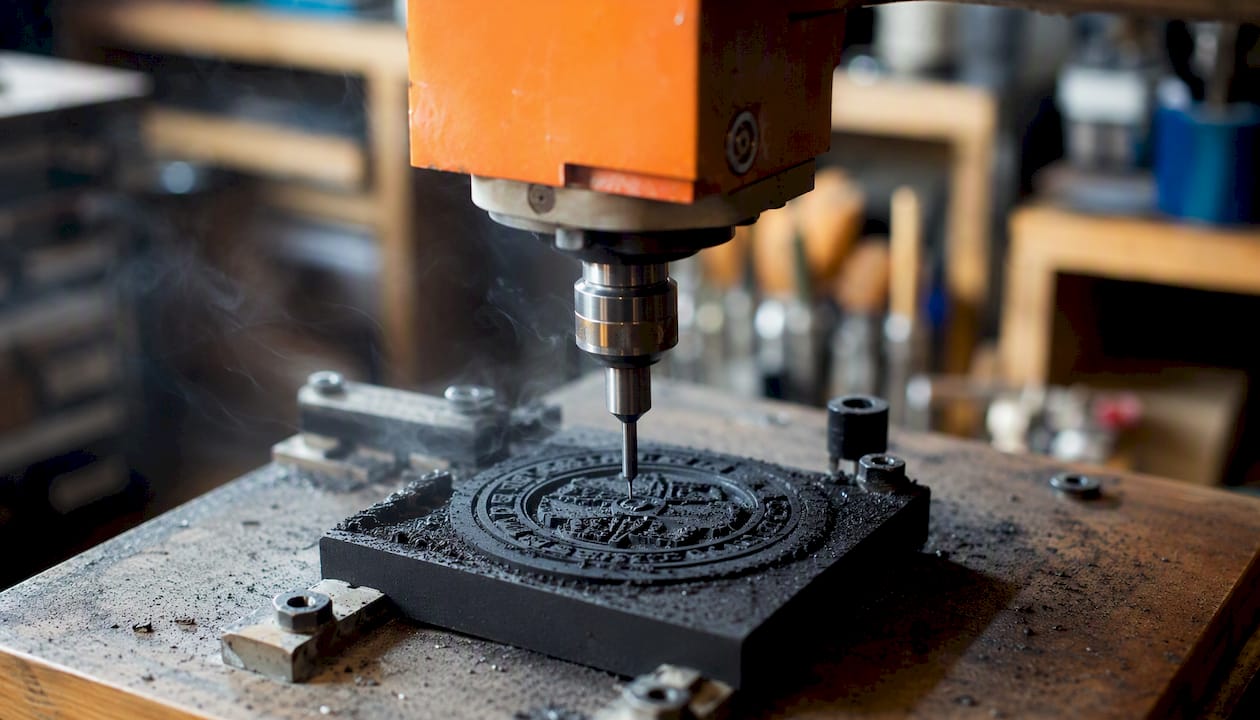
CNC (computer numerical control) routers can engrave rubber or nylon stamp blanks with good repeatability. They are more common in industrial settings than in craft workshops, and the upfront cost and footprint tend to be higher than desktop laser alternatives. Some nylon stamp-making machines are listed by international suppliers in non-UK currencies, and buyers need to factor in shipping, import duties, and spare parts availability before assessing the true UK cost.
CNC is worth considering if you are already running a CNC setup for other products and want to add stamps to your range. As a standalone stamp-making investment, most UK small businesses find desktop lasers more practical.
Desktop laser engravers
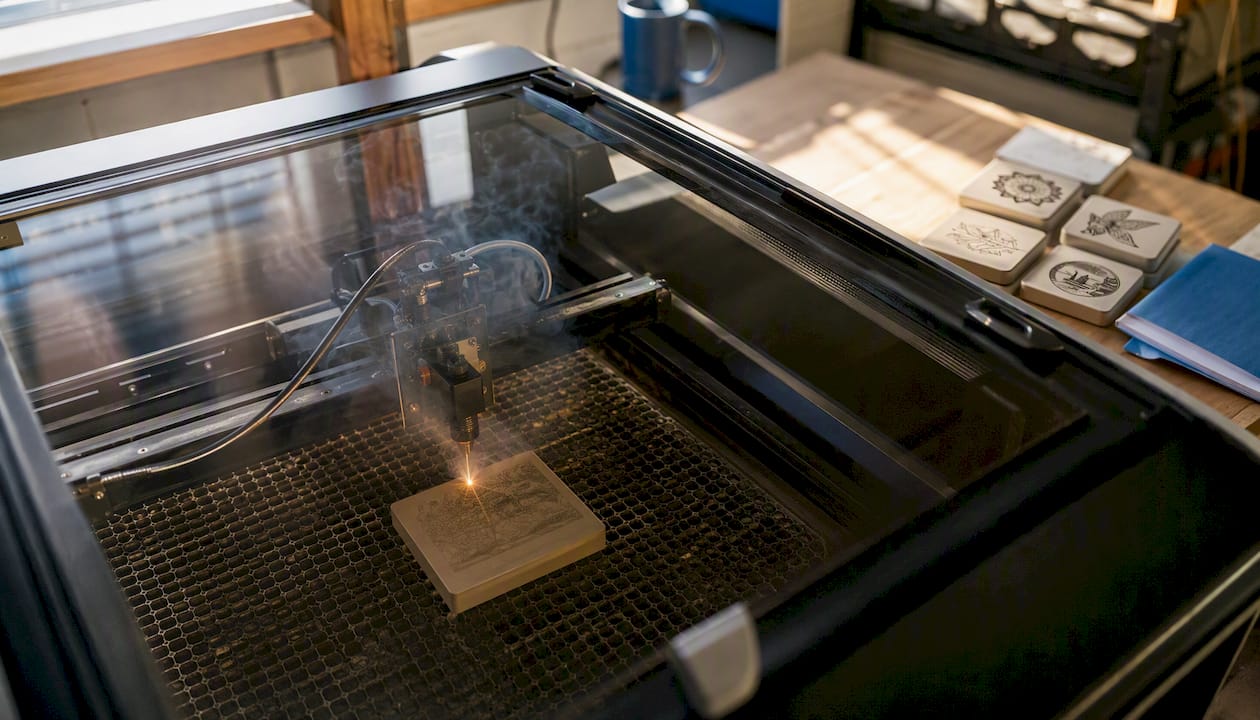
Laser systems offer high precision, non-contact cutting, and faster workflows compared with manual or photopolymer methods. A desktop laser engraver burns or ablates the surface of a laser-compatible rubber or foam blank directly from a digital file, with no film, no chemistry, and no washing stage. Set-up time between jobs is short, and the same machine can handle other materials entirely, which matters for businesses that want to diversify.
xTool models, available through Subliblanks in the UK, are a practical entry point for small businesses: capable of fine detail work, compatible with a range of laser-engraveable blanks, and supported with local after-sales service.
How the methods compare
| Method | Ease of use | Precision | Suitable scale | Material compatibility | Speed | Upfront cost | Running costs | Footprint and ventilation | UK support |
|---|---|---|---|---|---|---|---|---|---|
| Photopolymer platemaker | Moderate | Good for text and simple graphics | Hobby to small trade | Photopolymer resin sheets | Moderate (multi-step process) | £195–£995+ | Resin, film, developer | Compact; chemical disposal required | Available from specialist UK suppliers |
| Manual carving | Very easy | Low; inconsistent for fine detail | Hobby only | Lino, rubber carving blocks | Slow | Very low (under £30) | Carving tools, blanks | Minimal | N/A |
| CNC engraving | Steep learning curve | High | Small trade to industrial | Nylon, rubber | Fast once set up | High | Tooling, maintenance | Larger footprint; dust extraction needed | Limited UK-specific support for stamp use |
| Desktop laser engraver | Moderate; software-driven | Very high; micro-detail capable | Hobby to small commercial | Laser-engraveable rubber, foam, some acrylics | Fast; minimal set-up between jobs | Mid to high | Laser blanks, filter cartridges | Compact; ventilation or air filtration required | Growing UK supplier base including Subliblanks |
Why laser engraving is often the best choice for custom stamps
Laser systems consistently deliver the best combination of precision, speed, and material flexibility for small-batch custom stamp work. That is not a marketing claim; it reflects a straightforward technical reality.
A laser engraver works without touching the material. There is no blade pressure to distort fine lines, no film to align, and no chemistry to mix. You send a file, set the parameters, and the machine reproduces your artwork at a level of detail that photopolymer struggles to match for complex logotypes or very small text. For a business making personalised stamps for clients, that consistency is worth a great deal.
The workflow advantages compound quickly. Photopolymer exposure, washing, and post-curing can take 30–45 minutes per job even on a well-run bench. A laser engraver can complete a small stamp in a few minutes once the file is ready. When you are running multiple client orders in a day, that difference adds up to real capacity.
Safety and ventilation in UK workshops
Laser engraving rubber or coated blanks produces fumes, and this is not something to manage casually. Combining an enclosed laser with a dedicated smoke purifier or fume extractor is the practical standard for indoor UK workshops. An enclosed machine with a Class 1 or Class 2 laser rating is safer for shared or domestic workshop spaces than an open-frame unit, which requires additional guarding.
Check that any machine you buy carries CE or UKCA conformity marking. Reputable UK suppliers will provide documentation; if a seller cannot produce it, that is a clear signal to look elsewhere.
Key safety considerations for laser stamp-making:
- Use an enclosed laser unit or fit appropriate guarding for open-frame machines.
- Connect a fume extractor or inline smoke purifier rated for the materials you engrave.
- Never engrave PVC-containing materials; they release chlorine gas.
- Keep the workspace ventilated even with a purifier running.
- Follow the manufacturer’s guidance on laser class and eye protection.
Where photopolymer still has the edge
Photopolymer is not obsolete. For high-volume runs of the same design, the per-unit material cost of photopolymer resin is lower than laser blanks, and the process is well-suited to repetitive production once the workflow is dialled in. If your business model is producing large batches of a single stamp design, photopolymer platemakers remain a cost-effective workhorse.
Laser wins for variety, speed, and detail. Photopolymer wins for unit economics on long runs. Most small businesses end up wanting both, but if you are buying one machine first, the laser gives you more flexibility from day one.
Pro Tip: When evaluating laser blanks for stamp-making, test a small sample sheet from your supplier before committing to bulk stock. Laser-engraveable rubber varies in density and ablation characteristics between manufacturers, and a blank that works well at one power setting may char or under-engrave at the same setting from a different batch.
How do you choose the right stamp-making machine for your budget?
Match your expected monthly output, the level of detail in your designs, and your material mix to a machine class. That single sentence is the decision framework. Everything else is detail.
Decision checklist
- Estimate your monthly volume. How many stamps per week, and how many are unique designs versus repeat orders? High variety favours laser; high repetition of the same design favours photopolymer.
- Assess your design complexity. Fine logos, small text under 6pt, and intricate patterns push you towards laser. Simple text blocks and basic graphics work well on photopolymer.
- Check material compatibility. If you want to engrave foam, acrylic, or wood alongside rubber, laser is the only realistic option. Photopolymer is resin-only.
- Measure your available footprint. Desktop laser engravers and compact photopolymer platemakers both fit on a standard workbench. CNC routers typically need a dedicated table and dust extraction.
- Plan for ventilation. Laser engraving requires fume extraction. Photopolymer requires chemical storage and disposal. Neither is a dealbreaker, but both need planning before you buy.
- Ask about after-sales support. For any machine above £300, confirm the supplier offers UK-based support, holds spare parts, and can advise on consumables. A machine that sits idle waiting for an overseas spare part costs you more than the price difference.
- Calculate consumable costs over 12 months. Initial machine cost can be modest relative to lifetime consumable costs if usage and material selection are not planned carefully. Factor in resin, film, laser blanks, and filter cartridges before comparing machine prices.
Realistic price ranges by machine class
- Hobby photopolymer kit: From around £195 for a compact platemaker such as the PM-75, plus resin and film consumables.
- Mid-range photopolymer platemaker: Around £995 for a unit with a larger exposure area and vacuum system, such as the PLB-A4iv.
- Desktop all-in-one stamp creator: Typically a few hundred pounds including starter consumables; suits offices and low-volume crafters who want a simple, self-contained workflow.
- Desktop laser engraver (hobby to small commercial): Entry-level models start from a few hundred pounds; capable small-business units with enclosures and extraction sit in the £500–£1,500+ range depending on bed size and power.
- CNC engraving (trade/industrial): Higher entry cost, larger footprint, and more complex set-up; generally not the first choice for stamp-only production.
When buying from international suppliers, remember to account for shipping, import duties, and the availability of UK-compatible spare parts. A machine listed at an attractive price in US dollars or euros may cost significantly more by the time it arrives and is operational.
Pro Tip: Batch your stamp jobs by material type and size before you start a production run. Nesting multiple stamp designs onto a single sheet of laser blank or photopolymer resin reduces waste and cuts your cost per stamp significantly. This is one of the most overlooked efficiency gains for small-batch producers.
What stamp materials should UK crafters and businesses use?
The material you engrave or expose is as important as the machine itself. A good machine with the wrong blank produces poor stamps; a modest machine with the right material can produce excellent results.
Common stamp materials
- Photopolymer resin sheets: The standard for photopolymer platemakers. Available in different hardnesses for different impression qualities. Softer resins give a slightly cushioned impression; harder resins hold finer detail.
- Laser-engraveable rubber sheets: The primary material for laser stamp-making. Quality varies between suppliers. Look for sheets specifically rated for laser engraving; standard office rubber does not ablate cleanly and can produce toxic fumes.
- Pre-mounted stamp blanks: Rubber or foam blanks already mounted on acrylic or wood blocks, ready for engraving or exposure. Useful for small runs where you want a finished product quickly.
- Self-inking mechanisms and replacement pads: For businesses producing self-inking stamps, the mechanism quality matters as much as the stamp surface. Replacement ink pads need to be compatible with the stamp material and the ink type required by the customer.
Durability and impression quality
Laser-engraved rubber stamps tend to be durable and hold their impression quality well over thousands of uses, provided the rubber is a good grade. Photopolymer stamps are slightly more delicate and can degrade faster if stored improperly or used with incompatible inks. For archival or heavy-use applications, laser-engraved rubber is generally the more robust choice.
Batch uniformity depends directly on material consistency. Switching between suppliers mid-production, or buying unbranded sheets to save money, introduces variability that shows up in the finished stamp. For business customers who need identical results across an order, this matters.
Subliblanks supplies laser-engraveable blanks and related consumables to UK trade buyers, with no minimum order quantity. That means you can test a small quantity of a new blank type before committing to larger stock, which is exactly the right approach when you are matching materials to a specific machine and workflow. For a broader look at stamp making supplies for UK crafters, the Subliblanks blog covers product categories in practical detail.
What does the design-to-stamp workflow actually look like?
The process from artwork to finished stamp is straightforward once you have done it a few times. Here is the standard workflow for both photopolymer and laser methods.
- Prepare your artwork. Create or source your design as a high-contrast, pure black-and-white image. Photopolymer processes require 1-bit artwork; grey-scale images and very thin lines commonly fail or produce weak impressions. For laser engraving, high-contrast vectors or high-resolution bitmaps (600 dpi minimum) give the cleanest results.
- Choose your file format. Vector files (SVG, AI, PDF) are preferred for laser engraving because they scale without quality loss. For photopolymer, a high-resolution TIFF or PNG at 600–1200 dpi is standard for producing film negatives.
- Produce the negative or engraving file. For photopolymer, print your artwork as a film negative on a transparency. For laser engraving, import the file directly into your laser software (LightBurn is widely used) and set the engraving parameters.
- Set up the machine. For photopolymer: position the resin sheet, lay the negative on top, and set the UV exposure time according to the resin manufacturer’s guidance. For laser: focus the head, set power and speed, and run a test on a scrap piece of blank first.
- Run a test. Always run a test cut or exposure before committing a full sheet. For laser engraving, a small test patch at your intended settings takes under a minute and can save an entire blank. For photopolymer, a test strip confirms your exposure time is correct.
- Process and finish. Photopolymer stamps need washing (typically in water or a mild solvent, depending on the resin type) and a post-cure UV exposure to harden the surface. Laser-engraved stamps need only a quick clean to remove debris before mounting.
- Mount and test the impression. Trim the stamp to size, mount on an acrylic block or self-inking mechanism, ink it, and test on paper. Check for any areas that are not printing cleanly and adjust settings for the next run.
Timing expectations
A photopolymer stamp from artwork to finished, post-cured stamp typically takes a longer time including multiple steps. A laser-engraved stamp from file to finished surface takes considerably less time, with no washing or post-cure required. For a business running multiple jobs per day, that time difference is significant.
For a detailed walkthrough of how to create custom stamps, including file-prep specifics, the Subliblanks guide covers the process step by step.
Maintenance, running costs, and safety for UK workshops
Routine maintenance checklist
- Laser engravers: Clean the lens and mirrors regularly (frequency depends on usage; weekly for heavy use). Check and empty the debris tray. Inspect the air-assist nozzle for blockages. Replace the fume filter cartridge according to the manufacturer’s schedule, typically every few months for regular use.
- Photopolymer platemakers: Clean the exposure glass after each session. Dispose of used developer solution according to local authority guidance (photopolymer chemicals are regulated waste in the UK). Check UV bulb output periodically; degraded bulbs produce inconsistent exposures.
- General workshop: Keep extraction systems clear and test airflow regularly. Store resin and chemical developers in sealed containers away from UV light and heat.
Running costs
Consumable costs are where many buyers underestimate their total outlay. A laser engraver with a low purchase price can become expensive if you are buying premium laser blanks in small quantities without planning your batch sizes. Photopolymer resin and film are ongoing costs that add up quickly on a busy bench.
The practical approach is to calculate cost per stamp at your expected monthly volume before you buy the machine. Factor in blank sheets, film or resin, filter cartridges, and any replacement parts. Planning nesting and batch sizes to minimise scrap is best practice and can meaningfully reduce your cost per unit.
For machines sourced from international suppliers, spare parts availability in the UK is a genuine running-cost risk. A laser tube or a UV bulb that takes six weeks to arrive from overseas is not just an inconvenience; it is lost revenue.
Workshop safety essentials
- Ventilate the workspace independently of any machine-mounted extractor.
- Wear appropriate PPE when handling photopolymer resins and developers: nitrile gloves and eye protection as a minimum.
- Store chemical waste for collection by a licensed waste contractor; do not pour developer down the drain.
- For laser machines, confirm the laser class and follow the eye-safety guidance for that class. Class 1 enclosed machines are the safest for shared spaces.
- Check electrical safety: PAT test any machine annually if used in a commercial setting.
Reputable UK suppliers provide safety documentation with their machines. If a supplier cannot provide a safety data sheet for their consumables or conformity documentation for their equipment, that is a reason to buy elsewhere.
Why UK small businesses are shifting to laser engraving
The move towards laser engraving in the UK personalisation market is not a trend driven by novelty. It reflects a straightforward commercial calculation.
Laser systems reduce the number of steps between a customer’s artwork and a finished stamp. Fewer steps mean fewer points of failure, less labour time per job, and a faster turnaround that customers notice. For a small business competing on speed and quality rather than price alone, that matters more than the lower per-unit material cost of photopolymer.
“Choosing the right stamp-making machine is no longer just about print quality. It directly affects precision, speed, material flexibility, and how efficiently you can scale your production.” — Rubber Stamp Making Machine Guide, LaserPecker
The ROI case for laser is strongest when a business is handling varied, one-off, or short-run orders. A photopolymer platemaker earns its keep on long, repetitive runs of the same design, where the per-unit resin cost is lower and the workflow is predictable. But the moment a business starts taking custom logo stamps, address stamps, and decorative stamps in the same week, the laser’s flexibility pays back the higher upfront cost quickly.
Supplier reliability is the other factor that businesses often underestimate until something goes wrong. A machine from a supplier with no UK presence, no local spare parts, and no English-language technical support is a liability the moment it develops a fault. Established UK-based suppliers, or international brands with UK distribution and support, reduce that risk materially. For a broader view of laser engraving in business growth, the case for investing in quality equipment and local support is well documented.
Key takeaways
For UK crafters and small businesses, the best stamp-making machine is the one that matches your volume, design complexity, and material mix — not simply the cheapest or the most powerful option available.
| Point | Details |
|---|---|
| Hobby pick | A photopolymer starter kit (£195 for the PM-75) suits low-volume, simple-design work with minimal set-up. |
| Small business pick | A desktop laser engraver delivers the precision, speed, and material flexibility that commercial stamp work demands. |
| Top buying criteria | Match machine class to monthly volume, design complexity, and material mix before comparing prices. |
| Running costs matter | Consumable costs over 12 months often exceed the machine price; plan batch sizes and buy from reliable UK suppliers. |
| Subliblanks for UK buyers | Subliblanks stocks xTool laser engravers, laser-engraveable blanks, and stamp-making consumables with no minimum order quantity. |
The case for buying less machine than you think you need
There is a consistent pattern among first-time stamp-making equipment buyers: they over-specify the machine and under-plan the consumables. A £1,200 laser engraver sitting idle because the buyer ran out of compatible blanks, or because the fume extractor was never ordered, is a worse outcome than a £400 machine running steadily with a well-stocked supply shelf.
The advice that actually saves money is this: buy the machine that covers your current volume with a modest margin for growth, then invest the difference in a reliable consumable supply and a proper extraction setup. You can upgrade the machine in two years when you have outgrown it. You cannot recover the time lost to a workshop that is not set up to run safely and consistently from day one.
Photopolymer is not a stepping stone to laser; for some businesses, it is the right permanent answer. If your work is predominantly long runs of simple text stamps, the per-unit economics of photopolymer are genuinely better, and a well-maintained platemaker will serve you for years. The laser is the right first choice when variety and detail are your selling points, not when it is simply the more impressive-sounding option.
Subliblanks’s position as a trade wholesaler with no minimum order quantity is particularly useful at the start of a stamp-making operation, when you need to test materials without committing to bulk stock. That flexibility is worth factoring into your supplier decision alongside machine price.
Subliblanks: stamp-making supplies and laser systems for UK buyers
Skip the guesswork of sourcing machines and consumables from multiple suppliers. Subliblanks gives UK stamp makers a single trade source for xTool laser engraving machines, laser-engraveable blanks, stamp-making consumables, and related supplies, with no minimum order quantity and UK-based after-sales support.
What Subliblanks supplies for stamp makers:
- xTool laser engraving machines, available for UK buyers with local support
- Laser-engraveable rubber and foam blanks compatible with desktop laser systems
- Stamp-making consumables including mounting supplies and ink pads
- Packaging supplies for finished stamp products
- Trade pricing with no minimum order, so you can start small and scale
Whether you are setting up your first stamp-making bench or adding laser capability to an existing print operation, browse the full range at Subliblanks or contact trade sales directly to discuss your requirements.
Useful sources and further reading for UK buyers
A short list of authoritative pages for deeper technical detail, safety guidance, and product specifications:
- Rubber Stamp Making Machine Guide: Types, Comparison and Best Choice for Precision Stamps — Technical overview of stamp-making methods with laser-specific guidance; useful for comparing production workflows.
- What is a stamping machine? Guide for production and craft, Subliblanks — Background on production versus hobby stamp-making workflows; useful for buyers deciding between machine classes.
- Stamp making machine types: a crafter’s guide, Subliblanks — Practical breakdown of machine types with pros and cons for UK crafters.
- Why use laser engraving machines: a guide for UK small businesses, Subliblanks — Safety considerations and practical reasons for adopting laser systems in small UK workshops.
| Resource | Type | Best for |
|---|---|---|
| LaserPecker stamp machine guide | Technical overview / buying guide | Comparing laser vs photopolymer workflows |
| Polydiam PM-75 product page | Product spec and pricing | Entry-level photopolymer buyers |
| Polydiam PLB-A4iv product page | Product spec and pricing | Mid-range photopolymer buyers |
| Photocentric Craft Clear Stamps | Material quality and supplier guidance | Understanding photopolymer material standards |
| Subliblanks stamping machine guide | Production vs hobby workflow | Choosing between machine classes |
| Subliblanks machine types guide | Crafter-focused buying advice | UK crafters comparing methods |
| Subliblanks laser engraving guide | Safety and business case | Small businesses evaluating laser adoption |


