



Stamp making machine types: a crafter's guide
TL;DR:
- Choosing the right stamp making machine depends on your production volume, design complexity, and budget constraints. Photopolymer, flash, and CO₂ laser machines serve different needs, with each offering unique speed, detail, and cost considerations. Carefully assessing your workflow and expenses ensures you select a machine suited for both hobbyist and small business applications.
Picking the right stamp making machine is harder than it looks. The stamp making machine types available to crafters and hobbyists range from compact manual units costing under £100 to professional flash systems priced well above £15,000, and each one suits a different set of needs. Get it wrong and you end up with a machine that is either far more than you need or frustratingly limited. This guide breaks down the main types, explains exactly what each one does well, and helps you work out which machine is the right fit for your projects and budget.
Table of Contents
- Key takeaways
- What to consider before choosing a stamp making machine
- 1. Photopolymer stamp making machines
- 2. Flash stamp making machines
- 3. CO₂ laser engraving machines for stamps
- 4. Manual rubber stamp carving kits
- 5. UV exposure box setups for DIY stamp making
- 6. Comparison of stamp making machine types
- My honest take on choosing a stamp machine
- Find the right materials and machines at Subliblanks
- FAQ
Key takeaways
| Point | Details |
|---|---|
| Three core machine types | Photopolymer, flash, and CO₂ laser machines each serve distinct needs based on volume, detail, and budget. |
| Speed varies dramatically | Basic flash machines produce 1 stamp every 3 seconds; manual photopolymer variants average 5 to 30 units per hour. |
| Upfront cost is only part of it | Material waste in the learning phase can exceed 30%, so factor consumables into your budget from day one. |
| Match machine to output volume | High-detail, small-batch work suits laser engraving; fast, repeatable pre-inked stamps suit flash technology. |
| Hobbyists have affordable entry points | Entry-level photopolymer machines start from as little as $99, making them accessible for personal or small business use. |
What to consider before choosing a stamp making machine
Before comparing stamp making machine types side by side, it helps to get clear on what you actually need. The right machine for a crafter producing 20 custom wedding stamps a month looks nothing like the right machine for a small business fulfilling daily retail orders.
Here are the key questions worth working through:
- Production volume. Are you making a handful of stamps per week or hundreds per day? Manual machines are fine for low output. Automatic and electric options pay off when volume climbs.
- Design complexity. Intricate fine-line artwork demands precision. Not every machine type handles small text or detailed illustrations equally well.
- Upfront and running costs. The machine price is just the start. Photopolymer resin, flash foam pads, and ink cartridges all add up. Small business owners consistently underestimate these ongoing costs.
- Stamp material and ink compatibility. Some machines produce rubber stamps, others create pre-inked foam pads. Know which ink types your finished stamps need to work with.
- Space and power requirements. A CO₂ laser engraver needs ventilation and a stable work surface. A handheld UV exposure kit needs almost nothing.
- Your skill level and patience. Some machines have steep learning curves. Others are genuinely plug-and-play.
- Personal hobby versus small business use. A machine that works beautifully for weekend crafting may bottleneck a small business operation within months.
Pro Tip: Before buying, estimate your realistic monthly stamp volume and then double it. Most crafters underestimate how quickly demand grows once they start selling or gifting custom stamps.
1. Photopolymer stamp making machines
Photopolymer machines are among the most popular stamp making machine types for serious crafters. They work by exposing a light-sensitive polymer plate to ultraviolet light through a film negative or transparent printed design. The UV light hardens the raised areas of the plate while the unexposed sections wash away, leaving a crisp, reusable stamp surface.
Photopolymer stamps offer excellent durability and cost efficiency for larger production runs, which makes them a strong choice for anyone producing stamps in volume. The per-stamp cost drops significantly once you move past the learning curve.
Typical features and capabilities:
- Electric polymer machines produce approximately 80 stamps per hour, while manual variants sit between 5 and 30 per hour
- Handles fine detail and small text well
- Compatible with a wide range of ink types including dye, pigment, and archival inks
- Plates are reusable and durable across hundreds of impressions
- Ideal for scrapbooking, greeting cards, craft fairs, and small business branding
Considerations:
- Multi-step process involving film printing, UV exposure, and washing requires patience
- Entry-level machines start from around $99, though material costs accumulate
- Learning phase can produce wasted plates until exposure times are dialled in
- DIY UV LED setups can replicate entry-level results if you master resin exposure times
Photopolymer is arguably the best all-round choice for hobbyists who want professional-looking results without investing in industrial equipment.
2. Flash stamp making machines
Flash stamp technology takes a very different approach. Instead of moulding rubber or curing resin, it uses a porous foam pad pre-loaded with ink. A UV flash of light burns your design onto the foam, sealing the non-printing areas while the ink-loaded sections remain open and ready to stamp. The result is a self-inking, pre-inked stamp that requires no separate ink pad.
Flash stamp machines are favoured where speed is the priority. A single stamp takes just one to two minutes to produce, making flash technology the go-to for offices, retail counters, and crafters who need quick turnaround.
Typical features:
- Very fast production: some units deliver 1 stamp every 3 seconds at full automatic speed
- Simple operation with low skill requirements
- Pre-inked stamps are clean to use with no separate pad needed
- Compact machines available for home or studio use
Manual vs automatic flash machines:
Manual and automatic flash machines differ significantly in speed and cost. Manual units are lower cost and suit occasional personal use. Automatic machines increase throughput considerably for small business environments. The trade-off is a higher purchase price and a slightly larger footprint.
Considerations:
- Flash stamps have limited compatibility with alcohol-based inks
- Durability is lower than rubber or photopolymer stamps. Pre-inked foam eventually runs dry
- Less suited to highly detailed or ultra-fine artwork
- Professional automatic systems can exceed $21,000
Pro Tip: If you only need a small volume of clean, repeatable office-style stamps, a manual flash machine at the affordable end of the market is all you need. Save the upgrade budget for better design software instead.
3. CO₂ laser engraving machines for stamps
CO₂ laser machines represent the most technically capable category among different stamp making machines. They use a focused laser beam to engrave or cut directly into rubber, wood, acrylic, or specialist engraving blanks, removing material with precision to create the raised stamp surface.
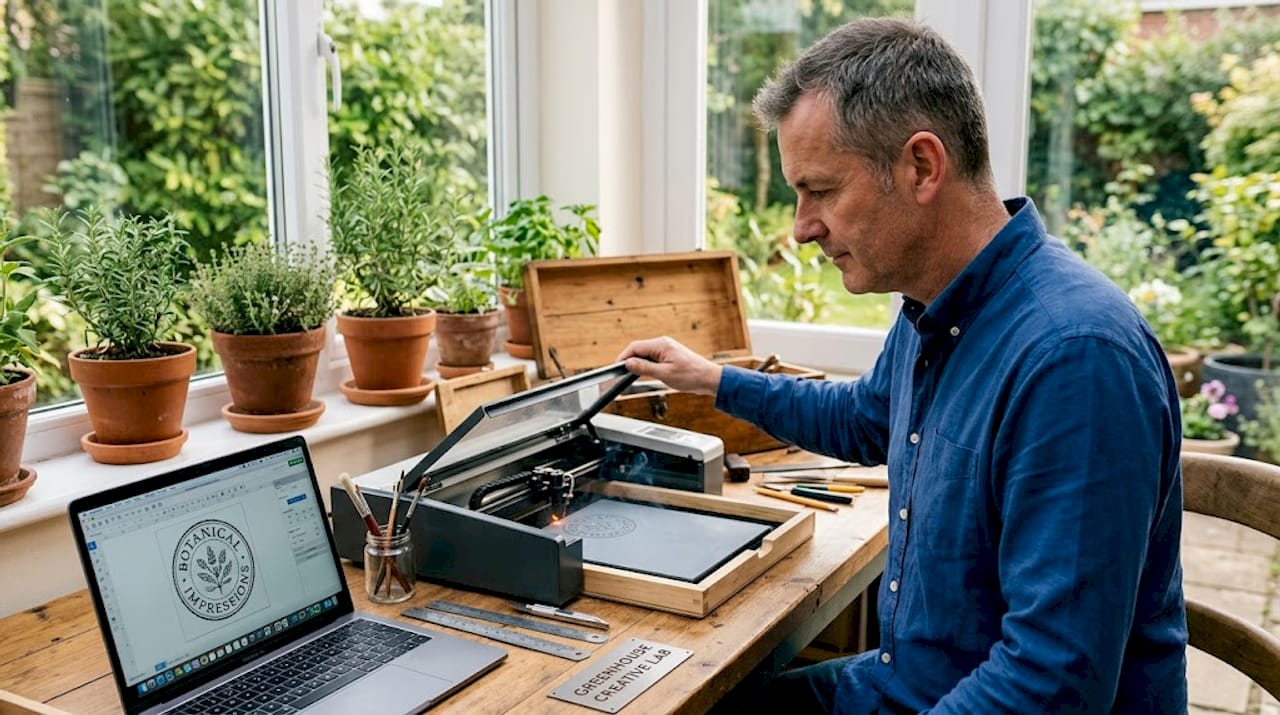
The results are exceptional. Laser engraving handles fine lines, intricate artwork, and small text better than any other method. For anyone producing bespoke or custom-designed stamps for a studio or creative business, laser is the gold standard.
CO₂ laser engraving offers high precision and versatility, though at a higher cost and with greater complexity. Expect to spend time on machine calibration, file format preparation, and material testing before achieving consistent results.
Key features:
- Produces approximately 1 stamp in around 3.5 minutes; a batch of 40 takes roughly 2 hours 40 minutes
- Works across multiple materials including rubber, timber, MDF, and laser engravable blanks
- Ideal for detailed custom work, personalised gifts, and small-batch speciality stamps
- Pairs well with vector-based design files for clean output
Considerations:
- Higher equipment cost compared to flash or photopolymer machines
- Requires adequate ventilation and a stable workspace
- Blank material choice directly affects precision and final stamp quality
- Steep learning curve for beginners unfamiliar with laser operation or design file requirements
For crafters ready to move into more advanced work, laser engraving opens up creative possibilities that flash and photopolymer simply cannot match.
4. Manual rubber stamp carving kits
Not every stamp making setup involves a machine at all. Hand-carving rubber or soft lino blocks is one of the oldest stamp making methods and it remains genuinely popular among printmakers, artists, and crafters who value the handmade quality of the result.
This approach requires only a carving tool set, a rubber block, and a sharp eye for detail. There is no power source, no UV exposure, and no ongoing consumable cost beyond fresh blocks. For anyone exploring stamping as a creative hobby before committing to a machine, hand carving is a low-cost and tactile starting point.
The obvious limitation is time. Complex designs take considerable effort to carve accurately, and the method does not scale to any meaningful production volume. That said, many professional printmakers carve blocks by hand on purpose. The organic imperfection of hand-carved stamps is part of the aesthetic.
5. UV exposure box setups for DIY stamp making
A step between hand carving and a purpose-built machine, UV exposure boxes allow hobbyists to produce photopolymer or flash-style stamps without buying a dedicated commercial unit. You set up a UV LED array, expose your polymer plate through a printed transparency, and wash away the unexposed resin.
DIY UV LED arrays and exposure timers can produce quality stamp plates when you get the technique right. The cost is low and the results, with practice, rival entry-level commercial machines. The catch is consistency. Exposure time varies with UV bulb age, ambient temperature, and resin type, so results can be unpredictable until you nail your process.
This route suits technically curious hobbyists who enjoy experimenting and are comfortable with a trial-and-error approach.
6. Comparison of stamp making machine types
Use this table as a quick reference when weighing up which machine type fits your situation.
| Machine type | Speed | Cost range | Detail quality | Skill required | Best suited for |
|---|---|---|---|---|---|
| Photopolymer machine | Medium (80/hr electric) | £80 to £500+ | High | Moderate | Volume crafting, scrapbooking |
| Flash stamp (manual) | Fast (1 to 2 min per stamp) | £100 to £600 | Medium | Low | Office, retail, quick output |
| Flash stamp (automatic) | Very fast | £1,000 to £15,000+ | Medium | Low to medium | Small business, high volume |
| CO₂ laser engraver | Slower per stamp | £400 to £3,000+ | Very high | High | Custom work, fine detail |
| Hand carving | Very slow | Under £30 | Variable | High | Artistic, printmaking |
| DIY UV exposure | Medium | £30 to £150 | Medium to high | Medium | Experimental, budget-conscious |
Practical scenario examples:
A crafter making personalised wedding stamps for an Etsy shop will get the most from a photopolymer machine. The detail is reliable, the cost per stamp is low at volume, and the results look professional. Someone running a market stall needing quick address or logo stamps will find a manual flash machine faster and easier. A graphic designer producing bespoke limited-edition art stamps for retail will find the CO₂ laser justifies its cost through design flexibility.
Pro Tip: Whatever type you choose, run a small test batch before committing to a full production run. Material choice and machine calibration are the two variables that catch most beginners out, regardless of machine type.
My honest take on choosing a stamp machine
I’ve seen a lot of crafters and small business owners make the same mistake. They read a list of features, get drawn in by the speed numbers on a flash machine or the precision claims of a laser engraver, and buy something that does not actually suit their day-to-day reality.
In my experience, the single most useful question is not “which machine is best?” It is “what does my workflow actually look like in a typical week?” If you are making ten stamps a month for personal projects, a photopolymer entry-level kit is all you will ever need. If you are fulfilling twenty orders a day, a manual flash machine will become a bottleneck within a fortnight.
What I have also learned is that machine cost rarely tells the full story. The recurring spend on photopolymer resin, foam pads, and replacement cartridges adds up quickly, particularly during the learning phase when waste is highest. I would always advise budgeting at least 30 to 40 percent on top of the machine price for consumables in the first three months.
My personal view is that photopolymer machines offer the best balance for most hobbyists moving into small business territory. They are affordable to start, produce high-quality results, and scale reasonably well. Laser engraving is brilliant, but it rewards people who already understand design software and are willing to invest time in learning the machine properly. Do not buy complexity you are not ready to use.
— chris
Find the right materials and machines at Subliblanks
Once you know which stamp making machine type suits your needs, having the right blanks and materials makes all the difference. Subliblanks supplies a full range of products for crafters and small business owners, including xTool laser engraving machines, laser engravable blanks, stamp-making machines, and a broad selection of craft-ready substrates with no minimum order quantities. If you are looking for stamp-friendly blanks to pair with your machine, the round MDF name badges are a popular starting point for crafters working across sublimation and stamping. Explore the full range at Subliblanks to find everything you need to get started.
FAQ
What are the main stamp making machine types?
The three main stamp making machine types are photopolymer machines, flash stamp machines, and CO₂ laser engravers. Each suits different production volumes, budgets, and design complexity needs.
Which stamp machine is best for a hobbyist on a budget?
An entry-level photopolymer machine is the most affordable route for hobbyists, with costs starting from around $99. Manual flash machines are also a low-cost option for simple, pre-inked stamp production.
What is the difference between manual and automatic flash stamp makers?
Manual flash machines are lower cost and suited to occasional or personal use. Automatic flash machines produce stamps faster and suit small businesses needing consistent, higher-volume output.
How long does it take to make a stamp with a laser engraver?
A CO₂ laser engraver produces approximately one stamp in around 3.5 minutes. A batch of 40 stamps takes roughly two hours and forty minutes, making it slower per unit than flash but far superior in detail quality.
Are there hidden costs when buying a stamp making machine?
Yes. Material waste during the learning phase can exceed 30% for photopolymer and flash machines. Factor in ongoing costs for resin, foam pads, film, and ink cartridges alongside the initial machine price.


