



How to run a wholesale trade business
TL;DR:
- Running a profitable wholesale business requires balancing costs, demands, and operations while establishing strong foundations. Success depends on niche validation, accurate pricing, thorough documentation, and proactive cash flow management. Building relationships through trade shows, marketplaces, and targeted outreach is key to acquiring and scaling B2B customers.
Running a profitable wholesale trade business means balancing supplier costs, buyer demands, cash flow pressures, and operational complexity all at once. Many entrepreneurs underestimate how much structure is required before the first order ships. Whether you are starting a wholesale business from scratch or trying to sharpen an existing operation, the path forward is the same: build solid foundations, price correctly, document everything, and market with intention. This guide walks you through each stage, from legal setup to scaling, with practical wholesale trade strategies that actually work.
Table of Contents
- Key takeaways
- How to run a wholesale trade business: the foundations
- Pricing, MOQs, and order documentation
- Fulfilment and warehouse management
- Acquiring B2B customers
- Cash flow and scaling
- My honest take on wholesale trade
- Stock your wholesale business with Subliblanks
- FAQ
Key takeaways
| Point | Details |
|---|---|
| Start with niche validation | Research demand and supplier viability before committing capital to any product category. |
| Price correctly from day one | Wholesale pricing at roughly 50% of retail protects your margin and meets buyer expectations. |
| Documentation reduces friction | Professional line sheets and clear order terms prevent buyer delays and lost accounts. |
| Cash flow needs active management | Model your cash conversion cycle carefully, as payment gaps between suppliers and customers create real risk. |
| Fulfilment requires staged workflows | Structured warehouse processes and freight planning are what keep bulk orders accurate and on time. |
How to run a wholesale trade business: the foundations
Before you list a single product or contact a supplier, you need a clear niche and a viable plan. The step-by-step wholesale launch timeline spans roughly three months, with the early weeks devoted entirely to research and setup, not selling. That pacing exists for a reason.
Choosing a profitable niche
Pick a niche where demand is demonstrable and where you can source consistently. Look for product categories with repeat purchase behaviour. Consumables, craft supplies, and print-on-demand blanks all perform well in wholesale because buyers reorder regularly. Avoid categories with highly seasonal demand unless you have the cash reserves to absorb slow periods.
Validate demand before you commit. Check trade catalogues, speak to potential buyers at local business events, and look at what is already selling on B2B marketplaces. If buyers are actively sourcing in your chosen category, that is a strong signal.
Legal setup and supplier compliance
Register your business correctly before approaching any supplier. In the UK, this means registering as a sole trader or limited company with HMRC, and obtaining any relevant reseller permissions for your product category. For businesses purchasing inventory tax-exempt, a resale certificate is critical. A valid resale certificate must include accurate business details, and suppliers can legally charge sales tax if your documentation is invalid or incomplete.
Once your legal status is sorted, begin evaluating suppliers. Compare minimum order quantities, unit pricing at different volume tiers, lead times, and quality control processes. Request samples before committing to bulk orders. Build a shortlist of at least two suppliers per product line so you are never dependent on one source.
Pro Tip: Keep a supplier comparison spreadsheet that tracks MOQ, payment terms, lead time, and sample quality scores side by side. Reviewing this monthly helps you renegotiate terms as your order volumes grow.
Initial capital planning is part of this stage, not an afterthought. Map out your first three months of costs including stock, storage, insurance, and website setup. Underestimating working capital is one of the most common reasons early wholesale businesses fail.
Pricing, MOQs, and order documentation
Getting your pricing structure right is non-negotiable. Wholesale pricing typically sits at around 50% of the retail price, which means your cost of goods must be low enough to leave a workable margin at that level. If your supplier costs eat too deeply into that figure, you either need to renegotiate or find a different supplier.
Setting minimum order quantities and payment terms
Your MOQ needs to balance two things: covering your cost to process and ship an order profitably, and staying attractive to smaller buyers who are testing you for the first time. A common approach is to set a value-based MOQ rather than a unit-based one, for example a minimum order value of £150 rather than a minimum of 50 units. This gives buyers flexibility while protecting your margins.
Payment terms are equally important. Standard wholesale terms run at net 30, meaning payment is due 30 days after delivery. For new accounts, consider requiring payment upfront or on delivery until a trading history is established.
Building a professional line sheet
Your line sheet is the document that converts interest into orders. A well-structured line sheet includes SKU codes, product variants, wholesale price, recommended retail price, MOQ, lead time, ordering instructions, payment terms, shipping terms, and your contact details. Buyers should be able to complete an order without needing to contact you for clarification.
| Element | Why it matters |
|---|---|
| SKU and variants | Prevents ordering errors and simplifies picking |
| Wholesale and RRP pricing | Sets clear margin expectations for buyers |
| MOQ and lead time | Manages buyer expectations upfront |
| Payment and shipping terms | Reduces invoice disputes and fulfilment delays |
| Contact details and ordering method | Removes friction from the purchase process |
Pro Tip: Treat your line sheet as an operational document, not a marketing one. An incomplete line sheet costs you orders. A clear one scales your sales without adding admin.
Fulfilment and warehouse management
Knowing how to manage wholesale sales at the operational level is where many businesses fall short. Good products and strong buyer relationships mean very little if orders ship late, arrive incorrect, or create compliance problems for your retail customers.

The core warehouse workflow
Wholesale fulfilment follows a defined sequence: receiving stock, putaway, order picking, packing, and freight scheduling. Typical labour times for these stages run as follows: receiving takes roughly 2 to 4 hours per batch; putaway around 1 hour; picking approximately 2 hours; and packing around 45 minutes. Freight scheduling requires 24 to 48 hours of advance carrier notice to avoid delays.
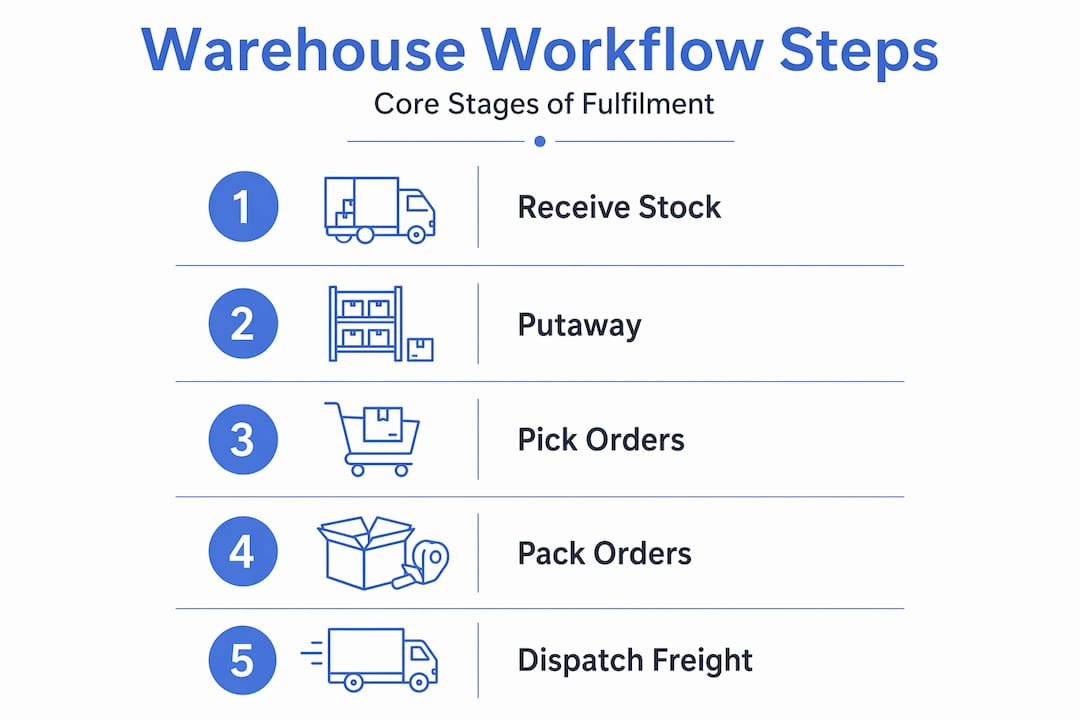
EDI (Electronic Data Interchange) validation plays an important role in larger wholesale operations by catching order errors before they cause shipment problems. Even if you are not using full EDI systems, building a manual order validation step into your workflow achieves a similar result. Review each order against your inventory and address discrepancies before packing begins.
Inventory accuracy underpins everything. Stockouts cost you sales and damage buyer trust. Excess stock ties up cash you need elsewhere. Use inventory management software from the outset, even a basic system, and conduct regular cycle counts rather than relying on annual stocktakes. For practical guidance on managing packaging within your warehouse workflow, the wholesale packaging workflow guide covers bulk fulfilment specifics in detail.
Acquiring B2B customers
Marketing for wholesale is distinctly different from consumer marketing. You are selling to buyers who are motivated by margin, reliability, and ease of ordering, not brand story alone. Your acquisition channels and messaging need to reflect that.
Here is a practical approach to building your first buyer base:
- Attend trade shows. Events like ASD Market Week connect you with thousands of wholesale buyers actively looking for new suppliers. Even one strong contact from a trade show can anchor a significant account.
- List on B2B marketplaces. Platforms built for wholesale give you visibility with buyers who are already in procurement mode. Keep your listings accurate and your pricing competitive.
- Direct outreach. Build a list of target retailers in your niche and reach out with a concise pitch and your line sheet attached. A short, professional email beats a lengthy brochure every time.
- Assess buyer creditworthiness. Before extending net payment terms, review a buyer’s trading history and consider a credit check for larger accounts. The cost of one bad debt can wipe out several months of margin.
- Use trial orders strategically. Offer first-time buyers a smaller opening order at standard terms. This lowers the barrier to entry and gives both sides a chance to test the relationship without significant risk.
Buyer profiles help you focus your effort. Define what your ideal account looks like in terms of order volume, product category focus, geography, and purchasing frequency. Then direct your outreach toward businesses that match. Selling to the wrong buyers wastes time and often leads to accounts that generate high admin for low return.
Cash flow and scaling
The financial reality of running a wholesale business is that you often pay suppliers before your customers pay you. Upfront supplier payments typically fall due within 30 days, while customer payment terms commonly run 30 to 90 days after delivery. That gap is your cash conversion cycle, and it demands active management.
- Model your working capital needs before you take on new accounts. Know exactly how much cash you need to bridge the gap between outgoings and incomings.
- Build a cash reserve equal to at least one full month of operating costs before you begin scaling order volumes.
- Healthy margins alone do not protect you if cash is tied up in unpaid invoices. Chase payments systematically and apply late payment charges where your terms allow.
- When you are ready to scale, analyse your sales data to identify your highest-performing product lines before expanding your catalogue. Scaling the wrong products is expensive.
- Consider third-party logistics (3PL) partners for fulfilment when order volumes outgrow your warehouse capacity. Treat 3PL onboarding like a technical integration project, because retailer-specific routing guidelines and EDI workflows require careful setup to avoid costly chargebacks.
Pro Tip: Understand the benefits of wholesale for UK businesses before you expand into new product lines. Knowing your unit economics at scale prevents you from growing your way into a cash shortfall.
My honest take on wholesale trade
I have worked with a lot of wholesale businesses over the years, and the pattern I see most often is this: operators focus intensely on product quality and almost not at all on their back-office processes. They are proud of what they sell. They should be. But their line sheets are incomplete, their payment terms are vague, and their freight scheduling is reactive rather than planned.
Buyers notice. They do not always tell you directly, but they do not reorder either. The businesses that convert and retain accounts are the ones that make ordering easy, communicate clearly, and never surprise a buyer with a delay they did not anticipate.
The cash flow piece is the other area where I see real damage done. Profitable on paper does not mean solvent in practice. I have seen businesses turning over strong revenue that nearly collapsed because they extended net 60 terms to too many accounts simultaneously without modelling the impact on their cash position. The fix is never glamorous. It is a spreadsheet, a payment chasing process, and the discipline to say no to buyers who want terms your cash position cannot support.
What I have learned is that wholesale success is mostly an operational discipline. Get your foundations right, document everything, and the product will sell itself.
— chris
Stock your wholesale business with Subliblanks
If you are setting up or scaling a trade wholesale operation, having a supplier who removes friction from the sourcing process makes a measurable difference.
Subliblanks supplies a broad range of products designed for wholesale resellers, from sublimation blanks and badge-making supplies to DTF materials, laser-engraveable blanks, 3D printing filaments, and packaging supplies. There is no minimum order quantity, which means you can test new lines without committing to large volumes. Whether you are building a line sheet for the first time or expanding an existing catalogue, products like the sublimation round MDF name badge with pin are exactly the kind of low-risk, high-margin items that perform well in B2B environments. Explore the full range at Subliblanks and start sourcing with confidence.
FAQ
What is a wholesale trade business?
A wholesale trade business purchases products in bulk from manufacturers or distributors and sells them to retailers, resellers, or other businesses at a price above cost but below standard retail. The model generates margin from volume rather than high per-unit markups.
How do I set wholesale prices correctly?
Wholesale pricing typically sits at around 50% of the retail price, though this varies by category. Start by calculating your cost of goods, add your required margin, and verify the resulting price is competitive against other wholesale suppliers in your niche.
Why do wholesale businesses struggle with cash flow?
The core issue is timing. Supplier payments often fall due within 30 days while buyers may have payment terms of 30 to 90 days. This gap means cash leaves your account long before it returns, requiring careful planning and adequate working capital reserves.
What should a wholesale line sheet include?
A complete line sheet covers SKU codes, product variants, wholesale price, recommended retail price, MOQ, lead time, payment terms, shipping terms, ordering instructions, and contact details. Well-structured line sheets allow buyers to place orders without needing to follow up for clarification.
How do I find buyers for my wholesale business?
Trade shows, B2B marketplaces, and direct outreach are the three most reliable channels for acquiring wholesale buyers. Build a clear buyer profile first, then direct your outreach toward businesses that match your ideal account criteria in terms of size, category, and location.
Recommended
- Why choose wholesale supplies? Key benefits for UK small businesses – SubliBlanks Ltd
- How wholesale supplies power retail growth and profits – SubliBlanks Ltd
- Wholesale packaging guide: cut costs and impress customers – SubliBlanks Ltd
- Why Buy Wholesale Sublimation for Small Brands – SubliBlanks Ltd


