



How wholesale supplies power retail growth and profits
TL;DR:
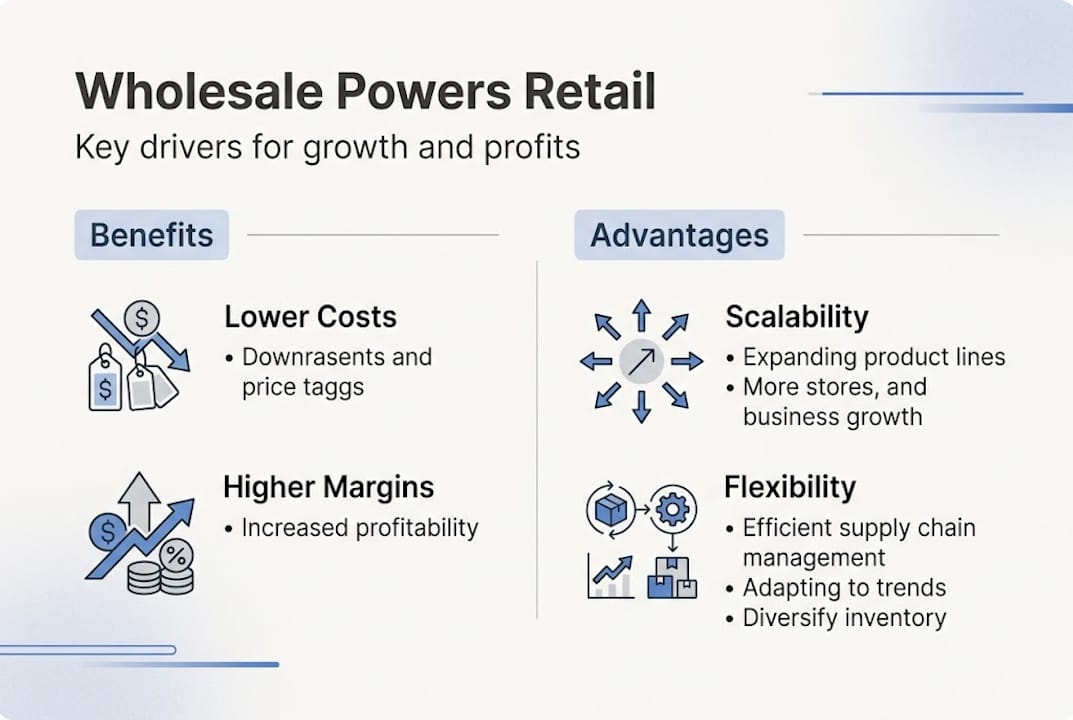
- Wholesale relationships influence product range, pricing, and supply reliability, shaping retail competitiveness.
- They offer economic advantages like lower costs, higher margins, and scalable growth opportunities.
- Strategic supplier partnerships enable product customization, trend responsiveness, and long-term retail resilience.
How wholesale supplies power retail growth and profits
Most retail business owners think of wholesale primarily as a route to cheaper stock. That framing is understandable, but it misses the bigger picture entirely. Wholesale supplier relationships shape your product range, your ability to respond to customer trends, your margins, and ultimately your competitive position in the market. This guide walks through the genuine strategic value of wholesale sourcing, covering the economic advantages, the flexibility it enables, how to pick the right partners, and what most retailers still get wrong about the whole thing.
Table of Contents
- Why wholesale supplies matter for modern retail
- Economic advantages: Profit margins, costs, and scalability
- Customisation, flexibility, and responding to trends
- Choosing the right wholesale partners: What to look for
- Our take: The overlooked strategic asset in retail growth
- Wholesale supplies that drive retail success
- Frequently asked questions
Key Takeaways
| Point | Details |
|---|---|
| Boosted profit margins | Wholesale sourcing reduces costs and increases the potential for higher retail profits. |
| Enhanced market agility | Wholesale supplies enable retailers to quickly adapt to trends and customer demands. |
| Strategic supplier selection | Choosing reliable wholesale partners is essential for consistent quality and business growth. |
| Expanded customisation options | Wholesale access allows for unique products and strong local differentiation. |
Why wholesale supplies matter for modern retail
Wholesale is often described in purely transactional terms: you buy in volume, you pay less per unit. That is true, but it is also the least interesting part of the story. The real function wholesale plays in a retail business is structural. It determines what you can offer, how reliably you can offer it, and what room you have to grow.
At its core, wholesale procurement means sourcing products or materials directly from a manufacturer or distributor rather than through a retail intermediary. For UK and Irish retailers, this typically means access to a broader catalogue at lower per-unit costs, but also access to product categories that simply would not be viable at full retail pricing.
What wholesale actually changes in your business:
- Product range: You can carry more variety without proportionally increasing your cost base.
- Pricing power: Lower input costs give you the flexibility to price competitively while protecting margins.
- Stock reliability: Established wholesale relationships mean more predictable supply chains, reducing the risk of stockouts during peak periods.
- Speed to market: Suppliers who know your business can turn around orders faster, letting you capitalise on seasonal or trend-driven demand.
- Innovation access: Many wholesale suppliers introduce new product lines or materials that allow you to offer genuinely novel items before competitors catch on.
The cost of neglecting wholesale relationships is often invisible until it becomes painful. Retailers who buy piecemeal through retail channels or rely on a single, untested supplier are perpetually exposed to price shocks, supply delays, and range limitations. In a market as competitive as UK and Irish retail, that kind of fragility is a real liability.
Wholesale supplies enable competitive pricing and product differentiation, which means the retailers who invest in building solid wholesale partnerships are consistently better positioned to withstand market disruption and serve customers more effectively.
Pro Tip: Before committing to a wholesale supplier, order a small trial batch if they permit it, and pay attention to packaging quality, delivery accuracy, and responsiveness. Small brands and independent retailers often share candid experiences on trade forums and social groups, and reading those accounts can save you from a costly mistake.
Having established why you should care about wholesale, the next focus is on the economic impacts.
Economic advantages: Profit margins, costs, and scalability
The economics of wholesale sourcing are straightforward in principle but surprisingly underestimated in practice. Most retailers know that buying in volume lowers unit costs, but fewer actively model what that means for their margins, their cash flow, and their capacity to grow.
Buying wholesale drives down cost per unit, directly lifting profit margins. When your cost base drops, you gain genuine flexibility: you can price more aggressively to win volume, hold margins steady and invest savings elsewhere, or create tiered product lines with different margin profiles.
| Factor | Traditional retail buying | Wholesale procurement |
|---|---|---|
| Cost per unit | Higher, limited negotiation | Lower, scalable discounts |
| Product range | Restricted by retail pricing | Broader, more viable categories |
| Stock reliability | Variable, dependent on retail stock | More consistent with direct relationships |
| Margin potential | Compressed by retail mark-ups | Stronger with direct sourcing |
| Scalability | Slow, expensive to grow range | Faster, lower barrier to expanding lines |
Beyond the obvious unit cost saving, there are hidden economic benefits that compound over time. Stockouts are expensive: you lose the immediate sale, potentially damage customer trust, and sometimes incur rush-order costs to plug the gap. A reliable wholesale partner reduces stockout frequency substantially. Faster turnaround times also mean less working capital tied up in large safety stock, improving your cash position.
Steps to evaluate potential wholesale cost savings for your business:
- Calculate your current average cost per unit for your top ten selling products.
- Request wholesale quotes for those same products and compare directly.
- Factor in delivery costs, minimum order values (or lack thereof), and lead times.
- Model the margin impact at your current selling prices and at a 5% lower price point.
- Assess how much working capital you would need to shift to a wholesale model and whether the return justifies it.
Scalability deserves particular attention. Many independent retailers in the UK and Ireland reach a growth ceiling because their cost structure does not improve as they grow. Wholesale procurement breaks that pattern. As your order volume increases, your per-unit cost typically falls further, and your supplier relationships deepen, giving you access to better terms, priority fulfilment, and early access to new lines. That combination turns wholesale from a cost tactic into a genuine growth lever.
Now that we understand the economic power of wholesale supplies, let us turn to how they enable customisation and unique product offerings.
Customisation, flexibility, and responding to trends
One of the most underappreciated advantages of wholesale sourcing is the creative and commercial freedom it gives retailers to build genuinely differentiated product ranges. This is especially relevant in markets like personalised gifts, branded merchandise, events, and print-on-demand, where the product itself is often the vehicle for a customer’s specific idea.
Wholesale custom blanks for retail make flexible, customisable products widely accessible for UK retailers. Sublimation blanks, laser-engraveable items, and DTF-ready materials are all examples of wholesale products that retailers can personalise and sell at significant mark-ups, without needing to manufacture anything from scratch.
The agility this creates is commercially powerful. Instead of being locked into a fixed product catalogue determined by a supplier’s pre-decorated range, you can experiment with limited runs, seasonal designs, or bespoke corporate orders. The sublimation blanks role in business demonstrates clearly how retailers who embrace this model build recurring revenue streams that competitors find difficult to replicate.
| Sourcing model | Product variety | Trend responsiveness | Margin potential | Differentiation |
|---|---|---|---|---|
| Fixed wholesale range | Moderate | Low | Standard | Limited |
| Flexible wholesale with blanks | High | High | Strong | Significant |
Industries in the UK and Ireland best positioned for wholesale customisation:
- Personalised gifts: Mugs, keyrings, photo slates, and ornaments are perennial sellers that wholesale blanks make viable at any scale.
- Corporate and branded merchandise: Businesses routinely order branded items in small batches, and flexible wholesale sourcing means you can serve them profitably.
- Events and weddings: Bespoke items for weddings, parties, and corporate events are high-margin and trend-sensitive, making wholesale flexibility essential.
- Schools and clubs: Badges, name tags, and branded clothing are consistent sellers for educational institutions and sports clubs.
- Local and artisan retail: Independent shops increasingly differentiate through locally personalised or custom products that mass retail cannot offer.
The key insight here is that trend responsiveness requires low-commitment sourcing. If your wholesale partner demands large minimum orders, you cannot test new product ideas without significant financial exposure. Suppliers who operate without minimum order quantities give you the freedom to experiment, fail cheaply, and scale what works. That flexibility is worth paying attention to when you are evaluating potential partners.
Having looked at flexibility, it is crucial to address how to strategically choose wholesale suppliers for retail success.
Choosing the right wholesale partners: What to look for
The quality of your wholesale relationships directly shapes the quality of your retail business. A poor supplier can undermine your brand, frustrate your customers, and tie up your capital. A strong one becomes a genuine competitive advantage. So the evaluation process matters enormously, and most retailers do not take it seriously enough.
Reliable wholesale relationships are central to sustained retail success. That reliability is built across several dimensions: product quality consistency, delivery accuracy, communication responsiveness, and the ability to adapt as your needs evolve.
Step-by-step due diligence for vetting wholesale suppliers:
- Define your requirements precisely. Before approaching suppliers, know what product specifications, volumes, lead times, and delivery expectations you actually need.
- Request samples. Any credible wholesale supplier will provide samples. Assess quality, packaging, and consistency across the batch.
- Check references. Ask specifically for references from UK or Irish businesses of a similar size. Their experience is the most relevant benchmark.
- Clarify minimum order terms. Suppliers with no minimum order quantities give you more flexibility, especially when you are testing new lines.
- Evaluate communication quality. How quickly and clearly they respond during the sales process is usually a reliable indicator of how they will perform when you have a problem.
- Review contract terms carefully. Pay attention to return and replacement policies, delivery guarantees, and price review mechanisms.
- Start with a pilot order. Even if you are confident, begin with a manageable order before committing to larger volumes.
Pro Tip: Ask potential suppliers directly for case studies or testimonials from UK and Irish retailers. Local market knowledge, familiarity with delivery infrastructure, and understanding of regional demand patterns are genuinely differentiating qualities in a wholesale partner. A supplier who has served businesses in your region will anticipate your needs more accurately.
Contract terms and ongoing communication are areas where many retailers are passive. Before signing anything, you should know the answer to these questions: What happens if a delivery is late or a product is faulty? How are price changes communicated and with how much notice? Is there a dedicated account contact you can call? These questions reveal a lot about how the relationship will actually function. You can also explore using blanks for merchandise to understand what product categories are worth building into your discussions with potential partners.
With the essentials of supplier evaluation in hand, it is time to consider the wider perspective retail decision-makers need.
Our take: The overlooked strategic asset in retail growth
Most conversations about wholesale focus on cost reduction, and that framing, while understandable, causes retailers to chronically underuse their supplier relationships. We see this pattern constantly. A retailer finds a wholesale supplier, locks in a standard order cadence, and then never revisits the relationship. They treat wholesale as a procurement function rather than a strategic one.
The businesses that genuinely outperform their competitors treat wholesale partnerships differently. They share trend data with their suppliers. They ask what new product lines are coming. They test small batches of experimental items. They give feedback on quality and packaging. In return, they get early access to new lines, better service, and occasionally bespoke product development that their competitors simply cannot access. The sublimation selection guide reflects exactly this kind of strategic thinking: knowing what to source, and why, before the market catches up.
Resilience in retail does not come from a single great supplier. It comes from a diverse network of reliable partners who each contribute something specific. Build that network deliberately, review it regularly, and you will find your business has far more options when conditions change.
Wholesale supplies that drive retail success
If you are ready to move beyond piecemeal sourcing and build a supply strategy that actually supports your growth, it helps to work with a supplier who understands what UK and Irish retailers genuinely need.
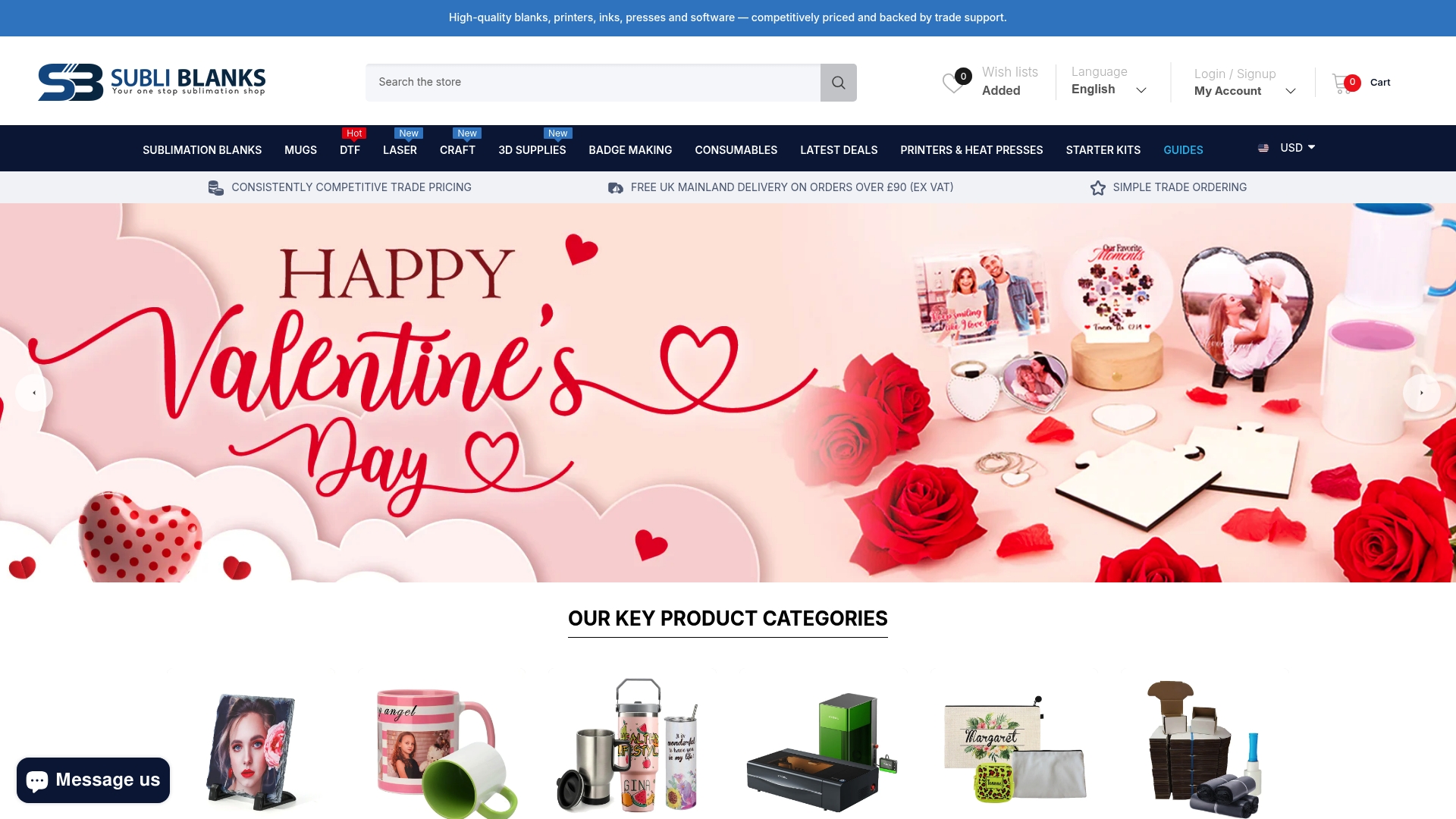
At SubliBlanks Ltd, we supply a full range of wholesale blanks, equipment, and materials with no minimum order quantities, so you can test new product lines without financial risk. From sublimation paper packs and round MDF namebadge pins to DTF supplies, laser-engraveable blanks, and badge-making equipment, our range is built around what retailers actually sell. We work with independent shops, gift businesses, event suppliers, and branded merchandise companies across the UK and Ireland, and we understand the specific pressures and opportunities you face. Explore the full range and see what fits your business.
Frequently asked questions
How can wholesale supplies help my retail business grow?
Wholesale supplies provide cost savings, product diversity, and the flexibility to meet changing market trends, all supporting business growth. Wholesale supplies enable competitive pricing and genuine product differentiation that retail sourcing simply cannot match.
What should I consider when choosing a wholesale supplier in the UK or Ireland?
Key factors are product quality, delivery reliability, flexible minimums, after-sales support, and supplier reputation with local businesses. Reliable wholesale relationships are built on consistency and communication, not just price.
Are wholesale supplies only useful for large retailers?
No, small and medium-sized retailers benefit just as much from wholesale sourcing. Buying wholesale drives down cost per unit even on modest order volumes, making it viable for businesses at any stage.
How does wholesale impact customisation for retailers?
Wholesale access allows retailers to offer custom and unique designs that keep pace with trends and customer preferences. Wholesale customisable products are widely accessible for UK retailers through suppliers who stock blanks and decoration-ready materials.


