



What is a stamping machine? Guide for production and craft
TL;DR:
- Stamping machines are versatile tools used in industries from automotive to craft jewelry.
- Types include mechanical, hydraulic, and servo-electric, each suited for different production needs.
- Proper setup and understanding of machine parameters are crucial for optimal, cost-effective results.
Stamping machines are widely assumed to belong exclusively to vast factory floors churning out car panels. That assumption leaves a lot of value on the table. In reality, these machines shape, cut, emboss, and mark materials at every scale — from a high-volume automotive pressings line to a small workshop producing custom jewellery or branded tin packaging. The technology has evolved considerably, meaning SMEs and craft entrepreneurs now have genuine, accessible options. This guide explains how stamping machines work, what distinguishes different types, and how to make an informed choice whether you are scaling up production or adding a new dimension to your craft business.
Table of Contents
- Defining stamping machines: Power, process, and versatility
- Types of stamping machines and their key differences
- Working principles: From force delivery to custom finishing
- Best practices and supplier benchmarks for the UK and Ireland
- What most guides get wrong about stamping machine choices
- Translating stamping insights into better results
- Frequently asked questions
Key Takeaways
| Point | Details |
|---|---|
| Versatile manufacturing power | Stamping machines cut, shape, and customise various materials for large and small businesses. |
| Multiple machine types | Mechanical, hydraulic, and servo presses offer different speeds, accuracies, and suitable uses. |
| Precision and efficiency | Servo presses enable high-precision customisation, while proper practices improve safety and output. |
| UK-specific insights | Regional suppliers and maintenance strategies help maximise investment for UK and Irish users. |
Defining stamping machines: Power, process, and versatility
A stamping press is a power-driven machine that uses dies and high force to cut, form, bend, or mark sheet metal or other materials into precise parts for high-volume production. That definition sounds industrial, but the core concept is far simpler than it sounds. Think of a stamping machine as an enormously controlled press: a shaped tool called a die comes down onto a material with measured force, and the material takes on the die’s shape or is cut to its outline.
Three terms matter here.
- Press: The machine framework that generates and directs force.
- Die: The custom-shaped tool that determines the final form, cut, or mark.
- Punch: The upper component that drives into the die to shape or cut the material below.
Most people picture steel when they think of stamping, and rightly so. Automotive, aerospace, and electronics manufacturers stamp steel, aluminium, and copper daily. However, stamping machines also process plastics, paper, card, leather, and thin foil — making them relevant far beyond the factory gate.
Applications run the full spectrum. On the industrial side, you have brake components, electrical connectors, and structural brackets. On the smaller scale, stamping is used to create embossed stationery, shaped craft pieces, and precisely cut packaging. A metal tin stamping operation, for instance, can produce consistent lids, bases, and embossed detail across thousands of units — exactly the kind of repeatability that makes stamping so commercially valuable.
“Stamping is not one process — it is a family of related techniques sharing one principle: controlled force through a shaped die transforms raw material into a finished form.”
Products like a rectangle metal tin or a stationary tin are everyday examples of stamped and formed metal blanks, ready for further customisation. Understanding the stamping principle helps you appreciate why these blanks hold such consistent dimensions and crisp edges — qualities that downstream personalisation processes depend upon.
Types of stamping machines and their key differences
Not all stamping machines are built alike, and choosing the wrong type is an expensive mistake. The three main categories are mechanical, hydraulic, and servo-electric presses, each serving distinct production scenarios.
| Type | Speed | Force range | Best for |
|---|---|---|---|
| Mechanical | 200 to 1,200 SPM | Low to medium tonnage | High-volume, thin sheet work |
| Hydraulic | 10 to 200 SPM | 50 to 5,000 tons | Heavy, thick materials |
| Servo-electric | Programmable | Medium range | Precision, complex profiles |
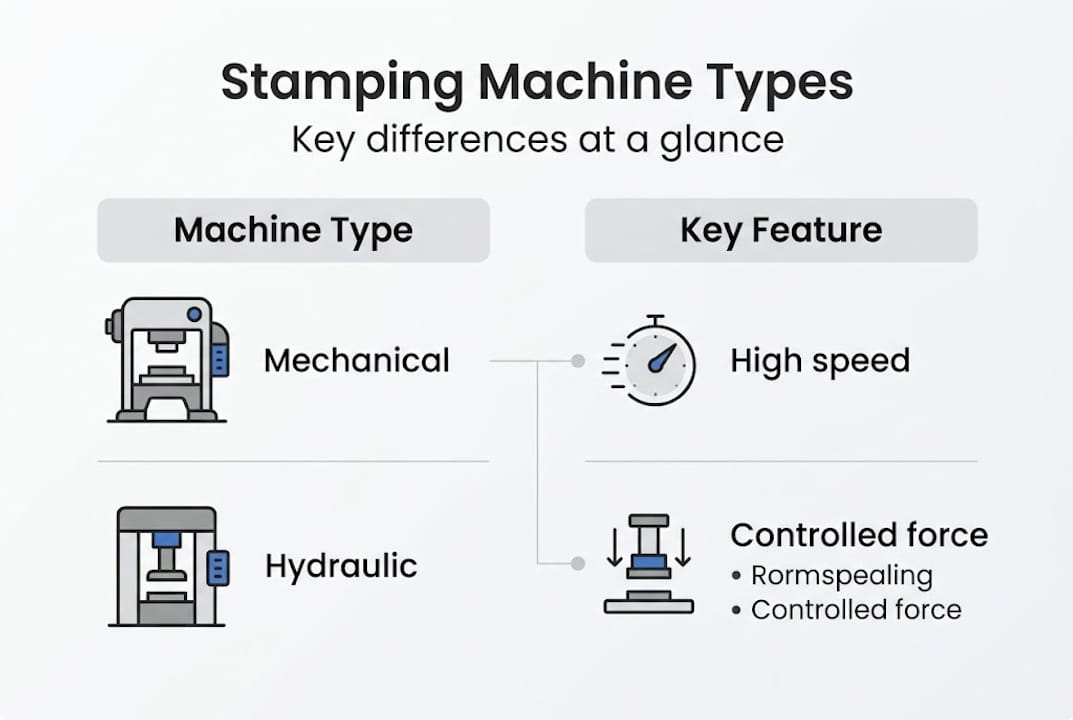
As benchmarked industry data confirms, mechanical presses run at 200 to 1,200 strokes per minute and suit thin sheets at high volumes, hydraulic presses deliver force between 50 and 5,000 tons for thick or complex materials at slower speeds, and servo-electric presses achieve positioning accuracy of ±0.01mm with fully programmable motion and improved energy efficiency.
Here is how those differences play out in practice:
- Mechanical presses suit mass-production environments where speed and simplicity matter most. Their limitation is fixed stroke length, meaning they struggle to adapt when part profiles change frequently.
- Hydraulic presses shine when force must be sustained over a longer stroke, ideal for deep drawing, forming thick plate, or tasks where material wants to spring back.
- Servo-electric presses are the most adaptable. Programmable ram motion means one machine can handle varied product runs without significant retooling, a compelling advantage for SMEs.
For craft entrepreneurs exploring heat press roles alongside stamping options, servo machines offer the closest analogy in flexibility. You can set stroke speed, dwell time, and ram position digitally, much like adjusting temperature and time profiles on a heat press.
Pro Tip: If your production involves short runs of several different parts, a servo-electric press often delivers a better return than a high-speed mechanical press, even if the mechanical unit carries a lower sticker price. Run cost per part, not cost per machine, when comparing.
If you want to browse current machine options from UK and European suppliers before committing, comparing servo and hydraulic configurations side by side is a sensible starting point.
Working principles: From force delivery to custom finishing
Understanding what happens inside the machine during each stroke helps you set up dies correctly and diagnose problems quickly.
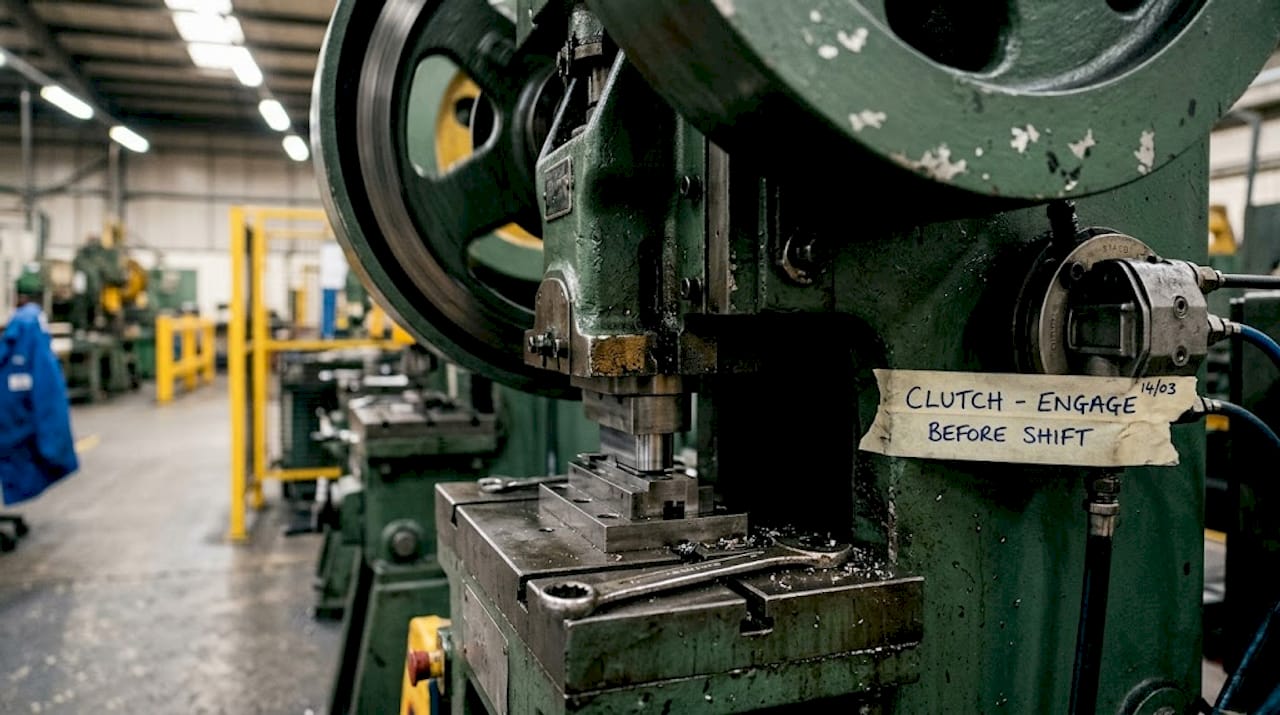
A mechanical stamping press uses a flywheel, crankshaft, clutch, and slide to convert rotational energy into linear motion, delivering peak force at bottom dead centre with fixed stroke lengths — ideal for high-speed production up to 1,200 strokes per minute. The flywheel stores energy between strokes, releasing it in a controlled burst at the moment of impact. This is why mechanical presses feel so decisive: the force delivery is sudden, powerful, and repeatable.
Hydraulic presses work differently. A pump forces fluid into a cylinder, moving the ram steadily downward at controlled pressure. Force is consistent throughout the stroke rather than peaking at one point. That makes hydraulic systems better suited to forming operations where the material needs sustained pressure to flow into a complex die shape.
Some critical technical parameters to keep in mind:
| Parameter | Typical value | Notes |
|---|---|---|
| Punch-to-die clearance | 7 to 15% of thickness | 10% for mild steel |
| Standard tolerance | ±0.05mm | Achievable with mechanical or hydraulic |
| Servo tolerance | ±0.01mm | Requires servo-electric press |
| Maximum emboss height | ≤40% of material thickness | Exceeding this risks tearing |
For embossing or marking, the die geometry controls depth and definition. Shallow embossing at under 40% of material thickness produces clean, consistent detail without stressing the material. Going deeper risks thinning the metal unevenly or causing micro-cracks.
Punch-to-die clearance is one of the most overlooked settings. Too little clearance creates excessive burring; too much leaves a ragged, poorly defined edge. At roughly 10% of material thickness for mild steel, you achieve a clean shear with minimal tool wear.
Good equipment maintenance is as critical for stamping as it is for any production machine. Die wear, misalignment, and inconsistent lubrication are the primary causes of quality variation and unexpected downtime.
Best practices and supplier benchmarks for the UK and Ireland
Knowing the theory is one thing. Knowing which suppliers serve the UK and Ireland, and what realistic investment looks like, is what makes a purchase decision concrete.
Several manufacturers operate directly in this market. Bruderer UK supplies high-speed mechanical presses ranging from 18 to 250 tons, capable of up to 2,000 strokes per minute, with a reputation for precision connector and lead-frame production. Transworld Engineering offers servo-driven presses from 80 to 500 kN, and European Springs Ireland handles pressings from 0.05 to 4mm thick using progression and multi-slide presses.
On the benchmarks side, the energy and accuracy figures are worth knowing before you budget:
- Mechanical presses typically consume 30 to 50 kW with accuracy of ±0.05mm.
- Servo presses run at 15 to 40 kW with accuracy of ±0.01mm.
- With optimised tooling and nesting, material utilisation of 98.5% is achievable.
- A Bruderer BSTA 280 unit configured for AI chip lead frame production in the UK commands around £500,000.
Those figures put the industrial end of the market in context. However, entry-level servo and hydraulic options exist well below that level for smaller operations.
Pro Tip: Calculate energy cost per thousand parts alongside capital cost. A servo press consuming 20 kW fewer than a mechanical equivalent can repay its price premium in electricity savings within two to three years at current UK energy rates.
Setup discipline matters enormously regardless of machine type. Before running production:
- Verify tonnage requirements for your specific material and thickness.
- Set stroke speed conservatively at first and increase only once quality is confirmed.
- Apply the correct lubricant for the material being stamped — oil viscosity affects both part quality and die life significantly.
- Inspect dies for wear after every major production run.
For SMEs exploring UK stamping suppliers and assessing how stamping fits alongside other essential equipment in a personalisation or production workflow, starting with clearly defined output requirements makes shortlisting far easier.
What most guides get wrong about stamping machine choices
Most buyers approach a stamping machine purchase the same way they approach buying a van: they look at maximum capacity and assume bigger numbers mean better value. This thinking leads to expensive oversizing, wasted energy, and machines that never operate in their efficient range.
The more useful question is not “what is the maximum tonnage?” but “what does this machine cost per useful part, over five years, including energy, tooling, and maintenance?”
For SMEs and craft producers, programmability and maintenance simplicity often deliver more real-world value than raw speed or capacity. A servo press that your team can re-programme between product runs without a specialist engineer is worth far more than a faster mechanical press that requires external support every time your die set changes.
Long-term adaptability matters as markets shift. If your product range evolves, your press should be able to evolve with it. Getting your setup for success right from the start — right machine, right ancillaries, right maintenance schedule — has a far greater impact on profitability than the headline specifications ever will.
Translating stamping insights into better results
Putting stamping knowledge to work means having the right blanks and supplies alongside the right machine. SubliBlanks supplies trade customers across the UK and Ireland with no minimum order quantities, so you can trial, prototype, and scale at your own pace.
Whether you are producing branded tin packaging, embossed name badges, or exploring new personalisation formats, the sublimation supplies and blank formats available cover a wide range of production needs. Products like the round MDF name badge show how stamping and personalisation workflows complement each other — consistent blanks, ready for your finishing process. Browse the full range and get in touch if you need guidance on matching blanks to your production method.
Frequently asked questions
How does a stamping machine differ from a heat press?
A stamping machine uses dies and force to physically cut or form materials, while a heat press applies heat and pressure to transfer coatings or graphics. A stamping press permanently changes the shape of the material itself, whereas a heat press bonds a surface layer to it.
Can stamping machines be used for both metal and non-metal materials?
Yes. Stamping machines can process metals, plastics, paper, card, and other sheet materials provided the die and press configuration suit the material’s properties. The same fundamental principle applies across all materials: force through a shaped die transforms the workpiece.
What type of stamping press is best for high-precision work?
Servo-electric presses offer the highest precision available, with programmable motion and tolerances as fine as ±0.01mm, making them the preferred choice for complex or close-tolerance components.
What is punch-to-die clearance and why does it matter?
Punch-to-die clearance is the gap between the punch and die cutting edges. Setting it correctly, typically 7 to 15% of material thickness, determines cut quality, burr level, and how long your tooling lasts between regrinds.
Recommended
- How to print on mugs: step-by-step guide for beginners – SubliBlanks Ltd
- Role of Heat Press in Production: Boosting Efficiency and Quality – SubliBlanks Ltd
- 6 Essential Items for Your Sublimation Equipment List – SubliBlanks Ltd
- Sublimation Equipment Setup Guide for Business Success – SubliBlanks Ltd
- From Screen to Stitch: The Process of Creating Custom Embroidered Merch - Custom T-Shirts and Embroidery in Utah | Pulse Merch


