



Wholesale packaging guide: cut costs and impress customers
TL;DR:
- Poor packaging choices can reduce profit margins and damage brand reputation.
- Selecting the right materials and optimizing packaging design can lower costs and improve protection.
- Treating packaging as a strategic tool supports business growth and enhances customer experience.
Poorly chosen packaging can quietly drain your profit margins before a single product ever reaches your customer. Many small business owners in the UK and Ireland focus on sourcing great products but overlook the packaging decisions that determine how those products survive transit, delight buyers, and fit within tight operational budgets. This guide walks you through the key principles of wholesale packaging: what to buy, how to choose materials wisely, how to keep fulfilment costs under control, and how to protect fragile goods without overspending on unnecessary materials.
Table of Contents
- What is wholesale packaging and why does it matter?
- Selecting the right packaging materials for wholesale operations
- How packaging decisions impact fulfilment costs and business operations
- Packaging strategies for fragile and specialty products
- The uncomfortable truth about wholesale packaging for small brands
- Explore effective wholesale packaging solutions for your business
- Frequently asked questions
Key Takeaways
| Point | Details |
|---|---|
| Packaging drives costs | Even small decisions about wholesale packaging can raise fulfilment fees and affect margins. |
| Material selection matters | The right packaging material protects products and optimises operational efficiency. |
| Reduce surcharges | Avoid oversized or fragile packaging design to minimise fulfilment surcharges. |
| Fragile goods strategies | Specialty packaging solutions and testing prevent losses and keep fragile items safe in transit. |
| Brand trust boost | Great packaging makes your brand look professional and earns customer loyalty. |
What is wholesale packaging and why does it matter?
Wholesale packaging means buying your packaging materials in bulk quantities directly from a trade supplier, rather than purchasing small amounts at retail prices. For small businesses producing or distributing physical products, this distinction matters enormously. Buying in bulk lowers your unit cost per box, bag, or label, which compounds across hundreds or thousands of orders.
The advantages go beyond simple cost savings. When you buy wholesale supplies consistently from a single source, your branding stays uniform across all your products. Every box looks the same. Every tissue paper matches. That consistency signals professionalism to your customers in a way that mismatched or variable packaging simply cannot achieve.
Key advantages of wholesale packaging for small businesses include:
- Lower unit costs that improve your gross margin on every product sold
- Consistent branding across all product lines, creating a professional unboxing experience
- Easier stock management when you reorder on a predictable cycle from a reliable supplier
- Reduced purchasing admin because you place fewer, larger orders rather than frequent small ones
- Predictable supply that prevents last-minute rushes when orders spike unexpectedly
That said, wholesale packaging is not without risks. Over-purchasing can leave you with stacks of boxes that no longer fit your product range after a redesign. Storage space becomes a real constraint for small operations without warehouse facilities. And hidden pick-and-pack costs can surprise you if your packaging design triggers handling surcharges.
Fragile items carry a hidden tax that many small business owners never account for at the planning stage. Pick-and-pack pricing in the UK shows that fragile items typically add a surcharge of £0.30 to £1.00 per item on top of the standard first pick rate of £0.95 to £1.25. Across 500 monthly orders, that fragile surcharge alone can add £150 to £500 to your monthly fulfilment bill.
Customer expectations around packaging quality have also shifted in recent years. Buyers in the UK notice when products arrive in oversized, poorly sealed, or flimsy boxes. A damaged item reflects badly on your brand even if the product itself was perfect before shipping. Getting packaging right from the start protects both your goods and your reputation.
Selecting the right packaging materials for wholesale operations
Choosing packaging materials is one of the most consequential decisions a small product business will make. The material affects durability, weight, environmental impact, storage space, and ultimately your cost per shipped unit. There is no single best option, only the best fit for your specific products.
The five main material categories in wholesale packaging are:
- Corrugated cardboard: The workhorse of e-commerce packaging. Strong, lightweight, recyclable, and available in dozens of box sizes. Excellent for most non-fragile goods.
- Paper and kraft wrapping: Ideal for inner wrapping, void fill, or outer wrapping of flat items. Cost-effective and environmentally friendly.
- Foam and foam inserts: Best for fragile or high-value items. Custom foam inserts cradle products securely and dramatically reduce breakage rates.
- Plastic mailers and polybags: Lightweight and moisture-resistant, ideal for clothing, accessories, and non-breakable items. Lower shipping weight reduces carrier costs.
- Composite and rigid boxes: Premium presentation boxes combining cardboard with foil, ribbon, or magnetic closures. Expensive per unit but powerful for premium product positioning.
Here is a comparison of popular material types to help you decide:
| Material | Durability | Cost per unit | Best for | Environmental impact |
|---|---|---|---|---|
| Corrugated cardboard | High | Low to medium | Most shipped products | Recyclable, low impact |
| Foam inserts | Very high | Medium to high | Fragile or high-value goods | Limited recyclability |
| Plastic mailers | Medium | Very low | Clothing, soft goods | Recyclable options available |
| Kraft paper wrapping | Low to medium | Very low | Inner wrap, eco branding | Excellent, biodegradable |
| Rigid gift boxes | High | High | Premium gifting | Variable |
If you are packaging sublimation products such as mugs, phone cases, or custom ceramics, corrugated cardboard with foam inserts is the most reliable combination. The foam absorbs impact during transit while the corrugated outer box withstands the compression forces that occur in courier vans and sorting facilities.
Getting your material choice right also pays off at the point of manufacture. A well-optimised material selection process can cut material costs by up to 20% without compromising product protection. Reviewing your sublimation blanks selection alongside your packaging choices means you can standardise box sizes across multiple product lines, reducing the number of SKUs you need to stock.
Pro Tip: Avoid over-packaging. Using a box three times larger than your product increases void-fill costs, adds weight, and can push your parcel into a more expensive courier size band. Measure your products accurately and order boxes that fit with no more than 3 to 5 centimetres of clearance on each side.
How packaging decisions impact fulfilment costs and business operations
Packaging and fulfilment costs are deeply connected. Every dimension of your packaging, its size, weight, fragility classification, and complexity, affects how much it costs to pick, pack, and ship each order. Understanding this relationship lets you design smarter packaging from the beginning rather than reacting to unexpected charges later.
Typical UK fulfilment cost structure for a single order:
| Fulfilment activity | Typical UK cost (2025) |
|---|---|
| First item pick | £0.95 to £1.25 |
| Each additional item | £0.20 to £0.30 |
| Fragile item surcharge | £0.30 to £1.00 per item |
| Peak period surcharge | Variable, often 10 to 20% |
| Returns processing | £1.50 to £3.00 per return |
These UK pick-and-pack costs are not fixed. They are directly influenced by the packaging you choose. Irregularly shaped packages, fragile items, or orders requiring special handling all attract higher fees. The good news is that most of these surcharges are preventable with thoughtful packaging design.
Follow these steps to reduce packaging-induced surcharges:
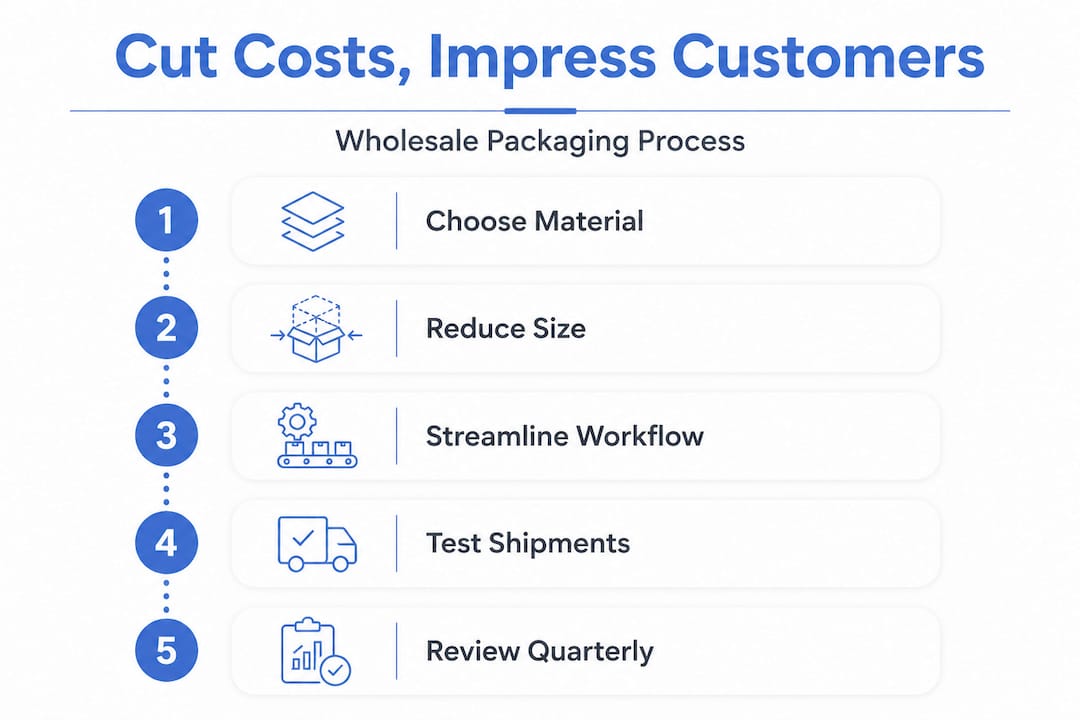
- Audit your current packaging dimensions. Measure every product and its packaging. Identify items where box size is unnecessarily large.
- Reclassify fragile items where possible. Use protective inserts or polymer-based products that resist breakage and avoid the fragile surcharge entirely.
- Standardise your box range. Fewer box sizes mean faster packing, lower pick times, and less storage space devoted to packaging.
- Test packaging before committing to large orders. Ship sample packs through your actual courier network and inspect what arrives.
- Review fulfilment costs monthly. Costs shift with fuel prices, carrier policies, and seasonal demand. What works in January may be expensive by November.
- Consider manufacturing efficiency principles from production environments. Lean thinking applied to packaging reduces waste, speeds up packing lines, and cuts labour time per order.
Packaging size also affects wholesale business efficiency at the warehouse level. Smaller, standardised boxes stack more efficiently, meaning you can store more stock in the same footprint. This matters particularly for small businesses operating from home offices, garages, or small commercial units where every square metre counts.

Pro Tip: Review your shipping invoices closely during the run-up to Christmas, Black Friday, and other peak periods. Many couriers and fulfilment houses apply peak surcharges that are not always clearly advertised. Packaging changes that reduce parcel weight or dimensions can significantly offset these seasonal cost increases.
Packaging strategies for fragile and specialty products
Fragile and specialty products demand a more considered packaging strategy. A mug cracked in transit is not just a refund cost. It is a customer lost, a one-star review gained, and a reputation dent that takes time to recover from. Investing the right amount in protective packaging upfront is almost always cheaper than the combined cost of replacements, returns, and negative feedback.
Common fragile packaging solutions that work well in practice:
- Custom foam inserts: Cut to the precise shape of your product, these eliminate movement entirely during transit and dramatically reduce breakage.
- Double-walled corrugated boxes: Significantly stronger than single-wall alternatives. The extra layer absorbs impact in ways that regular boxes cannot.
- Bubble wrap and air pillows: Lightweight and effective for filling void space around fragile items in otherwise standard boxes.
- Moulded pulp inserts: An eco-friendly alternative to foam, made from recycled paper. Increasingly available in standard sizes and growing in popularity among UK small businesses.
- Polymer or unbreakable product alternatives: In some cases, switching to a more resilient product variant removes the fragility problem entirely. An unbreakable polymer mug ships safely in a standard mailer without foam inserts, eliminating the fragile surcharge.
The pick-and-pack fragile surcharge of £0.30 to £1.00 per item is avoidable in many product categories simply by rethinking the product material rather than only the packaging material. This is a strategy many small business owners overlook because they assume fragility is fixed. It is not always.
For sublimation businesses dispatching items like MDF boxes or ceramic tiles, a structured packaging approach saves money at scale. An MDF storage box wrapped in kraft paper with cardboard corner protectors ships reliably without requiring expensive foam inserts. For businesses ordering mugs at volume, bulk polymer mugs sold in 48-piece sets arrive ready for resale or personalisation with built-in resilience that reduces packaging complexity.
Streamlining your packaging workflow means fewer steps between production and despatch. Every time a packer has to cut foam, hunt for the right box size, or apply extra tape, you are paying for that time. Thoughtful packaging design reduces the number of steps and speeds up your output per hour.
Pro Tip: Before placing a large bulk order of new packaging, ship ten to twenty test parcels through your live courier network. Open them when they arrive, or ask a friend or colleague at the destination to photograph the condition on arrival. Real-world testing reveals weaknesses that a table inspection at the packing bench simply cannot show.
The uncomfortable truth about wholesale packaging for small brands
Most small business owners in the UK treat packaging as a cost to minimise rather than a lever to pull. That instinct is understandable but often counterproductive.
Here is what we see repeatedly: a business owner sources a quality product, invests in good photography, writes strong listings, and then ships everything in a plain brown box with screwed-up newspaper as void fill. The product arrives looking like an afterthought. The customer’s first physical experience of the brand is disappointment, not delight. The refund rate is low, but the repeat purchase rate never climbs as high as it should.
The truth is that packaging is part of the product. Customers do not separate the two. A beautifully designed sublimation mug that arrives in a tight-fitting kraft box with a branded sticker closure and a small thank-you card creates a memory. That memory drives word-of-mouth and repeat orders. The extra cost per unit is typically pennies, and the return is disproportionate.
We also see businesses make the mistake of over-purchasing packaging in sizes or styles that quickly become obsolete. They buy 2,000 boxes for a product line that changes six months later and end up with a garage full of unusable stock. Buying wholesale does not mean buying enormous quantities upfront. It means buying at trade prices with sensible quantities that match your actual sales velocity.
The brands we have seen scale successfully treat packaging as a strategy, not a chore. They review it quarterly. They test customer reactions. They invest in understanding why wholesale works as a model rather than just treating it as a cheaper way to buy boxes. That mindset shift is what separates the businesses that grow steadily from those that stall after their first year.
Do not let perfect be the enemy of good. Start with sensible, well-fitted boxes in your most common sizes. Protect your fragile items properly. Keep your branding consistent. Then iterate as your volume grows and your understanding of your customers deepens.
Explore effective wholesale packaging solutions for your business
Applying what you have learned about packaging costs, material selection, and fragile goods protection becomes much simpler when you have the right products to work with.
At SubliBlanks Ltd, we supply trade-quality packaging alongside a full range of sublimation blanks, laser-engraveable products, and personalisation supplies, all with no minimum order quantities. Whether you need presentation-ready options like a round MDF name badge or a rectangle MDF pin badge for event or retail use, or you are looking to build a complete wholesale ordering system for your product range, our wholesale supplies hub gives you everything in one place. Browse our range, read our guides, and order exactly what your business needs today.
Frequently asked questions
How do I estimate my wholesale packaging costs for fragile products?
Start with the standard UK pick-and-pack rate of £0.95 to £1.25 per first pick, then add the fragile surcharge of £0.30 to £1.00 per item to get a realistic per-order cost baseline.
What types of packaging are best for protecting fragile goods?
Speciality foam inserts, double-walled corrugated cardboard boxes, and polymer-based product alternatives offer the most reliable protection for fragile items during UK courier transit.
How can I avoid unnecessary surcharges in pick-and-pack fulfilment?
Design your packaging to be compact, lightweight, and non-fragile where possible, since oversized or fragile orders consistently trigger the highest surcharges in UK fulfilment pricing.
How does wholesale packaging affect my brand image?
Consistent, well-fitted packaging signals professionalism and care, which builds customer trust, encourages repeat purchases, and reduces the negative reviews that come from products arriving in poor condition.
Are there eco-friendly wholesale packaging options suitable for UK small businesses?
Yes, recycled corrugated cardboard, kraft paper, moulded pulp inserts, and biodegradable poly mailers are all available for bulk purchasing and are increasingly preferred by UK customers who value sustainable business practices.


