



Laser engravable blanks: best materials and tips for 2026
TL;DR:
- Choosing the right laser engravable blanks depends on matching materials to your laser type and intended product durability. Wood blanks are versatile and ideal for broad applications, while acrylic, glass, and laminates offer modern, vibrant options, and metal blanks provide industrial-grade durability with fibre laser technology. Combining different materials and extensive testing enhances product variety and quality, enabling small businesses to serve diverse customer needs profitably.
Choosing the right laser engravable blanks for your small business should not feel like guesswork. With dozens of materials available, from rustic wood to polished stainless steel, many business owners in the UK and Ireland waste time and money ordering blanks that simply do not work with their laser setup. This guide cuts through the confusion by covering the most important selection criteria, walking through every major blank material category, and offering practical comparison tools so you can make confident, profitable purchasing decisions from the outset.
Table of Contents
- How to choose laser engravable blanks: key criteria
- Wood blanks: popular, versatile and easy to engrave
- Acrylic, glass and laminates: modern blanks for vibrant customisation
- Metal blanks: fibre laser advantages for industrial-grade customisation
- Quick comparison chart: best laser blanks by business need
- Why successful businesses combine versatility and testing
- Find high-quality blanks and supplies for UK/Ireland businesses
- Frequently asked questions
Key Takeaways
| Point | Details |
|---|---|
| Materials guide | Wood, acrylic, laminates, glass, and metals each suit different lasers and custom product goals. |
| Laser compatibility | CO2 lasers are best for non-metal blanks; fibre lasers excel for bare metal customisation. |
| Testing matters | Experimenting with settings and finishes is crucial for achieving optimal contrast and durability. |
| Practical comparison | A quick chart summarises which blanks work best for different business applications. |
| Where to buy | Specialist UK suppliers offer reliable blanks and supplies for small businesses looking to expand custom offerings. |
How to choose laser engravable blanks: key criteria
Before you order a single blank, you need a clear framework for decision-making. The most common mistake is choosing a blank based on aesthetics alone, then discovering it is incompatible with your laser machine. That single error can cost you both time and money on failed test runs.
The starting point is material compatibility. Every laser type excels with specific materials. CO2 lasers are ideal for non-metals such as wood, acrylic, laminates, leather, glass, and slate, delivering clean cuts and frosted engravings. Fibre lasers handle bare metals directly. Diode lasers are a lower-cost option that works reasonably well on wood and certain coated metals. Matching your machine to the right blank category is not optional; it is the foundation of quality output.
Beyond compatibility, consider these key criteria:
- End-use durability: Will the finished product be used outdoors, handled frequently, or displayed indoors? Wood is excellent for decorative items but may not suit outdoor signage without sealing. Metal blanks are better for keychains, tags, and industrial items that need to withstand daily wear.
- Finish and visual appeal: Some clients want a warm, tactile feel (wood or leather), while others expect crisp, modern results (acrylic or brushed aluminium). Know your market before buying stock.
- Design flexibility: Can the blank hold fine detail, text, or photographic imagery? Acrylic and laminates handle intricate designs exceptionally well, while coarser wood grains can soften fine lines.
- Budget and sourcing: Trade wholesalers who stock a broad range of blanks with no minimum order quantities make it far easier to test materials without overcommitting. Understanding how laser engravable blanks boost efficiency in your production process is equally important when planning budgets.
Pro Tip: If you are just starting out, begin with CO2-compatible blanks such as wood and acrylic. They offer the widest variety of shapes, the most forgiving engraving process, and the broadest appeal across product categories. You can read more about how to approach this in our custom blanks guide for the UK.
With the decision criteria established, let us look at the main material categories and their uses.
Wood blanks: popular, versatile and easy to engrave
Wood remains the single most popular laser engravable blank material for small businesses, and for good reason. It is affordable, widely available in dozens of shapes and thicknesses, and produces warm, high-contrast results that customers love. For gift shops, craft sellers, and home décor businesses in the UK and Ireland, wood blanks are often the first choice and, for many, the main revenue driver.
CO2 lasers are ideal for wood, and diode lasers also work well, though they tend to be slower on lighter-coloured woods. Fibre lasers are not suited for wood engraving. The most commonly used wood blanks include:
- Plywood: Light, affordable, and consistent. Great for keyrings, plaques, and tags.
- MDF (medium-density fibreboard): Smooth surface that holds fine detail very well. Ideal for signage and framed gifts.
- Hardwoods such as oak, walnut, and bamboo: Premium finishes that justify higher price points. Often used for corporate gifts and personalised homewares.
- Veneered blanks: Thin hardwood surface on a stable substrate. Delivers a high-end look at moderate cost.
Wood blanks come in an enormous variety of pre-cut shapes including hearts, stars, rounds, plaques, boxes, and bookmarks, which speeds up your workflow considerably. When you move to the professional production of engraved blanks, shape selection and grain orientation become important factors in the final result.
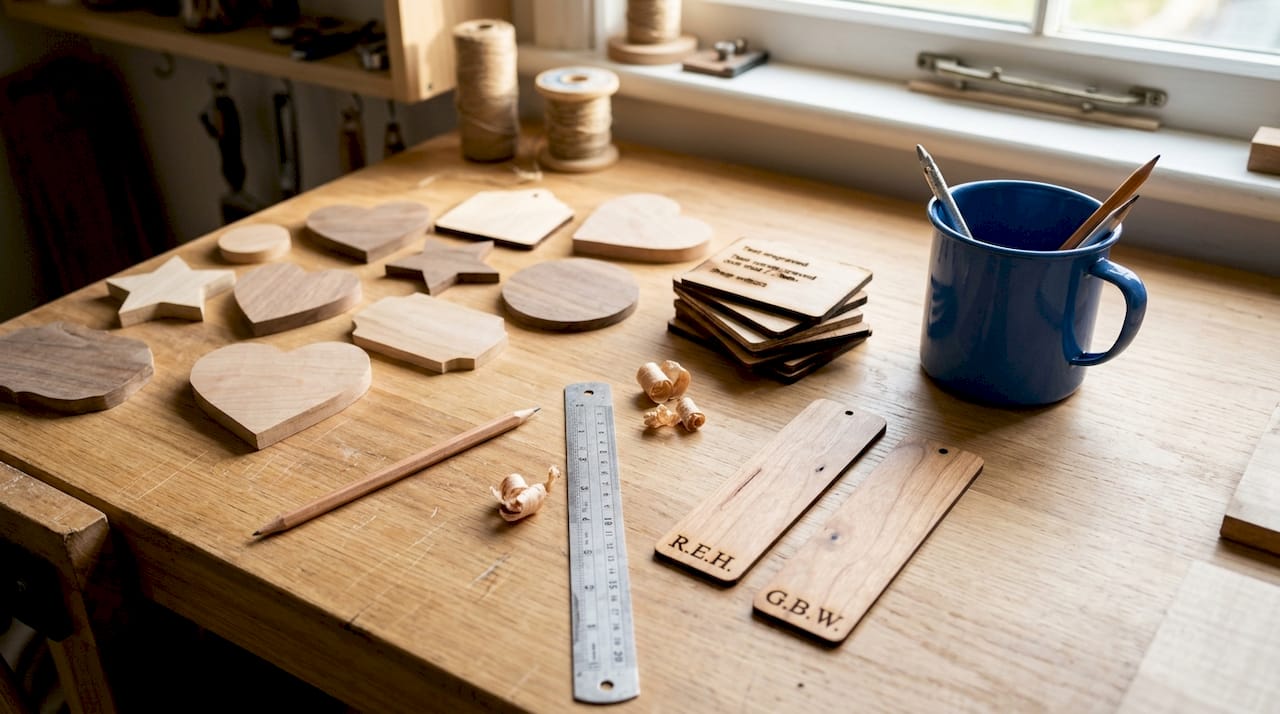
One consideration worth understanding is wood grain variation. Even within a single batch of blanks, grain density differs. This causes visible variation in engraving depth and darkness. It is not a flaw in the blank; it is the nature of the material. Managing customer expectations and choosing consistent species like MDF or bamboo for product lines that require uniformity will help you avoid complaints.
Pro Tip: Always run tester engravings on a small corner of a blank before committing to a full design. Adjusting speed and power by as little as 5% can dramatically shift contrast and depth, especially on lighter woods like maple or birch.
Wood blanks are a time-tested choice. Next, let us explore acrylic for sharper modern visuals.
Acrylic, glass and laminates: modern blanks for vibrant customisation
If wood represents warmth and tradition, acrylic, glass, and laminate blanks represent precision and modernity. These materials are growing rapidly in popularity with UK and Ireland businesses targeting corporate clients, event organisers, and retail gift markets.
Acrylic is arguably the most versatile of the three. It comes in clear, frosted, mirror, and fluorescent finishes, and CO2 lasers provide up to 3mm depth on acrylic, delivering that distinctive frosted finish that makes engraved text and logos pop. Acrylic is lightweight, easy to handle, and takes paint or ink fills beautifully, which opens up two-colour design possibilities.
Glass is the premium tier. Engraved glass items such as trophies, awards, paperweights, and drinking vessels carry a sense of quality that customers are willing to pay more for. CO2 engraving on glass produces a frosted, slightly rough finish. Bear in mind that glass does not cut cleanly with a standard CO2 laser; engraving is surface-level. For businesses looking to expand into corporate and awards markets, glass blanks are an excellent product line addition.
Laminates are a specialist category that deserves more attention. Two-ply and three-ply laminates (a coloured core sandwiched between contrasting surface layers) allow you to engrave through the top layer to reveal a different colour underneath. The result is crisp, durable signage with no paint or infill required. This makes laminates ideal for office nameplates, awards plaques, and directional signage.
Here is a quick comparison of these three material types:
| Material | Best laser | Finish | Typical uses |
|---|---|---|---|
| Acrylic | CO2 | Frosted, smooth | Awards, keyrings, signage, gifts |
| Glass | CO2 | Frosted | Trophies, gifts, barware |
| Laminates | CO2 | Two-colour contrast | Nameplates, signage, plaques |
“CO2 lasers produce frosted finishes and up to 3mm depth on acrylic, glass and laminates, making them the most flexible option for non-metal product lines.”
One thing worth noting is sustainability. Businesses that want to reduce material waste should consider how acrylic and laminate off-cuts can be repurposed. Our article on sublimation blanks and waste reduction explores some useful principles that apply equally to laser blanks procurement.
After non-metals, small businesses often want durable metal options. Fibre lasers excel here.
Metal blanks: fibre laser advantages for industrial-grade customisation
Metal blanks represent a step up in both investment and product quality. For small businesses targeting trade clients, industrial sectors, or premium personalised gifts, the ability to engrave stainless steel, aluminium, and brass opens entirely new revenue streams.
Fibre lasers excel at marking bare metals such as stainless steel, aluminium, and brass, achieving direct marking without any coatings. The typical engraving depth for fibre lasers on metal is approximately 0.05mm, which is precise enough for serial numbers, logos, and fine text. The results are permanent, resistant to abrasion, and look highly professional.
Here is a data summary for metal blank options:
| Metal | Best laser | Engraving depth | Common uses |
|---|---|---|---|
| Stainless steel | Fibre | ~0.05mm | Keyrings, tags, drinkware, tools |
| Aluminium | Fibre | ~0.05mm | Plaques, panels, promotional items |
| Brass | Fibre | ~0.05mm | Trophies, nameplates, gifts |
To get the best results from metal blanks, follow these steps:
- Clean the surface before engraving. Even fingerprint oils can affect marking quality on polished metals.
- Run a test grid at different speed and power combinations on a scrap piece of the same metal.
- Adjust frequency settings on your fibre laser; higher frequencies often produce darker marks on stainless steel.
- Check contrast under different lighting conditions, as marks can look very different under natural versus artificial light.
- Record your settings for each metal type in a log so you can reproduce results consistently across orders.
For those new to metal engraving, understanding what ancillary equipment is involved is useful. Industrial setups sometimes use laser cleaning equipment to prepare metal surfaces and remove oxides before engraving, which can significantly improve marking quality on older or unfinished metal stock.
UK and Ireland small businesses benefit from adding fibre laser capability to their production toolkit. Testing settings carefully per material is essential to achieving consistent contrast and depth. For those still forming a view on which blank formats make sense to stock first, our printing blanks guide for UK business owners provides useful context.
Pro Tip: Use test blanks made from the same batch as your production stock. Metal alloy composition can vary between suppliers and affect engraving results. A batch-specific test run is always worth the few minutes it takes.
With all major categories covered, it is helpful to summarise options side-by-side for easy comparison.
Quick comparison chart: best laser blanks by business need
For small business owners who need a fast reference point, this chart brings together all the key variables across blank material types.
| Material | Compatible lasers | Max depth | Durability | Relative cost |
|---|---|---|---|---|
| Wood (MDF, ply) | CO2, Diode | Up to 3mm | Moderate | Low |
| Acrylic | CO2 | Up to 3mm | Good | Low to medium |
| Glass | CO2 | Surface only | High | Medium |
| Laminates | CO2 | Up to 1.5mm | Very high | Medium |
| Aluminium | Fibre | ~0.05mm | Very high | Medium |
| Stainless steel | Fibre | ~0.05mm | Excellent | Medium to high |
| Brass | Fibre | ~0.05mm | High | Medium to high |
Key statistic: CO2 lasers achieve up to 3mm depth on acrylic and wood, while fibre lasers mark metals at approximately 0.05mm. Diode lasers can produce notably dark blacks on wood through carbonisation but may require 15 to 20 passes on lighter wood species to achieve comparable contrast.
This chart is a practical tool for matching your product ambitions to the right laser setup. If you are looking to expand your product catalogue in 2026, our sublimation blanks selection guide explores complementary blank formats that work alongside laser blanks in a well-rounded production setup.
Business owners now have all the facts to decide, but real success depends on practical implementation and smart testing.
Why successful businesses combine versatility and testing
Here is a perspective you will not often hear: the conventional advice to “start with wood and build from there” is a little too cautious for most UK and Ireland small businesses in 2026. Yes, wood is forgiving and popular. But the businesses we see growing fastest are the ones who treat their blank selection as a product strategy, not just a material preference.
What does that mean in practice? It means thinking from day one about what your customers actually buy, not just what is easiest to engrave. A gift shop owner in Dublin who only stocks wood plaques is leaving money on the table when a corporate client wants engraved stainless steel keyrings for a product launch. A Midlands craft seller who has only ever used acrylic misses the premium market for glass trophies at local awards ceremonies.
The real advantage comes from combining CO2 and fibre laser capabilities. They are not competing choices; they are complementary ones. CO2 gives you volume and variety across non-metals. Fibre gives you prestige and permanence on metals. Together, they position your business to serve a much wider range of customers.
Testing per material to optimise contrast and depth is not a beginner tip; it is a professional discipline. The businesses that consistently deliver excellent results are the ones that keep detailed settings logs for every blank type, every supplier batch, and every machine combination. A well-maintained settings log is honestly one of the most valuable assets a small engraving business can have.
We also think the fear of metal engraving is overdone. Fibre lasers have become far more accessible in price over the last few years, and suppliers like us stock a practical range of metal blanks with no minimum order requirement. You do not need to commit to 500 stainless steel keyrings to find out whether they sell. Our reliable blanks checklist applies many of these same principles and is worth bookmarking as you build your workflow.
Find high-quality blanks and supplies for UK/Ireland businesses
Ready to put this knowledge into practice? We supply a comprehensive range of laser engravable blanks and wholesale supplies for small businesses and entrepreneurs across the UK and Ireland, with no minimum order quantities. Whether you are starting with wood and acrylic or ready to move into metal customisation with fibre laser blanks, we have you covered.
Our catalogue covers wood, acrylic, laminate, metal blanks, xTool laser engraving machines, and everything else you need to build a professional, profitable production setup. From first-time buyers testing materials to established businesses scaling up, we make procurement simple, fast, and flexible. Browse our full range and order with confidence knowing there is no pressure to commit to large quantities before you are ready.
Frequently asked questions
Which laser type is best for small business blank engraving?
CO2 lasers are best for non-metals such as wood, acrylic, and laminates, while fibre lasers excel at marking bare metals like stainless steel and aluminium. Choosing the right laser depends entirely on the blank materials you plan to use most.
Can you engrave multiple materials with one laser?
CO2 lasers can engrave wood, acrylic, glass and laminates, whereas fibre lasers are primarily suited to metals. Matching your laser type to your chosen blank materials is essential for consistent, high-quality results.
What is the recommended depth for laser engraving on blanks?
On acrylic or wood, CO2 lasers achieve up to 3mm depth; for metals, fibre lasers reach approximately 0.05mm of direct marking depth. The right depth depends on the material and the level of detail required.
How can business owners optimise engraving contrast and quality?
Test multiple settings on each blank material to find the best combination of depth and contrast, and record successful settings in a log for repeatable results. Small adjustments to speed, power, and frequency can make a significant difference to finished quality.
Recommended
- Why use laser engravable blanks to boost efficiency – SubliBlanks Ltd
- How to engrave laser blanks for professional custom products – SubliBlanks Ltd
- What are custom blanks? A UK guide for creatives – SubliBlanks Ltd
- UK Wholesale Sublimation & Laser Supplies – SubliBlanks Ltd
- Top 10 Best Plastics for Laser Cutting (2025) | A Guide for Pros & DIYers


