



What is custom stamp design? A practical UK guide
TL;DR:
- Custom stamp design allows individuals and small businesses to create personalized ink-tools quickly online for branding, packaging, and correspondence. Choosing the right stamp type, keeping designs simple, and testing proofs help ensure clear, durable impressions across various surfaces. Proper planning and file preparation lead to professional, cost-effective branding that enhances business image and efficiency.
Custom stamp design is the process of creating a personalised ink-transfer tool built around your specific logo, text, or artwork. Far from being a specialist craft reserved for print shops, it is now something any individual or small business owner can do online in a matter of minutes. Whether you are marking packaging, adding a professional touch to correspondence, or sealing envelopes with a wax impression, the right stamp design makes an immediate and lasting difference. This guide covers the fundamentals, best practices, design steps, and common mistakes to help you get it right the first time.
Table of Contents
- Key takeaways
- What is custom stamp design?
- Design principles that actually matter
- Advantages of custom stamps for individuals and small businesses
- How to design your own custom stamp
- Common pitfalls to avoid
- My take on custom stamp design
- How Subliblanks supports your custom design needs
- FAQ
Key takeaways
| Point | Details |
|---|---|
| Custom stamp design is accessible | Anyone can create a personalised stamp online by uploading artwork, adding text, and choosing a shape. |
| Stamp type changes the outcome | Self-inking suits high-volume use; pre-inked delivers finer detail for complex logos and branding. |
| Simplicity wins every time | Clear, uncluttered designs produce sharper impressions across all surface types. |
| Stamps offer real business value | One stamp can replace thousands of printed labels and reduce repetitive administrative work. |
| Proofs prevent costly errors | Requesting a digital preview before production is the single most effective way to avoid mistakes. |
What is custom stamp design?
At its core, custom stamp design involves creating a personalised raised design that transfers ink onto a surface when pressed. You decide the content, shape, and style. The manufacturer then produces a physical stamp die from your artwork.
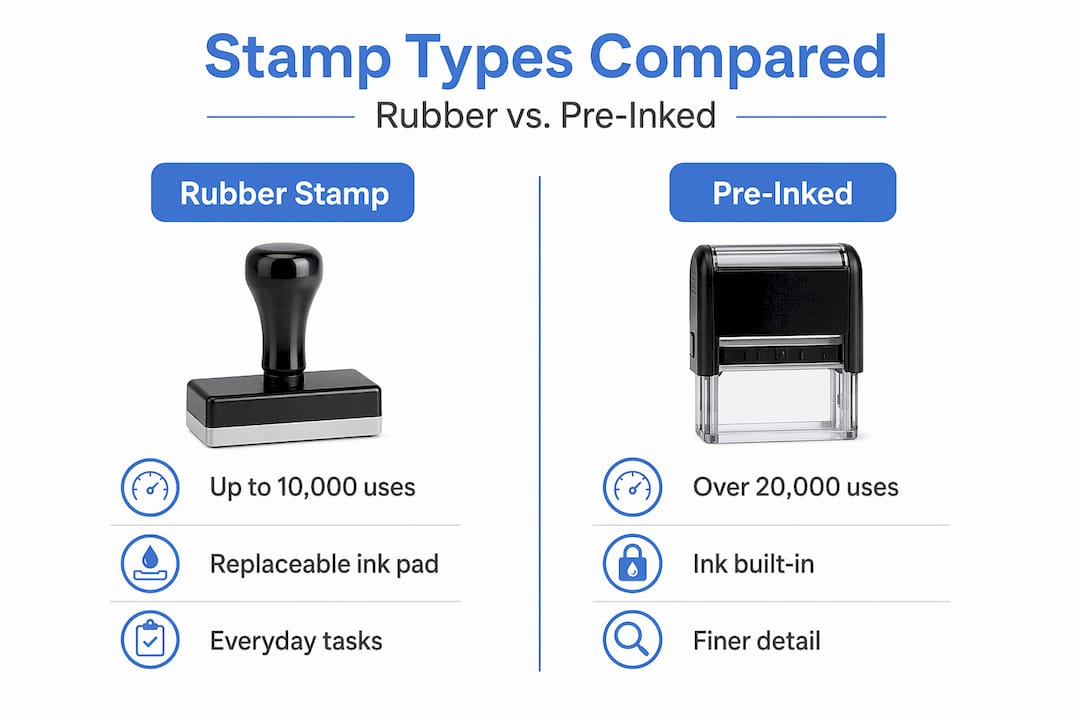
Two main categories cover most needs. Rubber stamps handle ink-based, rapid everyday use, with self-inking models containing a built-in ink pad and pre-inked models having ink impregnated directly into the die for finer detail. Wax seal stamps sit in their own category, using heat and coloured wax to create tactile, elegant impressions typically used for invitations, gifts, or premium correspondence, with brass heads commonly sized between 22mm and 30mm.
Shapes available for custom stamp creation span circle, rectangle, oval, and triangle options. Each shape suits different content arrangements. A circle works well for a logo surrounded by curved text, while a rectangle accommodates address stamps or multi-line business details neatly. When it comes to file formats, most manufacturers accept SVG, EPS, PDF, and PNG, with vector formats preferred for their scalability.
Here is a quick comparison of the two most common stamp types to help you decide which suits your needs:
| Feature | Self-inking stamp | Pre-inked stamp |
|---|---|---|
| Impression volume | Up to 10,000 impressions | Up to 50,000 impressions |
| Detail quality | Good for standard designs | Crisper, suited to complex logos |
| Ink refill | Replaceable ink pad | Requires re-inking the die |
| Best for | High-speed repetitive use | Detailed branding and professional seals |
| Portability | Compact and self-contained | Slightly larger, but very precise |
Design principles that actually matter
Good stamp design is not about making something look impressive on screen. It is about making something that transfers clearly and consistently onto paper, card, fabric, or packaging. Those are very different goals.
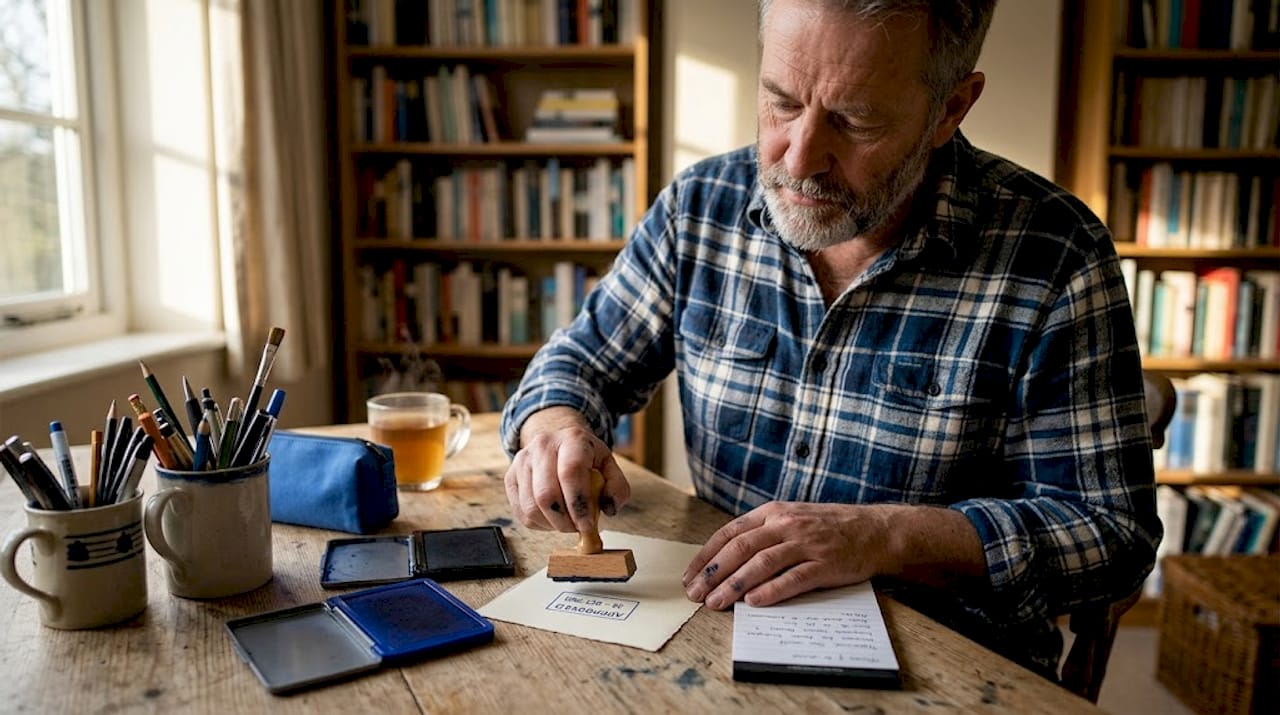
Simplicity and legibility are the foundations of every effective stamp. A common beginner error is cramming too much detail into a small area. Fine lines, thin fonts, and intricate illustrations all degrade under the pressure of inking and stamping, especially on textured surfaces. Bold, clear elements survive the process far better.
Negative space deserves as much attention as the inked portions of your design. Experts note that negative space in stamps is as important as the inked areas for a polished, confident look. When ink spreads slightly on contact, a cramped design blurs into a mess. Proper breathing room between elements keeps everything readable.
Font choice matters more than most people realise. Sans-serif typefaces such as Arial, Helvetica, or similar perform better than decorative scripts at small sizes. If you do want a script font, keep it to larger headline text only. A minimum font size of 8pt is a reasonable starting point for rubber stamps, though 10pt is safer if your surface is not perfectly smooth.
Pro Tip: Design your stamp artwork in black and white from the start. Working in vector software in black-and-white mode keeps your design scalable, removes colour distractions, and gives manufacturers exactly what they need to produce a sharp die.
Surface texture also affects the outcome. Rough surfaces require simpler, larger designs to maintain clarity, while smooth card or coated paper can handle slightly more detail. If your stamp will be used across varied materials, design for the roughest surface in your range.
Advantages of custom stamps for individuals and small businesses
The practical case for custom stamps is stronger than most people expect. Here is where the real value sits.
-
Time savings on repetitive tasks. Address stamps, approval marks, and “paid” or “received” stamps eliminate writing the same information by hand dozens of times a day. That adds up fast in a busy small business.
-
Cost savings over disposable materials. Self-inking and pre-inked stamps deliver thousands of impressions from a single purchase, replacing ongoing costs from printed labels or sticker rolls.
-
Branding consistency. A stamp with your logo, business name, and website creates a cohesive look across packaging, invoices, and thank-you cards. This is particularly effective for independent sellers and craft businesses where every touchpoint counts. If you are exploring complementary ways to reinforce your brand identity, understanding why custom badges matter for UK businesses offers useful context.
-
Durability. Quality stamp materials deliver crisp impressions consistently. Unlike a printed label sheet that runs out, a well-made stamp is a one-time investment with a long working life.
-
Document security. Stamped impressions reduce forgery risks because a personalised company seal or signature stamp is far harder to replicate than a handwritten mark. For solicitors, accountants, and other professionals, this is a meaningful consideration.
-
Versatility across materials. With the right ink type, custom stamps work on paper, card, fabric, wood, and even some plastics, making them genuinely multi-purpose tools for businesses with diverse packaging needs.
How to design your own custom stamp
The process is straightforward when broken into clear steps. Modern online tools make custom stamp creation genuinely accessible, even without graphic design experience.
-
Choose your stamp type and shape. Decide whether you need a self-inking stamp for daily office use or a pre-inked version for sharper branding work. Pick the shape that fits your content best. Circles suit logos with surrounding text; rectangles work better for multi-line address or business details.
-
Prepare your artwork. If you have a logo, export it as an SVG or high-resolution PNG. Remove colour from the file and check that all lines are at least 0.5mm thick. Thinner lines will not transfer cleanly.
-
Upload and arrange your design. Most online stamp tools let you upload a logo and then add custom text around or below it. Adjust font, size, and letter spacing carefully. Keep text away from the very edges of the stamp area.
-
Adjust styling and sizing. Set borders if your design needs a frame, and check alignment throughout. Many tools allow you to toggle between a filled preview (showing the stamp design) and a simulated impression preview (showing how it will actually look on paper). Use both.
-
Preview, proof, and export. Digital previews before production reduce costly errors significantly. Download your final design as an SVG or PDF for submission. Many manufacturers also offer a physical proof option before committing to the final product.
Pro Tip: Order a small-format test stamp first if your design involves intricate elements. A 28mm version will reveal any legibility issues far more cheaply than discovering them on a full-size production run.
If your broader workflow involves print and personalisation, it is worth reading about how printers boost business efficiency to see where stamping fits into a wider branding strategy.
Common pitfalls to avoid
Even experienced designers make stamp-specific mistakes. These are the ones worth knowing before you commit to an order.
-
Over-designing for the format. Intricate gradients, fine crosshatching, and small decorative flourishes all disappear or bleed together in a stamp impression. What looks refined on screen often prints as a muddy smudge. Simplify ruthlessly.
-
Choosing the wrong ink for the surface. Water-based inks work on most paper products but will smear on coated or glossy card. Pigment inks offer better opacity on darker surfaces. Solvent-based inks are needed for non-porous materials like plastic or metal. Match the ink to the job.
-
Mismatching design complexity with stamp type. Material choice and stamp construction affect print quality directly. High-grade brass and Delrin plastic deliver consistent impressions; lower-grade materials degrade faster and reduce clarity.
-
Skipping the proof stage. Requesting a physical or digital proof is not optional if accuracy matters. A proof costs very little compared to a full reorder.
The single best habit in custom stamp design is testing your impression on the actual surface you will use before signing off on production. What stamps beautifully on smooth white paper may look completely different on brown kraft packaging.
Understanding the mechanics behind stamp-making equipment also helps designers make better decisions. A solid overview of what a stamping machine does gives useful context when specifying production requirements.
My take on custom stamp design
I have seen a lot of stamp designs over the years, and the pattern is consistent: the ones that work are always simpler than the designer originally wanted them to be. There is a natural impulse to fill the space, add detail, include everything. Resist it. A stamp is not a business card. It is a mark, and marks work through clarity.
What I find genuinely underestimated is the cumulative effect of a well-designed stamp on a small business’s image. A clean, crisp logo stamp on packaging or an order card signals professionalism in a way that printed labels rarely achieve. It looks considered. It looks intentional. Customers notice.
The mistakes I see most often are font choices that are too delicate and design files that were never tested on the actual intended surface. Both are entirely avoidable. Work in vector software from day one, keep your fonts bold and your lines thick, and always request a proof. Get those three things right, and your custom stamp will do exactly what you need it to.
— chris
How Subliblanks supports your custom design needs
Subliblanks supplies stamp-making machines and a broad range of products for personal and professional customisation, all with no minimum order quantities. Whether you are a sole trader looking to add a branded touch to your packaging or a small business wanting to create cohesive, professional-looking materials, Subliblanks has the equipment and supplies to support you.
Pair your custom stamp work with high-quality sublimation name badges for a complete branded look at events, in the office, or for customer-facing staff. The round MDF name badge with pin is a popular choice for businesses wanting a sharp, consistent appearance across their team. For a rectangular option that suits more detailed branding, the rectangle MDF name badge is equally well-suited. Explore the full range at Subliblanks to find what fits your branding goals.
FAQ
What does custom stamp design involve?
Custom stamp design is the process of creating a personalised artwork file specifying the text, logo, shape, and size of a stamp, which a manufacturer then uses to produce the physical stamp die.
What file format should I use for my stamp design?
Vector formats such as SVG, EPS, or PDF are preferred because they scale without quality loss. PNG files at high resolution are also accepted by most manufacturers.
What is the difference between self-inking and pre-inked stamps?
Self-inking stamps have a built-in ink pad suitable for high-speed, repetitive use and last up to 10,000 impressions, while pre-inked stamps have ink inside the die for finer detail and can last up to 50,000 impressions.
Can custom stamps be used on materials other than paper?
Yes. With the correct ink type, custom stamps work on card, fabric, wood, and some plastics. Solvent-based inks are needed for non-porous surfaces; water-based inks suit most standard paper products.
How do I avoid blurry or unreadable stamp impressions?
Keep your design simple, use bold fonts no smaller than 8pt, avoid fine lines thinner than 0.5mm, and always test your impression on the actual surface you intend to stamp before placing a full production order.


