



Why custom badges matter for UK businesses and events
TL;DR:
- Custom badges are essential tools for building trust and reinforcing brand identity across various sectors. They improve professionalism, security, and team morale by providing clear, consistent visual identification for staff and visitors alike. Investing in well-designed, quality badges enhances first impressions and elevates a business’s overall brand perception.
Custom badges are one of those things businesses consistently underestimate until the moment they realise their staff look unrecognisable at a trade show, or a new customer cannot tell who to approach in a busy showroom. Far from being a relic of corporate formality, custom badges are a sharp, practical tool for building trust, reinforcing brand identity, and keeping operations running smoothly. Whether you run a small retail shop in Dublin or a large events company in Manchester, the right badge does more work than most people ever give it credit for.
Table of Contents
- What are custom badges and who uses them?
- Core benefits of custom badges for organisations
- Design options and materials: Making badges your own
- When custom badges make business sense: Event, staff, and bulk orders
- A quick guide to getting started with custom badges
- What most businesses miss about custom badges
- Create custom badges for your brand
- Frequently asked questions
Key Takeaways
| Point | Details |
|---|---|
| Strong brand presence | Custom badges reinforce your brand and create a professional impression at every interaction. |
| Versatile for all uses | From staff roles to giveaways, badges suit events, promotions, and team identity needs. |
| Cost-effective at scale | Bulk orders lower per-badge expenses and simplify distribution for organisations. |
| Design flexibility | Wide choice of materials, shapes, and fixings lets you match badges to any brand style. |
| Easy to implement | A few simple steps can put custom badges to work across your business or event quickly. |
What are custom badges and who uses them?
A custom badge is any wearable identifier that represents an organisation, a role, or an individual. At its simplest, it tells people who someone is and who they work for. At its most effective, it becomes a piece of walking brand communication that reinforces visual identity every time it catches someone’s eye.
Businesses across the UK and Ireland are using custom badges for branding and identification across a remarkable range of sectors. It is not just large corporates. Schools use them for staff and governors. Charities use them at fundraising events to help donors know who to approach. Retailers use them to signal expertise and approachability. Healthcare organisations use them for both identification and security access. Conference and exhibition organisers rely on them to keep hundreds of attendees and staff sorted without confusion.
Here is a snapshot of who typically uses custom badges and why:
- Corporate offices: Staff identification, visitor management, and brand consistency
- Retail businesses: Customer-facing role identification and brand representation
- Charities and non-profits: Fundraising events, volunteer identification, and public trust
- Schools and colleges: Staff safeguarding, visitor control, and student leadership roles
- Event companies: Staff differentiation, speaker identification, and delegate management
- Healthcare providers: Role clarity, security access, and regulatory compliance
| Sector | Primary badge use | Key benefit |
|---|---|---|
| Corporate | Staff and visitor ID | Security and professionalism |
| Retail | Customer-facing roles | Brand trust and approachability |
| Events | Staff and delegate ID | Smooth operations and clarity |
| Education | Staff and visitor ID | Safeguarding and authority |
| Healthcare | Role and access | Compliance and safety |
| Charity | Volunteer identification | Public trust and clarity |
What unites all of these use cases is a simple truth: people make faster, more confident decisions when they know who they are dealing with. Custom badges make that clarity instant.
Core benefits of custom badges for organisations
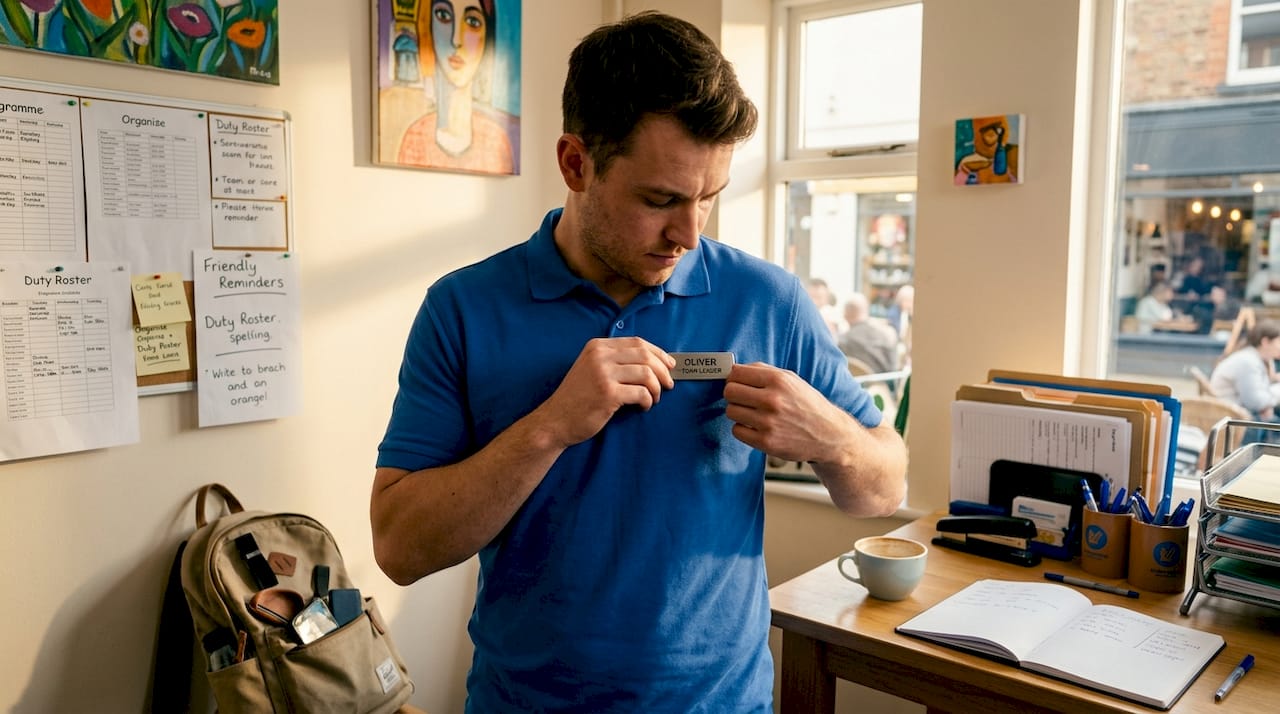
The moment a member of staff puts on a well-designed custom badge, something shifts. It is subtle but measurable. They look more professional. Customers approach them more readily. Colleagues orient themselves more easily in busy environments. These are not trivial gains.
Badges build trust and reinforce brand identity in ways that go beyond the purely visual. When a badge carries your logo, brand colours, and a clear name and role title, it signals that your organisation pays attention to detail. That kind of consistency sends a message to customers and visitors before a single word is spoken.
The core benefits break down into four clear areas:
- Professional first impressions: A branded badge tells customers they are dealing with a legitimate, organised business. This matters enormously at first contact.
- Brand consistency: Every staff member wearing a badge that matches your brand guidelines creates a uniform visual identity. This is particularly powerful at large events or across multiple sites.
- Security and access control: Clearly badged staff are easier to distinguish from unauthorised visitors. In environments like warehouses, schools, or healthcare settings, this is not optional; it is essential.
- Team morale and recognition: Personalised badges with names and roles give staff a sense of belonging and visible identity within the organisation.
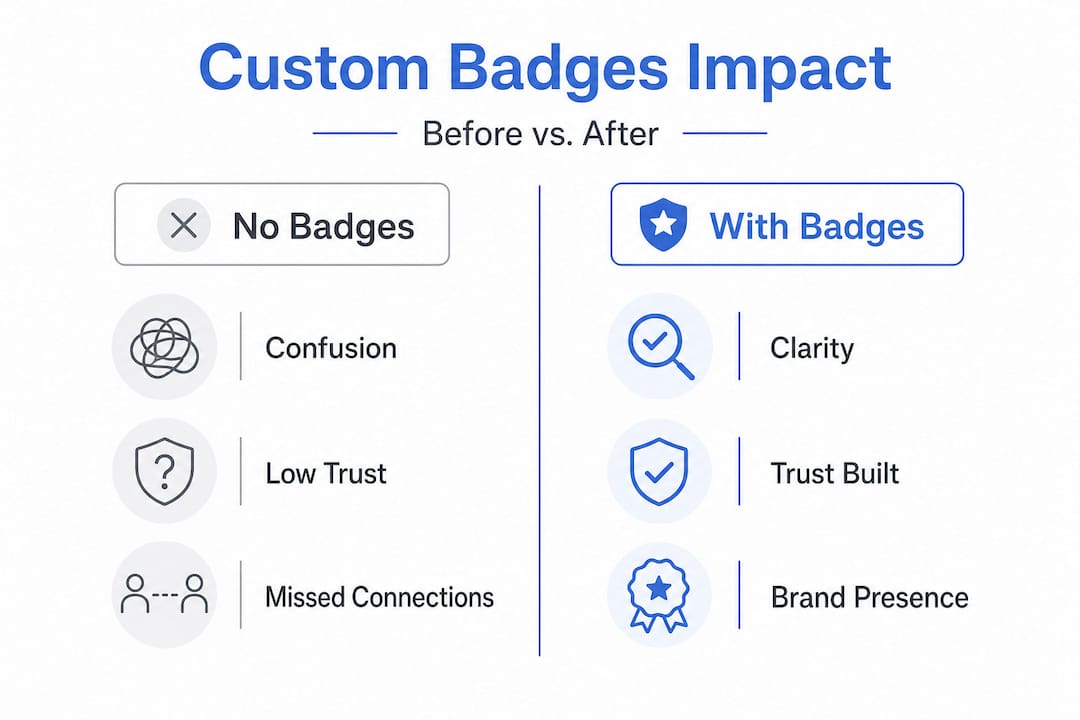
| Without custom badges | With custom badges |
|---|---|
| Customers unsure who to approach | Instant role clarity for customers |
| Inconsistent brand presentation | Uniform visual identity across all staff |
| Difficult to spot authorised personnel | Clear security differentiation |
| Generic, impersonal staff experience | Named, personalised team identity |
Pro Tip: If your team works across multiple departments or sites, consider colour-coding badges by department or location. It adds a layer of at-a-glance clarity that is immediately useful for both staff and visitors.
The morale argument is worth dwelling on. When staff wear a badge with their name on it, they are more personally accountable and more visibly part of something. Research consistently shows that employees who feel recognised and identifiable within their organisations report higher job satisfaction. A badge is a small thing, but it signals investment.
Design options and materials: Making badges your own
One of the most common misconceptions about custom badges is that they all look the same. They do not. The range of shapes, materials, and fixings available today means you can create something that feels entirely on-brand, whether that means sleek and corporate or warm and friendly.
Custom badges come in various shapes and attachment mechanisms, giving businesses real flexibility to match their aesthetic and practical needs. The most popular shapes are round and rectangular, but custom contour cutting is also available for brands that want something more distinctive.
Shapes:
- Round badges: Classic and approachable, popular with charities, schools, and hospitality
- Rectangular badges: Preferred by corporate and retail sectors for their clean lines and space for text
- Custom contour: Ideal for logo-shaped badges or promotions where standing out matters
Materials:
- MDF (medium-density fibreboard): Lightweight, smooth-surfaced, and excellent for sublimation printing. Full-colour designs look crisp and vibrant.
- Plastic: Durable and cost-effective for large volumes
- Metal: Premium feel, ideal for long-term use and high-end brand positioning
Fixings:
- Pin: The traditional choice. Secure and easy to attach to most fabrics.
- Magnet: Preferred for delicate fabrics where a pin would cause damage. Magnetic badge options are increasingly popular in retail and hospitality.
- Clip: Practical for uniforms without a suitable pinning surface
For businesses using sublimation printing, MDF badges offer an outstanding surface for reproducing full-colour artwork. Logos, photographs, and detailed brand graphics all transfer cleanly, making the finished result look entirely professional. Rectangular pin badges in MDF are a particularly popular choice for name badge programmes because they offer ample space for a name, role, and logo without overcrowding the design.
Pro Tip: When designing your badge layout, prioritise the name and role over decorative elements. Visitors and customers need to read the badge quickly, often from a metre away. Keep font sizes generous and contrast high.
A telling detail: studies on brand perception show that customers are significantly more likely to trust a business when its staff wear consistent, branded identification. When every person on your team wears the same style of badge with your logo and colour scheme, it communicates that you take your business seriously. That is a competitive advantage that costs very little to create.
When custom badges make business sense: Event, staff, and bulk orders
The question is not really whether to use custom badges. For most organisations, the question is when and how many. The answer to both becomes much clearer when you consider the operational context.
Here are the most common scenarios where custom badges deliver clear, measurable value:
- Trade shows and exhibitions: Visitors need to identify your team instantly. A branded badge means no one wastes time trying to work out who is with your company and who is a passing delegate.
- Staff onboarding: New employees with a badge from day one feel immediately part of the team. It also helps colleagues put names to faces far more quickly.
- Corporate events and conferences: Speaker and organiser identification reduces confusion and keeps programmes running on time.
- Promotional giveaways: Branded badges make great low-cost promotional items at public events. Recipients wear them, and your brand travels with them.
- Retail roll-outs: When you open a new location or launch a seasonal campaign, consistent badging across all staff reinforces the brand message at every customer touchpoint.
Bulk badge ordering leads to significant efficiency and cost savings for SMEs, and this is particularly relevant for businesses that badge all staff across multiple sites or departments. When you order in volume, your per-unit cost drops considerably, and you establish a consistent supply for replacements, new starters, or seasonal events.
| Order size | Typical cost per badge | Best suited for |
|---|---|---|
| Small (1 to 20) | Higher per unit | Trials, special roles, one-off events |
| Medium (21 to 100) | Moderate per unit | Department launches, seasonal campaigns |
| Large (100+) | Lowest per unit | Full staff programmes, large events |
Pro Tip: Order a slightly higher quantity than you currently need. Staff turnover, new hires, and lost badges are inevitable. Having stock on hand means you are never caught without badges at a critical moment.
Planning ahead is the most overlooked element of badge procurement. Lead times for custom printing can vary, and rushing an order often means compromising on quality or paying premium rates. Build badge ordering into your event planning timeline at least three to four weeks in advance.
A quick guide to getting started with custom badges
Getting from idea to finished badge is simpler than most people assume, provided you work through the decision points in the right order. Planning your badge design and use case before you order is what separates a successful badge programme from a box of badges nobody wants to wear.
Here is a clear step-by-step framework to follow:
- Define your purpose: Are these badges for daily staff identification, a one-off event, or a promotional campaign? Your purpose shapes every decision that follows, from quantity to material.
- Establish your brand requirements: Gather your logo files, brand colours, and any specific fonts your organisation uses. High-resolution artwork is essential for quality results, particularly with sublimation printing.
- Choose your shape and material: Match the badge style to your brand personality and the practical demands of the environment. A healthcare setting may need a clip badge for infection control reasons; a retail environment may prefer magnets to avoid fabric damage.
- Select your fixing type: Think about what your staff actually wear. Magnets suit smart clothing; pins are more versatile for heavier fabrics.
- Choose a reliable supplier: Look for a supplier with no minimum order restrictions so you can order exactly what you need, whether that is five badges or five hundred.
- Review samples before bulk ordering: Whenever possible, request a sample or proof before committing to a large run. Colour accuracy and print quality are much easier to verify in person than on a screen.
- Plan your distribution: Decide in advance how badges will be allocated, stored, and replaced. This is particularly important for organisations with high staff turnover or multiple sites.
Pro Tip: Create a simple badge register for your organisation. Logging who has which badge, when it was issued, and what condition it is in makes audits, replacements, and security reviews considerably easier.
The whole process, done well, takes a week or two from brief to delivery. Done poorly, it becomes a last-minute scramble. The difference is almost always in the planning.
What most businesses miss about custom badges
Here is the honest take after working with businesses across the UK and Ireland: most organisations think about badges purely in terms of cost per unit. They shop around for the cheapest option, order in a hurry, and then wonder why the result looks forgettable.
The businesses that get real returns from custom badges think about them differently. They treat a badge as the first physical touchpoint a customer or visitor has with their brand. Before anyone speaks, before a brochure is handed over, before a product is demonstrated, the badge is visible. That first impression is worth protecting.
There is also a consistency argument that most businesses underweight. One poorly designed badge in a team of ten does more damage than people realise. It signals that the organisation does not quite have its act together. Conversely, ten matching, beautifully printed badges create a halo effect that elevates the entire team’s perceived professionalism.
What the most consistently successful organisations do is treat their badge programme the same way they treat their signage or their uniforms: as an investment in how the world sees them, not a cost to minimise. They update badges when their branding evolves. They maintain stock. They take the design seriously. Exploring creative badge approaches is part of their ongoing brand management, not a one-off afterthought.
The businesses that cut corners on badges are often the same ones that wonder why customers do not take them seriously. The connection is not a coincidence.
Create custom badges for your brand
If this article has clarified the value a well-made badge brings to your business or event, the next step is straightforward.
At SubliBlanks Ltd, we supply a comprehensive range of badge-making products for businesses and organisations across the UK and Ireland, with no minimum order quantities. Browse our round MDF badge for a classic and versatile option, or explore our rectangle MDF badge if your brand calls for a more structured layout. For businesses that need a pin-free solution, our magnet name badge delivers the same quality finish without the fabric damage. Whether you need five badges or five hundred, we can help you get exactly what your brand deserves.
Frequently asked questions
Can small UK businesses benefit from custom badges?
Yes, even small businesses can strengthen branding and staff professionalism with customised badges. Badge making supports a professional image for organisations of every size, not just large enterprises.
What types of custom badges are most popular?
Pin, magnet, and clip badges in MDF, plastic, or metal remain the most common choices for UK organisations. Various forms such as pin and magnet badges are widely produced for everything from daily staff use to one-off events.
How do badges improve event experiences?
Custom badges make staff roles immediately visible, reducing confusion and improving communication at busy events. Badges facilitate identification and a smoother experience for both staff and attendees.
Is bulk ordering badges cost-effective?
Yes, bulk badge orders consistently lead to reduced unit costs and greater efficiency for businesses. Bulk ordering leads to savings that are particularly meaningful for SMEs managing staff across multiple locations or events.
How do I choose the right badge material?
Consider your budget, brand image, and whether magnetic, pin, or clip attachment best suits the working environment. Different badge materials and fixings serve genuinely different needs, so matching the material to the context is always worth the extra thought.


