



The real role of badge supplies in security and trust
TL;DR:
- Badges serve critical security, identification, and compliance functions beyond simple labels.
- High-quality, consistent badge supplies enhance trust, operational efficiency, and regulatory adherence.
- Thoughtful design and material choice directly impact perception, durability, and organizational credibility.
Most businesses treat badge supplies as a box-ticking exercise: order some plastic holders, print a few names, and move on. That assumption is quietly costly. Badges are the first line of identity verification in workplaces, events, and regulated environments across the UK and Ireland. They shape how staff, visitors, and guests perceive your organisation within seconds. For sectors where compliance with background checks is mandatory, accurate identity information is not optional. Getting badge supplies right is a decision with real consequences for security, trust, and operational efficiency.
Table of Contents
- What badge supplies really do: security, identity and beyond
- The manufacturing difference: materials, durability and standards
- Trust signals and brand perception: the hidden impact of badge design
- Choosing the right badge supplies: practical steps for businesses and organisers
- Why badge supplies are an undervalued asset in modern identity management
- Your next step: elevate your badges with trusted UK suppliers
- Frequently asked questions
Key Takeaways
| Point | Details |
|---|---|
| Badges drive trust and security | Well-chosen badge supplies are central to safeguarding identity and inspiring confidence. |
| Quality and compliance matter | Manufacturing standards and accurate data help organisations meet legal and operational requirements. |
| Design influences perception | Visible quality and branding in badge supplies send powerful trust signals to staff and visitors alike. |
| Smart selection saves time | A thoughtful badge supply choice helps avoid future admin headaches and maximises usability. |
What badge supplies really do: security, identity and beyond
It is easy to think of a badge as a laminated card dangling from a lanyard. In reality, a badge is a functional instrument that carries out several jobs simultaneously. It identifies individuals at a glance, controls access to sensitive areas, communicates authority, and signals organisational professionalism. Remove any one of those functions and the system begins to fail.
Consider a hospital trust in England. Staff badges do not simply display a name. They indicate role, department, and clearance level. Porters, consultants, and external contractors all carry distinct visual identifiers. Security teams rely on those distinctions to make rapid, accurate decisions about who belongs where. The same principle applies at corporate campuses, schools, and large-scale events. The badge is the fastest communication tool in a busy environment.
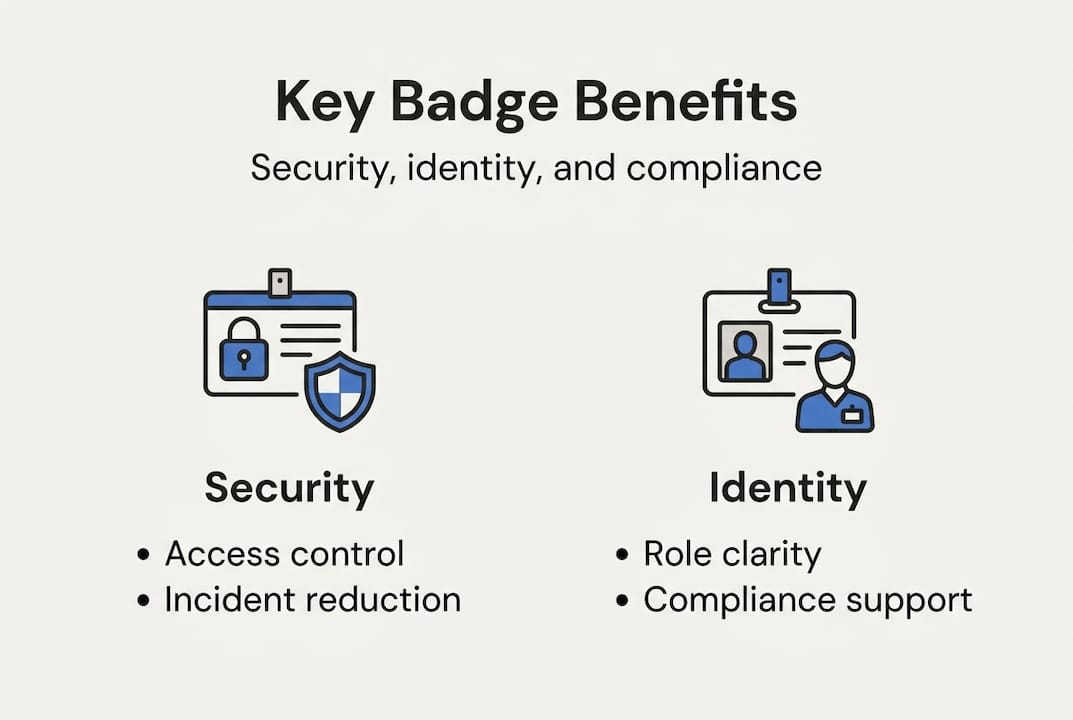
Beyond physical access, badges play a vital role in regulatory compliance. Under UK guidance, the accuracy of identity documentation is central to legal processes including disclosure and barring checks. Specifically, DBS guidance requires accurate identity information for complete and valid results, with records of documents kept for a minimum of two years. Any badge supply process that introduces errors in name, title, or role information creates downstream risk in these checks.
The psychological impact of badges is frequently underestimated. Research in organisational behaviour consistently shows that visible credentials influence how people are perceived and treated. A well-designed, clearly printed badge signals that an organisation is orderly, professional, and trustworthy. A faded, poorly printed, or generic badge suggests the opposite. For events with hundreds of guests, that first impression is set within moments of arrival.
Key operational roles that badge supplies fulfil include:
- Identity verification at entry points and during regulated checks
- Access control to restricted zones or sensitive equipment
- Role differentiation so staff, visitors, and contractors are immediately distinguishable
- Brand representation through consistent, quality design and materials
- Compliance support for regulated industries requiring documented identification
“A badge is not a piece of plastic. It is a trust instrument that tells everyone in the room who you are and why you are there. When it is unclear, so is your credibility.”
Understanding the role of sublimation blanks in personalised badge production also matters here. Sublimation allows for sharp, vibrant, permanent images on badge surfaces, which directly improves readability and longevity. A badge that fades within weeks is not just inconvenient; it is a security liability.
The manufacturing difference: materials, durability and standards
Understanding what badges do sets the stage. The next question is what they are made of, and why that matters far more than most organisations realise.
Badge materials fall broadly into three categories: MDF (medium-density fibreboard), plastic, and metal. Each has distinct characteristics that affect durability, print quality, compliance suitability, and long-term cost.
| Material | Durability | Print quality | Best suited for | Cost |
|---|---|---|---|---|
| MDF | Moderate | Excellent with sublimation | Events, name badges, short to medium term | Low to moderate |
| Plastic | High | Good, varies by finish | Workplace ID, frequent use, outdoor events | Moderate |
| Metal | Very high | Premium, engraved or printed | Executive, awards, long-term use | Higher |
MDF is particularly popular for event badges and day-to-day staff name badges because it accepts sublimation printing exceptionally well. The result is a crisp, colour-accurate print that holds detail without bleeding. An MDF name badge with pin is a practical, cost-effective choice for organisations that need large volumes without sacrificing clarity or professionalism.
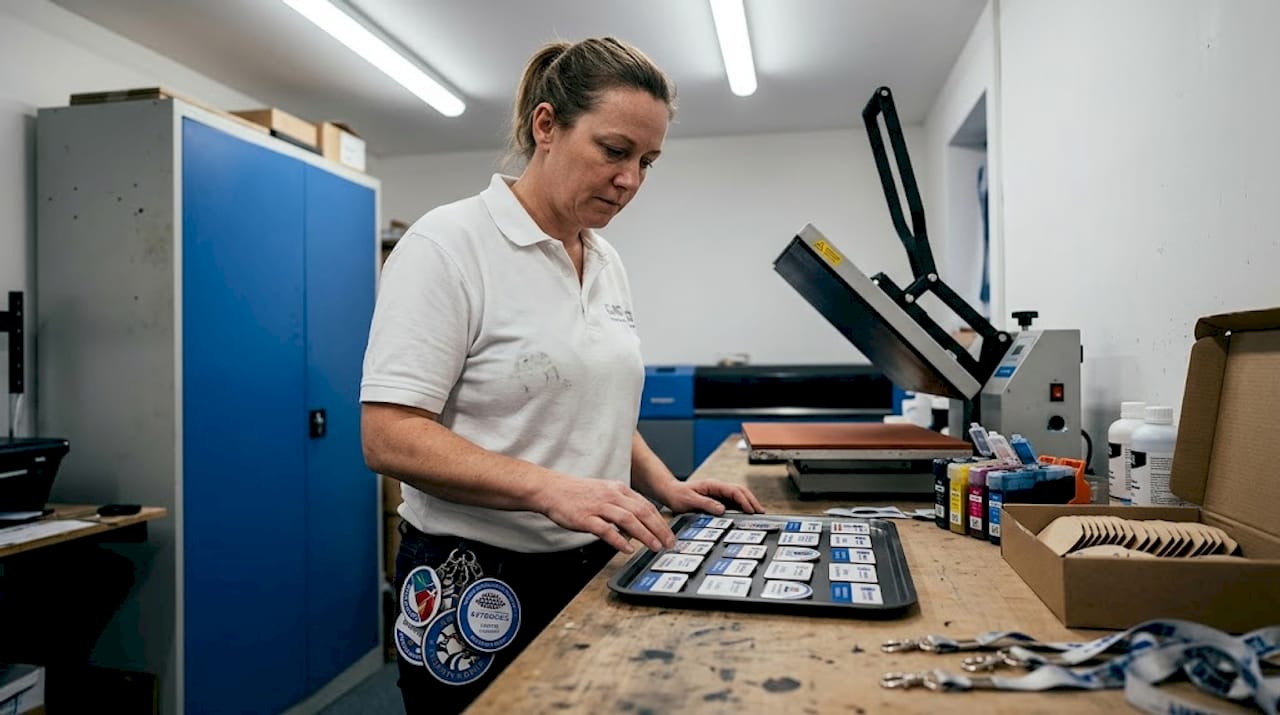
Plastic badges offer greater resilience in demanding environments. They resist moisture, flex without cracking, and maintain readability after months of heavy use. If your team works outdoors, in kitchens, or in environments with frequent cleaning, plastic is the wiser investment.
Metal badges carry a premium aesthetic that communicates seniority and permanence. They are common in hospitality, financial services, and corporate environments where the badge itself is part of the brand experience.
Manufacturing consistency is where many cheaper suppliers fall short. A batch of badges where text alignment shifts between prints, or where colours vary noticeably from card to card, creates immediate identification problems. For compliance-sensitive environments, this inconsistency is a genuine risk. As manufacturing quality research confirms, consistent production standards are directly linked to reliability in high-stakes applications. Poorly produced badges with truncated names or blurred images can introduce errors that affect the accuracy of identity verification processes, which the DBS guidance explicitly warns against for regulated checks.
Choosing suppliers who offer consistent production, quality-checked blanks, and materials suited to sublimation printing will save you time, cost, and compliance headaches. The badge materials selection guide provides a practical framework for matching material to purpose.
Pro Tip: Before ordering in volume, request a sample run of your chosen badge design on your preferred material. Check print clarity, colour accuracy, and whether the fixture (pin or magnet) holds securely. This single step catches most quality issues before they become an expensive problem.
Trust signals and brand perception: the hidden impact of badge design
With material and process essentials covered, let us look at how badge presentation subtly shapes trust. This is the dimension most organisations overlook entirely, and it is where the biggest gains are available.
In digital marketing, trust badges are well-studied. A case study published by the Conversion Team found that strategic placement of trust signals, including visual credentials, delivered a 12.2% uplift in conversion rate in a controlled A/B test. While that context is e-commerce, the underlying psychology is identical in physical environments: visible, quality credentials change how people feel about an organisation.
Apply this to your next conference or staff induction day. Attendees who receive a well-designed, professionally printed badge experience a subtle but measurable shift in confidence. The badge signals that the event is properly organised, that their presence is expected and valued, and that the organisation behind it operates to a high standard.
Key trust signals that badge design communicates:
- Legibility: Clear, correctly sized fonts mean no one has to squint. Squinting creates friction and erodes confidence.
- Colour consistency: Badges that match your brand palette reinforce identity without effort.
- Material quality: A badge that feels substantial in the hand communicates investment and care.
- Correct role descriptors: Titles and department names that reflect reality reduce confusion and increase perceived authority.
- Logo placement: Consistent, correctly sized logos anchor the badge in your brand identity.
| Design element | Impact on trust | Common mistake |
|---|---|---|
| Font size | High: affects legibility | Too small for quick reading |
| Brand colours | Moderate: reinforces recognition | Printing off-colour |
| Role/title field | High: affects authority signals | Abbreviating or omitting |
| Material finish | Moderate to high: sets quality tone | Choosing cheapest option |
| Fixture type | Moderate: affects wearability | Ignoring wearer preference |
For recurring events or large workplaces, magnetic badge solutions are worth serious consideration. Unlike pin badges, magnets do not damage clothing, which means staff and guests are more likely to wear them correctly and consistently. A badge that stays in a pocket is a trust signal that never fires.
Placement matters too. Badges worn at chest height are read effortlessly. Badges hanging low on a lanyard require deliberate effort to read, which creates a small but real social awkwardness. For environments where identity needs to be confirmed quickly, such as healthcare, education, or security, correct placement is a functional requirement, not just an aesthetic preference.
Choosing the right badge supplies: practical steps for businesses and organisers
Knowing why badge supplies matter and what good looks like brings us to the practical question: how do you actually make the right choices for your organisation? Here is a structured approach that works whether you are equipping a team of 20 or running an event for 2,000.
-
Define your purpose clearly. Are badges primarily for identity verification, access control, brand representation, or all three? The answer shapes every decision that follows, from material choice to print detail.
-
Estimate your volume and frequency. One-off events have different needs from ongoing workplace use. High-frequency reuse demands more durable materials. Short-term events can prioritise cost efficiency and design flexibility.
-
Check your compliance obligations. If your organisation processes DBS checks or similar regulated identity verification, remember that records must be kept for at least two years. Your badge information must align exactly with verified identity documents. Build that accuracy requirement into your production process from the start.
-
Shortlist suppliers on quality criteria. Look for suppliers who offer consistent material standards, sample options before bulk orders, and a range of materials to suit different applications. Trade wholesalers with no minimum order quantities give you the flexibility to test and scale without financial risk.
-
Select your material and fixture combination. Use the comparison table in the previous section as a starting point. Consider whether rectangular pin badges or magnet-backed alternatives better suit your environment and wearer preferences.
-
Plan for rebranding and updates. Organisations change names, logos, and structures. Badges that are easy to update using sublimation printing protect your investment. Think about how custom badge merchandising strategies can extend the value of your badge-making setup beyond identification alone.
-
Review and reorder systematically. Establish a cycle for reviewing badge quality and replacing worn or outdated items. A damaged badge is worse than no badge in many environments, as it introduces doubt rather than confidence.
Pro Tip: If your organisation runs hybrid working patterns or seasonal events, invest in a badge-making setup that lets you produce small batches on demand. This avoids the expense of large pre-printed runs that become obsolete when team structures change. On-demand sublimation badge production gives you control, speed, and cost efficiency simultaneously.
Why badge supplies are an undervalued asset in modern identity management
Most procurement decisions treat badge supplies as a commodity. Buy cheap, buy in bulk, and replace when broken. This view is genuinely holding organisations back, and we think it is worth saying plainly.
Here is what actually happens when organisations invest thoughtfully in badge quality: security incidents decrease because identity is clearer. Visitor experience improves because the organisation looks credible from the first interaction. Staff feel more professional, which has a measurable effect on morale. And compliance teams sleep easier because accurate, legible badges reduce the risk of identity data errors in regulated processes.
The business case for quality supplies is not just about aesthetics. It is about the downstream value of getting identity right every single time. Small upgrades, such as switching from generic plastic to sublimation-quality MDF, or replacing pin badges with magnetic alternatives, create outsized returns in trust, compliance, and operational efficiency.
The organisations that understand this treat their badge supply chain as a strategic function, not an administrative afterthought. We believe that reframe is available to every business and organisation, regardless of size.
Your next step: elevate your badges with trusted UK suppliers
If this article has shifted your perspective on what badge supplies actually do, the next step is straightforward. At SubliBlanks, we supply a comprehensive range of badge solutions for businesses and organisations across the UK and Ireland, with no minimum order quantities so you can trial and scale with confidence.
Whether you need an MDF pin badge range for your next event, a magnetic badge selection for your workplace team, or advice on building a complete badge production setup, our team is ready to help. As badge supply experts working with trade buyers across multiple sectors, we understand what quality looks like and what it takes to deliver it consistently. Explore our range today and give your organisation the trust signal it deserves.
Frequently asked questions
Why does badge information accuracy matter for UK organisations?
Accurate badge details support legal compliance, effective security, and smooth onboarding. Errors create verification problems and regulatory risk, particularly under DBS guidance, which requires precise identity information for valid results.
How do I choose the best badge material for my office or event?
Compare durability, print quality, and costs across MDF, metal, and plastic options, then match your choice to usage frequency, personalisation goals, and environmental conditions.
Should we keep records of badge verification documents?
Yes. UK guidance recommends keeping records for at least two years to support audits and checks. DBS identity records should be retained systematically and stored securely.
Do badge design choices really affect staff or guest trust?
Absolutely. Quality design and visible credentials have been shown to drive confidence and engagement. Research confirms that trust badge placement can lift measurable confidence signals by double digits in controlled tests.


