



Bulk supplies: power savings and efficiency for UK SMEs
TL;DR:
- Bulk buying lowers costs and improves operational efficiency for small creative businesses.
- It is best suited for non-perishable, regularly used supplies with long shelf lives.
- Proper stock management and careful planning prevent waste and financial risks.
Bulk buying carries an undeserved reputation for being reckless or wasteful, something suited only to supermarket chains or large manufacturers with vast warehouses. For small creative and manufacturing businesses across the UK and Ireland, that assumption is actively costing money. With Irish SMEs facing 10% operating cost rises, finding ways to control expenditure without sacrificing quality or reliability has never been more pressing. Buying supplies in bulk is one of the most straightforward strategies available, and when done correctly, it delivers genuine savings alongside real operational benefits.
Table of Contents
- What does bulk buying really mean for small businesses?
- Four reasons small businesses choose bulk supplies
- Which supplies should you buy in bulk—and which should you avoid?
- Common pitfalls: when bulk buying can backfire
- Our take: how to master bulk buying without waste
- Unlock efficient sourcing for your creative or manufacturing business
- Frequently asked questions
Key Takeaways
| Point | Details |
|---|---|
| Bulk buying cuts costs | Purchasing supplies in larger quantities can lower per-unit prices and reduce delivery fees. |
| Choose supplies wisely | Non-perishable items with long shelf lives are best suited for bulk purchase to avoid waste. |
| Always review true cost | Promotions on smaller packs and storage or cash flow issues can mean bulk isn’t always cheaper. |
| Gradual scaling is best | Audit your business usage first and increase bulk orders as you grow to avoid overstocking. |
What does bulk buying really mean for small businesses?
The term “bulk buying” gets thrown around loosely, but for a creative or manufacturing SME it has a very specific meaning. It refers to purchasing larger quantities of materials or consumables at a time, typically at a lower unit cost, with the goal of reducing both what you spend and how often you need to order. It is not about filling a spare room with stock you will never use.
For businesses producing personalised gifts, branded merchandise, printed apparel, or custom-engraved products, this matters enormously. Your materials are your cost base. Sublimation blanks, DTF film, laser-engraveable surfaces, packaging, and badge components are all supplies you use repeatedly. Ordering them frequently in small amounts means paying more per unit and absorbing multiple delivery charges.
“Fewer orders from bulk purchases lower delivery charges, admin time, and stockout risks for UK small businesses.”
That single shift, consolidating orders, can free up meaningful time and money every month. Understanding the wholesale supplies benefits available to small businesses helps you see that this approach is not reserved for large corporations.
Common misconceptions worth addressing:
- Bulk buying means spending a fortune upfront. Not necessarily, especially when working with a wholesaler who has no minimum order quantities.
- Only businesses with large storage facilities can benefit. Many bulk orders involve compact, stackable products like sublimation blanks or packaging sleeves.
- Larger orders automatically mean lower quality control. With a reliable supplier, consistency actually improves because you are drawing from the same production batch.
- Stockpiling is inevitable. Smart bulk buying matches order volume to actual usage rates, not guesswork.
For those new to the concept, wholesale sublimation advice is a useful starting point for understanding how the model works in practice for creative businesses specifically.
Four reasons small businesses choose bulk supplies
Once the myths are cleared away, the practical case for bulk purchasing becomes straightforward. Here are the four reasons that consistently drive UK and Irish business owners towards this model.
1. Direct cost savings under inflationary pressure
When your operating costs are climbing, the unit price of materials becomes critical. Buying in larger quantities typically unlocks tiered pricing. A business spending £500 per month on sublimation blanks at retail prices might reduce that to £360 or less by purchasing wholesale in volume. Over a year, that is a substantial sum reinvested into equipment, marketing, or staffing.
2. Budget stability through consistent pricing
Spot buying (purchasing as and when you need materials) exposes you to price fluctuations. Suppliers adjust prices based on raw material costs, currency shifts, and demand spikes. When you lock in bulk pricing, consistent pricing and budgeting become achievable, which is especially useful when quoting customers fixed prices for ongoing orders.
3. Operational efficiency
Every order you place takes time. Researching, approving, processing, and receiving deliveries adds up to real administrative hours. Reducing order frequency frees staff and founders to focus on production and customer relationships. Fewer deliveries also mean fewer chances of delays disrupting your workflow at a critical moment.

4. Scalability and reliability
As your business grows, your supply chain needs to keep pace. Bulk purchasing establishes a rhythm that scales naturally. You understand your consumption rates, your supplier knows your patterns, and your stock levels remain stable. Reviewing a sublimation blanks guide can help you identify exactly which products within your range benefit most from this approach.
Cost comparison: spot buying vs bulk purchasing
| Metric | Spot buying | Bulk purchasing |
|---|---|---|
| Unit cost | Higher (retail rate) | Lower (wholesale rate) |
| Delivery costs per month | Multiple charges | One or two consolidated charges |
| Admin time | High (frequent orders) | Low (fewer, larger orders) |
| Stockout risk | High | Low |
| Budget predictability | Poor | Strong |
| Minimum order requirement | None (but costly) | Varies by supplier |
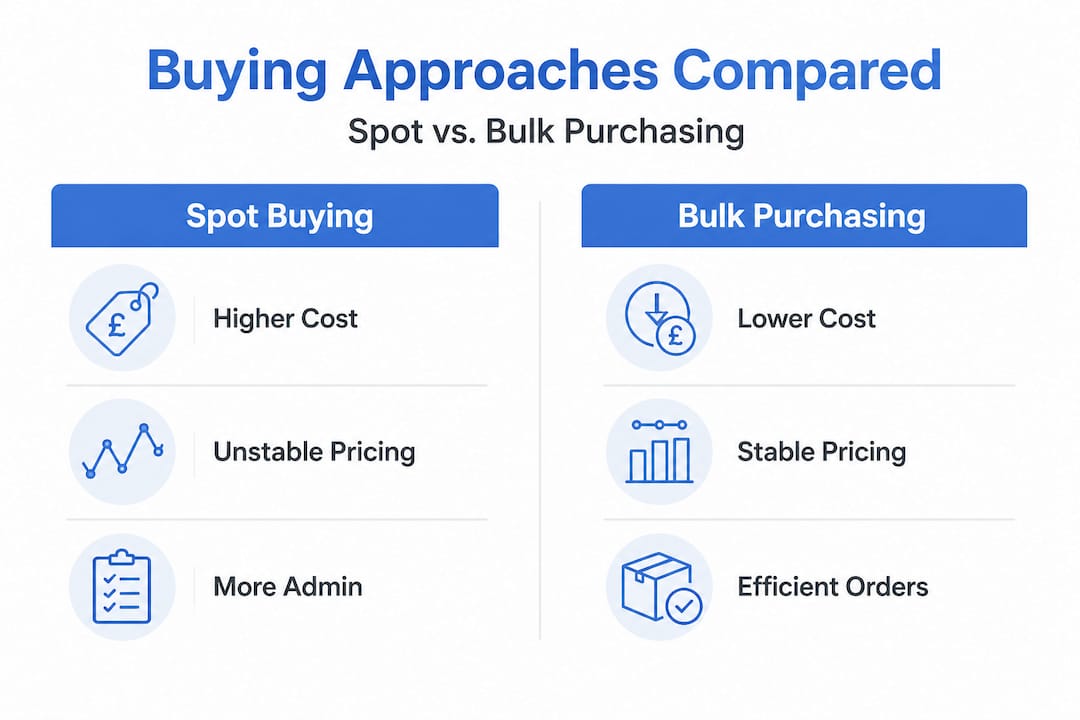
The table above illustrates why Irish SMEs facing 10% cost rises are increasingly turning to bulk procurement as a structural response rather than a one-off tactic.
Pro Tip: Before committing to a bulk arrangement, run a three-month review of your actual material spend and order frequency. The numbers often reveal savings opportunities far larger than expected.
Which supplies should you buy in bulk—and which should you avoid?
Not every material suits bulk purchasing. Getting this right is what separates a genuinely cost-effective strategy from one that creates waste and cash flow problems. The key variable is shelf life, alongside how consistently you use the product.
Best candidates for bulk purchasing:
- Sublimation blanks (mugs, panels, coasters, keyrings): non-perishable, stable, and used continuously
- DTF transfer film and powder: long shelf life when stored correctly, used in high volumes
- Packaging materials (mailers, boxes, tissue paper, void fill): used on every order, no degradation risk
- Badge-making components: button parts, pin backs, and mylar are compact and stable indefinitely
- Laser-engraveable blanks (acrylic, wood, slate): non-perishable and easy to stack and store
- Cleaning and maintenance supplies: non-perishables like cleaning supplies and fabrics with long shelf lives are ideal for bulk orders
- Heat-resistant tape and transfer paper: stable indefinitely in dry conditions
The sublimation blanks benefits of buying in volume are particularly strong because the products are uniform, compact, and used in every production run.
Supplies to approach with caution:
- Polymer clay and similar materials that harden or degrade with age
- Specialist inkjet inks with short shelf lives once opened
- Perishable adhesives with narrow working windows
- Niche or experimental materials where your usage volume is unproven
A data-driven guide to bulk suitability:
| Supply type | Shelf life | Bulk suitability | Notes |
|---|---|---|---|
| Sublimation blanks | Indefinite | Excellent | Non-porous, stable |
| DTF film | 12 to 24 months | Good | Store flat, away from moisture |
| Packaging materials | Indefinite | Excellent | Compact storage |
| Polymer clay | 6 to 12 months | Poor | Degrades without use |
| Sublimation ink | 12 months | Moderate | Match to print volume |
| Acrylic paint | 2 to 5 years | Good | Seal tightly |
Audit your usage against shelf life before placing any bulk order. A material you use every week can be ordered in volume with confidence. One you use occasionally is a different matter entirely.
Pro Tip: If you are unsure about bulk quantities for a new product line, start with a mid-range order and track how quickly you use it. Let real consumption data drive your next order, not optimism about future sales volumes.
Understanding how to use sublimation blanks for merchandise at scale helps clarify exactly what volume of blanks a business at different stages genuinely needs.
Common pitfalls: when bulk buying can backfire
The case for bulk purchasing is strong, but it is not without genuine risks. Every experienced business owner who has moved to wholesale supply will have at least one story of an order that did not go to plan. Knowing the pitfalls helps you avoid them.
The unit price trap
One of the most counterintuitive findings about bulk buying is that larger packs sometimes cost more per unit than smaller packs, particularly when promotions are applied to standard sizes. Before placing a bulk order, always calculate the per-unit cost and compare it to what you currently pay. Do not assume bigger automatically means cheaper.
Cash flow pressure
A large upfront payment reduces your working capital. If your business operates on tight margins or has variable monthly revenue, committing a significant sum to stock can create short-term cash flow problems. This is especially relevant for sole traders and micro-businesses in Ireland and the UK who are managing payments from multiple clients simultaneously.
Storage reality checks
It is easy to order more than your space can comfortably hold. Poor storage conditions can damage stock, and cramped working spaces reduce productivity. Before scaling up an order, physically measure your available storage and consider environmental factors: dampness, heat, and direct sunlight all affect material integrity.
Promotions that beat bulk pricing
Promotions and loyalty deals on small packs can sometimes beat bulk pricing, making them best for high-usage staples in small UK and Irish businesses.
This happens more often than people realise. Supplier promotions, seasonal discounts, or clearance lines on smaller quantities can occasionally undercut the per-unit bulk price. Staying alert to these opportunities and building them into your procurement calendar is worth the effort.
Checklist before placing any bulk order:
- Calculate and confirm the per-unit cost versus current pricing
- Verify your storage capacity and conditions
- Assess current cash flow and how a large payment affects operations
- Confirm usage rate from the past three months of records
- Check for active promotions on standard pack sizes
Use a reliable bulk checklist to structure your evaluation before committing. For broader context on streamlining manufacturing operations, it is worth reviewing how procurement decisions fit within your wider production workflow.
Our take: how to master bulk buying without waste
Here is what most guides on bulk purchasing miss entirely: the savings are only as good as your stock management. Buying in volume creates an opportunity to save money, but that opportunity disappears quickly if you let ordering become automatic rather than intentional.
We have seen businesses get excited about bulk pricing, place a large order, and then discover six months later that they have significant dead stock sitting in a corner. The materials are not expired, but the product line they were bought for has changed, demand shifted, or the business pivoted. The savings on paper never materialised in practice.
The businesses that genuinely benefit from wholesale supply strategies treat procurement as a living process. They review their stock position monthly, track actual consumption against forecasts, and adjust order volumes when demand changes. They do not set an order schedule and walk away from it.
There is also a storage discipline that separates good bulk buyers from bad ones. Knowing your actual available space, rather than the optimistic version of it, is the foundation of a sensible bulk purchasing strategy. If materials are stored badly, the savings from volume discounts are partially or completely wiped out by damage and waste.
Our honest advice: start your bulk buying journey with two or three core materials that you use consistently and heavily. Master the rhythm of those before expanding. The confidence and data you build from those initial categories will make every subsequent bulk decision far more reliable. Bulk procurement done well is not a single decision; it is a habit of disciplined, honest analysis repeated on a rolling basis.
Unlock efficient sourcing for your creative or manufacturing business
If this article has shifted your thinking about how your business sources materials, the logical next step is finding a supplier whose model actually fits small business realities.
At Subliblanks, we supply sublimation blanks, DTF supplies, laser-engraveable blanks, badge-making components, xTool laser engraving machines, 3D printing filaments, packaging materials, and much more, all with no minimum order quantities. Whether you are testing a new product line or scaling an existing one, you can order the amount that suits your current needs and your storage capacity. Our range is designed specifically for creative and manufacturing businesses across the UK and Ireland who need consistent quality, reliable supply, and trade pricing that makes commercial sense. Explore our full catalogue and see how straightforward efficient sourcing can be.
Frequently asked questions
Does bulk buying always save money for small businesses?
Bulk buying can save money, but not always. Promotions on smaller packs can sometimes offer better per-unit value, so always compare prices before committing to a large order.
What are the first steps to buying in bulk for a creative business?
Audit your material usage over the past three months and match your planned order size to both shelf life and realistic consumption before scaling up.
What types of products are best suited for bulk buying?
Non-perishables with long shelf lives are the strongest candidates. Fabrics, cleaning supplies, and acrylic paints suit bulk purchasing well, while perishable materials like polymer clay do not.
What are the risks of bulk buying for small businesses?
The main risks are cash flow pressure, storage limitations, and the possibility that larger packs cost more per unit than smaller ones when promotions are factored in. Always calculate per-unit costs before ordering.
Recommended
- Why choose wholesale supplies? Key benefits for UK small businesses – SubliBlanks Ltd
- Sublimation Blanks Selection Guide 2026: Cut Waste 25% – SubliBlanks Ltd
- Understanding DTF technology: Key benefits for UK printers – SubliBlanks Ltd
- What Is Heat Transfer Printing? 30% Better Colour UK SMEs – SubliBlanks Ltd
- Energy Efficiency in Buildings: Complete Guide – Mats4U USA
- Why buy surplus equipment? Cut costs, preserve cash, boost ESG | Blog | Insights on Asset Liquidation and Auction Trends


