



Engravable blanks explained: the essential guide for UK crafters
TL;DR:
- Engravable blanks are purpose-designed objects with compatible materials for consistent laser engraving results.
- Using high-quality blanks reduces waste, improves product quality, and enhances customer satisfaction.
- Choosing the right blank depends on the project, equipment, durability needs, and market demand.
Many crafters assume that if you can put something under a laser, you can engrave it. That assumption leads to ruined stock, poor-quality finishes, and frustrated customers. The truth is that engravable blanks are specifically designed objects, with precisely chosen materials and coatings, that respond predictably to laser or mechanical engraving. For UK and Irish small businesses turning personalised gifts into reliable income, understanding the difference between a suitable blank and a random surface is not a minor detail. It is the foundation of consistent, profitable production.
Table of Contents
- What is an engravable blank?
- How does engraving on blanks work?
- Popular types of engravable blanks and their uses
- Choosing the right engravable blank for your project
- What most businesses miss about engravable blanks
- Find the perfect engravable blank for your next project
- Frequently asked questions
Key Takeaways
| Point | Details |
|---|---|
| Defined purpose | Engravable blanks are pre-made items specifically designed to be permanently marked or customised. |
| Material matters | The right blank material is crucial for durability and engraving accuracy. |
| Compatibility counts | Laser type and blank material must be matched for the best results. |
| Business impact | Proper blank selection improves product quality, efficiency, and customer satisfaction. |
What is an engravable blank?
An engravable blank is a precut, preformed object produced specifically to receive a permanent personalised mark. Think keyrings, plaques, name badges, tags, coasters, and frames, all manufactured to a consistent standard so that engraving delivers clean, repeatable results every single time. The object itself is the “blank” because it has no design applied yet. It is the canvas waiting for your personalisation.
What separates a true engravable blank from a random piece of material is compatibility. The material or coating must respond correctly to the engraving process without warping, cracking, discolouring unevenly, or producing harmful fumes. Our custom blanks guide covers how this compatibility works across different blank types, which is well worth reading before you invest in stock.
Common materials used for engravable blanks include:
- Wood and MDF (medium-density fibreboard): affordable, widely used, produces warm, high-contrast marks
- Acrylic: available in many colours, produces sharp, clean edges on engraved text and artwork
- Coated metals: anodised aluminium or colour-coated steel that reveals the metal beneath when the coating is removed
- Bare metals: stainless steel, brass, and aluminium used with specialist equipment
- Leather: natural or synthetic, popular for corporate gifting and accessories
Laser engraving vaporises or removes material or coating to create visible contrast, whether that is darkening the wood grain, revealing an acrylic underlayer, or marking through a coated metal surface.
Not every material sold in craft shops qualifies. Painted timber from a DIY store, for instance, may contain resins or surface treatments that react badly under a laser. Purpose-made engravable blanks remove that guesswork entirely, which saves you time, material costs, and complaints from customers who ordered something special.
How does engraving on blanks work?
Understanding the process helps you make better purchasing decisions and set realistic expectations with your customers. Laser engraving is not simply “burning” a design on. Different materials require different interactions with the laser beam, and the mechanics behind those interactions determine the quality of the final result.
Here is a step-by-step overview of how the process works on a typical engravable blank:
- Design preparation: your artwork or text is created in compatible software (such as LightBurn or xTool Creative Space) and sent to the laser engraver as a file.
- Laser focussing: the machine positions its focal point precisely at the surface of the blank to maximise energy concentration at that exact depth.
- Material interaction: the laser beam either vaporises the top surface of the material (as with wood or acrylic) or ablates (removes) a coating to expose the contrasting layer beneath (as with anodised metals).
- Cooling and finishing: once engraved, the blank cools and may require light cleaning to remove residue, after which the personalised design is permanent.
- Quality check: each blank is inspected for depth consistency, edge clarity, and any unwanted discolouration before it is packed for the customer.
The type of laser you use matters enormously. CO2 lasers (40 to 100W) are the standard choice for wood, acrylic, leather, and coated metals. Fibre lasers are reserved for bare metals like stainless steel or brass. Using the wrong laser for your blank material will either fail to mark the surface at all or cause irreversible damage. This is one reason why knowing your equipment before sourcing your blanks is so important. Our printing blank guide explores how equipment and blank selection interact across different personalisation methods.
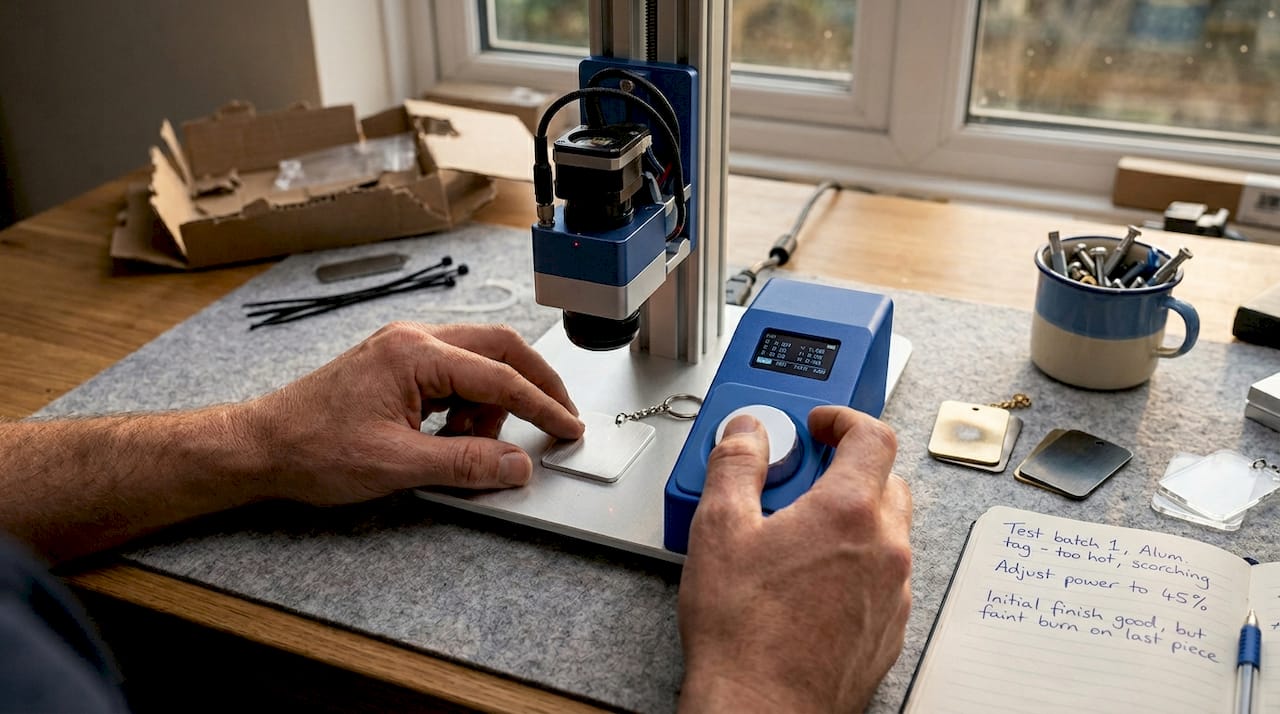
Pro Tip: Always test a sample blank from any new supplier before placing a larger order. Run a small engrave at your standard settings and check for consistent depth, clean edges, and no unexpected discolouration. A five-minute test saves you from scrapping an entire batch.
Popular types of engravable blanks and their uses
Now that you understand how engraving works, it is useful to see the main categories of engravable blanks side by side. Each material has distinct strengths, cost profiles, and ideal applications for small businesses.
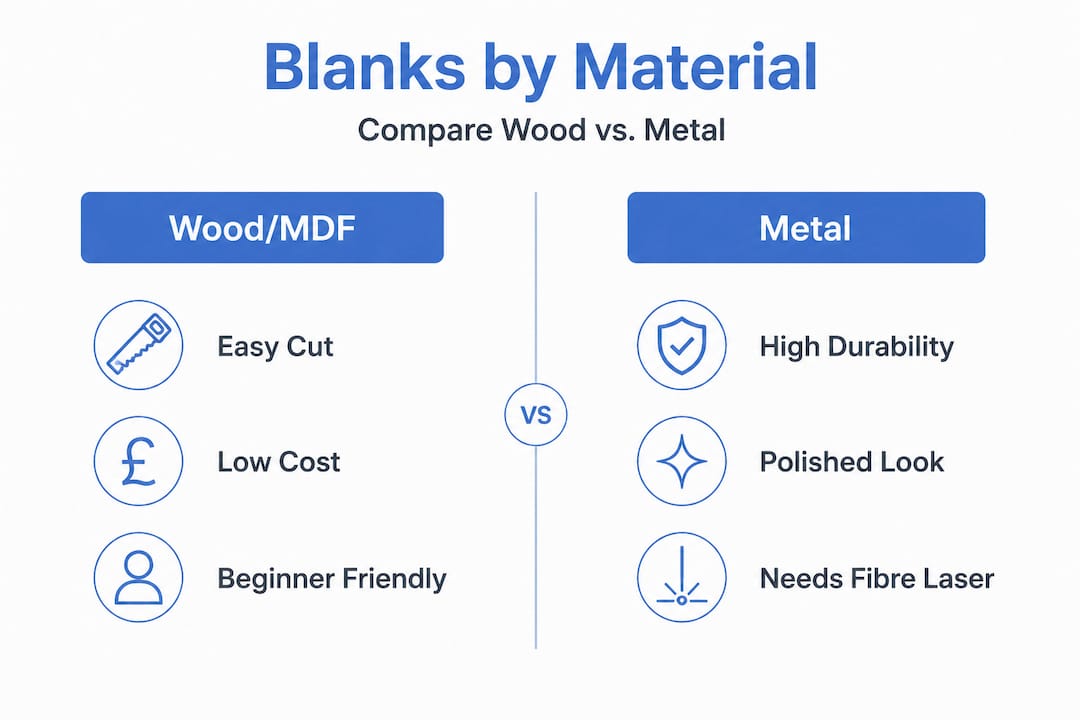
| Material | Laser type | Typical cost | Durability | Best uses |
|---|---|---|---|---|
| MDF / wood | CO2 | Low | Moderate | Name badges, plaques, frames, signage |
| Acrylic | CO2 | Low to medium | High | Awards, keyrings, decorative signs |
| Coated metal (anodised aluminium) | CO2 | Medium | Very high | Tags, industrial labels, premium gifts |
| Bare metal (stainless steel, brass) | Fibre | High | Excellent | Jewellery, premium plaques, tools |
| Leather | CO2 | Medium | High | Wallets, keyrings, corporate accessories |
The CO2 laser compatibility with wood, acrylic, leather, and coated metals makes these materials the most accessible starting point for small businesses. A single CO2 machine, such as an xTool D1 Pro or xTool S1, covers a wide range of popular blank types without additional hardware investment.
Popular finished products made from engravable blanks include:
- Name badges: MDF and acrylic blanks are the most common choice for lightweight, wearable badges used in hospitality, retail, and events
- Corporate gifts: coated metal and leather blanks produce premium-feeling items that clients keep on their desks or in their bags
- Wedding and celebration keepsakes: wooden blanks engraved with names and dates create sentimental products with strong perceived value
- Pet tags and bag tags: acrylic and coated aluminium work brilliantly for lightweight, durable ID tags
- Signage and labels: MDF blanks are cost-effective for home or office signs with a warm, natural appearance
If you are considering expanding into sublimation printing alongside laser engraving, it is worth exploring the benefits of sublimation blanks and the range of sublimation blank types available to you. Many small businesses run both methods side by side to maximise their product range and customer appeal.
Choosing the right engravable blank for your project
Selecting the correct blank for each project is where many small businesses either save or lose money. The decision is not just about aesthetics. It involves your equipment, your customer’s expectations, your budget, and your production volume.
Here is a practical, stepwise approach to choosing your blank:
- Define the end use: is the product for a corporate client, a wedding, a pet owner, or a retail display? The occasion and audience directly influence which material feels appropriate and premium enough.
- Check your laser equipment: confirm whether you have a CO2 or fibre laser (or both) and its wattage range. Laser type and blank material must be compatible for precise, consistent results.
- Set your budget per unit: calculate the total cost including the blank, machine running time, packaging, and your time. Cheaper blanks are not always more profitable once waste is factored in.
- Consider durability requirements: outdoor signage and industrial labels need coated metals or UV-resistant acrylic. Indoor gifts and badges can use MDF or standard acrylic without issue.
- Test before committing: order a small sample batch from your supplier and engrave a representative design. Evaluate the contrast, finish quality, and how the blank handles post-processing.
| Blank type | CO2 laser | Fibre laser | Beginner friendly | Intermediate |
|---|---|---|---|---|
| MDF | Yes | No | Yes | Yes |
| Acrylic | Yes | No | Yes | Yes |
| Anodised aluminium | Yes | Yes | No | Yes |
| Stainless steel | No | Yes | No | Yes |
| Leather | Yes | No | Yes | Yes |
Checking laser machine compatibility before purchasing blanks in bulk is a step that experienced engravers never skip but beginners routinely overlook. Our sublimation blanks selection guide and sublimation blanks checklist also offer practical frameworks for building a reliable supplier relationship and managing stock efficiently.
Pro Tip: Do not lock in large quantities of any blank until you have sold at least ten to twenty units to real customers. Market feedback from actual sales is more reliable than your own preference. Start small, validate the product, then scale your orders with confidence.
What most businesses miss about engravable blanks
Here is the perspective that rarely appears in beginner guides: the biggest risk for small engraving businesses is not choosing the wrong laser setting. It is underestimating how blank quality affects everything downstream.
When you save a few pence per unit by purchasing the cheapest possible blanks, you are not just accepting a slight cosmetic compromise. You are introducing variability into your production process. Cheap MDF blanks can have inconsistent density, meaning your laser cuts deeper on some units than others. Bargain acrylic can have micro-bubbles or surface imperfections that scatter the laser beam. Off-brand coated metals can have uneven coatings that ablate unpredictably, producing patchy, uneven reveals. Every one of these issues results in wasted material, wasted time, and potentially a disappointed customer who shares their experience online.
We have seen this pattern play out repeatedly. A UK gifting business we know switched from a low-cost acrylic blank to a mid-tier MDF badge and immediately noticed fewer rejects, faster production speed (because they were not re-running failed units), and higher customer satisfaction scores. Their repeat order rate improved not because they changed their designs, but because the consistency of the blank meant the end product looked the same every single time. Customers trust consistency. It is what turns a one-off buyer into a loyal repeat client.
The flip side of this is equally important. Do not overbuy stock before you have tested market demand. Agility in a small business is a genuine competitive advantage. Purchasing six months of stock in a material your customers turn out not to prefer ties up cash and storage space. The ideal approach is to choose sublimation blanks and engravable blanks with a supplier who allows you to order in small quantities, so you can respond quickly to what your market actually wants rather than what you assumed it wanted.
Quality and agility are not opposites. They work together when you source from the right supplier.
Find the perfect engravable blank for your next project
If you are ready to stock engravable blanks for your laser engraving business, sourcing from a specialist UK and Ireland trade supplier makes a real difference to consistency, lead times, and cost per unit.
At Subli Blanks, we supply a wide range of laser-engraveable blanks with no minimum order quantities, so you can test before you commit. Whether you are looking for a round MDF name badge for hospitality events, a rectangle name badge blank for retail or corporate use, or a broader range of acrylic and coated metal options, we stock what UK and Irish crafters and small businesses actually need. Browse our full range to find the blank that suits your equipment, your budget, and your customers.
Frequently asked questions
What makes a blank engravable?
A blank is engravable if its material or coating can withstand laser or mechanical engraving and produce a permanent, high-contrast mark. As the process vaporises or removes material, the surface must react cleanly without warping or releasing harmful substances.
Which materials are best for laser engraving blanks?
Wood, acrylic, coated metals, and bare metals are the top choices, each suited to specific laser types. CO2 lasers suit wood, acrylic, leather, and coated metals, while fibre lasers are required for bare metal surfaces like stainless steel or brass.
Can engravable blanks be used with both fibre and CO2 lasers?
Yes, but matching the laser type to the blank material is essential. Fibre lasers suit bare metals, while CO2 lasers are the correct choice for wood, leather, acrylic, and anodised or coated metals.
Do I need to prepare blanks before engraving?
Some blanks benefit from a light clean to remove dust or oils that could affect laser performance, but most purpose-made engravable blanks from specialist suppliers are ready to use straight from the packaging.
Are engravable blanks reusable?
No. Engravable blanks are designed for a single use. The engraving process permanently alters the material or coating, which is precisely what makes the personalised mark durable and long-lasting for your customers.
Recommended
- What are custom blanks? A UK guide for creatives – SubliBlanks Ltd
- Sublimation Blanks Selection Guide 2026: Cut Waste 25% – SubliBlanks Ltd
- Personalise gifts with sublimation: a step-by-step guide – SubliBlanks Ltd
- Why Choose Sublimation Blanks for Custom Products – SubliBlanks Ltd
- What Is a Personalised Stamp? Complete Guide UK – Stamp Design 4U
- Your complete guide to creating custom luxury jewelry – Diamonds


