



What is bulk trade supply? A guide for UK businesses
TL;DR:
- Bulk trade supply encompasses more than volume discounts; it involves complex logistics, detailed contracts, and strategic sourcing models.
- Understanding the differences between bulk buying, wholesale trade, and bulk cargo helps businesses optimize procurement, pricing, and supply chain management.
- Effective bulk supply arrangements require clear contractual terms, phased deliveries, and strong supplier relationships to avoid costly disputes and cashflow issues.
Most businesses that start exploring bulk trade supply assume it simply means buying more to spend less. That part is true. But the term covers a much wider territory than most people realise, including wholesale distribution models, consolidated freight logistics, and detailed supply contracts that govern everything from delivery phases to quality acceptance. For businesses and entrepreneurs in the UK and Ireland, understanding what is bulk trade supply in full means fewer costly procurement errors and far stronger supplier relationships from the outset.
Table of Contents
- Key takeaways
- What is bulk trade supply, really?
- How bulk trade supply works in the UK and Ireland
- Wholesalers and distributors as bulk supply intermediaries
- Choosing the right bulk supply strategy
- My take on bulk trade supply complexity
- How Subliblanks supports your bulk supply needs
- FAQ
Key takeaways
| Point | Details |
|---|---|
| Bulk trade supply is broader than discounts | It covers pricing, logistics, and formal contractual terms, not just volume savings. |
| Wholesale trade is a distinct model | Wholesalers act as intermediaries, buying in bulk and reselling smaller lots to businesses. |
| Contracts must be specific | Bulk supply agreements should define quantity, quality standards, delivery phases, and variation procedures. |
| Direct vs. wholesaler sourcing matters | Choose based on your volume capacity, storage capability, and product category requirements. |
| Phased deliveries protect cashflow | Splitting large orders into batches aligns with warehousing limits and financial planning cycles. |
What is bulk trade supply, really?
The confusion starts because three distinct concepts get lumped under the same umbrella: bulk buying, wholesale trade, and bulk cargo. Many businesses conflate these before entering negotiations, which leads to mismatched expectations with suppliers, pricing errors, and logistics complications that could have been avoided.
Bulk buying means purchasing significantly larger quantities than you would normally order to secure a lower unit price. It is fundamentally a pricing strategy built on economies of scale. The more you buy, the less you pay per unit.
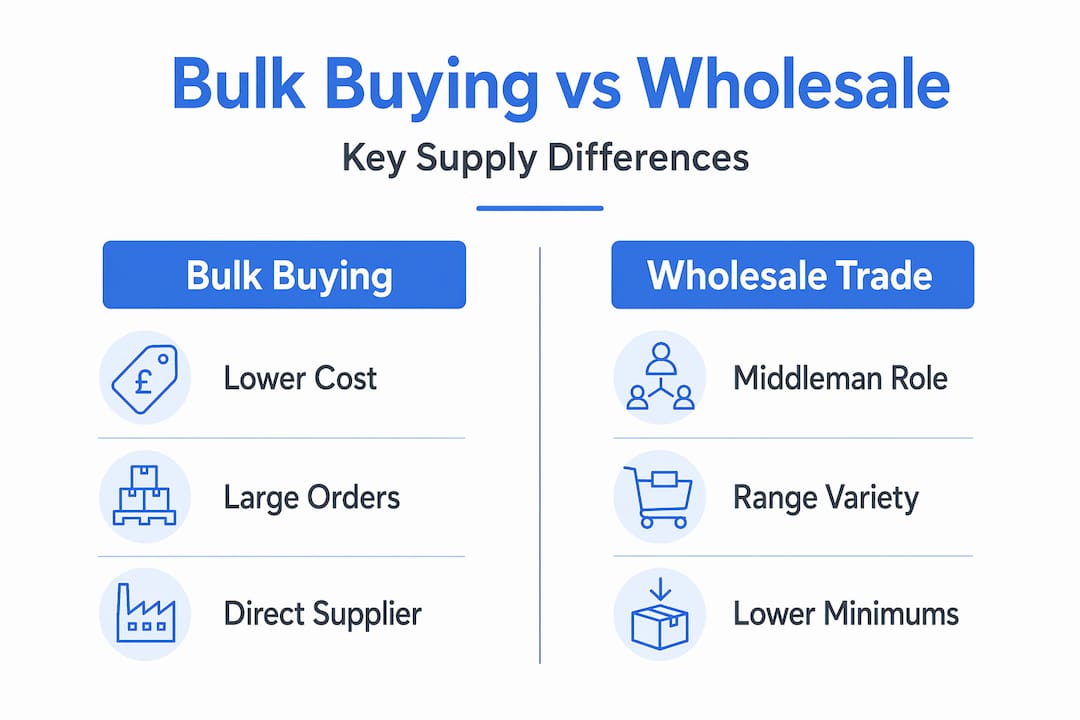
Wholesale trade is something different. It is a distribution model where an intermediary, the wholesaler, purchases goods from manufacturers in bulk and then resells smaller quantities to retailers, ecommerce businesses, or end-use trade buyers. Wholesale distribution adds value by simplifying supplier relationships, providing product variety from a single source, and handling warehousing on your behalf.
Bulk cargo is a shipping and logistics term. It refers to unpackaged goods transported in large volumes, typically by container, rail, or tanker. This is most relevant to commodities like grain, chemicals, and aggregates, though the principles carry over to any business managing consolidated pallet shipments.
| Term | What it means | Business relevance |
|---|---|---|
| Bulk buying | Purchasing large quantities to reduce unit cost | Pricing and procurement strategy |
| Wholesale trade | Buying via intermediary who resells at volume | Supplier and distribution model |
| Bulk cargo | Shipping large unpackaged volumes via freight | Logistics and import planning |
| Bulk trade supply | The full process combining volume purchasing, wholesale sourcing, and supply chain contracts | End-to-end procurement planning |
How bulk trade supply works in the UK and Ireland
Once you understand the terminology, the practical picture becomes clearer. In a UK or Irish business context, bulk trade supply typically involves sourcing products from a manufacturer or wholesaler under a formal supply arrangement, managing the inbound logistics, and storing goods before distributing them onwards or using them in production.
Bulk supply arrangements are usually governed by a written contract. A well-constructed bulk supply clause will set out the total quantity being ordered, the pricing basis (whether fixed or indexed), quality specifications the goods must meet, and a phased delivery schedule broken into batches over weeks or months. This structure matters because phased deliveries help both parties manage warehousing constraints and cashflow without needing to handle the full order volume in one go.
For UK businesses importing from overseas suppliers, consolidated freight is usually more cost-effective than sending individual parcels. UK and Ireland cross-border bulk supply works best through pallet and container shipments, which align with customs clearance procedures and bonded warehousing infrastructure far more efficiently than fragmented parcel flows.
A few things worth building into your bulk supply process from day one:
- Confirm quality acceptance criteria in writing before the first shipment arrives.
- Agree on what happens if a delivery batch fails inspection, including timelines for replacement.
- Specify whether delivery dates are estimates or binding, as this affects your own production or sales planning.
- Clarify who bears the cost and liability for damaged goods in transit.
Pro Tip: When negotiating bulk supply contracts, ask suppliers to include a variation approval clause. This gives you a documented process for changing quantities or delivery dates without voiding the agreement, which is particularly useful when sales demand shifts mid-contract.
Wholesalers and distributors as bulk supply intermediaries
For many UK and Irish businesses, particularly smaller ones, buying directly from a manufacturer is not always practical. Minimum order quantities can be prohibitively high, product lead times long, and supplier vetting complex. This is where wholesale distribution intermediaries become genuinely useful.
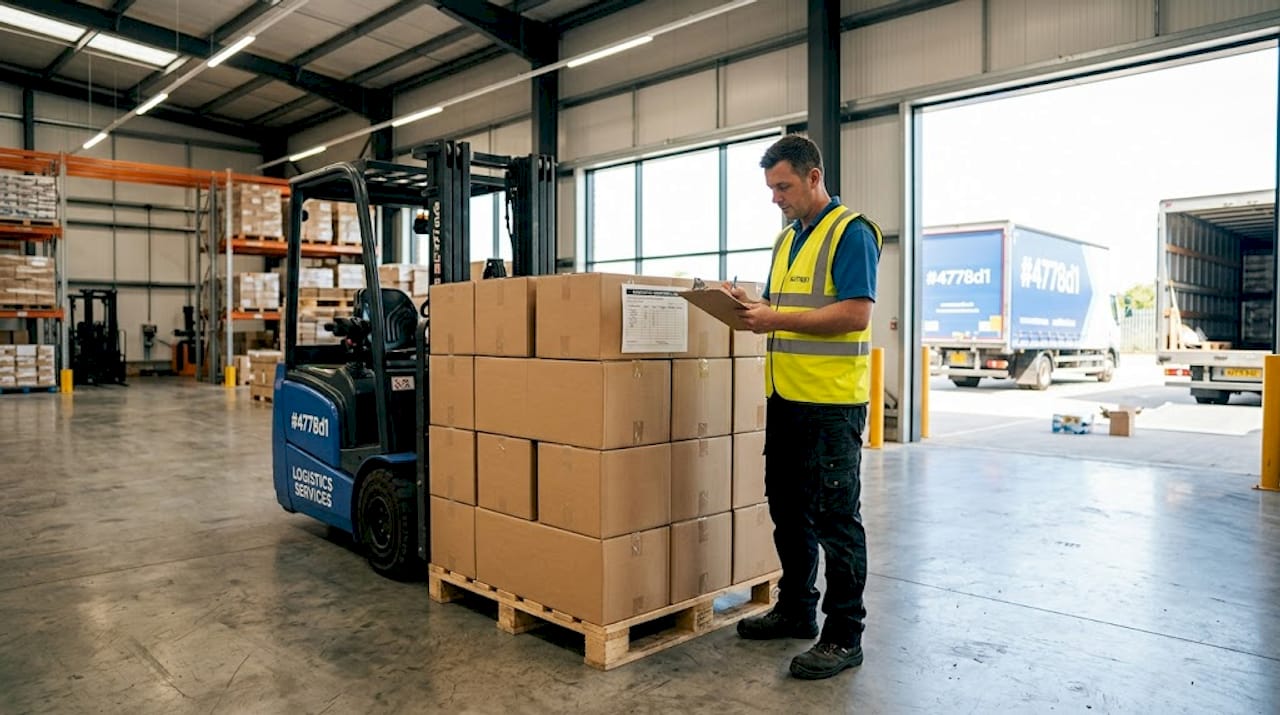
Wholesalers purchase goods from manufacturers in bulk, warehouse them, and resell to trade buyers in smaller quantities at a margin. The advantage for you is clear: you get access to volume-priced stock without having to commit to a full manufacturer MOQ, and you reduce the number of supplier relationships you need to manage simultaneously.
Here are the key advantages of working through a wholesale intermediary rather than buying direct:
- Lower entry point. You can access bulk pricing without meeting a manufacturer’s full minimum order.
- Reduced supplier management. One wholesale account can give you access to dozens of product lines.
- Faster fulfilment. Stock is already in the country, removing lead times tied to overseas production.
- Broader product variety. Wholesalers specialise in product categories and offer curated ranges rather than forcing you to source individual lines separately.
- Built-in quality filtering. Reputable wholesalers have already vetted their suppliers, reducing your due diligence burden.
The challenges are real too. Your margin is compressed compared to buying direct. You depend on the wholesaler’s own stock levels and restocking cycles. And in some product categories, pricing via a wholesaler may not be competitive once you reach sufficient order volumes to approach manufacturers directly.
A useful rule of thumb: use a wholesale intermediary when you are building range, testing demand, or working at lower volumes. Move to direct bulk procurement when you have proven demand, sufficient storage capacity, and the contract management capability to handle manufacturer relationships properly.
Pro Tip: Before committing to a wholesale supplier, check whether they operate without minimum order quantities. Suppliers like Subliblanks allow you to test product lines at low volumes before scaling, which reduces the risk of over-investing in stock you cannot move.
Choosing the right bulk supply strategy
There is no universal answer to whether you should buy direct or through a wholesaler. The right bulk trade strategy depends on a combination of your business model, product type, financial position, and operational capacity. Working through those factors clearly saves you from locking into an approach that creates more problems than it solves.
Consider these questions before committing to a bulk supply arrangement:
- Volume and frequency. How much do you buy per month or quarter, and how predictably? High, consistent volume favours direct bulk procurement. Variable or seasonal demand suits a more flexible wholesale relationship.
- Storage and handling. Do you have the warehouse space and handling equipment to receive and manage large deliveries? Without adequate storage, bulk supply creates as many costs as it saves.
- Cashflow position. Bulk orders require larger upfront payments. If your cashflow is tight, a wholesaler with no minimum order quantity or a phased payment arrangement may serve you better.
- Product complexity. For technical or regulated products, buying direct from a manufacturer gives you tighter quality control and clearer traceability.
- Contract readiness. Direct bulk supply requires proper contract management. If you do not yet have the internal capacity to handle bulk supply contract clauses covering delivery schedules, variation procedures, and quality standards, start via a wholesaler and develop those capabilities as you scale.
The bulk purchasing guide for businesses on the Subliblanks blog covers the contractual side in more depth if you want to develop your understanding before entering supplier negotiations.
Warehousing and inventory management decisions run in parallel with your bulk supply strategy. Understand your reorder point, lead time, and storage capacity before committing to batch sizes, and build those numbers into any contract you sign.
My take on bulk trade supply complexity
I have seen businesses treat bulk trade supply as little more than a volume discount exercise, and it nearly always causes problems. The pricing benefit is real, but it is also the most visible part of a much more involved process.
What tends to catch people out is the contractual side. In my experience, most disputes in bulk supply arrangements come down to ambiguous delivery terms or unwritten quality expectations, things that seem minor when both parties are motivated to close the deal but become significant when something goes wrong three months in. The variation approval process alone is worth spending an hour on before signing anything.
The cashflow dimension also gets underestimated. A large bulk order that improves your unit economics can simultaneously put real pressure on your working capital, particularly if your sales cycle is longer than your payment terms. I have found that businesses who plan their bulk supply around phased delivery schedules almost always manage this better than those chasing the largest possible discount on a single upfront order.
Finally, supplier relationships matter more than most procurement guides admit. The businesses I have seen do this well invest time in understanding their supplier’s constraints, production cycles, and capacity limitations. That mutual understanding tends to produce more reliable deliveries and more flexible terms than a purely transactional approach ever achieves.
— chris
How Subliblanks supports your bulk supply needs

If you are sourcing trade supplies in bulk for your UK or Irish business, Subliblanks is built for exactly that. As a trade wholesaler with no minimum order quantities, Subliblanks lets you source across a wide product range, from sublimation blanks and DTF supplies to laser-engraveable products and packaging, without being forced into quantities you cannot move. For businesses buying in volume, the round MDF name badges with pin are a popular choice for bulk badge orders, available alongside the rectangular sublimation MDF pin badge for branded promotional and staff badge runs. Explore the full catalogue at Subliblanks and find a wholesale supplier that scales with you.
FAQ
What is bulk trade supply?
Bulk trade supply refers to the process of purchasing goods in large quantities at a lower unit price, typically governed by a formal supply contract covering quantity, quality, and phased delivery schedules.
What is the difference between bulk buying and wholesale trade?
Bulk buying is a pricing strategy where you purchase large quantities to reduce unit cost. Wholesale trade is a distribution model where an intermediary buys in bulk from manufacturers and resells smaller lots to trade buyers.
Do bulk supply contracts need to be in writing?
Yes. A proper bulk supply agreement should specify quantity, pricing, quality standards, delivery timelines, and variation procedures to prevent disputes during high-volume transactions.
When should I use a wholesaler rather than buying direct?
Use a wholesaler when your order volumes are lower, storage capacity is limited, or you are testing demand for a product. Move to direct bulk procurement once you have consistent volume, storage infrastructure, and contract management capability in place.
How does phased delivery work in bulk supply?
Phased delivery splits a large total order into smaller batches delivered on agreed dates. This aligns with warehousing limits and cashflow cycles, making large bulk contracts more manageable for both buyer and supplier.


