



What is bulk purchasing? A guide for businesses
TL;DR:
- Bulk purchasing is a strategic method for businesses to buy large quantities of goods internally, reducing per-unit costs and order frequency. It differs from wholesale, which involves reselling to others, and requires careful planning to manage risks like cash flow, storage, and demand fluctuations. Proper implementation, including pilot orders and data analysis, can maximize savings and operational continuity.
Bulk purchasing is one of those procurement strategies that sounds straightforward until you actually try to implement it. Many businesses assume it simply means buying a lot of something, but the real bulk purchasing definition goes further than volume alone. It is about deliberately concentrating your procurement to reduce per-unit costs, cut administrative overhead, and give your supply chain breathing room. This guide explains what bulk purchasing means in practice, how it differs from wholesale, where it creates genuine savings, and what pitfalls to plan around before you commit to your next large order.
Table of Contents
- Key takeaways
- What bulk purchasing means for businesses
- Benefits of bulk purchasing for businesses
- Common challenges in bulk purchasing
- Strategies and best practices for bulk purchasing
- Bulk purchasing vs wholesale vs retail
- My take on bulk purchasing misconceptions
- How Subliblanks supports your bulk procurement
- FAQ
Key takeaways
| Point | Details |
|---|---|
| Bulk purchasing reduces unit costs | Concentrating orders lowers per-unit price and cuts procurement frequency significantly. |
| It is not the same as wholesale | Bulk purchasing is for internal operational use; wholesale involves resale to third parties. |
| Cash flow must be planned carefully | Large upfront orders tie up capital, so liquidity analysis should precede any commitment. |
| Storage and spoilage carry hidden costs | True savings only materialise when storage, logistics, and shelf-life costs are factored in. |
| Pilot orders reduce risk | Starting at 10 to 15 percent of intended volume lets you verify supplier quality before scaling. |
What bulk purchasing means for businesses
The bulk purchasing definition, at its core, is the practice of ordering goods in significantly larger quantities than you would through routine procurement, specifically to benefit from lower per-unit costs and reduced ordering frequency. It is a supply-side strategy aimed at improving operational and financial efficiency for the buyer’s own use.
Wholesale per-unit prices sit 40 to 60 percent below retail, and bulk purchasing operates on the same principle of economies of scale. The more units you commit to, the less each unit costs, because the supplier can spread fixed production, packaging, and logistics costs across a greater volume.
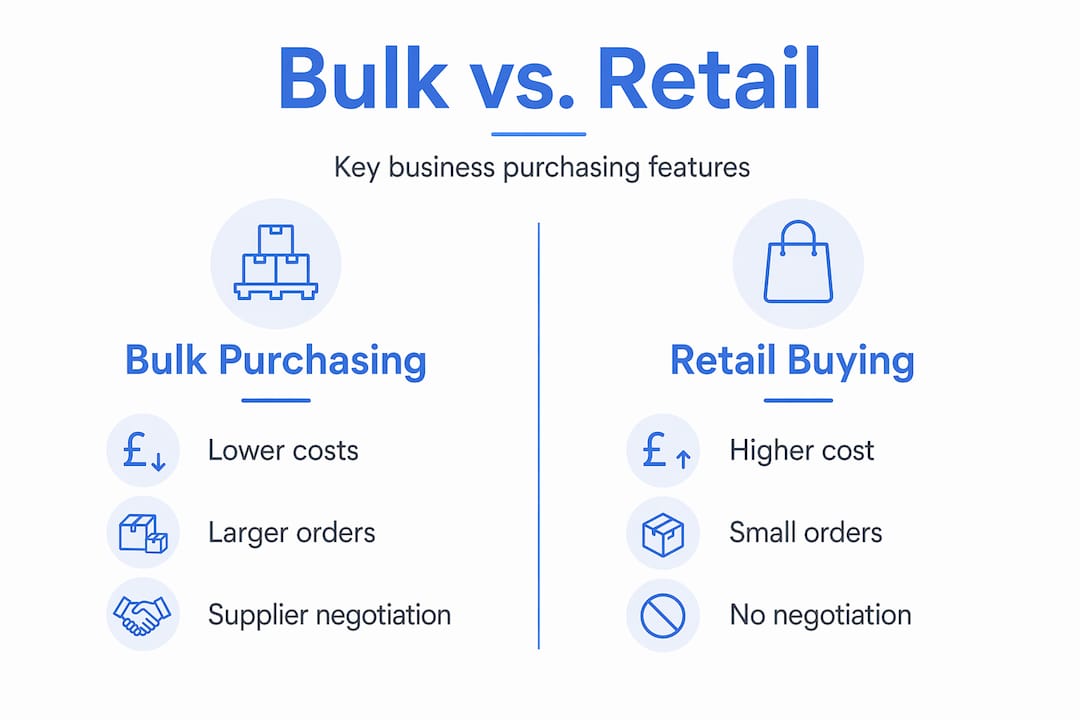
Here is where many businesses trip up. Bulk purchasing and wholesale are not interchangeable terms. Wholesale refers to buying goods for resale to a third party, typically a retailer or end customer. Bulk purchasing refers to buying goods for your own internal operational use, whether that is manufacturing inputs, consumable supplies, or packaging materials. The distinction matters because the financial models, stock management requirements, and supplier relationships for each approach are quite different.
Common examples of bulk purchasing across industries include:
- A print-on-demand business ordering several thousand sublimation blanks at once to reduce cost per item produced
- A hospitality group buying cleaning supplies in pallet quantities to eliminate weekly top-up orders
- A school purchasing stationery and materials at the start of each academic year rather than termly
- A manufacturer sourcing raw filament in bulk to keep production lines moving without costly restocking delays
What qualifies as bulk buying does not have a universal threshold. Some suppliers define it by order value, others by unit quantity, and others by pallet or container volume. What matters is that the volume is sufficient to unlock a meaningfully lower price point than standard single-order purchasing.
Benefits of bulk purchasing for businesses
The benefits of bulk buying extend well beyond the obvious discount on unit price. When you look at total procurement cost rather than line-item price, the picture becomes even more compelling.
Here are the core bulk purchasing advantages, ranked by the impact most businesses report:
- Lower cost per unit. This is the headline benefit. Economies of scale reduce per-unit cost, sometimes dramatically, which directly improves your gross margin on every item produced or used.
- Fewer orders, less administration. Bulk purchasing reduces reorder frequency and cuts administrative overhead. Every purchase order, invoice approval, and supplier communication takes staff time. Consolidating orders means fewer of those cycles, freeing your team for higher-value work.
- Logistics cost reduction. Consolidating procurement cycles lowers logistics costs by 15 to 20 percent. Fewer deliveries means fewer handling costs, lower inbound freight bills, and simpler receiving processes.
- Improved demand forecasting. Predictable bulk ordering gives procurement teams reliable data on consumption rates, which makes forward planning more accurate. When you know you order 5,000 units every quarter, forecasting becomes a calculation rather than a guess.
- Operational continuity. Running out of a critical supply mid-production is expensive. Bulk purchasing creates a buffer that keeps operations moving even when a supplier experiences a short-term delay.
There are also environmental arguments worth considering. Fewer deliveries mean fewer vehicle movements, lower packaging waste per unit, and a reduced carbon footprint per item consumed. For businesses working toward sustainability targets, this is a meaningful side benefit.
Pro Tip: Calculate your true cost-per-unit before committing to bulk. Add warehousing costs, insurance, and the interest cost of tied-up capital to the purchase price. Only then does the real saving become visible.

Common challenges in bulk purchasing
Cost savings with bulk buying are not automatic. There are real risks that can turn a seemingly good deal into a financial problem if you do not plan carefully.
The most common challenges businesses face include:
- Cash flow strain. Bulk ordering requires upfront capital, and tying up large sums in stock affects working capital. A business with tight liquidity can find itself unable to meet operating costs while sitting on a warehouse full of goods.
- Storage and spoilage. Storage needs and spoilage risks are among the top reasons bulk orders fail to deliver value. A food manufacturer buying ingredients in bulk must account for shelf life. A print business buying consumables must have dry, temperature-controlled storage to prevent deterioration.
- Demand mismatch. Buying in bulk assumes future demand is consistent with past consumption. If your market changes, a large order can leave you overstocked with items that have no home.
- Supplier quality risk. A supplier who performs reliably on small orders may not maintain the same quality standards at scale. Larger orders can expose weaknesses in their production process that smaller orders never revealed.
- Inflexibility. Once you have committed capital to a large purchase, pivoting to a different product, specification, or supplier becomes costly. Bulk purchasing reduces agility, which matters in fast-moving markets.
Mitigating these risks comes down to contractual discipline and verification. Before scaling to full bulk volume, audit your supplier’s capacity and quality processes. Negotiate delivery schedules rather than taking everything at once. And build a contingency into your storage cost calculation.
Pro Tip: Never commit to a full bulk order with a new supplier. Run a pilot at 10 to 15 percent of your intended volume first, assess quality and delivery performance, and only then scale your commitment.
Strategies and best practices for bulk purchasing
Knowing the theory is one thing. Executing bulk procurement well requires a structured approach that most businesses underinvest in. These best practices for bulk purchasing reflect what actually works when procurement moves from reactive to planned.
Start with accurate consumption data. Before approaching suppliers, know exactly how much of each item you use per month, per quarter, and per year. Gut feel is not enough. Pull three to six months of actual usage data and build your bulk quantities from that baseline.
Use tiered pricing to your advantage. Volume discount methods include tiered pricing, incremental pricing, cumulative rebates, and bundle discounts. Understanding which model your supplier uses lets you optimise your order size to hit the most favourable price break without over-committing on volume.
Integrate technology into your inventory planning. AI-driven pricing adjustments achieve a 15 to 18 percent uplift in sales performance when applied to procurement planning. Modern inventory platforms can flag when you are approaching a volume threshold, model total landed cost including storage, and alert you to demand shifts before you over-order.
The table below compares three procurement approaches to help you assess which fits different situations:
| Approach | Best for | Cost profile | Flexibility |
|---|---|---|---|
| Standard single orders | Variable or unpredictable demand | Higher per-unit cost | High |
| Bulk purchasing | Consistent, high-volume internal use | Lowest per-unit cost | Low |
| Just-in-time ordering | Lean manufacturing or limited storage | Medium per-unit cost | Medium |
Coordinate across departments. Bulk purchasing decisions made by procurement in isolation often fail. Operations needs to confirm storage capacity. Finance needs to approve the capital impact. Sales or production needs to validate the demand forecast. Bring all three into the conversation before placing a large order.
Bulk purchasing vs wholesale vs retail
These three terms get conflated constantly, and mixing their approaches undermines both cost and operational efficiency. Here is a clear breakdown of how each model works and who it is designed for.
| Model | Who buys | Purpose | Pricing | Minimum order |
|---|---|---|---|---|
| Retail purchasing | End consumers or small businesses | Personal or small-scale use | Highest per-unit | Usually none |
| Bulk purchasing | Businesses, for internal use | Operational cost reduction | Lower per-unit | Set by supplier |
| Wholesale | Businesses, for resale | Resale to retailers or end users | Lowest per-unit | Often significant |
The key distinction between bulk purchasing and wholesale is the end destination of the goods. Bulk purchasing keeps goods within your own operation. Wholesale moves goods onward to another party for resale. Understanding wholesale vs bulk differences helps you choose the right supplier relationship, negotiate the right terms, and build the right inventory infrastructure.
Many businesses combine both models strategically. A print studio might bulk purchase sublimation blanks for its own production while also operating as a reseller of finished goods through a wholesale channel. These are separate procurement streams that should be managed with separate cost structures and supplier agreements.
My take on bulk purchasing misconceptions
I’ve seen businesses get burned by bulk purchasing not because the strategy is flawed, but because they approached it with oversimplified assumptions. The most common one is treating bulk purchasing as a straightforward discount mechanism rather than a capital allocation decision.
What I’ve found in practice is that the businesses who benefit most from bulk purchasing are those who treat it with the same rigour they apply to any significant investment. They model total landed cost. They audit suppliers before scaling. They tie bulk order quantities to verified consumption data rather than optimistic projections.
I’ve also noticed that smaller businesses often underestimate how much the storage component erodes their savings. A 25 percent unit price reduction sounds impressive until you factor in the warehouse space, the insurance, and the cash locked in stock for 90 days. In some cases, the net saving drops below 10 percent. That can still be worth it, but you need to know the real number before you commit.
My honest advice: start smaller than you think you need to. A pilot procurement approach at 10 to 15 percent of intended volume tells you more about a supplier than any reference check. The supplier relationship is at least as important as the price. A supplier who delivers consistently and communicates proactively when issues arise is worth more than a marginally cheaper one who goes quiet when problems emerge.
— chris
How Subliblanks supports your bulk procurement
If you are ready to put bulk purchasing into practice, Subliblanks is built for exactly this kind of procurement. As a UK trade wholesaler with no minimum order quantities, Subliblanks gives you the flexibility to start with what you need today and scale as your operation grows. Whether you are sourcing sublimation blanks in volume, stocking up on DTF supplies, or building out your badge-making materials, you will find consistent quality and trade pricing without being locked into large minimums.
Subliblanks supplies businesses across the UK with a broad catalogue of products including sublimation blanks, laser-engraveable blanks, badge-making supplies, packaging materials, and more. If you are comparing procurement costs and looking for a supplier that scales with you, explore the full UK wholesale supply range at Subliblanks. For businesses specifically looking at branded goods, the sublimation MDF name badges are a popular bulk order choice for events, hospitality, and retail branding.
FAQ
What is bulk purchasing in simple terms?
Bulk purchasing is the practice of buying goods in large quantities to reduce the cost per unit and minimise ordering frequency. It is intended for a business’s internal operational use rather than resale.
How does bulk purchasing differ from wholesale?
Wholesale involves buying goods to resell to another party, while bulk purchasing is for a buyer’s own internal use. The pricing models, logistics requirements, and supplier relationships differ significantly between the two.
What are the main benefits of buying in bulk?
The core benefits include lower per-unit costs, reduced administrative and logistics overhead, improved supply continuity, and better demand forecasting. Logistics cost reductions of 15 to 20 percent are achievable through consolidated procurement.
What are the risks of bulk purchasing?
The main risks are cash flow strain from large upfront costs, storage and spoilage challenges, and demand mismatches that leave you overstocked. Careful cost-per-unit analysis before committing to volume is the most reliable way to mitigate these risks.
How do I know if bulk purchasing is right for my business?
Bulk purchasing suits businesses with consistent, predictable demand for specific items and sufficient storage capacity. If your consumption data shows stable patterns and you have the working capital to cover upfront costs, bulk purchasing is likely to generate meaningful savings.
Recommended
- Bulk supplies: power savings and efficiency for UK SMEs – SubliBlanks Ltd
- Why choose wholesale supplies? Key benefits for UK small businesses – SubliBlanks Ltd
- Wholesale packaging guide: cut costs and impress customers – SubliBlanks Ltd
- How printers drive impact in merchandising displays – SubliBlanks Ltd


