



The role of blanks in creative industries
TL;DR:
- Blanks in design and products are deliberate, structural elements that shape readability, visual hierarchy, and creativity.
- Understanding their purpose through subtraction tests and strategic constraints enhances confidence and creative control.
Most people treat blank space as leftovers. The gap between paragraphs, the unprinted edge of a page, the plain white T-shirt before the artwork goes on. The role of blanks in creative industries is far more deliberate than that. Blanks are not what remains after the creative work is done. They are part of the creative work itself. Whether you are a graphic designer wrestling with layout, a digital product builder thinking about user experience, or a creative entrepreneur building a product line, understanding how blanks function will sharpen everything you produce.
Table of Contents
- Key takeaways
- The role of blanks in visual design
- Blanks in digital workflows and creative block
- Blank products as creative canvases
- Best practices for using blanks effectively
- Why I think we undervalue blank space
- Subliblanks: your foundation for creative work
- FAQ
Key takeaways
| Point | Details |
|---|---|
| Blanks are structural, not incidental | Empty space in design carries load, shaping readability and visual hierarchy when used with intention. |
| Constraints unlock blank potential | Creative challenges like themed briefs or time limits convert paralysing blank canvases into productive frameworks. |
| Blank products lower barriers | Physical blanks such as apparel or badges give small creative businesses an affordable, scalable starting point. |
| Test before you fill | Remove a blank space from your design and check if clarity suffers. If it does, that space was doing real work. |
| Quality of the blank matters | Whether in design or product, the quality of your blank foundation determines the ceiling of your finished work. |
The role of blanks in visual design
Before defining what blanks do, it helps to name what they are not. Negative space is not wasted space. Negative space functions as infrastructure, shaping how the eye moves, where attention lands, and how quickly someone understands what they are looking at.
Designers talk about two distinct types. Macro negative space handles the large-scale skeleton of a layout: the margins around a page, the padding around a block of text, the breathing room between sections. Micro negative space operates at a finer level, governing the spacing between letters, the leading between lines, the padding inside a button. Macro and micro space serve distinct functions, and treating them interchangeably is one of the most common layout mistakes.
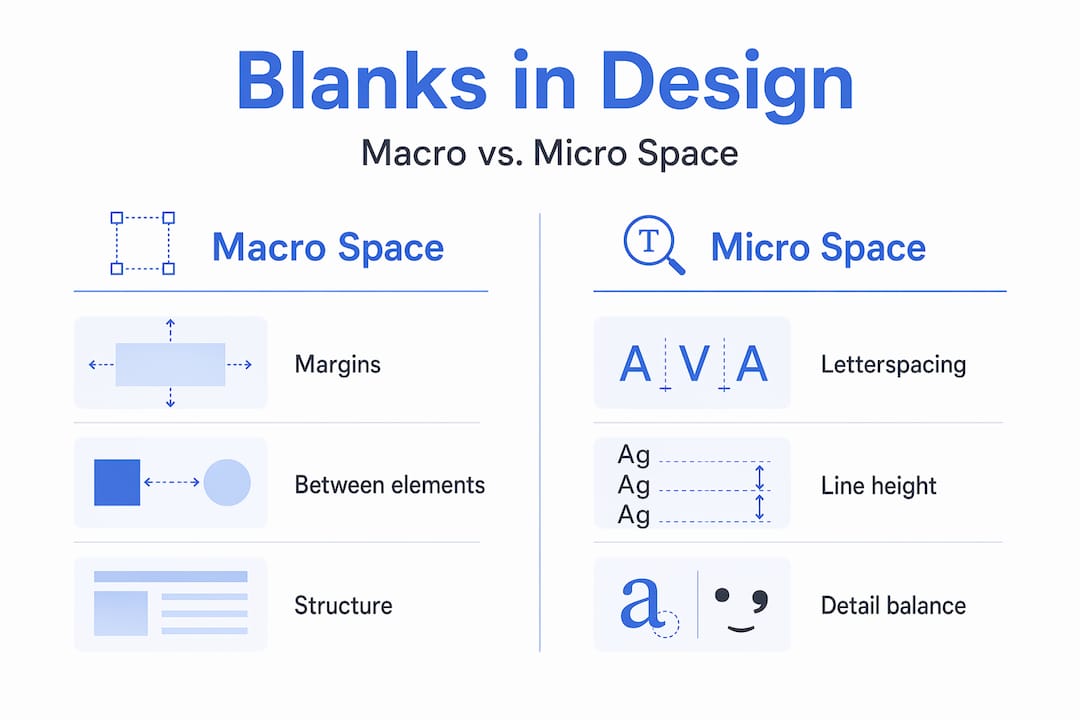
The cognitive case for blanks in design is not philosophical. Correct line height spacing improves reading speed by 20%, which is a measurable performance outcome from something that looks like nothing. Gestalt psychology adds another layer. The principle of proximity tells us the brain groups nearby objects as related, which means spacing can replace drawn lines, separators, or boxes entirely. The blank itself becomes the organiser.
Here is a practical diagnostic that professional designers use:
- Remove the blank space from your layout.
- Check whether readability suffers, whether visual hierarchy collapses, or whether the message becomes harder to decode.
- If the answer is yes, that space was load-bearing. It was doing structural work.
- If nothing changes, the space was genuinely wasted and can be reclaimed.
This subtraction test builds design instinct faster than any style guide. It shifts the question from “should I fill this?” to “what is this space currently doing?”
Pro Tip: When you feel the urge to fill a gap in your layout, pause and ask what the gap is already doing. Resisting the impulse to fill every corner is often what separates clear, confident design from cluttered, anxious work.
Typography is where this plays out most visibly. A well-spaced typeface with generous margins communicates confidence. The same words crammed together communicate urgency at best and chaos at worst. The importance of aesthetics in any visual output is inseparable from how much space surrounds each element.
Blanks in digital workflows and creative block
The role of blanks shifts interestingly when you move into digital creative environments. Two challenges emerge that are worth addressing separately: the empty state in digital products, and the blank page paradox in creative practice.
The empty state is what a user sees when they first open a tool before they have added anything. It is, by definition, a blank. Empty states in AI tools often cause user confusion and drop-off when they are treated as minimalism rather than as design opportunities. A blank screen with nothing to anchor to leaves people unsure where to begin.
Effective empty state design should expose product limits and prompt early action, reducing the friction of that first interaction. Practically, this means:
- Show worked examples inside the empty state so users understand what the filled version looks like.
- Use starting verbs in prompts (“Create your first badge,” “Upload your artwork”) to direct attention immediately.
- Expose the boundaries of what the tool can do so users do not waste time guessing.
- Trigger an early, achievable action that builds momentum and reduces abandonment.
This is not about filling the blank. It is about designing the blank so it functions as an invitation rather than a wall.
The second challenge is more personal. The blank page paradox describes how infinite possibility can paralyse creativity rather than inspire it. When nothing is ruled out, nothing is obvious either. The result is staring at the cursor or the canvas long enough to convince yourself you have nothing worth saying.
Creative constraints convert limitless blanks into manageable subsets. This is exactly why structured creative challenges work so well. Events like Inktober give illustrators a daily prompt. Game jams give developers a 48-hour window and a theme. Both reduce the surface area of decisions without removing creative ownership. The blank is still there, but the constraint frames it so that getting started becomes the obvious next move.
Pro Tip: If a blank canvas is stopping you, give yourself a single constraint before you begin. Limit your colour palette, set a 20-minute timer, or choose a word that must appear in your output. One rule turns infinite space into a specific problem to solve.
Blank products as creative canvases
The conversation about the role of blanks in creative industries extends well beyond design theory. Physical blank products, whether T-shirts, tote bags, badges, or MDF panels, are foundations for creative entrepreneurship. Understanding what custom blanks mean for creatives is the first step in seeing them as strategic assets rather than raw materials.
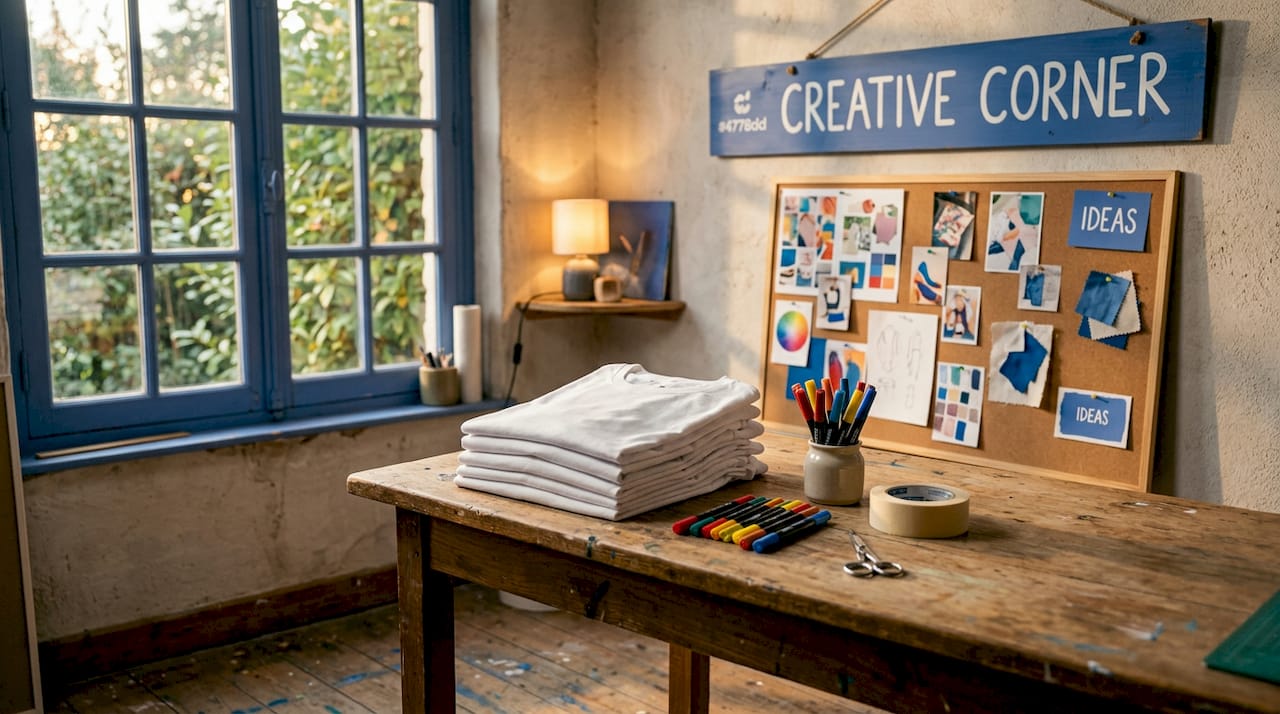
The blank apparel category demonstrates this clearly. House of Blanks built its reputation on made-in-Canada manufacturing, positioning its products as premium canvases rather than commodity stock. The blankness was the point, but what made the blank worth choosing was the quality of the fabric, the construction, and the story behind it. That is a lesson worth absorbing. AS Colour built a similar position in wholesale, growing into a billion-dollar business on blank T-shirts by giving small brands an affordable and scalable entry point to custom merchandise.
| Approach | Blank-based model | Fully branded model |
|---|---|---|
| Upfront investment | Low. No design locked in at manufacture. | High. Design and branding required before production. |
| Flexibility | High. Designs can change between runs. | Low. Changing designs means new tooling or stock. |
| Customisation | Full. Each unit can differ. | None. Product ships as designed. |
| Barrier to entry | Low. Ideal for small or new creative businesses. | High. Requires established demand to justify costs. |
| Creative control | Retained by the creative at application stage. | Fixed at manufacturer level. |
For creative professionals, the practical advantages are significant:
- Blank products allow you to test designs without committing to large production runs.
- They give you complete control over the final visual output.
- They can be personalised individually, which is impossible with pre-printed stock.
- The value of simplicity in design applies to the product itself. A clean blank is a better canvas than one with competing visual elements.
The quality of the blank determines how good the finished product can be. A low-grade fabric will limit how sublimation inks absorb and bond. A poorly surfaced MDF badge will compromise engraving depth and clarity. Blank product brands differentiate through fabric selection and local production, because the base quality is the ceiling of your creative output.
Best practices for using blanks effectively
Knowing that blanks matter is one thing. Putting that knowledge into practice is another. Whether you are working with negative space in a layout or choosing physical blanks for a product line, a few consistent principles will improve your results.
-
Choose your blank with the end use in mind. A sublimation print needs a polyester-coated surface. A laser-engraved design needs a compatible material such as MDF or acrylic. Starting from the finished output and working backwards to the blank prevents expensive mismatches.
-
Resist filling space as a reflex. In design, the urge to fill every gap often comes from discomfort rather than creative need. Sit with the empty space and ask what it is already communicating before adding anything to it.
-
Use the subtraction test regularly. Iterative removal tests identify load-bearing blanks and build your instinct for what is structural versus what is visual noise. Apply this to both digital layouts and physical product designs.
-
Balance minimalism with meaning. The role of minimalism in art and design is not to strip everything away. It is to make what remains carry full weight. Blanks work when they have purpose, not when they are the result of indecision.
-
Test at scale before committing. If you are producing physical blank products for customisation, order a small sample run first. Check how your chosen decoration method performs on the blank before scaling.
Pro Tip: Keep a reference file of layouts or designs where blank space is doing clear structural work. When you are unsure whether a gap in your current project is carrying its weight, compare it against your reference. Developing an eye for structural emptiness takes repetition.
Why I think we undervalue blank space
I have worked alongside designers, printers, and creative entrepreneurs long enough to notice a pattern. The most confident creative professionals are comfortable with space. The ones still finding their footing feel compelled to fill it. That discomfort with emptiness, with the blank, shows up in cluttered layouts, overstuffed products, and creative work that shouts instead of speaks.
What I find interesting is that the understanding exists. Ask most designers whether negative space matters and they will say yes immediately. But watch them work under pressure and the reflex to fill reasserts itself. Blanks are undervalued not because people think they are worthless, but because leaving space deliberately requires a kind of confidence that takes time to build.
The same applies to blank products. I have seen creative businesses spend considerable money on pre-printed stock that locks them into a single visual direction, when the same budget spent on quality blanks would have given them far more creative range. The blank is not the absence of a decision. It is the decision to keep your options open and your creative work at the highest possible quality.
Mastering how blanks enhance creativity, whether in a layout, a digital product, or a physical item you are preparing for decoration, is one of the clearest signals of creative maturity. It is also one of the most transferable skills across industries.
— chris
Subliblanks: your foundation for creative work
If you create custom products for retail, events, or promotional use, the quality of your blank is where the quality of your finished work begins. Subliblanks supplies a broad range of blank products designed specifically for creative professionals and small businesses, with no minimum order quantities so you can test and scale on your own terms.
The sublimation MDF name badge with pin and the round MDF name badge with magnet are two of the most versatile starting points in the range, ideal for events, retail branding, and personalised gifts. For those exploring broader product lines, the sublimation blanks guide walks you through choosing the right blank for your specific decoration method and end use. Subliblanks is built for creatives who take the quality of their blank seriously, because everything that follows depends on it.
FAQ
What is the role of blanks in creative industries?
Blanks serve structural, aesthetic, and functional roles across design, digital products, and physical creative output. They shape readability, guide attention, and provide the canvas for customisation in both visual and product-based work.
What is negative space in design?
Negative space is the intentional empty area surrounding or between design elements. It improves legibility, reduces cognitive load, and organises visual information without requiring additional graphic elements.
How do blanks help with creative block?
Adding a constraint to a blank canvas, such as a theme, time limit, or single-colour restriction, converts infinite possibility into a defined problem. This makes starting significantly easier and is the principle behind structured creative challenges like Inktober.
Why does blank product quality matter for customisation?
The quality of the blank determines how well a decoration method, such as sublimation printing or laser engraving, performs. Poor base materials limit ink absorption, surface clarity, and overall finish of the final product.
How do I know if blank space in my design is doing useful work?
Remove the space and check whether readability, hierarchy, or clarity suffers. If the layout becomes harder to read or understand without it, the space was structural and should stay.


