



Why buy wholesale in the UK: a guide for SMEs
TL;DR:
- Wholesale buying in the UK offers small businesses more than just lower unit prices; it enhances operational efficiency, inventory stability, and competitive margins. Establishing strong supplier relationships and understanding total landed costs is essential for maximizing benefits and avoiding common pitfalls. Modern digital platforms enable small firms to manage wholesale relationships effectively, provided they approach purchasing strategically and focus on long-term value.
Most small business owners discover wholesale buying the same way: chasing a cheaper price. But if that is your only reason to buy wholesale in the UK, you are leaving most of the value on the table. Bulk purchasing, or wholesale trade as it is formally known, is a strategic sourcing model that affects your margins, your cash flow, your inventory risk, and your operational overhead all at once. This guide breaks down what wholesale buying actually means for UK small businesses, where it genuinely helps, and where it can quietly cost you more than you expected.
Table of Contents
- Key takeaways
- Why buy wholesale in the UK: the core principles
- Benefits of buying wholesale for UK small businesses
- Common pitfalls when buying wholesale in the UK
- How to buy wholesale effectively in the UK
- Comparing wholesale sourcing channels
- My honest take on wholesale buying strategy
- Get started with Subliblanks wholesale supplies
- FAQ
Key takeaways
| Point | Details |
|---|---|
| Wholesale is more than cheap prices | Bulk purchasing reduces per-unit cost but also lowers shipping overhead and operational complexity. |
| Total landed cost matters | Unit price alone is misleading; storage, cash flow, and sales speed all affect real profitability. |
| Supplier relationships are a competitive asset | Strong wholesaler relationships give you access to better terms, promotional ranges, and stock continuity. |
| MOQ and bulk pricing serve different needs | Minimum order quantities protect cash flow for slower lines; bulk pricing rewards fast-moving stock. |
| Digital wholesale is now standard | 96% of UK B2B buyers prefer digital self-service portals for large orders. |
Why buy wholesale in the UK: the core principles
Wholesale purchasing means buying goods directly from a supplier, distributor, or intermediary in larger quantities than a standard retail transaction, at a discounted price per unit. The economics are straightforward: suppliers reduce their per-order cost when you commit to volume, and they pass a portion of that saving to you.
In the UK, wholesale pricing typically targets business margins of 15% to 30%, which is considerably lower than typical retail margins. That gap is where small business owners find their opportunity. You buy at a lower cost, sell at a market rate, and keep the difference.
Wholesale vs retail: what actually changes
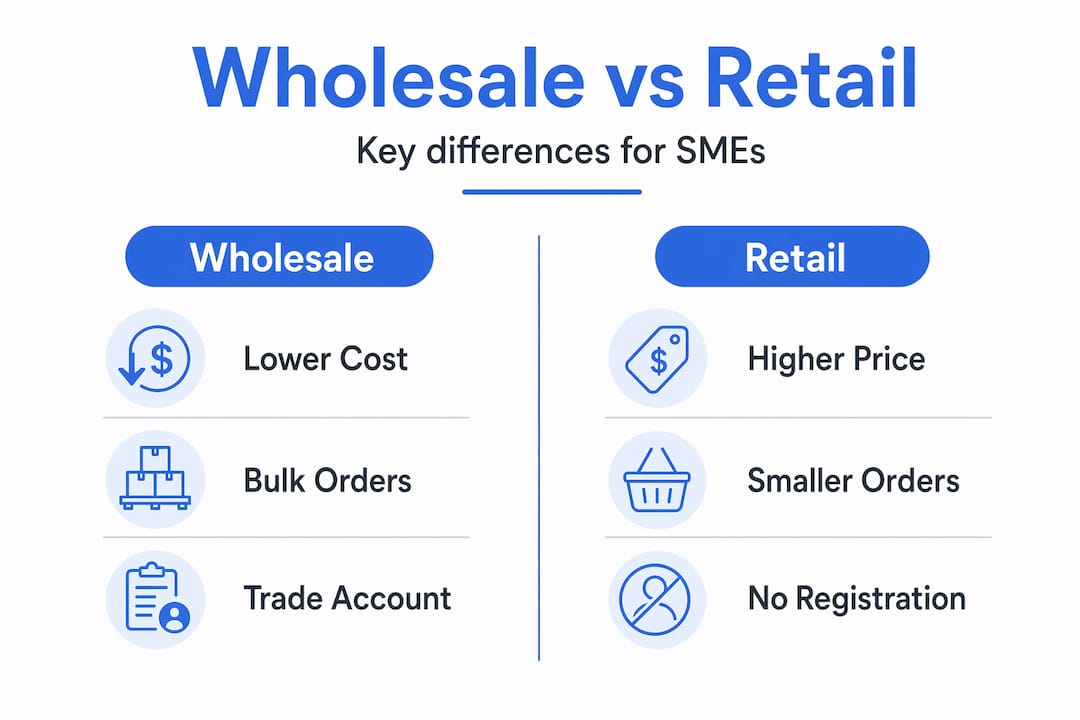
The table below shows the practical difference between buying at retail and buying wholesale for a small UK business.
| Factor | Retail purchase | Wholesale purchase |
|---|---|---|
| Unit cost | Higher | Lower with volume |
| Minimum quantity | None | MOQ applies |
| Payment terms | Pay on purchase | Net 30/60 often available |
| Relationship required | No | Yes, typically |
| Access to trade pricing | No | Yes |
| Shipping frequency | Per order | Consolidated, less frequent |
Most wholesale suppliers in the UK require you to register as a trade buyer and demonstrate a legitimate business purpose. Some ask for a VAT number or Companies House registration. This is not a barrier. It is simply how the channel is structured, and it filters out the general public to protect trade pricing.
Benefits of buying wholesale for UK small businesses
The most obvious benefit is cost reduction. But the advantages of bulk buying extend well beyond the unit price, and that is where many business owners miss the bigger picture.
Fewer orders, lower shipping costs. Bulk ordering consolidates purchases into fewer, larger shipments. If you currently place twelve small orders a year for the same product, consolidating to four larger ones cuts your shipping spend significantly. It also cuts the time your team spends processing invoices, chasing deliveries, and managing stock receipts.
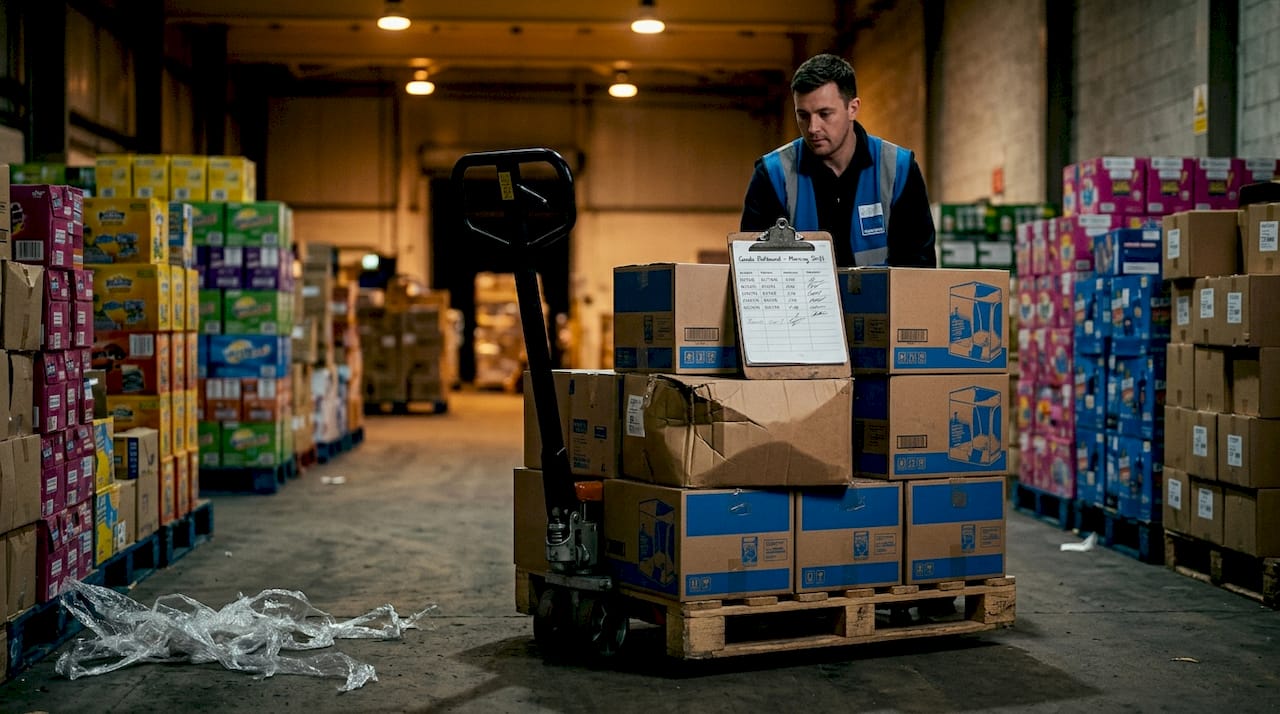
Inventory continuity and reduced supply risk. When you have an established relationship with a wholesale supplier, you gain access to predictable stock availability. Wholesalers reduce operational complexity and inventory risk for retailers by holding stock on your behalf, which means you are not scrambling to find a new supplier every time you run low.
Margin protection in a competitive market. UK retail is price-sensitive. Trade channels support access to promotional deals and own-label ranges that help you defend your margins even when market prices are squeezed. This is especially valuable if you operate in a sector where competitors regularly discount.
Access to broader product ranges. Many wholesale suppliers carry product lines that simply are not available through retail channels. For creative businesses and print-on-demand entrepreneurs in particular, wholesale access means getting the right sublimation blanks and specialist supplies at prices that make the business model work.
Pro Tip: When you calculate the benefit of a wholesale deal, factor in how many hours per month you spend on reordering, supplier communication, and stock chasing. Time has a cost too. A slightly higher unit price from a reliable wholesale supplier who delivers on time every time can easily beat a cheaper supplier who creates constant admin headaches.
Common pitfalls when buying wholesale in the UK
Understanding the benefits is only half the picture. The wholesale purchasing advantages can disappear quickly if you approach it without discipline.
Here are the four most common mistakes UK small businesses make with wholesale buying:
-
Focusing only on unit price. The cheapest unit price is not always the best deal. Total landed cost includes shipping, storage, insurance, handling, and the cost of capital tied up in your stock. A product that costs 20p less per unit but requires you to hold three months of stock in a paid storage facility may actually cost more overall.
-
Confusing MOQ with bulk pricing. Minimum order quantity (MOQ) is the smallest amount a supplier will sell you. Bulk pricing is a volume discount applied above a certain threshold. These are different levers. Choosing between MOQ and bulk pricing should be based on your sales velocity, storage capacity, and cash position. Not simply on which order is largest.
-
Overstocking slow-moving lines. Dead stock is expensive. It ties up cash, occupies storage space, and often has to be cleared at a loss. Before committing to a large wholesale order on a new product line, run a smaller test order first, even if the unit economics look better at higher volumes.
-
Ignoring supplier service quality. Evaluating wholesalers must go beyond price to include stock availability, replenishment speed, and service reliability. A supplier who is regularly out of stock or slow to deliver forces you into expensive emergency purchases elsewhere, which cancels out any savings you made upfront.
Pro Tip: Before placing a large bulk order with a new UK wholesaler, ask for a sample order first. Most legitimate trade suppliers will accommodate this. It lets you assess product quality, delivery speed, and communication before committing your full budget.
How to buy wholesale effectively in the UK
Once you understand the risks, the process of buying wholesale becomes far more manageable. Here is how to approach it with confidence.
-
Research wholesalers thoroughly. Look beyond the first Google result. Check independent reviews, ask in trade forums, and look for suppliers with a clear track record in your sector. UK-based wholesalers operating under UK consumer and trade law offer stronger protections and more reliable delivery timelines.
-
Understand the terms before you order. Payment terms, delivery windows, return policies, and MOQ rules vary widely between wholesale suppliers in the UK. Read the terms carefully. Net 30 or Net 60 payment terms can be genuinely useful for cash flow management if you negotiate them upfront.
-
Use demand forecasting to guide order volumes. Even a rough forecast based on your last three months of sales is better than ordering on gut instinct. Match your wholesale order quantities to realistic expected sales, not optimistic ones.
-
Negotiate. Many UK wholesalers are open to discussion on price, especially once you have an established buying history. Volume commitments, prompt payment, and repeat orders all give you negotiating leverage. You can also ask about promotional pricing or end-of-line deals.
-
Use digital platforms to your advantage. Modern wholesale purchasing has moved online. You can compare catalogues, track orders, and manage accounts through supplier portals without needing to phone a sales rep for every transaction. This makes the whole process faster and far easier to manage your wholesale trade on your own terms.
Comparing wholesale sourcing channels
Not all wholesale suppliers operate the same way. The three main sourcing channels each come with different trade-offs.
| Channel | Pricing | Lead time | Flexibility | Best suited for |
|---|---|---|---|---|
| Direct manufacturer | Lowest potential | Longer | Less flexible | High-volume, stable lines |
| Wholesale intermediary | Competitive | Faster | More flexible | Most UK SMEs |
| Cash-and-carry | Variable | Immediate | Very flexible | Low-volume, urgent needs |
Buying direct from a manufacturer can offer the lowest unit prices, but it comes with complexity. You typically need to meet high MOQs, manage longer lead times, and handle your own quality control and logistics.
Wholesale intermediaries reduce that complexity considerably. They hold stock, manage supplier relationships on your behalf, and often provide faster delivery and more flexible order sizes. For most UK small businesses, an intermediary wholesaler offers a better balance of price and practicality than going direct.
Cash-and-carry outlets work well for urgent, low-volume top-ups but are rarely the right primary sourcing channel. Pricing is inconsistent and you lose the operational benefits that come from a managed wholesale relationship.
My honest take on wholesale buying strategy
I have seen a lot of UK small businesses approach wholesale purchasing as a simple cost-cutting exercise, and most of them are disappointed when the savings do not materialise the way they expected. The problem is almost never the supplier. It is the strategy.
What actually works, in my experience, is treating wholesale as a relationship rather than a transaction. The businesses that consistently benefit from bulk supply savings are the ones that take the time to understand their own sales patterns before they commit to volume. They know which lines sell fast, which sit on shelves, and what their real storage costs are. That knowledge turns a wholesale account from a potential cash drain into a genuine competitive advantage.
The digital shift in B2B wholesale has made this easier than ever. Self-service ordering portals, digital catalogues, and automated reorder triggers mean you can manage a wholesale buying strategy without a dedicated procurement team. For a small business owner wearing five hats at once, that matters.
My strongest piece of advice: do not let a good unit price override your judgement about cash flow. The business that runs out of operating capital because it over-committed to a bulk order it has not yet sold is not in a better position than the one that paid slightly more per unit and kept its cash working.
— chris
Get started with Subliblanks wholesale supplies
If you run a print, craft, or personalisation business in the UK, getting your supply costs right is the difference between healthy margins and constant pressure.
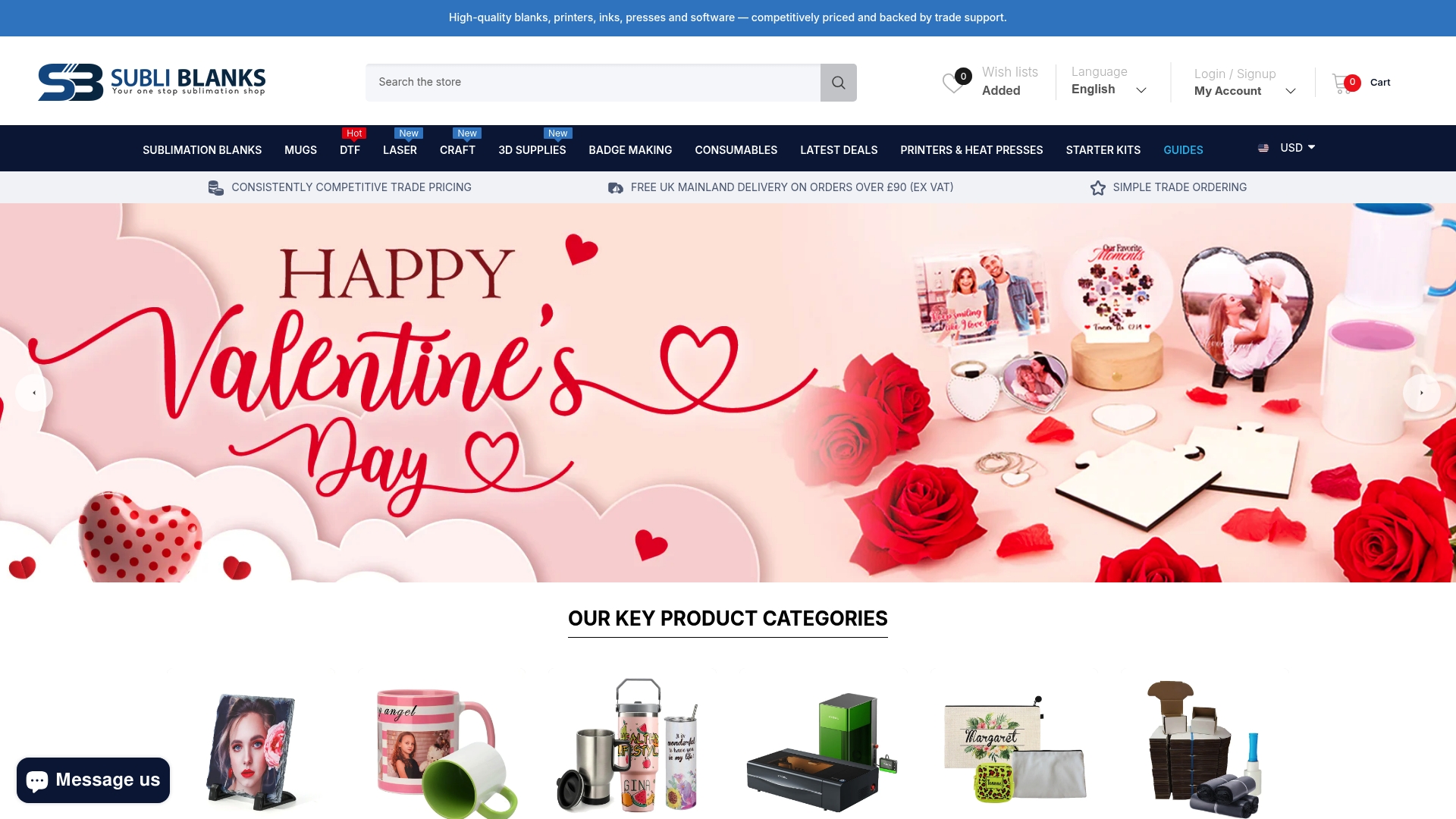
Subliblanks is a UK-based trade wholesaler supplying sublimation blanks, sublimation paper, DTF supplies, laser-engraveable blanks, and a full range of creative production materials. Critically, there are no minimum order quantities, which means you can buy what you actually need rather than what a MOQ forces on you. That changes the cash flow equation entirely for smaller operations. Whether you are just starting out or scaling up, explore the pre-cut sublimation paper range or the full A4 bulk paper packs to see how wholesale pricing works without the usual volume pressure.
FAQ
What does buying wholesale in the UK actually mean?
Wholesale buying means purchasing goods in bulk from a supplier or intermediary at a discounted per-unit price. In the UK, you typically need to register as a trade buyer with a valid business.
Is wholesale worth it for small UK businesses?
Yes, when approached strategically. Wholesale purchasing reduces per-unit and shipping costs, but the real value comes from inventory continuity and supplier relationships, not just cheaper prices.
What is the difference between MOQ and bulk pricing?
MOQ is the minimum quantity a supplier requires per order. Bulk pricing is a volume discount applied above a certain threshold. They are separate mechanisms and should each be evaluated based on your sales speed and cash position.
How do I find reliable wholesale suppliers in the UK?
Research through trade directories, sector-specific forums, and supplier review platforms. Prioritise suppliers with clear delivery records, transparent terms, and responsive customer service over those offering simply the lowest price.
Do I need a VAT number to buy wholesale in the UK?
Most UK wholesale suppliers require proof of a legitimate business, which often includes a VAT number or Companies House registration. This protects trade pricing from being accessed by the general public.


