



DIY credit card badge guide for UK makers
TL;DR:
- Making your own credit card badges with fabric and vinyl offers a cost-effective, customizable alternative to generic options, enhancing branding and personalisation. The process involves precise cutting, sewing, and decorating, with optional electronics like LED syncing for tech-savvy projects, all while ensuring quality through thorough testing and proper materials. This DIY approach produces professional-looking badges that can stand out at events, fostering a unique, handcrafted impression and saving money over commercial alternatives.
If you’ve ever searched for affordable, personalised credit card badges for an event or workplace ID scheme, you’ll know how quickly costs add up and how uninspiring the generic options look. This diy credit card badge guide walks you through everything you need: materials, sewing techniques, decoration methods, and even electronics for tech-enthusiastic makers. Whether you’re an individual crafter or a small business owner in the UK or Ireland looking to save money and strengthen your branding, making your own badge holder, the recognised term for a credit card sized ID carrier, puts you firmly in control.
Table of Contents
- Key takeaways
- Your DIY credit card badge guide: materials and tools
- Sewing a fabric and vinyl badge holder step by step
- Customising and decorating your badge holder
- Advanced option: syncing LED badges
- Checking quality and fixing common mistakes
- My honest take on making your own badge
- Start your badge project with Subliblanks
- FAQ
Key takeaways
| Point | Details |
|---|---|
| Materials matter | Choose clear vinyl for the window and durable outer fabric or faux leather for a badge that survives daily use. |
| Accurate sizing is critical | Cut pieces to approximately 5" H x 4" W with a 1/4" seam allowance for a comfortable card fit. |
| Customise with confidence | Cricut machines and resin topcoats let you add professional decoration without expensive equipment. |
| Electronics are optional but impressive | ESP32 microcontrollers with the ESP-NOW protocol can sync LED badges wirelessly across a crowd. |
| Quality checks save rework | Test card fit, seam strength, and grommet security before handing out finished badges at an event. |
Your DIY credit card badge guide: materials and tools
Before cutting a single piece of fabric, getting your supplies sorted makes the difference between a frustrating afternoon and a satisfying result. A well-stocked workstation means fewer interruptions and a neater finished piece.
Physical materials
The core of any fabric badge holder is a clear vinyl window, which lets the card remain visible without being removed. Heavy-duty, soft vinyl or fabric in the 12 to 16 gauge range works well for the window panel. Your outer shell can be cotton fabric, canvas, or faux leather. Faux leather in particular looks polished and holds its shape, making it a popular choice for small business ID badges.
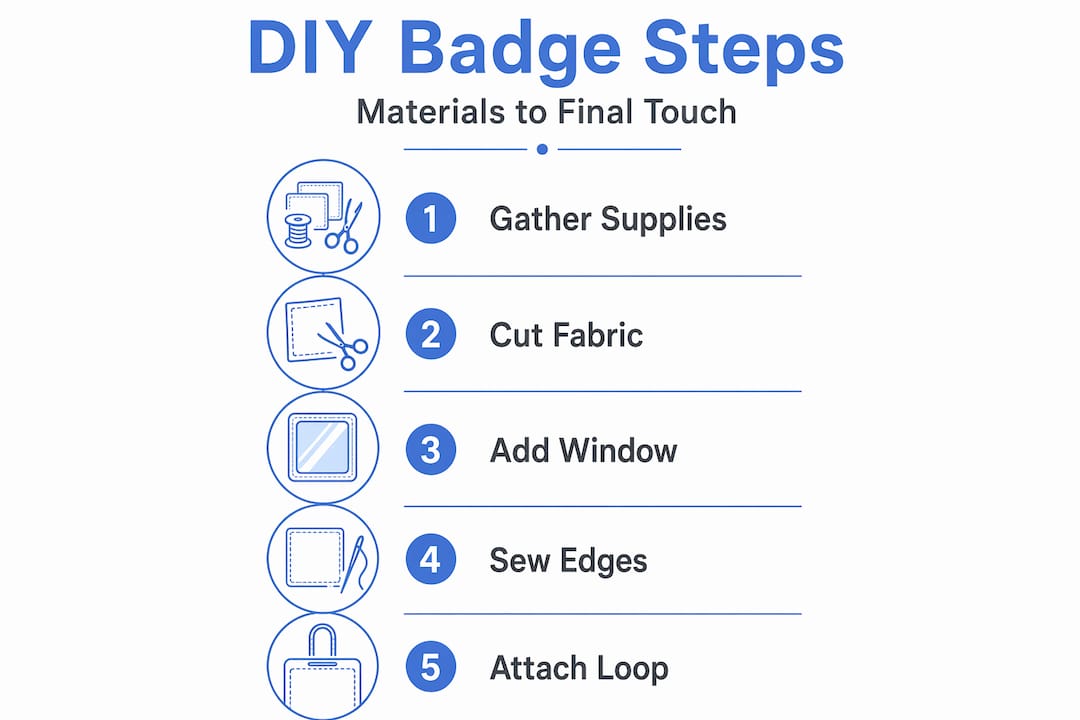
You’ll also need a grommet or a reinforced fabric loop at the top to accept a lanyard or badge reel clip. Grommets come in packs from most UK craft suppliers and are inexpensive.
| Supply | Purpose | Optional or required |
|---|---|---|
| Clear vinyl (12-16 gauge) | Visible window for the card | Required |
| Cotton fabric or faux leather | Outer shell of the holder | Required |
| Grommets or D-ring loops | Lanyard attachment point | Required |
| Double-sided tape | Holds vinyl in place while sewing | Recommended |
| Embroidery thread or topstitch thread | Decorative and durable stitching | Recommended |
| LED components and ESP32 board | Wireless syncing light effects | Optional |
| Resin or epoxy coating | Gloss finish and scratch resistance | Optional |
Tools you’ll need
- Sewing machine with a size 90/14 needle (thick enough to pierce vinyl without skipping)
- Sharp fabric scissors or rotary cutter
- Metal grommet setter or eyelet tool
- Ruler and fabric marker
- Craft glue or gel superglue for non-sewn elements
Pro Tip: Place a strip of tissue paper between your presser foot and the vinyl when sewing. It stops the foot from dragging and peeling the material, and you simply tear it away once the seam is done.
Good preparation also means understanding your badge supply options before committing to a method, especially if you plan to produce more than a handful of holders.
Sewing a fabric and vinyl badge holder step by step
This method follows a popular UK sewing approach that produces a tidy badge holder with a clear vinyl window and a reinforced top loop for a lanyard. It suits complete beginners as well as more experienced sewers.
- Cut your pieces. Cut two rectangles of outer fabric and one piece of clear vinyl, all at approximately 5" H x 4" W with a 1/4" seam allowance included. Precision here prevents a wonky finish.
- Attach the vinyl window. Lay the vinyl piece onto the right side of your front fabric panel and pin or tape it in place across three edges, leaving the top edge open as an access flap so the card can slide in and out. Sew around the three pinned edges with a straight stitch.
- Prepare the back panel. If you want a pocket on the back, now is the time to fold and press a small piece of matching fabric before positioning it on the second rectangle.
- Join the layers. Place the front and back panels right sides together and stitch around all four edges, leaving a short gap at the bottom for turning. Clip the corners close to the stitching, without cutting through the thread, to reduce bulk.
- Turn right side out. Push the corners out gently with a blunt pencil or chopstick. Press the holder flat with a warm iron, being careful not to apply direct heat to the vinyl. A pressing cloth protects both surfaces.
- Topstitch. Run a topstitch line approximately 3mm from the edge all the way around. This is the step that gives the finished holder its neat, professional appearance and adds structural strength. Leather and vinyl holders benefit particularly from precise topstitching as it holds the layers flat without glue.
- Add the grommet. Mark the centre of the top edge, punch a hole with your eyelet tool, and set the grommet according to the manufacturer’s instructions. Thread your lanyard clip or fabric loop through and you’re done.
Pro Tip: Run a test seam on scrap fabric and vinyl before starting on your actual pieces. Vinyl behaves very differently from cotton and a quick practice run saves you from unpicking stitches in the finished piece.
For reference on how this approach applies to making event badges at scale, it’s worth reviewing how production quantities change the workflow.
Customising and decorating your badge holder
Once the construction is solid, decoration is where you can really make the badge your own. There is a wide gap between what a basic badge looks like off the machine and what a bit of creative effort produces.

Faux leather flowers are one of the most popular embellishments for badge reels in the UK. Cut on a Cricut Maker, Explore, or Joy machine with the correct blade setting, faux leather produces clean, intricate petal shapes that you layer and glue onto the front of a badge reel clip. The result looks handcrafted rather than homemade.
Popular decoration techniques include:
- Printed vinyl decals applied directly to the badge holder front
- Hand-stamped fabric panels using ink and rubber stamps
- Faux leather laser-cut shapes glued with a gel superglue such as Gorilla Super Glue Gel XL
- Fabric paint or embroidery for a truly unique finish
- Resin topcoats for a smooth, glossy, protective layer
A resin topcoat is worth considering for any badge that will be handled repeatedly. Resin resists scratches and prevents decals or printed vinyl from peeling, which makes a real difference over months of daily wear. You apply it in a thin, even layer over the decorated surface and allow it to cure flat, usually overnight.
Pro Tip: When using resin over stickers or vinyl decals, seal the edges of the decal first with a thin layer of PVA glue and let it dry before applying the resin coat. This prevents air bubbles forming under the design.
If you want a truly distinctive badge for your business or event, look at what custom badge branding can do beyond simple decoration. The principles are the same whether you’re making one or fifty.
Advanced option: syncing LED badges
For festival organisers, event managers, or tech-savvy makers, adding electronics to a badge pushes it well beyond a simple ID holder. Synced LED badges create a crowd effect where dozens of badges pulse or flash in unison, and they are genuinely achievable without an electronics engineering degree.
The core component is an ESP32 microcontroller paired with the ESP-NOW wireless protocol. What makes this approach clever is how the syncing works. Rather than relying on a single master unit broadcasting a signal, each badge broadcasts its local clock tick to nearby devices. Every device listening updates to match the highest tick value it receives. This distributed consensus mechanism means no single point of failure can disrupt the whole network, and badges that arrive late or swap hands during an event resync quickly.
| Feature | Standard fabric badge holder | LED syncing badge |
|---|---|---|
| Construction difficulty | Low to medium | Medium to high |
| Cost per unit | Under £5 in materials | £10 to £25 depending on components |
| Tools required | Sewing machine, basic craft tools | Soldering iron, microcontroller, coding knowledge |
| Best for | Everyday ID, small business branding | Festivals, large public events, tech showcases |
| Durability | High with resin finishing | Moderate, depends on waterproofing |
| Personalisation | Visual only | Visual and interactive |
The electronics approach is not for every project, but for a festival or brand activation where visual impact matters, the effect is striking and the cost per unit remains manageable.
Checking quality and fixing common mistakes
Even experienced makers encounter issues on their first few badge holders. Knowing what to look for saves you from handing out a poorly finished product.
- Check card fit before finishing. Slide a credit card into the holder before you add the grommet. If it’s stiff, the seam allowance may have been cut too tight. Better to catch this now than after the grommet is set.
- Test seam strength. Tug the top and bottom seams firmly. Any seam that opens under light tension needs reinforcing with a second line of stitching before the badge is used.
- Inspect the vinyl window. Look for any stitching that has punctured the vinyl too close to the edge, which can cause tearing over time.
- Verify the grommet is set securely. A loose grommet is a safety issue if the badge is worn on a lanyard around the neck. Press it firmly onto a hard surface and try to rotate it by hand. It should not move.
- Check decoration adhesion. If you’ve used glue or resin, flex the badge gently to confirm nothing lifts or cracks.
A badge that fails in the first week reflects poorly on your brand or event, regardless of how good it looked on the table. Taking ten minutes to verify each batch is always worth it.
For further context on how badge security and trust connect to the quality of the finished product, it’s a topic that matters far beyond aesthetics.
My honest take on making your own badge
I’ve worked with makers and small business owners across the UK and Ireland who assumed DIY badge holders were a compromise. A cheap fallback when the budget ran dry. In my experience, that’s the wrong framing entirely.
The badge holders that get noticed at events are almost never the laminated, off-the-shelf ones. They’re the fabric and faux leather ones with a distinctive finish, or the LED badges pulsing in a crowd. The DIY version is frequently the better product.
What I’d caution against is overcomplicating your first attempt. The sewing method covered here produces a genuinely professional result with basic equipment. Get that right first, then layer on the decoration and, if it interests you, the electronics. Trying to do everything at once on a first project leads to frustration rather than satisfaction.
For small business owners, the cost saving is real but the branding advantage is larger. A badge you made yourself, with your logo printed via sublimation and a resin-sealed finish, communicates more care than a generic printed insert in a clear plastic sleeve. Your customers notice these details, even when they can’t articulate why.
The learning curve is a single afternoon, not a long-term commitment. Start with two or three samples. By the third one, you’ll have it dialled in.
— chris
Start your badge project with Subliblanks
If you’re ready to take your badge designs beyond basic fabric and into sublimation-quality printing, the paper you use makes a significant difference to colour vibrancy and durability. Subliblanks stocks a range of professional-grade sublimation papers suited to badge projects of every size. The A4 SubliFlex sublimation paper in a 200-sheet pack is an excellent starting point for makers producing small batches of custom badge inserts. For larger format designs or A3 sheet work, the A3 SubliFlex paper pack delivers consistent transfers at a trade-friendly price with no minimum order required. Whether you’re a sole crafter or a small business building a stock of branded ID holders, Subliblanks has the supplies to support the whole process.
FAQ
What materials do I need to make a credit card badge holder?
You need clear vinyl for the window, outer fabric or faux leather for the shell, grommets for the lanyard loop, and a sewing machine with a size 90/14 needle. Double-sided tape helps hold the vinyl in place while stitching.
What size should I cut the pieces for a credit card badge?
Cut your fabric and vinyl pieces to approximately 5" H x 4" W, including a 1/4" seam allowance on all sides, to achieve a comfortable fit for a standard credit card.
How do I stop vinyl from sticking to the sewing machine foot?
Place a strip of tissue paper between the presser foot and the vinyl surface. The tissue prevents dragging and tears away cleanly once the seam is complete.
Can I add a glossy finish to my DIY badge holder?
Yes. A resin or epoxy topcoat applied over the decorated surface resists scratching and peeling, making it suitable for badges that will be handled every day.
Do synced LED badges require a central controller?
No. Using the ESP-NOW protocol with ESP32 microcontrollers, each badge broadcasts its clock tick and syncs to the highest value it receives, so the network functions reliably without any single master device.


