



How to make custom badges that build your brand
TL;DR:
- Custom badges enhance brand visibility, convey professionalism, and strengthen identity at events and workplaces. Choosing quality materials and diligent quality checks are essential for producing durable, impactful badges. Start with storytelling and audience connection before selecting design and production methods to create meaningful, memorable badges.
Custom badges are rarely given the credit they deserve. Spend time at any industry expo, community event, or trade show and you’ll notice that the booths drawing the most attention aren’t just the ones with the biggest banners — they’re the ones where every detail, right down to the staff badges, signals professionalism and purpose. For small business owners and craft enthusiasts across the UK and Ireland, mastering custom badge making opens a surprisingly powerful channel for brand visibility, event identity, and creative expression. This guide walks you through every stage, from choosing materials to scaling production, so you can create badges that actually do something.
Table of Contents
- Why custom badges matter for modern brands and events
- Essential materials and tools for badge making
- Step-by-step guide: The custom badge making process explained
- Ensuring quality and what most badge makers miss
- Scaling up: From craft to commercial badge production
- Why creativity and storytelling matter more than machinery
- Start your custom badge journey with SubliBlanks
- Frequently asked questions
Key Takeaways
| Point | Details |
|---|---|
| Badges boost branding | Custom badges help small businesses and event organisers stand out and build trust. |
| Material choice matters | Picking the right badge material affects durability, design, and user experience. |
| Quality assurance is vital | Consistent checks during badge making protect reputation and customer satisfaction. |
| Scaling is possible | With batch production and workflow tools, even craft-scale makers can tackle large badge orders. |
Why custom badges matter for modern brands and events
There’s a common misconception that badges are purely functional, handed out at the door and forgotten by lunchtime. The reality is quite different. A well-designed badge communicates hierarchy, builds trust between staff and customers, and reinforces brand identity in a way that’s immediate and personal. When a customer sees a staff member wearing a clearly branded, professionally finished badge, it signals that the business takes itself seriously.
Badge supplies play a key role in establishing security and trust at events and in workplaces. This matters especially at larger gatherings where event staff need to be identifiable at a glance, or in retail environments where customer confidence hinges on visible, consistent branding.
Here’s what custom badges can do for your brand or event:
- Establish credibility by showing visitors and clients that your team is organised and professional
- Improve security by making authorised personnel instantly recognisable at events
- Reinforce brand colours and fonts through consistent design across all team members
- Serve as conversation starters when unique or personalised designs catch a visitor’s eye
- Create community at trade events, fan conventions, or team building days where identity matters
“The smallest details often carry the biggest messages. A badge isn’t just identification — it’s a statement about how much you care about the experience you’re creating.”
For smaller businesses especially, the badge is one of the few branded touchpoints that gets right up close to customers. It’s worth getting it right.
Essential materials and tools for badge making
Choosing the right material for your badge is where quality begins. Each material type suits different purposes, and selecting the wrong one can lead to faded prints, broken backings, or badges that simply don’t survive a busy event day.
The most popular options are:
- MDF (medium density fibreboard): Excellent for sublimation printing. MDF badges with pin backing offer a smooth surface that holds colour brilliantly and feels substantial in hand.
- Metal: Durable, premium-looking, and ideal for long-term use such as corporate name badges.
- Polymer/plastic: Lightweight and cost-effective for large runs or short-term event badges.
- Eco-friendly materials: Biodegradable or recycled options are growing in popularity for sustainability-conscious brands.
MDF and polymer options are particularly popular for their combination of durability and vibrant printing possibilities. For those wanting versatile shapes, a rectangle MDF badge is a great choice for name badges that need more text, while a round badge with magnet backing works well where pin holes in clothing are not acceptable.
| Material | Best for | Durability | Print quality | Cost |
|---|---|---|---|---|
| MDF | Sublimation, events, branding | High | Excellent | Low to mid |
| Metal | Corporate, long-term use | Very high | Good | Mid to high |
| Polymer/plastic | Short events, promos | Medium | Good | Low |
| Eco-friendly | Sustainable brands | Medium | Variable | Mid |
When it comes to backings, the three most common options are pin, magnet, and clip. Pin backings are the most secure and widely used. Magnetic backings are fabric-friendly and suit uniforms or delicate materials. Clips are used for lanyards or belt loops.
Pro Tip: Always test your chosen backing on the actual garment fabric your team will be wearing before ordering in bulk. A strong magnet may be unsuitable for lightweight shirts, and a pin on a knitted jumper can cause damage.
Step-by-step guide: The custom badge making process explained
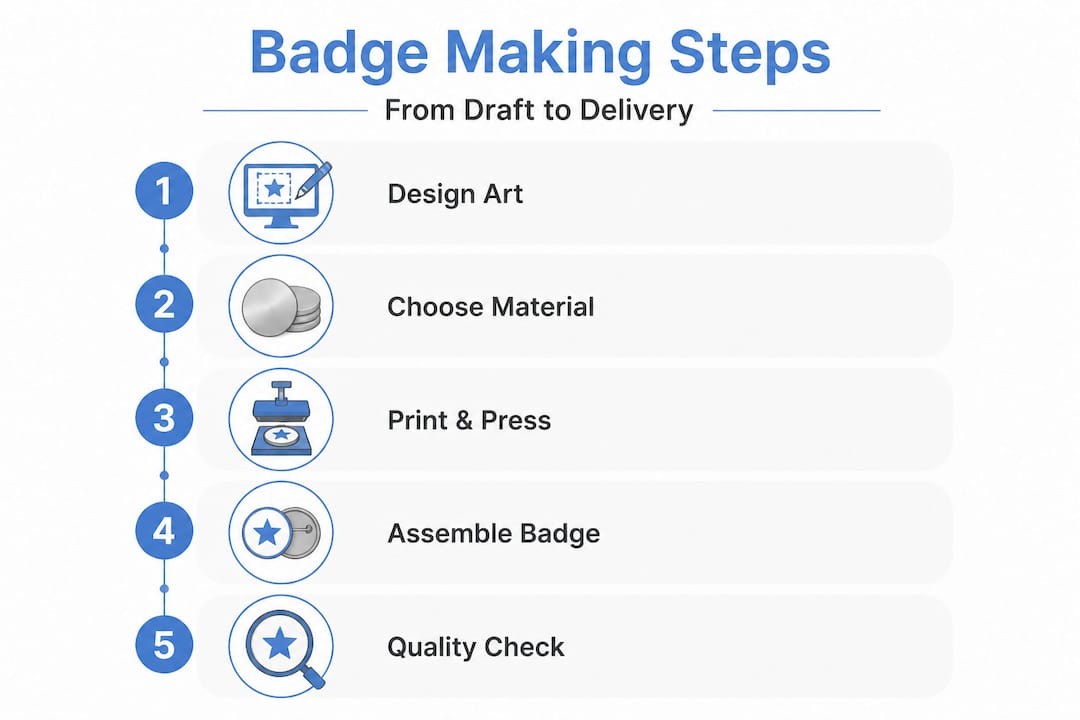
Understanding the full production process helps you plan more accurately, avoid costly mistakes, and produce badges with consistent quality. Modern badge making processes can be broken down into preparation, printing, cutting, assembling, and finishing.
Here’s how that looks in practice:
-
Design preparation. Create your badge artwork on a computer using design software such as Adobe Illustrator, Canva, or CorelDRAW. Work at the correct dimensions and resolution (at least 300 DPI for print). Include bleed lines if your badge will be cut after printing.
-
Printing. Transfer your design onto the badge blank using your chosen method. Sublimation printing onto MDF produces particularly vibrant and lasting results. Digital printing and screen printing are alternatives depending on your equipment and volume.
-
Cutting and shaping. For precut badge blanks this step is straightforward, but if you’re working with sheet materials, use a die cutter or laser cutter for clean, consistent edges. Precision here is essential for a professional look.
-
Assembly. Attach your chosen backing (pin, magnet, or clip) securely. For sublimation MDF badges, backings are typically pre-attached to the blank, but always verify the bond before packaging.
-
Finishing. Apply any protective coating if required, check for smears or surface damage, and package appropriately. Presentation matters, especially if you’re supplying badges for a premium event or corporate client.
-
Quality check. Before anything goes out, inspect a sample from each batch for print clarity, secure backing, and overall finish.
| Production stage | Time estimate | Key risk |
|---|---|---|
| Design preparation | 30 min to 2 hours | Incorrect sizing or resolution |
| Printing | 5 to 15 min per batch | Colour shift or sublimation errors |
| Cutting and shaping | 10 to 30 min | Uneven edges if not precision-cut |
| Assembly | 5 to 20 min | Backing not bonded securely |
| Quality check | 10 to 15 min | Overlooked defects reaching customers |
Pro Tip: Always print a test badge before running your full batch. This single step catches colour, sizing, and alignment issues before they multiply across your entire order.
Ensuring quality and what most badge makers miss
Quality assurance (QA) is the step that separates hobbyist badge makers from those who build real reputations. A strong focus on QA can noticeably reduce defects and improve buyer confidence by as much as 30%.
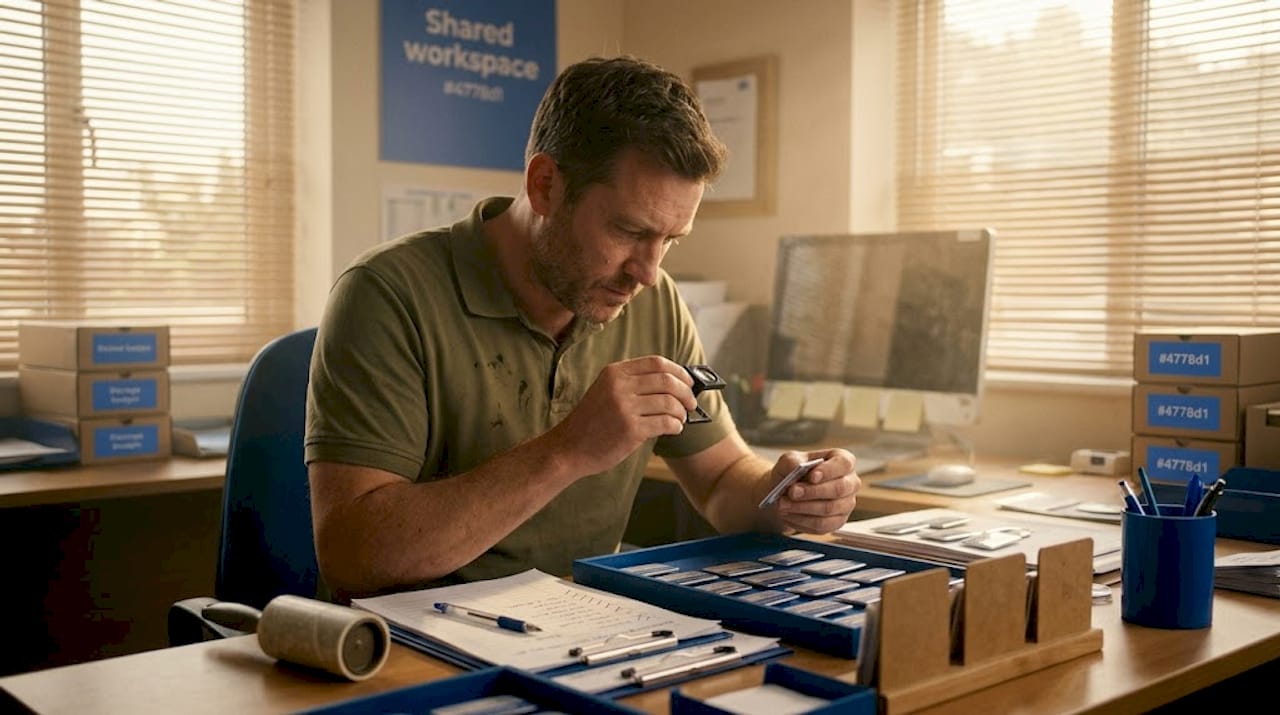
Most badge makers rush the finishing stage. Once the printing looks good, there’s a temptation to move straight to packaging. But this is where critical details get missed.
Key quality checks to carry out on every batch:
- Print clarity: Check for fading, colour banding, or smudging across the full surface of the badge
- Edge quality: Inspect for rough cuts, chips, or uneven edges, particularly on rounded badges
- Backing security: Physically test each pin or magnet attachment. A loose backing is the most common complaint from badge buyers
- Surface integrity: Look for bubbles, scratches, or delamination on the print surface
- Sizing consistency: Measure a sample from each batch to confirm dimensions are accurate
“Skipping a sample check at the start of a new badge run is the single most expensive mistake a small maker can make. One faulty setting can ruin an entire day’s production.”
A practical approach for small businesses is to establish a simple QA checklist that’s completed before packaging each order. This doesn’t need to be sophisticated. A printed sheet with checkboxes, completed and signed off per batch, gives you accountability and helps identify recurring issues quickly.
Common pitfalls to avoid include using incorrect heat settings during sublimation (which causes colour shifts), applying too much pressure during pressing (which distorts the badge blank), and skipping protective coatings on high-use badges that will be handled frequently.
Scaling up: From craft to commercial badge production
Once you’ve nailed the process for small runs, you’ll likely find demand growing. Scaling badge production is a different challenge from simply making more badges. It requires rethinking your workflow, managing consumables, and deciding what stays in-house versus what gets outsourced.
Optimising processes and workflow is critical when scaling production for larger orders. Here’s how to approach it:
Batch production tips:
- Group badge orders by material type and design so you can run full sublimation sheets rather than individual pieces
- Pre-cut all blanks before printing to reduce downtime between stages
- Set up a dedicated workspace with clearly labelled stations for each production phase
- Use blank sublimation sheets or bulk badge blank packs to reduce per-unit material cost
Deciding between DIY and outsourcing:
| Factor | Keep in-house | Consider outsourcing |
|---|---|---|
| Order size | Under 200 units | Over 500 units |
| Turnaround time | Flexible lead times | Tight deadlines |
| Design variation | High personalisation needed | Standard repeated designs |
| Equipment investment | Already owned | Major new spend required |
Managing consumables is often underestimated. Running out of badge blanks, sublimation paper, or ink mid-run causes costly delays. Maintain a small buffer stock of your most used materials, and track usage per batch so you can forecast accurately.
Automation helps at scale. Even simple steps like printing address labels and order sheets in advance, or batching your design files the night before production, add up to significant time savings across a working week.
Why creativity and storytelling matter more than machinery
Here’s something the badge making industry doesn’t say loudly enough: the quality of your equipment matters far less than the quality of your thinking. We’ve seen makers with entry-level badge presses produce results that outshine those with professional print setups, simply because they thought harder about the design and the story the badge needed to tell.
Anyone can learn to operate a heat press or a sublimation printer. What’s genuinely rare is the maker who considers the audience receiving the badge, the moment it will be worn, and the feeling it should evoke. A badge for a children’s literacy event should feel playful and warm. A badge for a corporate security conference should feel authoritative and precise. These are not the same badge, even if they’re made from the same MDF blank.
Personalising designs for team culture, event theme, or brand values leads to measurably better engagement. Attendees keep badges that mean something to them. They photograph them, share them, and sometimes wear them long after the event ends. That’s free brand exposure that no amount of machinery can buy.
Our honest view is that crafters and small business owners too often focus on the technical side first, researching equipment and materials before they’ve decided what they actually want to say with the badge. Flip this around. Start with the story and the audience. Then choose the material, shape, and process that best brings that story to life. The machinery follows the idea, not the other way around.
Don’t make another round disc with a logo and a name. Make something the wearer feels proud to put on.
Start your custom badge journey with SubliBlanks
Ready to put these ideas into practice? SubliBlanks stocks everything you need to go from design concept to finished badge, whether you’re making a handful for a local event or scaling up to supply corporate clients.
Browse our full range of badge making supplies including sublimation blanks, badge presses, inks, and packaging. Pick up a round badge with pin to start experimenting with sublimation on MDF, or try a MDF badge with magnet backing for a cleaner look on uniforms. With no minimum order quantities, you can test different formats before committing to a bulk run. Our team is happy to help with material selection, design guidance, and advice on scaling your production efficiently.
Frequently asked questions
What is the best material for making durable badges?
MDF is popular for its combination of strength and clean print finish, making it ideal for sublimation. Metal offers even greater longevity for corporate or high-use applications.
How can small businesses streamline badge production for large events?
Batch processing by design and material type is the most effective first step. Optimising your workflow before a large run, rather than during it, prevents the bottlenecks that slow most small producers down.
What quality checks are essential for custom badges?
Check print clarity, edge finish, and backing security before any batch leaves your workspace. A rigorous QA process at the batch level, rather than checking individual items, is the most time-efficient approach for small producers.
Are magnetic backings safe for all users?
Magnetic badge backings are safe for most people, but may be unsuitable for those with pacemakers or other implanted medical devices. Always check with wearers if this is a concern at your event.
Is there an eco-friendly option for making custom badges?
Yes, biodegradable and recyclable badge materials are increasingly available from specialist suppliers, making it straightforward for sustainability-conscious brands to choose greener options without sacrificing print quality.
Recommended
- The real role of badge supplies in security and trust – SubliBlanks Ltd
- Sublimation Round MDF Name Badge with Pin. – SubliBlanks Ltd
- Sublimation Round MDF Name Badge with magnet. – SubliBlanks Ltd
- Sublimation MDF Name Badge with pin. – SubliBlanks Ltd
- Elevate Your Brand Identity with Bespoke Bathrobes – Lotus Linen
- Well O’Clock - Business gifts


