



3D printing benefits for small businesses in the UK
TL;DR:
- Most UK and Irish small businesses underestimate 3D printing’s applicability, missing operational and cost benefits. It replaces costly tooling, accelerates prototyping, enhances small-batch production, and reduces waste, offering quick ROI when integrated properly. Effective adoption depends on careful workflow embedding, starting with internal tools, and aligning technology with business needs.
Most small business owners in the UK and Ireland still think of 3D printing as something reserved for aerospace engineers or well-funded tech start-ups. That assumption is costing them. The reality is that UK SMEs can already use 3D printing for prototyping, custom small-scale production, cost reduction, and improved efficiency, with sustainability and quality gains built in through reduced waste and tighter process control. If you run a small manufacturing, trade, or product-based business, this article will show you exactly what 3D printing offers, where it fits, and how to approach it without wasting money.
Table of Contents
- The core benefits of 3D printing for small businesses
- How small firms actually use 3D printing: Proven applications
- What are the real limitations? Challenges and integration barriers
- Maximising results: Getting started and scaling up for real ROI
- Why successful small business adoption means thinking beyond the printer
- Take the next step with bespoke printing solutions
- Frequently asked questions
Key Takeaways
| Point | Details |
|---|---|
| Start small for ROI | Begin with low-risk 3D printing like in-house prototyping or jigs to build experience and see quick returns. |
| Skills drive value | Sustained training and process integration yield far greater results than just owning a printer. |
| Cut costs and waste | 3D printing enables fast, flexible manufacturing while reducing material waste and dependency on suppliers. |
| Assess real needs | Evaluate practical use cases and business fit before significant investment to maximise effectiveness. |
| Think beyond equipment | Strategically embedding 3D printing in workflows is key to long-term SME success. |
The core benefits of 3D printing for small businesses
The most convincing argument for 3D printing is not the technology itself. It is what the technology replaces: costly tooling, long lead times, and expensive minimum-order commitments with external suppliers. When you bring that capability in-house, you gain speed, flexibility, and financial control.
Here are the five core benefits that UK SMEs gain from 3D printing in practical, everyday settings:
- Prototyping speed: Design iterations that once took weeks through external toolmakers can be turned around overnight, which shortens your product development cycle significantly.
- Custom and small-batch production: You can produce single units or micro-batches without needing the volume commitments that traditional manufacturing demands.
- Cost efficiency: Reduced reliance on outside suppliers for jigs, fixtures, and bespoke parts lowers your ongoing operational costs.
- Improved product quality: Greater control over the manufacturing process allows for tight tolerances and consistent output that you can verify in-house.
- Environmental gains: Additive manufacturing produces only the material needed for each part, which means less raw material waste compared to subtractive processes like CNC milling.
Understanding printing for business efficiency more broadly helps put these gains in context. When you cut delays and reduce the need for external suppliers, your production line becomes more responsive and your margins improve.
“3D printing helps small businesses achieve sustainability and product-quality improvements through reduced waste and better control of the manufacturing process.”
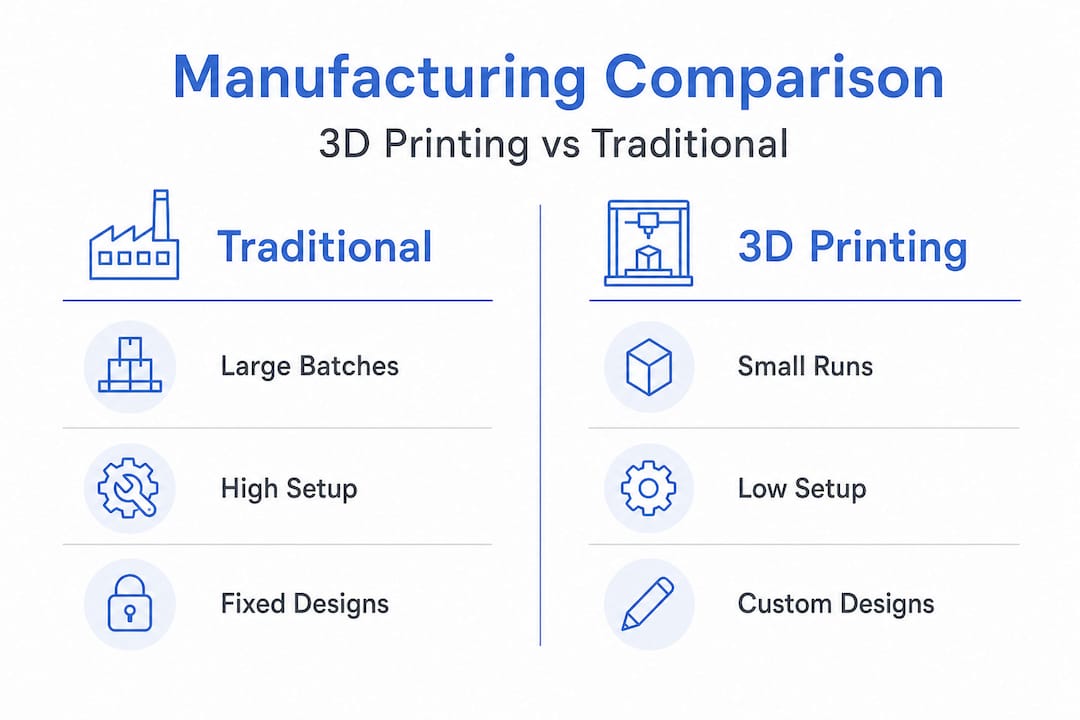
The table below shows how 3D printing compares to traditional manufacturing for small-batch runs, which is where most SMEs will first feel the benefit.
| Factor | Traditional manufacturing | 3D printing |
|---|---|---|
| Minimum order quantity | Often 50 to 500+ units | Single unit possible |
| Lead time for tooling | 2 to 8 weeks | Same day to 48 hours |
| Design change cost | High, requires new tooling | Minimal, just update the file |
| Waste material | High in subtractive processes | Low, material only used as needed |
| Upfront investment | High for tooling and setup | Low to moderate for equipment |
| Suitability for bespoke work | Difficult and expensive | Straightforward and affordable |
The outcomes of applying this technology well are tangible: faster time to market, genuinely bespoke products, significantly less material waste, and lower financial risk when testing new product lines. And if you already sell custom products, adding 3D printing creates another avenue for differentiation that your competitors may not yet be exploiting.
How small firms actually use 3D printing: Proven applications
Knowing the benefits is one thing. Seeing where real UK businesses are already applying them is far more useful. The good news is that the most effective early applications do not require advanced design skills or industrial-grade printers.
Here are the most proven, low-risk uses you can consider for your own operation:
- Prototyping new product designs: Instead of paying a toolmaker or waiting for an external prototype, you print your own iteration overnight. Test, tweak, and test again in days rather than weeks.
- Custom jigs and fixtures: These are the internal tools used to hold, align, or guide components during production or assembly. Printing them in-house saves money and allows constant refinement.
- On-demand spare parts: When a small component on a machine fails, waiting for a supplier can shut down production. Printing replacements yourself eliminates that dependency.
- Small-run product samples: Before committing to a full production run, you print samples to share with buyers or clients for approval. This reduces the risk of producing unsellable stock.
- Bespoke display and packaging fixtures: Retail-oriented businesses can print custom display holders, stands, or organisers tailored precisely to their products.
Pro Tip: Start with internal tools, jigs, and fixtures before attempting final consumer products. The ROI is faster because you immediately cut out supplier costs, and the stakes are lower because these items do not go directly to customers.
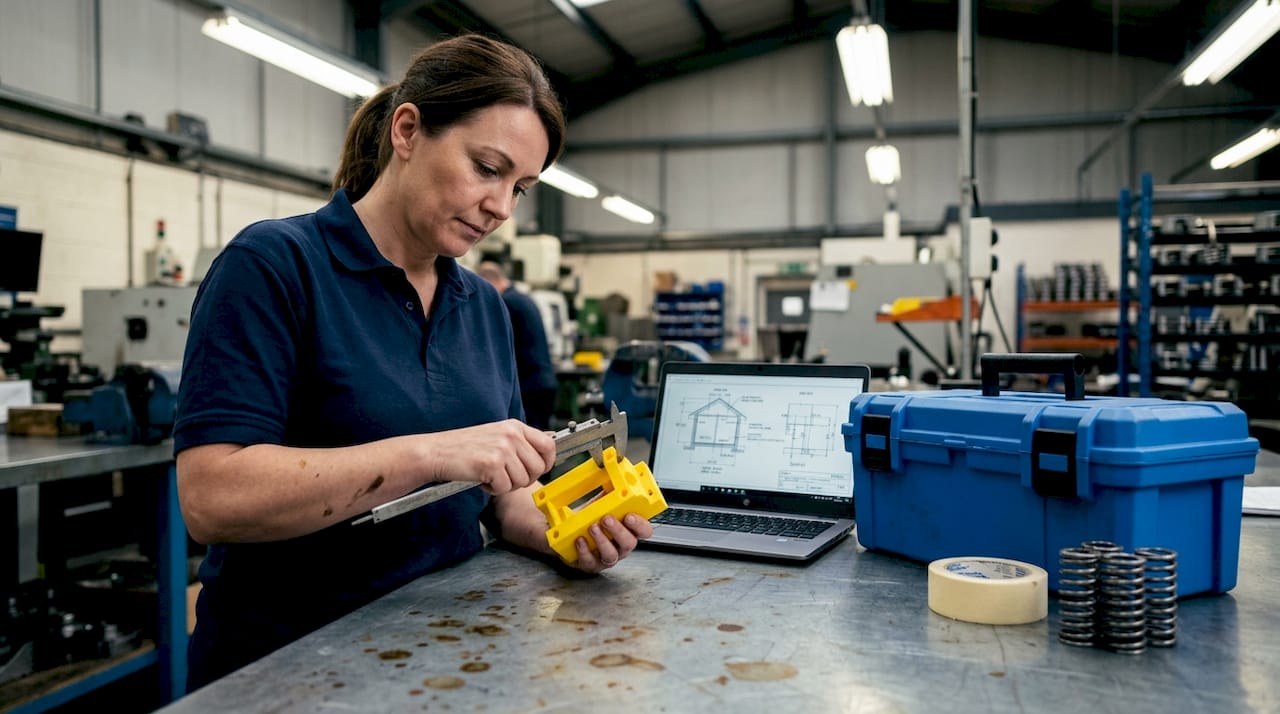
The efficiency gains from custom tooling can be striking. Micro Spring and Presswork, a UK manufacturer, cut over 40 hours of toolroom time by producing a 3D-printed jig for their CNC setup, reducing lead time for engineering changes dramatically. That is a compelling result for any business where production line downtime is expensive.
Large companies like Nestlé have also validated the approach by using 3D printing for replacement parts in their manufacturing facilities, but the principle scales down perfectly to a small workshop or production unit. If improving workflow with print technology is a priority for your business, starting with internal applications is the fastest path to seeing results.
What are the real limitations? Challenges and integration barriers
It would be dishonest to present 3D printing as a straightforward solution for every small business. The technology has genuine limitations, and misunderstanding them is one of the main reasons some early adopters feel disappointed.
Here are the most common limitations you should factor into your assessment:
- Material selection: Consumer and desktop-grade printers work well with PLA and PETG filaments, but more demanding applications requiring high heat resistance, chemical resistance, or structural strength need specialist materials and more capable printers.
- Surface finish and aesthetics: Printed parts often require post-processing such as sanding, priming, or painting to achieve a consumer-ready finish, which adds time and cost.
- Durability and longevity: Parts printed on entry-level machines may not match the lifespan of injection-moulded components in high-wear applications.
- Production speed for high volumes: 3D printing is ideal for small batches but becomes impractical for high-volume runs where injection moulding or other traditional methods are far faster.
- Complexity of design files: Someone in your business needs to be able to create or modify 3D design files, which requires either training or hiring a capable person.
“Adoption among UK SMEs is still at low or moderate capacity in many cases, which means benefits are not automatically realised without the right skills, integration, and sustained use.”
This is worth sitting with for a moment. The technology does not deliver value on its own. A 3D printer that sits unused or is only switched on occasionally will not generate meaningful returns. Even in more advanced fields, such as medical device manufacture, material limitations around haptics and durability mean that 3D-printed models do not fully replicate the properties of the real thing. For SMEs, the lesson is the same: be clear about what your application actually requires before investing.
Understanding your printer choices for businesses and alternative print technologies is useful context here. Not every print challenge requires a 3D printer. Sometimes DTF, sublimation, or laser engraving is the more practical and cost-effective route for a given product type.
Maximising results: Getting started and scaling up for real ROI
You have seen the potential and you understand the pitfalls. Now the practical question is: how do you actually move forward in a way that generates a return rather than creating an expensive experiment that gathers dust?
Follow this step-by-step approach to build adoption that sticks:
- Conduct a needs analysis: Identify three to five specific problems in your current workflow that 3D printing could solve, such as costly external tooling, long lead times for prototypes, or recurring spare-parts delays.
- Run a basic pilot: Choose the lowest-risk application from your list, typically an internal jig or fixture, and test whether a desktop 3D printer can produce a usable result for that specific task.
- Train your staff: Identify one or two team members to lead on 3D printing operations. Ensure they can confidently use design software, operate the printer, and maintain the equipment.
- Integrate into workflow: Once your pilot proves successful, write the use of 3D printing into your standard operating procedures. This is the step most businesses skip, and it is why many revert to old methods.
- Scale up deliberately: Only after internal applications are running reliably should you consider expanding into customer-facing or product-line uses of 3D printing.
Pro Tip: Prioritise repeatability over specification. A printer that consistently produces the right result for your specific application is worth far more than a higher-spec machine that your team struggles to use reliably.
The evidence supports this patient approach. Studies show that adopting 3D printing at low capacity without skills and workflow integration means benefits are rarely realised. The businesses that succeed are those that treat it as a process improvement tool from day one rather than a one-off purchase.
| Approach | Likely outcome |
|---|---|
| Buy printer, use occasionally | Low ROI, equipment underused, team skill gaps persist |
| Buy printer, train staff, integrate into workflow | Consistent results, growing capability, measurable cost savings |
| Pilot internally first, then expand | Fastest path to ROI with lowest financial risk |
| Jump straight to customer products | High risk of quality issues without foundational experience |
Equipment setup for businesses follows a very similar principle across print technologies: the setup and integration process matters as much as the hardware itself. For those interested in understanding industrial 3D scanning as a complementary technology, it is worth exploring once foundational 3D printing is established and you are looking at more advanced quality control or reverse-engineering applications.
Why successful small business adoption means thinking beyond the printer
Here is a perspective that most articles on this topic avoid: the printer is the least important part of the equation.
We have seen businesses invest in capable hardware only to achieve almost nothing because nobody took ownership of integrating it into everyday work. The printer sits next to the packaging table, gets used a handful of times in the first month, and then slowly becomes a conversation piece rather than a production asset. The problem is not the technology. It is the mindset around how technology gets embedded in a business.
The firms that genuinely benefit from 3D printing treat it the same way they treat any other production tool: with standard processes, assigned responsibilities, training schedules, and performance expectations. They start small, prove value internally, build team confidence, and then expand scope. The Micro Spring and Presswork example is instructive precisely because the win was not glamorous. It was a jig. An internal tool. Forty hours saved. That is how real ROI begins.
There is also a temptation to assume that a more expensive printer will solve the problem. It rarely does. A £300 desktop printer used consistently by a trained operator for a well-defined task will outperform a £3,000 machine used sporadically by staff who are unsure what it is for. Process alignment always beats equipment specification.
The same principle applies across the broader printing world. We see it with business printing strategies across sublimation, DTF, and laser engraving. The businesses achieving the best results are those that have thought carefully about workflow, matched the technology to the right applications, and given their team the time and support to build genuine competence. 3D printing is no different. Think beyond the printer, and the printer will deliver.
Take the next step with bespoke printing solutions
If this article has you thinking seriously about what print technology could do for your business, you are already ahead of most competitors in your sector.
We supply a wide range of printing and customisation products to small businesses across the UK and Ireland, with no minimum order quantities. Whether you are curious about 3D printing filaments, want to explore sublimation blanks like our round MDF name badge or rectangle MDF name badge for custom branded products, or you want to understand how different print technologies can work together in your operation, we are here to help. Browse our full range of wholesale sublimation supplies and get in touch with our team for straightforward, practical advice tailored to your business.
Frequently asked questions
What are the most cost-effective 3D printing applications for small businesses?
The most cost-effective uses are prototyping, producing custom jigs or internal tools, and printing spare parts on demand, all of which reduce reliance on external suppliers and cut lead times significantly.
How much investment is needed to get started with 3D printing?
You can begin with a desktop printer at a relatively modest cost, focusing first on low-risk internal applications such as prototypes and fixtures before scaling up to more complex or customer-facing uses.
Can 3D printing help with small-batch or custom production?
Yes, it is particularly well suited to this. Custom small-scale production is one of the primary advantages for SMEs, especially where traditional manufacturing imposes impractical minimum order quantities.
What skills or workflow changes are required to succeed with 3D printing?
You need at least one trained team member who can operate the equipment and manage design files, and the technology must be integrated into regular workflow rather than used only occasionally.
Are there industries where 3D printing is not suitable for SMEs?
High-volume production environments and applications with demanding material durability requirements may find that standard 3D printing cannot match the performance of traditional manufacturing methods at the SME level.
Recommended
- How printers boost small business efficiency and marketing – SubliBlanks Ltd
- Cut Sublimation Ink Costs 90%: Best Printers 2026 UK Guide – SubliBlanks Ltd
- Why choose wholesale supplies? Key benefits for UK small businesses – SubliBlanks Ltd
- What Is Heat Transfer Printing? 30% Better Colour UK SMEs – SubliBlanks Ltd


