



Step-by-step guide to making custom badges for events
TL;DR:
- A well-made custom badge enhances brand visibility, signals team identity, and leaves a lasting impression at events. Selecting appropriate size, material, design simplicity, and fixings ensures badges are durable, legible, and practical for long-term branding. Proper inspection before distribution prevents common issues, maximizing the badge’s effectiveness as a multi-use promotional tool.
A well-made custom badge does more than sit on a lapel. It carries your brand into every room, signals team identity at a glance, and gives event attendees something tangible to remember you by. Yet too many small businesses and event organisers end up with badges that disappoint: fuzzy logos, text too small to read, fixings that scratch delicate fabric, or a colour that looks nothing like the original artwork. This guide walks you through every decision, from choosing the right size and material to inspecting the finished product before a single badge is handed out.
Table of Contents
- Choosing the right materials and size for your custom badge
- Designing your badge: artwork, fonts, and colour best practices
- Production methods: DIY badge makers versus professional services
- Fixings and finishing touches: making sure your badges work in the real world
- Verifying final quality and avoiding common pitfalls
- What most guides miss about making effective custom badges
- Custom badge solutions for every project
- Frequently asked questions
Key Takeaways
| Point | Details |
|---|---|
| Size and material matter | Matching badge size and material to your purpose ensures maximum impact and longevity. |
| Design for clarity | Use bold graphics, strong colours, and vector files for the clearest results at small scales. |
| Proof before production | Always check digital or physical proofs before a bulk order to avoid costly mistakes. |
| Right backing for every badge | Choosing the correct fixing means better comfort, security, and fabric protection. |
| DIY or professional | Weigh cost, speed, and finish when deciding between home production and expert suppliers. |
Choosing the right materials and size for your custom badge
Now that you know what this guide will offer, let’s start with the basics: how to select the proper badge size and material for your specific needs.
Size is the decision most people underestimate. A 20mm badge might look fine on a mood board but become illegible when pinned to a jacket lapel. Conversely, a 50mm badge on a tote bag strap looks out of proportion and can feel heavy. Getting this right before you commit to production saves significant time and money.
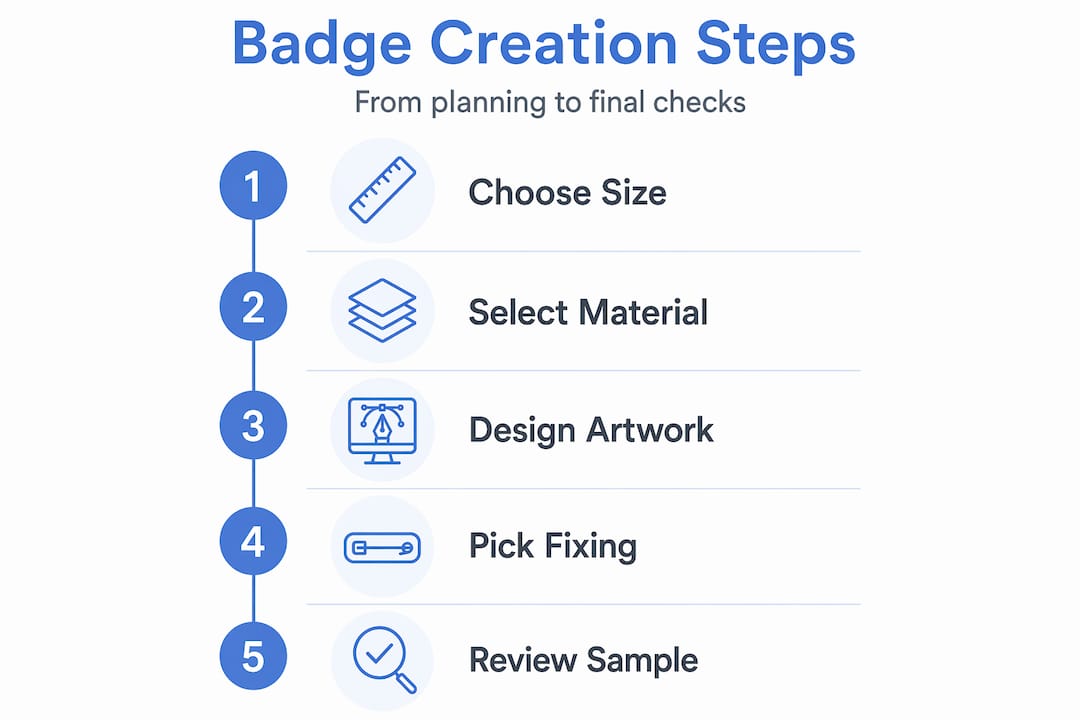
Badge sizes vary by use: 20 to 25mm suits bags and caps with simple, bold graphics; 30 to 35mm is the sweet spot for jacket badges where a logo needs to be clearly visible; 40 to 50mm gives room for detailed artwork or statement designs. Use the table below as a quick reference:
| Badge size | Best application | Design complexity |
|---|---|---|
| 20 to 25mm | Bags, caps, lanyards | Simple icons, minimal text |
| 30 to 35mm | Jackets, shirts, uniforms | Clear logos, short brand name |
| 40 to 50mm | Display, events, promotions | Detailed artwork, full colour |
Material choice shapes the overall feel of the badge. Metal badges are durable and carry a premium, professional look that’s well suited to corporate use. Acrylic and plastic options are lighter and better for large-volume giveaways where cost must be controlled. Hard enamel delivers a smooth, glass-like finish ideal for premium branded merchandise, while soft enamel is textured and slightly lower in cost, making it a practical choice for budget-conscious projects that still want colour depth.
Different badge material options come with their own production constraints. Metal requires a longer lead time and specialist tooling. Acrylic can be cut and printed quickly. Enamel, whether hard or soft, involves multiple firing and polishing steps that add days to the schedule.
For a deeper look at what you’ll need before you start, our badge making supplies guide covers the essential kit from blanks to button machines.
Pro Tip: Always leave a 2 to 3mm margin around the edge of your artwork so nothing gets cut off during production. Match your minimum text height to your badge size: anything below 4pt becomes illegible at 25mm or smaller.
Designing your badge: artwork, fonts, and colour best practices
Once you’ve settled on size and material, your next focus should be creating a design that stands out and reproduces well at small-scale.
The single biggest mistake people make at this stage is scaling down a complex design and hoping it will still look good. It rarely does. Small badges are unforgiving. Thin serifs blur, intricate gradients turn muddy, and multi-element logos become a smudge of colour. The solution is to simplify before you shrink.
Vector files are essential: AI, SVG, and EPS formats scale infinitely without any loss of sharpness, which is critical when a supplier needs to translate your design into a physical die or print plate. Raster files like JPG or PNG are fine for screen proofs but should never be the source file sent to production. If your artwork only exists as a PNG, invest in having it redrawn in vector format before ordering.
Colour discipline matters enormously at badge scale. The following guidelines will help:
- Keep to 3 to 7 colours. More colours increase cost and reduce sharpness.
- Use Pantone references wherever possible so the physical badge matches your brand standards.
- Prioritise high contrast. Dark text on a light background, or vice versa, is far more legible than mid-tone combinations.
- Avoid very thin strokes. Lines thinner than 0.5mm can disappear entirely at 25 to 30mm diameters.
- Test in greyscale. If your design still reads clearly without colour, it’s well-structured.
The table below outlines common font choices and their suitability for badge production:
| Font style | Suitability for badges | Notes |
|---|---|---|
| Bold sans-serif | Excellent | Stays legible at very small sizes |
| Medium sans-serif | Good | Minimum 6pt at 30mm+ |
| Serif | Fair | Avoid at sizes below 35mm |
| Script or handwritten | Poor | Thin strokes blur at small scale |
Designing for visibility at small formats follows the same principles used in signage: bold, high-contrast, and stripped back. Always request both a digital proof and a physical proof for larger orders. Looking at a badge on screen is very different from holding it in your hand.
For a thorough understanding of what files and specifications to provide, review our guidance on badge artwork requirements before sending anything to production.
Pro Tip: Print your artwork at actual badge size on plain paper and hold it at arm’s length. If you can read every element clearly, it will reproduce well. If anything looks cramped or unclear, simplify further before committing.
Production methods: DIY badge makers versus professional services
With your design finalised, you’ll need to decide how to actually bring your badges to life. Should you make them yourself or use a professional service?
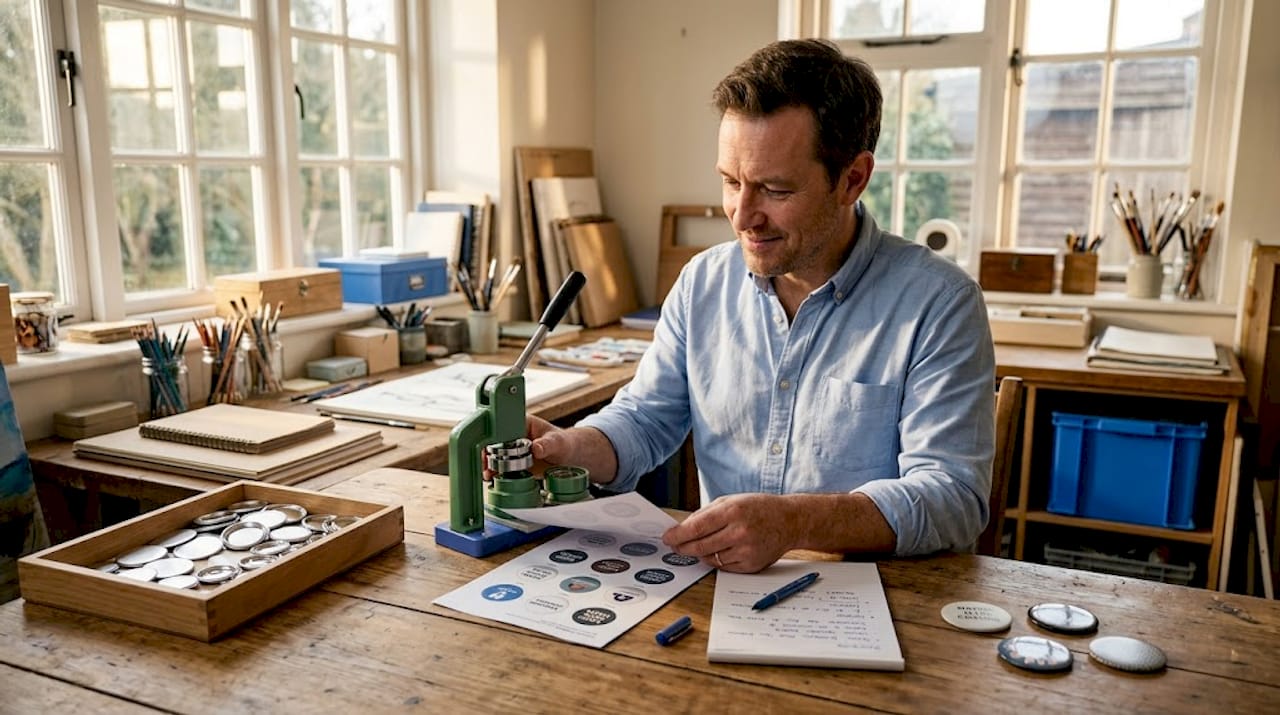
Both routes are valid, but they suit very different situations. Understanding the trade-offs will help you make the right call for your timeline, budget, and volume.
DIY badge making is ideal for small runs, on-demand production, and situations where creative control matters. DIY badge maker kits in the UK are available for 25 to 77mm badge sizes, with starter kits costing around £65 and including 1,000 component parts. A compact machine can produce up to 200 badges per hour, which is more than enough for a market stall, a school fundraiser, or a pop-up event.
Professional badge suppliers handle larger volumes with specialist finishes that DIY machines simply cannot replicate. Enamel badges, for example, require kiln firing and multiple polishing stages. UK suppliers like Best Badges, Badgemaster, Rocket Badge, and others offer a range of finishes with varying minimum order quantities. Some operate with no minimum at all, which is a genuine advantage for small businesses testing a new design.
Here’s a clear breakdown to help you choose:
| Factor | DIY badge making | Professional service |
|---|---|---|
| Setup cost | Low (one-off kit purchase) | Low (no tooling for digital print) |
| Per-badge cost | Medium | Lower at volume |
| Lead time | Instant | 1 to 4 weeks depending on finish |
| Finish quality | Good for button badges | Excellent for enamel and metal |
| Minimum order | None | Varies by supplier |
| Design flexibility | High | High |
Step-by-step, your decision process should look like this:
- Confirm your quantity. Under 200 badges for a one-off event? DIY is fast and cost-effective.
- Decide on finish. If you need enamel or plated metal, a professional service is essential.
- Check your deadline. Enamel badge production typically takes about four weeks due to the multi-stage process. Plan accordingly.
- Consider reuse. If you’ll be making badges regularly, a machine pays for itself quickly.
The step-by-step signage process used in physical branding applies equally here: plan first, produce second, inspect third.
If you’re using sublimation printing on badge blanks, the results can be outstanding. Our guide on sublimation for badges explains how to get vivid, full-colour results with a desktop setup. And if you’re thinking about the broader brand impact of your badge programme, the section on building your brand with badges is well worth reading alongside this guide.
Fixings and finishing touches: making sure your badges work in the real world
With your method sorted, you’ll want to pick the right badge backing and ensure a professional finish.
The fixing is the part of a badge that most people ignore until something goes wrong. A badge that falls off a £200 jacket or leaves rust marks on a white shirt is not a branding win. Getting the fixing right is as important as getting the design right.
The main badge fixings and backings you’ll encounter include:
- Safety pin: The most common option. Versatile and secure on most fabrics.
- Butterfly clutch: A two-part pin and retainer system, often used for lapel pins. More secure than a plain safety pin.
- Magnet: Two-part magnetic backing that attaches without piercing the fabric. Ideal for delicate materials, silk, or knitwear.
- Brooch pin: Heavier duty, often used on premium or larger format badges.
- Adhesive backing: Single-use, suited to paper or card-based name badges for events.
Magnets are increasingly popular for corporate name badges because they protect suits and blouses from pin holes. However, they can be a concern for anyone with a pacemaker or other electronic implant, so it’s worth flagging this if you’re running an event with a broad audience. For standard promotional badges and lapel pins, a butterfly clutch is the most dependable option.
The finish of a badge is your brand’s handshake. A wobbly fixing or a scratched surface tells people exactly how much care you put into the details.
If you’re looking for a smart, no-fuss solution for staff or event name badges, our magnetic name badge options are worth a look before you place your order.
Verifying final quality and avoiding common pitfalls
With your badges ready, make sure to inspect them to catch any potential issues before they’re distributed.
Quality checking is the step most people skip when they’re in a rush. It’s also the step that saves you from handing out 500 badges with a misaligned logo at a trade show. Build inspection into your production timeline, not as an afterthought.
Follow this numbered checklist for every badge order or production run:
- Check colour accuracy. Hold the badge next to your Pantone reference or your brand colour card. Colours can shift during printing, especially on curved or metalite surfaces.
- Verify text clarity. Read every word on the badge from a normal viewing distance. If you need to squint, something is wrong.
- Check alignment. Make sure artwork is centred and consistent across multiple badges. Small batches can drift during production.
- Test the fixing. Pin and unpin the badge several times. The fixing should operate smoothly and hold firmly.
- Inspect the surface finish. Look for scratches, bubbles, or uneven enamel on any hard or soft enamel badges.
Always order samples or proofs before running a full production batch. Hard enamel is more durable than soft enamel but costs more. Verifying the sample gives you confidence in both the finish and the colour matching before you scale up.
Pro Tip: For bulk orders over 100 pieces, request a pre-production sample from your supplier. Inspect it under good lighting and against your original artwork. Never approve from a digital proof alone. What looks sharp on screen can still disappoint in physical form.
Common errors to watch for include blurry or pixelated logos caused by raster source files, loose or stiff fixings from poor component quality, and surface colour that doesn’t match the brief because Pantone references weren’t provided.
For a versatile blank that works with sublimation printing, our rectangular pin badge blanks come in a format that gives you full creative control over the finished result.
What most guides miss about making effective custom badges
Most how-to articles treat badges as a simple print job. Choose a size, upload your logo, hit order. But anyone who has run badge programmes across events, retail environments, or corporate settings knows the reality is more layered than that.
The interaction between material, fixing, and design determines whether a badge works or fails. A beautiful hard enamel design paired with a cheap safety pin loses credibility the moment the pin bends. Conversely, a modest button badge with a clear, bold design and a solid butterfly clutch outperforms the costly option every time. The three elements must be considered as a system, not separate decisions.
Here’s an insight that rarely appears in generic guides: badges are multi-use branding tools. A well-made badge doesn’t live on one lapel for one event. It ends up on jacket collections, pinboards, bags, and shelving units. UK businesses that invest in good-quality badges, particularly hard enamel or metal, find that the item is kept, displayed, and talked about long after the original event. That’s earned media with no ongoing cost.
The value of paying extra for a digital proof before production is also consistently underestimated. A proof catches problems early, from a slightly off-brand blue to a font that scaled poorly, before they’re baked into hundreds of physical units. That small upfront cost is far cheaper than reprinting.
Think of your badge as part of your long-term brand toolkit. A consistent badge design used across events, staff uniforms, and customer loyalty programmes builds recognition over time, in the same way a well-designed logo does. For practical inspiration on how badges extend your branding beyond a single use, the advice in building your brand with badges offers a useful framework.
Custom badge solutions for every project
Ready to start your own badge project? Here are some trusted solutions to get going quickly.
At Subliblanks, we supply badge-making machines and a curated range of badge blanks with no minimum order quantities, so you can order exactly what you need whether you’re making five badges or five hundred. Our blanks are ready for sublimation printing, giving you vivid, full-colour results at a fraction of the cost of outsourced production.
Browse our round pin badge blanks for classic button-style badges, or explore our rectangular badge blanks for name badges and event ID. If you work with delicate fabrics or need a smarter staff badge solution, our magnetic badge options are ready to order today. From hobby projects to professional event branding, we have the supplies to get your badges made right.
Frequently asked questions
What is the best size for a custom badge?
Badge sizes depend on where they’ll be worn: 20 to 25mm suits bags and caps with simple designs, 30 to 35mm works well for jackets, and 40 to 50mm gives room for detailed or statement artwork.
Which badge material lasts the longest?
Metal and hard enamel are the most durable options, with hard enamel offering a premium, scratch-resistant finish that maintains its appearance even with regular handling.
How quickly can I produce badges for an event?
DIY badge kits allow instant on-demand production, while printed badges can often be completed the same day. Enamel badges take around four weeks due to the multi-step firing and polishing process.
Which fixing should I choose for my badges?
Magnets protect delicate fabrics without leaving holes, while butterfly clutches offer a secure and tidy finish for lapel pins and heavier badge formats.
What’s the most common mistake in custom badge design?
Using thin fonts or intricate details that become unreadable when reproduced at small badge sizes is the most frequent problem, particularly on badges under 30mm.


