



What is custom stamping? Techniques and applications
TL;DR:
- Custom stamping involves creating tailored tools, dies, or digital templates for consistent, precise marks or components. It encompasses metal, rubber, and digital stamping, each requiring distinct designs, processes, and equipment. Businesses benefit from improved accuracy, efficiency, branding, and workflow standardization through properly implemented custom stamping systems.
Custom stamping is the process of producing stamps or components uniquely designed to meet specific personalisation, branding, or manufacturing requirements. Whether you are a small business owner wanting a branded rubber stamp for your packaging, or an engineer specifying precision metal parts for a production line, the same principle applies: a tailored design is transferred repeatedly and accurately onto a surface or material. The term covers three distinct disciplines. physical rubber and polymer stamps, industrial metal stamping using dies and presses, and digital stamps created in software like Adobe Acrobat. Understanding which category fits your need is the first decision that shapes every choice that follows.
What is custom stamping and how does it work?
Custom stamping is defined as any process in which a purpose-built tool, die, or digital template applies a specific design, mark, or shape to a material with consistent, repeatable results. The word “custom” is the operative one. Off-the-shelf stamps produce generic marks; custom stamping produces marks or parts engineered to exact specifications.
Metal stamping uses specialised dies to precisely cut, bend, or form flat metal sheet into parts with exact dimensions. A stamping press drives the upper die downward onto a metal blank, shaping it in a single controlled stroke. This is the industrial end of the spectrum, used by manufacturers supplying the automotive, electronics, and medical device sectors.
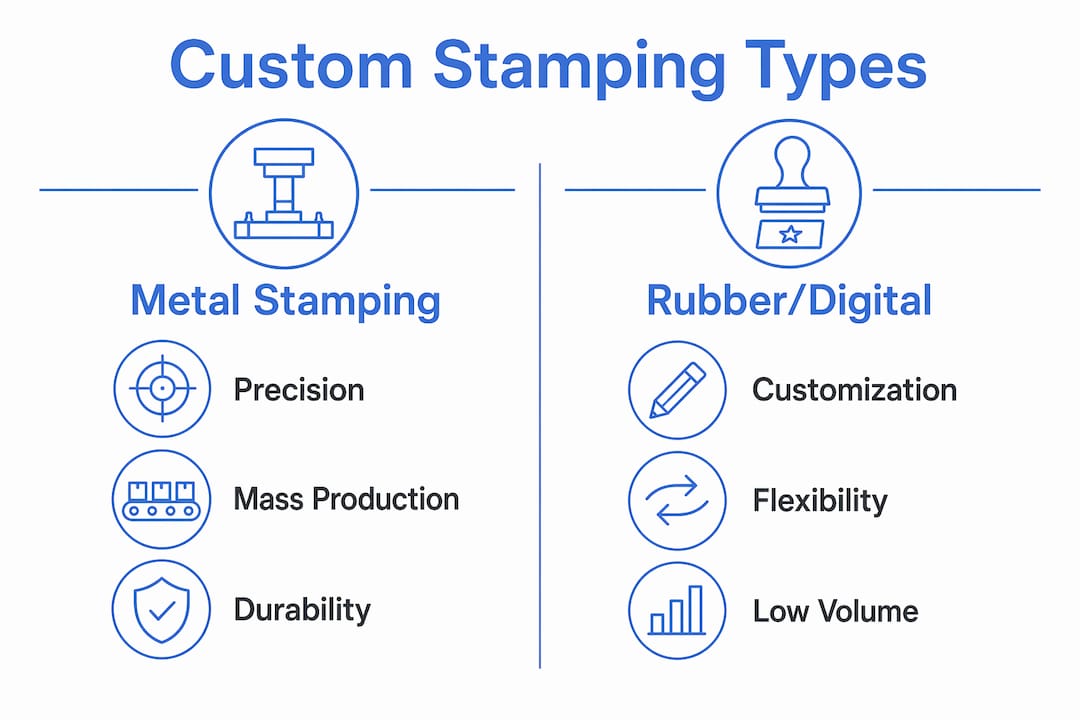
At the craft and business end, rubber and polymer stamps are produced by laser engraving or die-cutting a design into a resilient material mounted on a handle or block. The raised surface carries ink and transfers it to paper, card, fabric, or packaging. Subliblanks supplies stamp-making machines that bring this capability in-house for trade customers, removing the need to outsource every new design.
Digital custom stamps sit in a third category entirely. Adobe Acrobat allows users to import images or PDFs and save them as reusable stamp identities for document workflows. These are not physical objects, but they serve the same branding and identification function in paperless offices.
Pro Tip: If you are new to the field, treat metal stamping, rubber stamping, and digital stamping as three separate crafts that share a name. Confusing them leads to mismatched supplier conversations and wasted budget.
What are the main custom stamping processes used today?
Metal stamping is better understood as a family of related processes selected according to tooling complexity and production volume. The three most common are blanking, forming, and progressive die stamping.
- Blanking cuts a flat shape from sheet metal in a single press stroke. It is the starting point for washers, brackets, and electrical contacts.
- Forming bends or draws the blank into a three-dimensional shape. Deep drawing, for example, produces cups, cans, and housings.
- Progressive die stamping advances a metal strip through multiple forming stations in one continuous cycle, completing several operations simultaneously. This method suits high-volume production runs where speed and consistency are non-negotiable.
Rubber stamp creation follows a different path. A designer produces artwork in vector format, which is then laser-engraved or chemically etched into a rubber or photopolymer sheet. The engraving removes material from the non-printing areas, leaving raised surfaces that carry ink. Laser engraving is now the dominant method because it handles fine detail and curved text without the chemical waste of older processes. You can read more about the equipment involved in this stamp-making machine guide from Subliblanks.
Digital stamping in Adobe Acrobat supports file formats including PDF, JPEG, PSD, and AI for full Acrobat users. Acrobat Reader, however, limits stamp creation to PDFs only. This distinction matters when rolling out a branded stamp across a team where some members use the free Reader version.
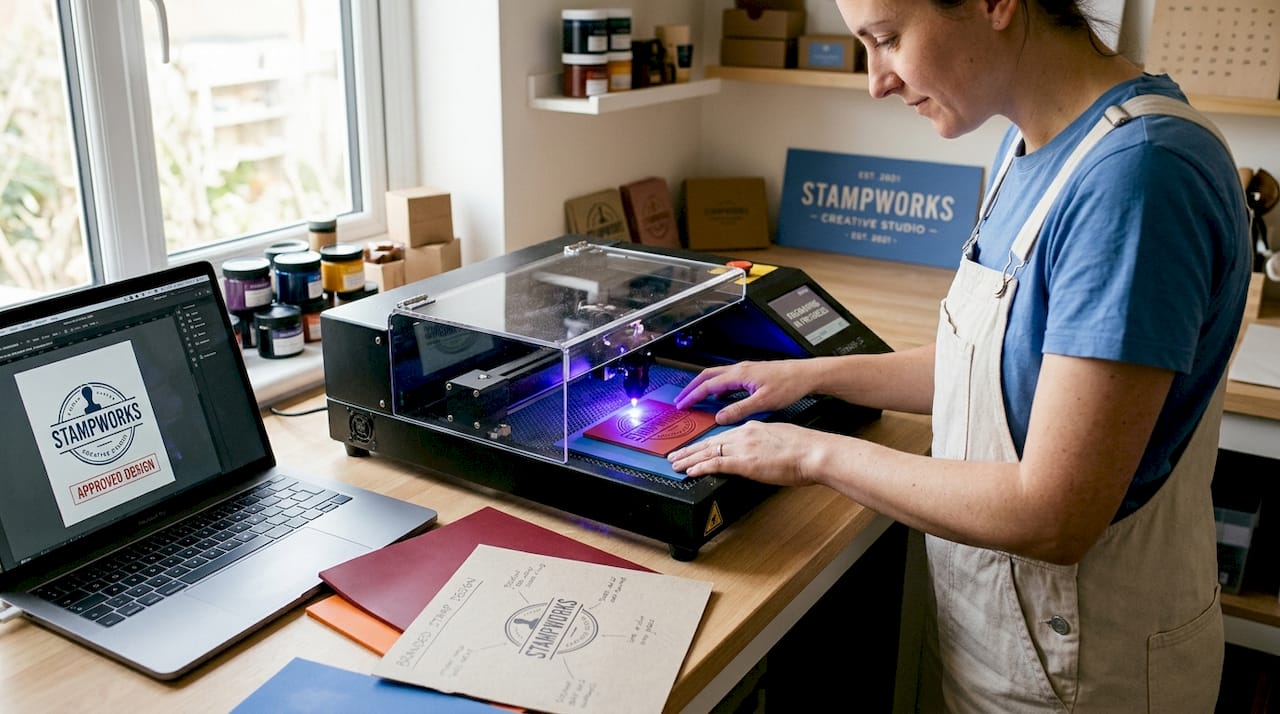
Pro Tip: For rubber stamp artwork, convert all fonts to outlines before sending files to production. Font substitution is the single most common cause of rejected proofs.
What are the benefits of custom stamping for businesses and individuals?
Custom tooling is engineered for specific design tolerances and unique part requirements, which is the core advantage over generic alternatives. The benefits differ slightly depending on whether you are working in manufacturing or personalisation, but the underlying logic is the same: a purpose-built tool outperforms a general one.
For manufacturers, the primary advantages are:
- Dimensional accuracy. Custom dies produce parts that meet tight tolerances consistently across thousands of cycles, reducing scrap and rework.
- Complex geometry capability. Custom stamping is preferred for parts requiring complex dimensions and high accuracy that standard tooling cannot achieve.
- High-volume efficiency. Once tooling is amortised, the per-unit cost of stamped metal parts falls significantly below machining or casting alternatives.
- Material optimisation. Quality tooling maximises raw material use and reduces production waste, which matters both for cost and sustainability targets.
For individuals and small businesses, the benefits are more immediate. A custom rubber stamp applied to packaging, envelopes, or stationery delivers brand consistency at a fraction of the cost of printed materials. A single stamp can produce thousands of impressions before needing replacement, making it one of the most cost-effective branding tools available.
“Custom stamping tooling engineering is central to achieving complex dimensions and repeatable precision at scale.” — Keats Manufacturing
Document workflows benefit too. Digital custom stamps in Adobe Acrobat enable consistent, branded document handling across teams, replacing handwritten annotations with reusable, professional identities. For businesses processing high volumes of contracts, invoices, or approvals, this saves measurable time.
How do materials and tooling affect quality and cost?
The material you stamp onto and the tool you use to stamp it are the two variables that determine output quality. Getting either wrong produces poor results regardless of how good the design is.
| Factor | Soft tooling | Hard tooling |
|---|---|---|
| Best suited for | Runs below 5,000 units | Mass production runs |
| Die material | Temporary, lower-grade steel | Hardened tool steel |
| Upfront cost | Lower | Higher |
| Part accuracy | Moderate | High |
| Lifespan | Short | Long |
Soft tooling suits short-run stamping below 5,000 units and is the sensible choice for prototyping or pilot production before committing to a full hard-tooling investment. Hard tooling in hardened steel is the correct choice once a design is stable and volumes justify the spend. The die set is the largest upfront cost in any metal stamping project, so changing a design after hard tooling is cut is expensive. Get the design right first.
For rubber stamps, the material choice is between natural rubber, red rubber, and photopolymer. Photopolymer captures finer detail and suits intricate logos or small text. Natural rubber is more durable for high-frequency use. Small design lines may fill in or be lost entirely without proper test stamps before finalising production, so always request a test impression before approving a full run.
For digital stamps, the material question becomes a file format question. PDF files are the safest choice for cross-platform compatibility. JPEG and PSD files work in full Adobe Acrobat but will not function in Acrobat Reader, which limits their usefulness in mixed-software environments.
Pro Tip: When specifying metal stamping tooling, ask your supplier for a Design for Manufacturability review before cutting dies. Small geometry changes at the design stage cost nothing; the same changes after tooling is made can cost thousands.
What does the custom stamp design and creation process involve?
Designing a custom stamp, whether physical or digital, follows a logical sequence. Skipping steps is the most common cause of poor results.
- Define the brief. Specify the surface to be stamped, the required impression size, the ink or marking method, and the expected production volume. For metal stamping, add material grade, thickness, and dimensional tolerances.
- Produce the artwork. Vector files (AI or EPS format) are standard for rubber and polymer stamps. CAD files (DXF or STEP) are required for metal stamping dies. Raster images like JPEGs are acceptable for digital stamps in Adobe Acrobat but not for physical production.
- Review for manufacturability. Check that line weights are sufficient to survive engraving or die-cutting. For rubber stamps, lines thinner than 0.5pt are at risk of being lost. For metal dies, internal radii must meet minimum bend radius requirements for the chosen material.
- Prototype and test. For rubber stamps, produce a test impression and check legibility at the intended scale. For metal stamping, cut a soft-tool prototype and measure against the engineering drawing. For digital stamps, test across both Adobe Acrobat and Acrobat Reader to confirm compatibility.
- Approve and produce. Once the test confirms the design performs as intended, proceed to full production. For metal stamping, this means cutting the final hardened die. For rubber stamps, it means producing the full batch of stamp mounts.
Understanding the full design-to-production cycle helps you plan realistic lead times. Metal die cutting typically takes two to four weeks. Rubber stamp production from approved artwork is usually two to five working days. Digital stamps are ready the moment the file is saved. You can explore the broader context of how stamping machines fit into production workflows in this stamping machine guide from Subliblanks.
For businesses considering metal fabrication processes more broadly, stamping sits alongside laser cutting, bending, and welding as one of the core methods for producing sheet metal components at scale.
Key takeaways
Custom stamping delivers precision, repeatability, and branding consistency across physical rubber stamps, industrial metal components, and digital document workflows, with tooling quality being the single greatest determinant of output quality.
| Point | Details |
|---|---|
| Three distinct disciplines | Metal stamping, rubber stamping, and digital stamping share a name but require different tools, files, and suppliers. |
| Tooling drives quality and cost | The die set is the largest upfront investment in metal stamping; getting the design right before cutting saves significant cost. |
| Soft tooling for prototypes | Runs below 5,000 units suit soft tooling; commit to hardened steel dies only when volumes and design are confirmed. |
| Test before full production | Rubber stamp designs need a test impression to catch fine lines that fill in; digital stamps need cross-platform compatibility checks. |
| Branding value is immediate | A custom rubber stamp produces thousands of consistent impressions at low cost, making it one of the most efficient branding tools for small businesses. |
Why I think most businesses underestimate custom stamping
Most businesses I speak with think of custom stamping as either a heavy industrial process or a craft novelty. Very few recognise that it sits squarely in the middle of their daily operations. Every parcel that leaves a warehouse with a branded mark, every document that carries an approval stamp, every name badge worn at an event. these are all custom stamping applications, and most businesses are handling them inefficiently.
The shift I have noticed in 2026 is that the barrier to bringing stamp production in-house has dropped considerably. Laser engraving machines capable of producing professional rubber stamps are now accessible at trade prices, and suppliers like Subliblanks offer stamp-making equipment with no minimum order requirement. That changes the economics entirely for small and medium businesses that previously had to outsource every design change.
The digital side is equally underused. Teams that have moved to paperless workflows often overlook Adobe Acrobat’s custom stamp function, defaulting to typed annotations instead. A properly designed digital stamp with a company logo and approval text takes twenty minutes to set up and saves hours of inconsistent formatting over a year.
My honest view is that the businesses getting the most from custom stamping in 2026 are those treating it as a system rather than a one-off purchase. They invest in quality tooling or equipment once, design with longevity in mind, and apply the output consistently across every customer touchpoint. That is where the real return sits.
— chris
Start creating custom stamps with Subliblanks
Subliblanks supplies stamp-making machines, laser-engraveable blanks, and personalisation equipment to trade customers across the UK, with no minimum order quantities.
If you are looking to add branded stamping to your product range or business workflow, Subliblanks has the equipment and supplies to get you started without a large upfront commitment. For event branding and corporate identity projects, the sublimation MDF name badge with pin and the round MDF name badge are ready-to-personalise blanks that pair directly with custom stamping and sublimation workflows. Browse the full range at Subliblanks to find the right starting point for your project.
FAQ
What is custom stamping in simple terms?
Custom stamping is the production of a purpose-built stamp, die, or digital template that applies a specific design to a material with consistent, repeatable results. It covers rubber stamps for branding, metal dies for manufacturing, and digital stamps for document workflows.
How do I create a custom rubber stamp?
Produce your artwork as a vector file, then send it to a stamp-making machine or supplier for laser engraving onto rubber or photopolymer. Always request a test impression before approving the full production run, as fine lines can fill in without adjustment.
What file formats work for digital custom stamps?
Adobe Acrobat supports PDF, JPEG, PSD, and AI formats for custom stamp creation. Acrobat Reader accepts PDF files only, so teams using the free version need PDF-format stamps to maintain compatibility across the workflow.
When does custom metal stamping make financial sense?
Custom metal stamping becomes cost-effective when production volumes are sufficient to amortise the die set cost, typically above several thousand units. Soft tooling is the practical choice for prototyping and short runs before committing to hardened steel dies.
What is progressive die stamping?
Progressive die stamping advances a metal strip through multiple forming stations in a single continuous cycle, completing several operations simultaneously. It is the preferred method for high-volume production of precision metal components where speed and consistency are the primary requirements.


