



How to make steel badges: a practical guide
TL;DR:
- Steel badge making involves designing, tooling, metal forming, finishing, and mounting to produce durable emblems. Professional die striking offers high detail and consistency, while DIY methods like chemical etching suit small batches and prototypes. Proper finishing, plating, and mounting planning are essential for achieving a polished, professional-quality badge.
Steel badge making is the process of producing durable metal emblems through a structured sequence of design, tooling, metal forming, finishing, and mounting. Whether you are crafting personal insignia, branded business badges, or collectible pieces, the method you choose determines both the quality and the cost of the final product. The core techniques range from professional die striking using hardened steel dies and plating equipment, to accessible DIY approaches using vinyl masks, chemical etching, and hand finishing. This guide covers every stage so you can make informed decisions about tools, methods, and materials before you cut a single piece of metal.
What tools and materials are needed to make steel badges?
The right materials are the foundation of any successful badge project. Steel is the most common base metal for structural badges, but brass and zinc alloy are widely used in professional production because they accept plating and enamel more predictably. For small-batch or prototype work, pre-cut steel blanks from suppliers give you a consistent starting point without the need for sheet metal cutting equipment.
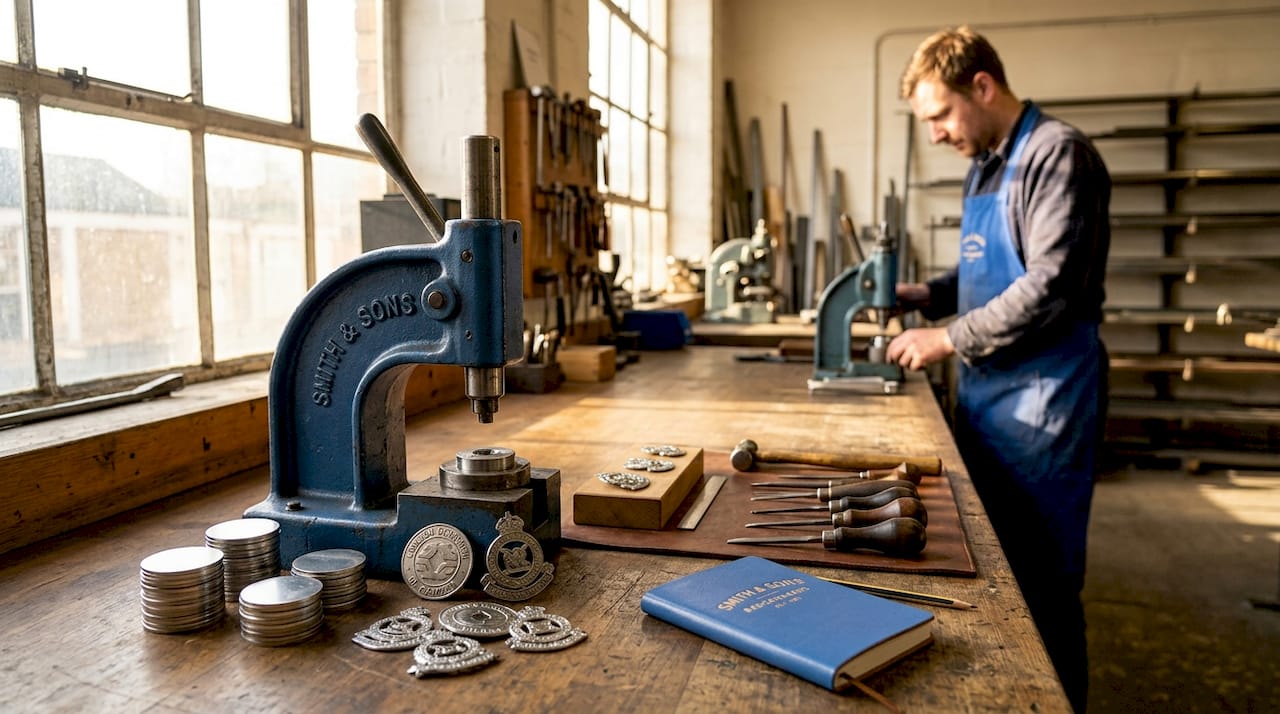
Your tooling choice defines your production route. Professional badge makers use hardened steel dies for stamping, which are machined using CNC equipment and hand tooling to create a permanent negative image of the design. For DIY and semi-professional work, vinyl masks combined with a chemical etchant remove metal selectively to reproduce a design. CNC engravers and xTool laser etching machines sit between these two approaches, offering repeatable precision without the cost of a custom die.
Finishing materials are just as important as the base metal. You will need:
- Plating solutions or plating kits for gold, silver, or nickel finishes
- Soft or hard enamel paints for colour fills
- Polishing compounds and buffing wheels for surface preparation
- Backing hardware including butterfly clutches, magnetic fasteners, or adhesive pads
Mounting hardware must be selected before production begins, not after. Failing to plan mountings upfront risks weakening badge edges when holes or slots are added post-production. A butterfly clutch pin requires a pre-drilled hole at a specific point; a magnetic fastener needs a recessed backing pad. Both affect the badge’s structural integrity if added as an afterthought.
Pro Tip: When sourcing steel blanks, choose 304-grade stainless steel for etched badges. It resists corrosion, accepts laser engraving cleanly, and holds plating well without pre-treatment.
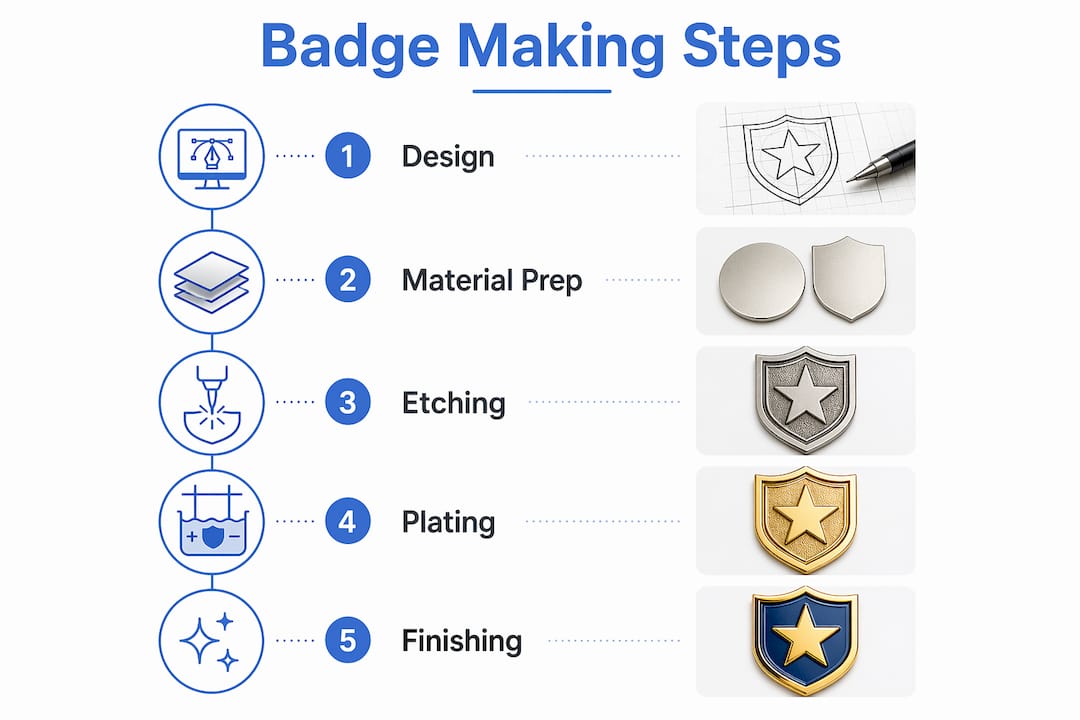
For a fuller breakdown of what to stock before starting, the badge making supplies guide at Subliblanks covers tools and consumables in practical detail.
How does the professional die striking process work?
Die striking is the gold standard for steel badge production, and the quality of the steel die determines everything that follows. The die is a hardened steel block machined to the exact inverse of your design. Under high pressure, it forces a metal blank, typically brass or bronze, into the die cavity, reproducing fine detail with consistency across thousands of units.
The full professional process runs as follows:
- Design approval. Artwork is finalised as a vector file and approved before any tooling begins. Changes after die creation are expensive.
- Die creation. A CNC machine cuts the primary form, and skilled toolmakers refine fine details by hand. This stage can take several days.
- Die striking. Metal blanks are fed into a hydraulic or mechanical press. The die strikes each blank under extreme pressure, raising the design in relief.
- Trimming and edge finishing. Excess metal is trimmed and edges are smoothed to remove burrs.
- Polishing. The badge surface is buffed using progressively finer compounds to achieve a mirror or satin finish.
- Plating. Professional badge plating uses 3 to 5 times thicker layers than jewellery manufacturing to withstand daily wear. Gold, silver, and nickel are the most common choices.
- Enamel application. Colour is added at this stage, either as soft enamel or hard enamel, depending on the specification.
- Final inspection. Each badge is checked for plating consistency, enamel coverage, and edge quality before dispatch.
The enamel workflow differs significantly between the two types. Soft enamel badges are polished and plated first, then filled with colour and baked to cure. Hard enamel reverses this: colour is applied and baked one layer at a time before the final polish and plating. This makes hard enamel more time-consuming and costly, but the result is a flush, glass-like surface that is significantly more durable.
“Ensuring design approval before tooling creation is critical to prevent costly changes downstream and ensure the final badge meets branding and usability requirements.” — From design to delivery
What DIY methods can you use to make steel badges?
DIY steel badge production centres on the vinyl mask etching method, which is the most accessible route for hobbyists and small-batch makers. The process involves printing your design onto adhesive vinyl, cutting it precisely, applying it to a steel sheet as a resist, and then using a chemical etchant to remove the exposed metal. What remains is a recessed design that can be painted, filled with resin, or left as bare etched steel.
The step-by-step enamel pin process follows this sequence: draw the design, transfer to vinyl, etch the steel sheet, cut and finish edges, apply paint in multiple layers, bake to harden the enamel, and polish the surface. Baking at 350 to 400°C for around 50 minutes produces a hard, glass-like enamel finish comparable to professional results, provided the earlier stages are executed cleanly.
DIY etching has real limitations compared to die striking. Detail resolution is lower, edge roughness is harder to control, and consistency across a batch requires practice. Small batch or prototype badges that combine printable vinyl, resin, or paint on metal blanks do not match professional finish quality. Professional production becomes cost-effective starting at 50 to 100 pieces, so DIY makes most sense for one-off pieces, prototypes, or creative experiments.
Key design rules for successful etching:
- Use solid, well-defined edges on your vinyl mask. Fine lines thinner than 0.5mm will likely be lost.
- Space design elements at least 1mm apart to prevent the etchant from undercutting adjacent areas.
- Avoid isolated islands of vinyl that have no connection to the main mask. These lift during etching and ruin the design.
- Work with vector artwork so you can scale without losing edge sharpness.
Pro Tip: Ferric chloride is the most widely available etchant for steel and brass. Use it in a well-ventilated space, agitate the solution gently during etching, and neutralise with bicarbonate of soda before disposal.
For a comparison of DIY versus professional production routes, the custom badges for events guide at Subliblanks offers useful context on when each approach makes practical sense.
How to finish and assemble steel badges for a professional look
Finishing is where most DIY badges fall short, and professional badge quality depends disproportionately on the final 10% of the process, including polishing, enamel coverage, plating consistency, and edge smoothness. Skipping or rushing these steps produces badges that look handmade in the wrong sense of the word.
Plating and polishing
Plating protects the base metal and gives the badge its visual character. Gold plating reads as premium and suits corporate or commemorative badges. Nickel produces a bright silver tone and is the most durable option for everyday wear. Antique finishes, achieved by applying a darkening agent and then selectively polishing raised areas, add depth to relief designs. Polish the badge to your target finish before plating, since plating follows the surface beneath it exactly. A scratched base produces a scratched plated surface.
Enamel application
| Enamel type | Application order | Surface result | Relative cost |
|---|---|---|---|
| Soft enamel | Plate first, fill colour, bake | Recessed colour, raised metal lines | Lower |
| Hard enamel | Fill colour, bake each layer, plate last | Flush surface, glass-like finish | Higher |
Hard enamel requires multiple baking cycles, one per colour, which adds significant time. The result is a badge that feels smooth to the touch and resists chipping far better than soft enamel. For badges that will see daily handling, such as security or staff ID badges, hard enamel is the correct choice.
Mounting options
The mounting method affects both the badge’s usability and its structural integrity. The most common options are:
- Butterfly clutch pin: The standard for lapel badges. Requires a pre-drilled post on the reverse.
- Magnetic fastener: Preferred for delicate fabrics where a pin would cause damage. Needs a recessed backing pad.
- Screw post: Used for permanent or semi-permanent mounting on uniforms or plaques.
- Adhesive pad: Suitable for lightweight badges on smooth surfaces, but not for repeated use.
Planning the mounting method at design stage prevents structural problems later. A butterfly clutch post must be soldered or pressed into the badge body before plating, not after. Adding it post-production means grinding through the plated surface, which compromises both appearance and corrosion resistance.
Key takeaways
Producing quality steel badges requires design precision, correct tooling selection, and disciplined finishing. Rushing any single stage undermines the entire result.
| Point | Details |
|---|---|
| Design approval comes first | Finalise artwork as a vector file before any tooling or etching begins to avoid costly rework. |
| Die striking outperforms DIY at scale | Professional die striking becomes cost-effective from 50 to 100 pieces and delivers superior detail and consistency. |
| Plating thickness matters | Professional badge plating uses 3 to 5 times thicker layers than jewellery to withstand daily wear. |
| Hard enamel outlasts soft enamel | Hard enamel produces a flush, glass-like surface that resists chipping, making it the right choice for badges in daily use. |
| Plan mountings at the design stage | Butterfly clutches, magnetic fasteners, and screw posts must be integrated before plating, not added afterwards. |
Why the last 10% is where most badge projects succeed or fail
I have seen more badge projects go wrong in the final stages than at any other point in the process. The design is approved, the die is made, the striking looks clean, and then someone decides to skip a polishing pass or rush the enamel bake. The result is a badge that looks almost right, which is somehow worse than one that looks obviously unfinished.
The detail that separates a genuinely professional badge from a competent amateur one is almost always edge quality. Burrs left from trimming catch the light and feel rough to the touch. A single missed polishing pass before plating leaves micro-scratches that the plating layer amplifies rather than hides. These are not dramatic failures. They are quiet ones that erode confidence in the finished piece.
My strongest advice is to treat the finishing sequence as non-negotiable. Polish to the correct grade before plating. Apply enamel in thin, even layers and bake each one fully before adding the next. Inspect every badge against a light source at an angle, not straight on, because oblique light reveals surface defects that flat inspection misses.
The other mistake I see consistently is choosing a mounting method after the badge is otherwise complete. A magnetic fastener backing pad needs clearance behind the badge face. A butterfly clutch post needs to be set before plating. If you decide on these details at the end, you are either reworking finished pieces or compromising the design. Decide on the mounting before you finalise the artwork, and build it into the production sequence from the start.
— chris
Get started with Subliblanks badge-making supplies
If you are exploring badge making for branding, events, or personalised gifts, Subliblanks stocks a range of ready-to-customise blanks that complement steel badge production. The sublimation MDF name badge with pin is a practical option for high-volume personalisation projects where a full steel production run is not required. Round formats are also available as sublimation round MDF badges with pin backings, suited to events, hospitality, and retail branding.
Subliblanks operates as a trade wholesaler with no minimum order quantities, so you can order the exact quantity you need whether you are testing a new design or fulfilling a large event brief. Browse the full range at subliblanks.com to find badge blanks, badge-making machines, and finishing supplies in one place.
FAQ
What metal is best for making steel badges?
Steel and brass are the most common choices for badge production. Brass accepts plating and enamel more predictably than mild steel, while 304-grade stainless steel is preferred for laser-engraved or etched badges due to its corrosion resistance.
How does die striking differ from DIY etching?
Die striking uses a hardened steel die and high-pressure press to raise a design in relief on a metal blank, producing sharp, consistent results across large batches. DIY etching uses a vinyl mask and chemical etchant to remove metal selectively, which suits small batches and prototypes but offers lower detail resolution.
What is the difference between soft and hard enamel badges?
Soft enamel badges are plated first and then filled with colour, leaving a recessed finish. Hard enamel applies and bakes each colour before plating, producing a flush, glass-like surface that is more durable and more expensive to produce.
When should I use a professional badge maker instead of DIY?
Professional production is cost-effective from around 50 to 100 pieces and delivers finish quality that DIY methods cannot match at scale. For one-off pieces, prototypes, or creative projects, DIY etching and hand finishing are a practical and rewarding alternative.
How do I choose the right mounting for a steel badge?
Choose your mounting method before finalising the design. Butterfly clutch pins require a pre-set post; magnetic fasteners need a recessed backing pad; screw posts suit permanent uniform or plaque mounting. Planning mountings at the design stage prevents structural rework after plating.


