



What are packaging supplies? A UK and Ireland guide
TL;DR:
- Packaging supplies are essential materials classified into primary, secondary, tertiary, and ancillary levels, each serving a specific role in protecting and transporting products. Proper selection and management of these supplies, especially void fill and sealing aids, are crucial for reducing damage, ensuring compliance with UK EPR regulations, and minimizing costs. Sourcing from UK-based trade wholesalers like Subliblanks provides flexibility, extensive ranges, and cost-effective options tailored for businesses of all sizes.
Packaging supplies are the physical materials and accessories used to contain, protect, transport, store, and present products from manufacture through to the end user. The term covers two distinct categories: packaging materials (the primary containers and structural elements) and packaging aids (tapes, strapping, bubble wrap, and void fill). For UK and Ireland businesses, understanding both categories is not optional. Get either wrong and you face damaged goods, compliance gaps, or unnecessary costs. This article breaks down the types, functions, and sourcing of packaging supplies so you can make informed decisions.
What are packaging supplies and how are they classified?
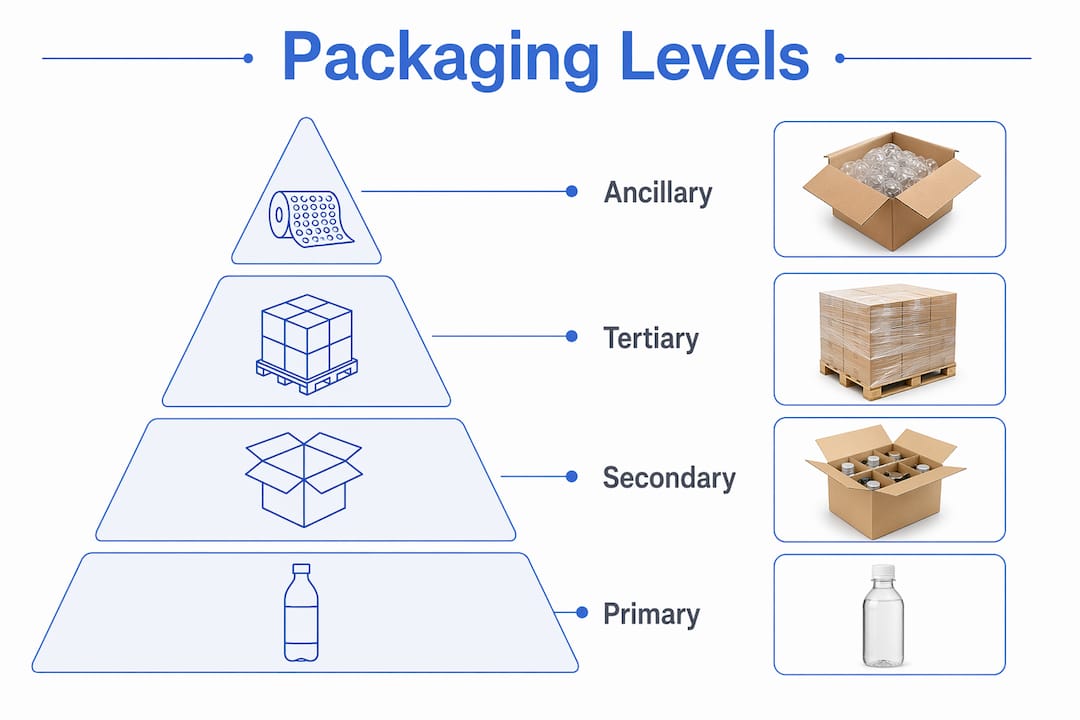
Packaging supplies are classified into four levels: primary, secondary, tertiary, and ancillary. This four-level framework is the most practical way to build a complete packaging supply list without missing critical components. Each level serves a distinct function in the supply chain, and overlooking any one of them creates weak points that lead to product damage or inefficiency.

Primary packaging makes direct contact with the product. Examples include glass bottles, aluminium cans, polythene bags, blister packs, and cardboard sleeves. This level defines the product’s immediate protection and presentation.
Secondary packaging groups primary units together. Corrugated cartons, retail trays, and shrink-wrapped multipacks all fall here. Secondary packaging is what a retailer typically handles and displays.
Tertiary packaging handles bulk transport and warehousing. Pallets, wooden crates, stretch-wrap film, and bulk corrugated boxes are the standard options. This level absorbs the physical stress of logistics.
Ancillary supplies are the materials that seal, stabilise, and identify the above. Packing tapes, security labels, void fill, and strapping bands belong in this category. Ancillary supplies are not optional extras. They are the components that complete the packaging system and make safe transport possible.
| Level | Function | UK examples |
|---|---|---|
| Primary | Direct product contact and containment | Polybags, glass jars, blister packs |
| Secondary | Grouping and retail presentation | Corrugated cartons, retail trays |
| Tertiary | Bulk shipping and warehousing | Pallets, stretch-wrap film, crates |
| Ancillary | Sealing, cushioning, and identification | Tape, void fill, labels, strapping |
Pro Tip: Audit your packaging station against all four levels before peak trading periods. Businesses that account for all four levels significantly reduce the risk of stockouts in ancillary supplies, which are the items most commonly forgotten until they run out.
What types of packaging materials are commonly used in the UK?
The most widely used packaging materials in the UK and Ireland are corrugated cardboard, polyethylene, polypropylene, glass, and metal. Each material suits specific product types, transport conditions, and regulatory requirements. Choosing the wrong material for a product’s protection needs, such as ignoring oxygen barrier requirements for food or moisture resistance for electronics, creates damage risk that no amount of ancillary padding will fix.
Corrugated cardboard dominates e-commerce and retail shipping because it is lightweight, recyclable, and available in hundreds of sizes. Polyethylene film and polypropylene bags handle flexible, lightweight items. Glass and metal are reserved for food, beverage, and pharmaceutical applications where contamination barriers are non-negotiable.
Void fill is where many businesses underinvest. Void fill materials prevent product shifting inside boxes and can reduce transit damage by up to 70 to 80 per cent. That figure matters because damage claims and returns are direct costs. The main void fill options available in the UK are:
- Paper void fill: Recyclable, increasingly preferred by UK consumers and retailers with sustainability commitments
- Air pillows: Lightweight and space-efficient, widely used in e-commerce fulfilment
- Foam peanuts: High cushioning but poor recyclability, falling out of favour under UK sustainability pressure
- Bubble wrap: Versatile for wrapping fragile items individually before boxing
Tapes and labels complete the ancillary picture. Standard brown packing tape handles most carton sealing. Reinforced filament tape suits heavier loads. Security tapes and tamper-evident labels add a layer of protection for high-value or sensitive shipments.
Pro Tip: If you ship fragile or high-value products, treat your packaging as a pack-out system rather than individual components. The most common failure points are sealing and cushioning, not the box itself.
How do packaging supplies relate to UK EPR obligations?
UK Extended Producer Responsibility (EPR) defines packaging as any product made of material intended for containment, protection, handling, delivery, or presentation of goods. This definition is broad enough to capture most packaging supplies you use, buy, or import. UK EPR obligations apply to businesses that place goods in packaging, sell packaging, or import packaged products into the UK market.
The practical implication is that your choice of packaging materials directly affects your compliance costs. PackUK, the approved compliance scheme administrator, uses a red, amber, and green rating system to modulate disposal fees. Modulated fees are lower for materials rated green (easily recyclable) and higher for materials rated red (difficult to recycle or sort). Switching from non-recyclable plastic void fill to paper-based alternatives is not just an environmental choice. It is a cost management decision.
Multi-material packaging adds reporting complexity. Under UK EPR, composite packaging with plastic layers at or below five per cent of total mass may be classified differently from packaging where plastic is the dominant component. Getting this classification wrong affects both your fee calculation and your reporting accuracy.
| Material type | PackUK recyclability rating | Fee implication |
|---|---|---|
| Cardboard and paper | Green | Lower disposal fees |
| Clear PET plastic | Amber | Moderate disposal fees |
| Black plastic | Red | Higher disposal fees |
| Paper void fill | Green | Lower disposal fees |
Packaging supply decisions must account for how packaging enters the UK market, because the point of supply determines who holds the EPR obligation. Importers, brand owners, and retailers can each carry reporting duties depending on the transaction structure.
What are specialist and security packaging supplies?
Specialist packaging supplies include tamper-evident tapes and tamper-evident labels, both of which display visible VOID marks or irreversible colour changes when someone attempts removal. Tamper-evident materials serve two functions: deterring unauthorised access and providing clear evidence if tampering has occurred. These are not the same product and are not interchangeable.
Tamper-evident tape is applied across carton seams and box closures. It is the right choice when you need to seal a shipping carton and show that it has not been opened in transit. E-commerce businesses, pharmaceutical distributors, and electronics retailers in the UK use this tape routinely on outbound orders.
Tamper-evident labels, by contrast, are applied to individual items, documents, warranty seals, or internal packaging. They are better suited to product authentication, warranty protection, and document security than to carton sealing.
| Supply type | Best application | Key feature |
|---|---|---|
| Tamper-evident tape | Carton and box sealing | VOID mark on box surface after removal |
| Tamper-evident label | Product, warranty, document sealing | Irreversible surface marking on removal |
| Security printed label | Brand authentication and retail | Holographic or serialised print features |
For businesses shipping high-value goods or operating in regulated sectors, these supplies reduce theft, improve customer confidence, and provide a clear audit trail if a dispute arises. A thermal tape dispenser paired with the right security tape makes consistent application faster and more reliable at the packing station.
Where can you source packaging supplies in the UK and Ireland?
The three main sourcing routes for packaging supplies in the UK and Ireland are trade wholesalers, specialist packaging distributors, and online retailers. Each route has a different cost profile, minimum order structure, and product range. The right choice depends on your order volume, product mix, and how quickly you need stock.
Trade wholesalers offer the broadest product ranges and the best unit pricing at volume. Specialist packaging distributors often carry technical expertise alongside their product range, which is useful when you need advice on material selection or compliance. Online retailers offer convenience and speed but rarely match wholesale pricing for regular, high-volume orders.
Key factors to evaluate when selecting a supplier:
- Product range: Does the supplier cover all four packaging levels, including ancillary supplies?
- Sustainability credentials: Do they stock recyclable and EPR-friendly materials?
- No minimum order quantities: Critical for small businesses and start-ups managing cash flow
- UK stock and logistics: Local stock reduces lead times and avoids import complications
- Technical support: Can the supplier advise on material selection for your specific products?
Subliblanks operates as a trade wholesaler with no minimum order quantities, which removes the barrier that stops smaller UK businesses from accessing wholesale pricing. For guidance on reducing costs without compromising presentation, the wholesale packaging guide on the Subliblanks blog covers practical strategies in detail.
Pro Tip: Treat ancillary supplies as part of your stock management system, not an afterthought. Operational audits by packaging level help you identify which supplies are most likely to cause a stockout and set reorder points accordingly.
Key takeaways
Packaging supplies work as an integrated system across four levels, and gaps in any level create damage, compliance, or cost problems.
| Point | Details |
|---|---|
| Four-level classification | Primary, secondary, tertiary, and ancillary levels each serve distinct functions in the supply chain. |
| Ancillary supplies are critical | Tapes, void fill, and labels complete the packaging system and are the most common stockout risk. |
| Void fill reduces damage significantly | Correct void fill selection can cut transit damage by up to 70 to 80 per cent. |
| EPR affects material choice | UK EPR modulated fees make recyclable materials a cost management decision, not just an ethical one. |
| Sourcing strategy matters | Trade wholesalers with no minimum order quantities offer the best combination of range, price, and flexibility for UK businesses. |
The part of packaging most businesses get wrong
I have seen businesses invest heavily in branded boxes and then seal them with the cheapest tape available. The box survives the journey. The seal fails. The product arrives damaged or, worse, visibly tampered with. That is the core lesson I keep coming back to: packaging is only as strong as its weakest component.
The four-level framework changed how I think about packaging supply lists. Most people start with the box and work outward. The smarter approach is to start with the product’s specific vulnerabilities, work through each level systematically, and treat ancillary supplies with the same seriousness as the primary container. A fragile ceramic mug needs a polybag liner, a corrugated box, paper void fill, and reinforced tape. Remove any one of those elements and the system fails.
On the EPR side, I would encourage any UK business placing packaged goods on the market to get a clear picture of their material mix before the next reporting period. The difference between a green-rated paper void fill and a red-rated foam peanut is not just environmental. It shows up directly in your fee calculation. That is a straightforward swap with a measurable financial return.
The businesses I see managing packaging well treat it as a pack-out system rather than a collection of individual purchases. That shift in thinking is what separates businesses that have packaging problems from those that do not.
— chris
Packaging supplies for sublimation and print businesses
If you run a sublimation, DTF, or print business in the UK or Ireland, your packaging supply needs go beyond standard brown boxes. Subliblanks stocks packaging supplies alongside sublimation paper, sublimation blanks, and print equipment, so you can source everything from one UK-based wholesaler with no minimum order quantities.
Whether you need void fill for fragile mugs, security tape for high-value orders, or specialist paper for your print workflow, Subliblanks has you covered. The SubliFlex pre-cut sublimation paper is a popular starting point for businesses combining print production with professional product presentation. Browse the full range at Subliblanks and order exactly what you need, without committing to bulk quantities you do not yet require.
FAQ
What are packaging supplies exactly?
Packaging supplies are the materials used to contain, protect, transport, store, and present products. They include both packaging materials (boxes, bottles, bags) and packaging aids (tapes, void fill, labels, strapping).
What are the main types of packaging materials?
The main types are corrugated cardboard, polyethylene, polypropylene, glass, and metal. Each suits different product types, protection requirements, and transport conditions.
What is the difference between packaging materials and packaging aids?
Packaging materials form the structural container around a product. Packaging aids, such as tape, bubble wrap, and void fill, secure and stabilise that container for safe transit and storage.
Do packaging supplies fall under UK EPR regulations?
Yes. UK EPR covers any material intended for containment, protection, handling, delivery, or presentation of goods. Businesses that place packaged goods on the UK market, sell packaging, or import packaged products may carry reporting and fee obligations.
Where is the best place to buy packaging supplies in the UK?
Trade wholesalers offer the best combination of range and unit pricing. Subliblanks is a UK-based trade wholesaler with no minimum order quantities, stocking packaging supplies alongside sublimation and print equipment for businesses of all sizes.


