



Role of custom stamps in business: a UK SME guide
Custom stamps give small and medium businesses a fast, low-cost way to enforce brand consistency, speed routine operations, and satisfy basic compliance needs. That single sentence covers most of what you need to know. Everything below unpacks the how, the when, and the how much.
The three core benefits break down like this:
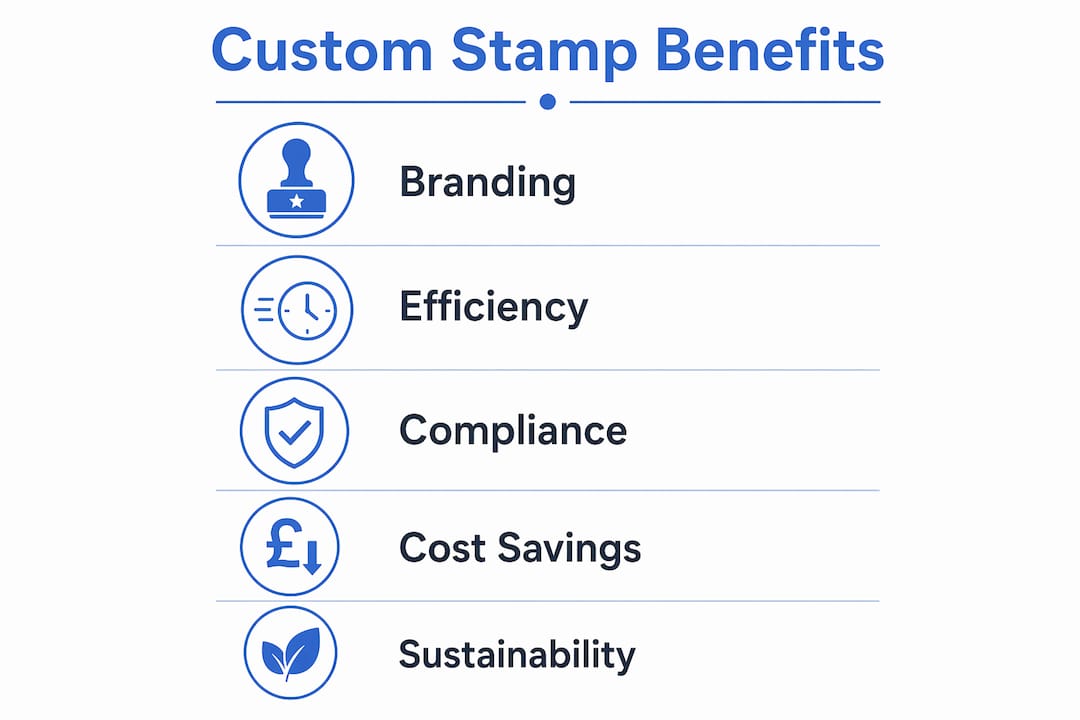
- Brand reinforcement: logo and address stamps turn plain packaging, receipts, and stationery into branded touchpoints without the cost of full custom print runs.
- Operational speed and accuracy: date, signature, and endorsement stamps cut repetitive manual tasks, reducing errors on documents such as invoices, delivery notes, and returns.
- Compliance and document control: “Received,” “Approved,” “Confidential,” and inspection marks create a visible, consistent audit trail that satisfies basic recordkeeping requirements.
Common use-cases include logo stamps on kraft bags and tissue paper, address stamps on outgoing post, date stamps on incoming correspondence, and inspection marks on food or manufactured goods. Subliblanks supplies stamp-making machines and consumables to UK trade customers who want to bring this capability in-house, and their practical guide to stamp making is a useful companion to this article.
Table of Contents
- What is the role of custom stamps in business?
- What types of custom stamps should you use?
- How do you design a stamp that works first time?
- What are the legal and compliance considerations for UK businesses?
- How much do custom stamps cost, and what should you ask a supplier?
- What mistakes do businesses make with custom stamps, and how do you avoid them?
- Is investing in custom stamps worth it for a UK small business?
- Are custom stamps environmentally sustainable?
- How do custom stamps fit into digital and hybrid document workflows?
- Key takeaways
- Why I think most businesses underestimate stamps
- Subliblanks: stamp-making equipment and supplies for UK trade customers
- Useful sources and further reading
What is the role of custom stamps in business?
The short answer: they make your business look the same every time, without adding staff or cost. A stamped logo on a plain brown box costs a fraction of a pre-printed equivalent. A date stamp on an incoming invoice takes two seconds and creates a record that would otherwise require a typed entry or a handwritten note. The cumulative effect across hundreds of documents a week is significant.
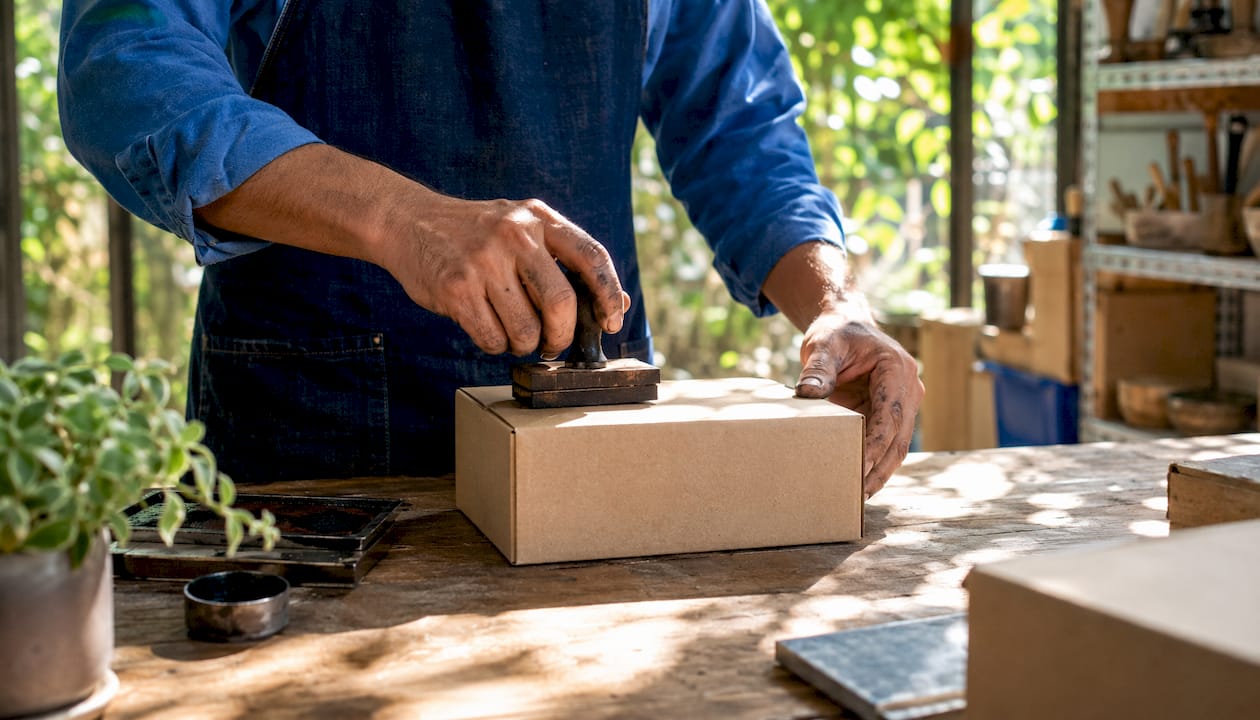
Custom rubber stamps reduce hours spent on repetitive tasks such as dating documents or addressing envelopes, and case examples show firms cutting admin time meaningfully after adopting them. That is not a dramatic claim; it is arithmetic. If stamping an address takes three seconds versus writing it by hand in fifteen, the saving across fifty envelopes a day is ten minutes. Across a year, that is roughly forty hours.
Branding: stamps as a low-cost identity tool
Consistent visual identity is what turns a transaction into a recognisable brand. A logo stamp on packaging, a return address stamp on correspondence, and a branded “Thank You” stamp on tissue paper all do the same job: they tell the recipient who sent this and what to expect next time. Personalised rubber stamps act as a consistency tool for small businesses, keeping signatures, return addresses, and compliance markings uniform across all communications.
For an e-commerce seller dispatching fifty orders a day from a spare room, a logo stamp on plain kraft bags is the difference between anonymous packaging and a branded unboxing. The cost per impression is negligible, but the brand signal is not.
Operational efficiency: three quick examples
E-commerce packaging: a logo stamp and a “Fragile” stamp applied at packing reduce the time spent writing labels by hand and cut the risk of a courier mishandling an unmarked parcel.

Small accounting practice: a date-received stamp on every incoming document creates an automatic chronological record. A “Reviewed” stamp on processed files tells any colleague or auditor exactly where a document stands without a conversation.
Food producer inspection marks: a batch or inspection stamp applied at the end of a production run creates a visible traceability record that satisfies basic food safety documentation requirements. It takes seconds per unit and requires no software.
Trust and compliance: the visible audit trail
Stamps create document status at a glance. “Approved,” “Received,” “Paid,” and “Confidential” are not decorative; they are functional signals that reduce the chance of a document being processed twice, shared incorrectly, or lost in a pile. For businesses subject to any form of inspection or audit, a consistent stamping practice is a simple, low-cost control.
What types of custom stamps should you use?
The right stamp depends on volume, surface, and purpose. Here is a breakdown of the main types and when each earns its keep.
| Stamp type | Primary purpose | Best surface | Typical durability | Cost shape |
|---|---|---|---|---|
| Self-inking | High-volume office use (dating, endorsing) | Paper, card | high impression volume | Mid-range upfront, low running cost |
| Pre-inked | Fine detail, logos, signatures | Paper, card | medium impression volume | Higher upfront, very low running cost |
| Traditional rubber + pad | Large designs, craft, occasional use | Most surfaces | Pad-dependent | Low upfront, pad replacement ongoing |
| Embosser/seal | Formal documents, certificates | Paper | Mechanical, very long life | Higher upfront, near-zero running cost |
| Date stamp | Chronological records | Paper | Mechanism-dependent | Low–mid range |
Self-inking stamps are fast and suited to high-volume office use; pre-inked models give finer detail and longer runs between re-inking. That distinction matters when you are stamping logos rather than text: a pre-inked stamp will hold a finer line and reproduce a more detailed image.
Quick-pick guide:
- Logo on packaging (moderate volume): pre-inked stamp for crisp detail on paper and card.
- Date/received on incoming post (high volume): self-inking date stamp, refillable.
- Return address on envelopes: self-inking address stamp; saves the most time at scale.
- Signature on routine correspondence: pre-inked signature stamp; restrict access carefully (see Section 5).
- Formal company documents: embosser or seal for certificates, deeds, or documents requiring a raised impression.
- Inspection or batch marks on goods: traditional rubber stamp with a separate pad, which allows ink colour changes and works on a wider range of surfaces.
Business stamp categories such as endorsement, address, date, and signature are commonly used to speed workflows and create standardised records. The key is matching the mechanism to the volume and the surface, not simply ordering the cheapest option.
How do you design a stamp that works first time?
Most stamp failures come from the same three mistakes: artwork that is too detailed for the impression size, the wrong ink for the surface, and no proof test before a full run. Here is how to avoid all three.
Sizing and artwork
Keep logo stamps simple. Fine lines under 0.5mm and small reversed-out text (white on a dark background) rarely survive the impression cleanly, especially at sizes below 30mm. If your logo has a complex gradient or thin serifs, ask your supplier for a simplified single-colour version before ordering. For text-only stamps, limit yourself to three or four lines of copy; more than that and the impression becomes illegible at practical stamp sizes.
File formats matter. Most suppliers accept EPS, PDF, or high-resolution PNG (300dpi minimum). Send vector artwork where possible; a rasterised logo scaled up from a small JPEG will produce a blurry die. Subliblanks’s custom stamp design guide covers UK-specific file requirements in detail.
Ink and surface pairings
Standard water-based inks work well on uncoated paper and card. They frequently fail on non-porous surfaces such as glossy bags, coated boxes, or plastics, where the ink sits on the surface and smears rather than absorbing. For those materials, use a pre-inked stamp with oil-based or permanent ink and allow a longer drying time. Pigment-based inks are an alternative for glossy card; they dry faster than dye-based options on coated stock.
For kraft paper and uncoated bags — the most common surface for small e-commerce businesses — a standard dye-based ink in a self-inking or pre-inked stamp works reliably. Test on the actual material before committing to a full order.
Pro Tip: Order a single proof stamp before a batch. Stamp it on the exact packaging material you use, let it dry for two minutes, then smear it with your thumb. If it smears, change the ink type before ordering more. One proof run prevents a costly reorder.
Placement and consistency
Decide on stamp placement before you start using it and write it down. “Bottom-left corner of the outer box, 15mm from the edge” sounds pedantic, but inconsistent placement across a team of three people produces packaging that looks different every day. A simple one-page reference sheet pinned near the packing station solves this entirely.
Proofing checklist before a first order:
- Artwork supplied as vector or 300dpi+ PNG
- All text checked for spelling and correct contact details
- Impression size tested against actual packaging dimensions
- Ink type confirmed for the target surface
- Test impression reviewed for legibility at arm’s length
What are the legal and compliance considerations for UK businesses?
Custom stamps touch several areas of UK law and regulation. None of them are complicated, but ignoring them creates avoidable risk.
Signature stamps
A stamped signature is legally acceptable for many routine business documents: internal approvals, standard correspondence, and repetitive administrative forms. It is not acceptable as a substitute for a wet signature on contracts, deeds, statutory declarations, or any document where the law specifically requires a personal signature. The practical rule: if the document has legal consequences for another party, use a wet signature. If it is an internal process document or a routine outgoing letter, a signature stamp is generally fine.
Access control is the critical point. A signature stamp in the wrong hands is a forgery risk. Treat it like a chequebook: keep it locked when not in use, restrict it to named authorised users, and log who used it if the volume warrants it.
Company seals
The Companies Act 2006 removed the legal requirement for UK companies to have a common seal. Most companies no longer use one. However, some formal documents, particularly certain deeds and share certificates, may still call for a seal depending on the company’s articles of association or the counterparty’s requirements. If you are unsure whether a document requires a seal, check with a solicitor rather than assuming either way.
Data protection and recordkeeping
Stamps that add dates, reference numbers, or identifiers to documents form part of your recordkeeping system. Under UK GDPR, documents containing personal data must be handled, stored, and disposed of appropriately. A “Received” stamp on a letter containing personal data does not change the data protection obligation, but it does create a dated record that may be subject to a subject access request. Keep stamped documents in the same secure storage as any other business record.
Legal callout: If your business operates in a regulated sector — food production, pharmaceuticals, construction, or financial services — check whether your sector regulator specifies requirements for batch marking, inspection stamps, or traceability records. The Food Standards Agency, for example, sets traceability requirements for food businesses that a simple date or batch stamp can help satisfy. Always verify current sector-specific rules with the relevant authority or a qualified adviser rather than relying on general guidance.
How much do custom stamps cost, and what should you ask a supplier?
Price varies considerably depending on mechanism, size, and whether you are buying finished stamps or investing in stamp-making equipment.
Price drivers
- Mechanism: self-inking stamps cost more upfront than traditional rubber stamps but have lower running costs per impression.
- Size: larger dies cost more to produce; most suppliers charge by impression area.
- Custom die vs stock: a bespoke logo die costs more than a text-only stamp using standard fonts.
- Setup and proof charges: some suppliers charge a one-off artwork fee; others include it in the unit price.
- Lead time: next-day or same-day production typically carries a premium.
Indicative price ranges (illustrative only)
| Stamp type | Indicative unit cost (£) | Typical lead time |
|---|---|---|
| Self-inking address stamp | £10–£20 | a few working days |
| Self-inking logo stamp (small) | £15–£40 | several working days |
| Pre-inked logo stamp | £20–£40 | 2–5 working days |
| Traditional rubber stamp + pad | £10–£20 | a few working days |
| Embosser/seal | £30–£80 | about a week |
| Stamp-making machine (entry-level) | £200–£400 | Varies by supplier |
These are indicative ranges based on typical UK market pricing; always request a quote for your specific size and artwork.
Procurement options
Buying individual finished stamps suits most businesses starting out or with low volume needs. Batch orders reduce the per-unit cost when you need multiple stamp types or want spares. Investing in an on-site stamp-making machine makes sense when volume is high, designs change frequently, or turnaround speed matters. Logo stamps are a cost-effective alternative to pre-printed packaging and let businesses brand plain stock on demand without holding large custom print runs.
Questions to ask any supplier before ordering:
- Can you supply a proof impression before the full order?
- What ink type do you recommend for my specific surface material?
- What is the re-inking or pad replacement process, and what does it cost?
- What is your returns or remake policy if the impression is not as specified?
- What is the realistic turnaround for a first order versus a repeat?
For businesses considering in-house equipment, Subliblanks’s guide on stamp-making machines covers the procurement decision in practical detail.
What mistakes do businesses make with custom stamps, and how do you avoid them?
Most stamp problems are predictable and preventable. The list below covers the ones that come up repeatedly.
Common mistakes:
- Wrong ink for the surface: water-based ink on glossy packaging smears every time. Test before ordering at volume.
- Stamp too small for the design: a complex logo at 20mm produces an illegible blob. Simplify the artwork or increase the size.
- No access controls on signature stamps: leaving a signature stamp on a shared desk is a governance failure. Lock it away.
- Inconsistent placement: three people stamping in three different positions produces packaging that looks unprofessional. Write the placement rule down.
- Skipping the proof: ordering fifty stamps without a proof run is a gamble. One test impression costs almost nothing.
- Neglecting re-inking: a dry stamp produces faint, uneven impressions. Check ink levels weekly if the stamp is in daily use.
Routine maintenance
Self-inking stamps need re-inking when impressions become faint. Most accept standard refill ink via a small port on the body; use the ink type specified by the manufacturer, not a generic substitute. Pre-inked stamps last longer between re-inks but eventually need a pad replacement rather than a top-up. Traditional rubber stamps need the pad replaced when it dries out or becomes saturated with mixed colours.
Clean the rubber die periodically with a damp cloth to remove ink build-up, which can fill fine lines and degrade impression quality. Store stamps face-down (for self-inking) or in a case away from direct sunlight, which degrades rubber over time.
Governance
Assign named authorised users for each stamp type, particularly signature and approval stamps. Record the stamp designs in a simple procedure document so that a replacement can be ordered accurately if one is lost or damaged. Keep a small sample log — a stamped impression on a dated card — for each stamp in use. This takes thirty seconds per stamp and gives you an instant reference if a quality dispute arises.
Pro Tip: For signature stamps specifically, keep a written log of each use: date, document reference, and the name of the person who applied it. This takes ten seconds per use and provides a complete audit trail if the stamp’s authority is ever questioned.
Is investing in custom stamps worth it for a UK small business?
The short answer is yes, at almost any volume above occasional use. The longer answer depends on whether you buy finished stamps or invest in equipment.
A simple cost comparison: stamping vs pre-printed packaging
Consider a small bakery dispatching 200 orders per week in plain kraft bags. Pre-printed bags with a custom logo typically cost 20–40% more per unit than plain equivalents, depending on print run size. A logo stamp costing £25 applied to plain bags at a cost of fractions of a penny per impression produces the same branded result. At 200 bags per week, the stamp pays for itself in days.
For an accounting practice processing 100 incoming documents per week, a date-received stamp at £15 eliminates the need to write or type a date on each document. At fifteen seconds saved per document, that is 25 minutes per week, or roughly 20 hours per year. The stamp costs less than an hour of staff time.
Illustrative calculation: A stamp-making machine costing £400 produces stamps at a material cost of roughly £2–£5 per die, compared with £15–£40 per finished stamp ordered from a supplier. At ten new stamp designs per year, the machine pays for itself within the first year and reduces per-design cost by 80–90% thereafter. These figures are illustrative; actual costs depend on machine model, ink, and labour.
When does a stamp-making machine make sense?
The volume threshold varies, but the signals are consistent: you need new or updated designs regularly, you want same-day turnaround, or you are producing stamps for multiple clients or product lines. A stamp-making machine also gives you control over ink type and impression quality in a way that outsourcing does not. Subliblanks’s advantages of stamp making article covers the cost and volume thresholds in more detail.
| Cost line | Outsourced stamps | In-house machine |
|---|---|---|
| Per stamp (logo, small) | £15–£40 | £2–£5 material cost |
| Setup/artwork fee | £0–£15 per order | One-off machine cost |
| Turnaround | several working days | Same day |
| Design flexibility | Limited by order cycle | Immediate |
| Break-even (illustrative) | N/A | multiple stamp designs |
All figures are illustrative. Request quotes for your specific requirements.
Are custom stamps environmentally sustainable?
Sustainability is a fair question, and the answer is more nuanced than most stamp suppliers acknowledge.
Traditional rubber stamps use natural rubber, which is a renewable material, but the rubber is often vulcanised with sulphur compounds and the pads use synthetic foam. Self-inking stamp bodies are predominantly plastic; some manufacturers use recycled plastic content in their casings. Pre-inked stamps use a polymer foam reservoir that is not easily recyclable at end of life.
Inks are the more significant variable. Water-based dye inks have a lower environmental impact than solvent-based or oil-based alternatives. However, oil-based inks are sometimes necessary for non-porous surfaces, and the volume used per impression is tiny. The practical environmental impact of stamp ink is small compared with, say, the packaging it is applied to.
The strongest sustainability argument for stamps is the one that is also the strongest commercial argument: they extend the life of plain, recyclable packaging. A plain kraft bag is more easily recycled than a laminated, foil-printed equivalent. Stamping a logo onto plain kraft rather than ordering custom-printed bags with plastic coatings is a genuine environmental improvement, not just a cost saving.
If sustainability matters to your brand, look for suppliers who use water-based inks, recycled plastic stamp bodies, and natural rubber dies. Ask specifically; most suppliers will confirm their materials on request.
How do custom stamps fit into digital and hybrid document workflows?
The assumption that stamps are incompatible with digital workflows is wrong. They fit into hybrid processes more naturally than most businesses realise.
The most common integration is the simplest: a physical stamp creates a visible status marker on a paper document, which is then scanned and filed digitally. A “Received” stamp with a date means the scanned version carries a clear, machine-readable date without any additional metadata entry. A “Reviewed” or “Approved” stamp on a printed contract, once scanned, creates a digital record of approval status that is immediately visible without opening the document properties.
For businesses using document management systems such as SharePoint, Dropbox, or Google Drive, the stamped-then-scanned workflow is a practical bridge between physical and digital records. The stamp does the work at the physical stage; the scanner does the work at the digital stage. No additional software is required.
More advanced integrations exist. Some businesses use stamps with QR codes or short URLs, linking a physical document to a digital record. A delivery note stamped with a QR code pointing to the relevant order in a warehouse management system, for example, allows a warehouse operative to confirm receipt physically and digitally in one step. This requires slightly more design work upfront but no specialist equipment beyond a standard stamp and a QR code generator.
For businesses considering a fully digital signature workflow, tools such as DocuSign or Adobe Acrobat Sign handle electronic signatures for documents that require them. Physical signature stamps remain useful for the large volume of internal documents that do not require a legally binding electronic signature and where the overhead of a digital signing workflow is disproportionate to the task.
The practical advice: map your document types before deciding. High-stakes, legally binding documents belong in a digital signing workflow. Routine internal documents, packaging marks, and correspondence are exactly where a physical stamp earns its keep, with or without a scan at the end.
Key takeaways
Custom stamps deliver consistent branding, measurable time savings, and basic compliance support for UK small businesses at a cost that is almost always justified within weeks of first use.
| Point | Details |
|---|---|
| Branding at low cost | A logo stamp on plain packaging produces branded results without the cost of custom print runs. |
| Time savings add up | Stamping repetitive tasks such as dating and addressing saves hours per week across a team. |
| Match stamp to surface | Use oil-based or permanent ink for non-porous surfaces; water-based ink works on uncoated paper and card. |
| Governance matters | Restrict signature and approval stamps to named authorised users and keep a simple usage log. |
| Subliblanks for in-house production | Subliblanks supplies stamp-making machines and consumables with no minimum order, letting UK trade customers produce stamps on demand. |
Why I think most businesses underestimate stamps
The conventional wisdom treats custom stamps as a legacy tool — something your accountant’s office used in 1987 and that has since been replaced by digital everything. That framing misses the point entirely.
Stamps are not competing with digital workflows. They are filling the gap that digital workflows leave: the physical moment when a package is sealed, a document is filed, or a batch leaves a production line. No software replaces the two-second act of stamping “Inspected” on a product before it ships. No email signature replaces the branded impression on a customer’s parcel.
What I find consistently underestimated is the compounding effect of consistency. A business that stamps every outgoing package the same way, in the same position, with the same ink, for a year looks more established than one that does not, regardless of size. That is not a branding theory; it is what customers actually notice. The stamp is a proxy for the business’s attention to detail.
The other underestimated point is the machine ownership threshold. Most businesses buy finished stamps indefinitely when, past a certain volume or design frequency, owning a stamp-making machine is simply cheaper and faster. The upfront cost feels significant; the per-design saving makes it obvious in retrospect. If you are ordering more than ten new stamp designs a year, the arithmetic almost always favours equipment.
Subliblanks: stamp-making equipment and supplies for UK trade customers
If you want to bring stamp production in-house rather than ordering finished stamps each time, Subliblanks is a practical starting point. As a UK trade wholesaler, Subliblanks supplies stamp-making machines, inks, pads, and packaging supplies with no minimum order quantity — which means you can start with a single machine and scale as volume grows.
The range covers everything from entry-level flash stamp machines to consumables and replacement pads, alongside the broader packaging supplies that complement a stamping workflow. For a print shop, maker, or small business that wants same-day stamp production and full control over design and ink choice, the economics are straightforward: lower cost per design, faster turnaround, and no dependency on a third-party supplier’s lead times.
Browse the full range at Subliblanks and check the stamp-making guides for technical setup advice before you order.
Useful sources and further reading
Subliblanks internal guides (practical and UK-focused):
- The role of stamp making in business explained — covers how stamp making supports brand recognition and packaging workflows.
- What is custom stamping? Techniques and applications — technical overview of stamping techniques, ink types, and machine options.
- What is custom stamp design? A practical UK guide — file formats, artwork preparation, and design rules for UK suppliers.
- What is a stamping machine? Guide for production and craft — procurement guide for businesses considering in-house equipment.
- Packaging solutions for small business — when to use stamps versus full custom printed packaging.
- Advantages of stamp making for crafters and small businesses — cost and volume analysis for UK SMEs.
Sector guidance and further context:
- Food Standards Agency (food.gov.uk) — traceability and labelling requirements for UK food businesses.
- ICO guidance on UK GDPR (ico.org.uk) — recordkeeping and document handling obligations under UK data protection law.
- Custom packaging solutions for eCommerce — practical overview of packaging options for e-commerce businesses, including where stamping fits alongside other branding methods.


