



Packaging solutions for small business: a practical guide
TL;DR:
- Small businesses should prioritize low-cost options like custom labels and stock die formats to maximize value. Eco-friendly packaging with certifications such as FSC and EN 13432 is increasingly expected by customers and regulators. Planning development stages and shipping methods carefully helps control costs and ensures a professional brand presentation.
Packaging solutions for small business owners are defined by three criteria: cost per unit, minimum order quantity, and how well the pack represents your brand at the door. The right choice protects your product, impresses the customer, and keeps your margins intact. For small businesses across the UK and Ireland, that balance is harder to strike than it sounds. This guide covers the most cost-effective formats, the development process, eco-friendly options, and practical tips to get professional results without overspending.
1. What are the most cost-effective custom packaging options?
Custom packaging sits on a wide cost spectrum. Custom labels cost roughly £0.04–£0.05 per unit, making them the most affordable branded touchpoint available to any startup. Mailer boxes deliver a premium unboxing feel and start at around £1.00 per unit at 500 units. Rigid boxes look exceptional on a shelf but can reach £4.00–£5.00 per unit, which makes them unsuitable for most first orders.
The most practical formats for small businesses include:
- Custom labels: Apply to plain stock boxes or poly mailers for instant branding at minimal cost.
- Mailer boxes: Ideal for e-commerce and direct-to-consumer shipments; foldable, lightweight, and printable inside and out.
- Stand-up pouches: Well suited to food, supplements, and cosmetics; available with resealable zips and compostable films.
- Paper tubes: A distinctive format for candles, spirits, and beauty products; strong shelf presence at moderate cost.
- Folding cartons: The standard retail box; cost-effective at volume and compatible with most automated packing lines.
Pro Tip: Use a supplier’s existing box templates rather than commissioning a new structural design. Cutting dies for new sizes cost between £950 and £1,200. Matching your product to a stock die eliminates that fee entirely.
2. How can small businesses choose eco-friendly packaging?
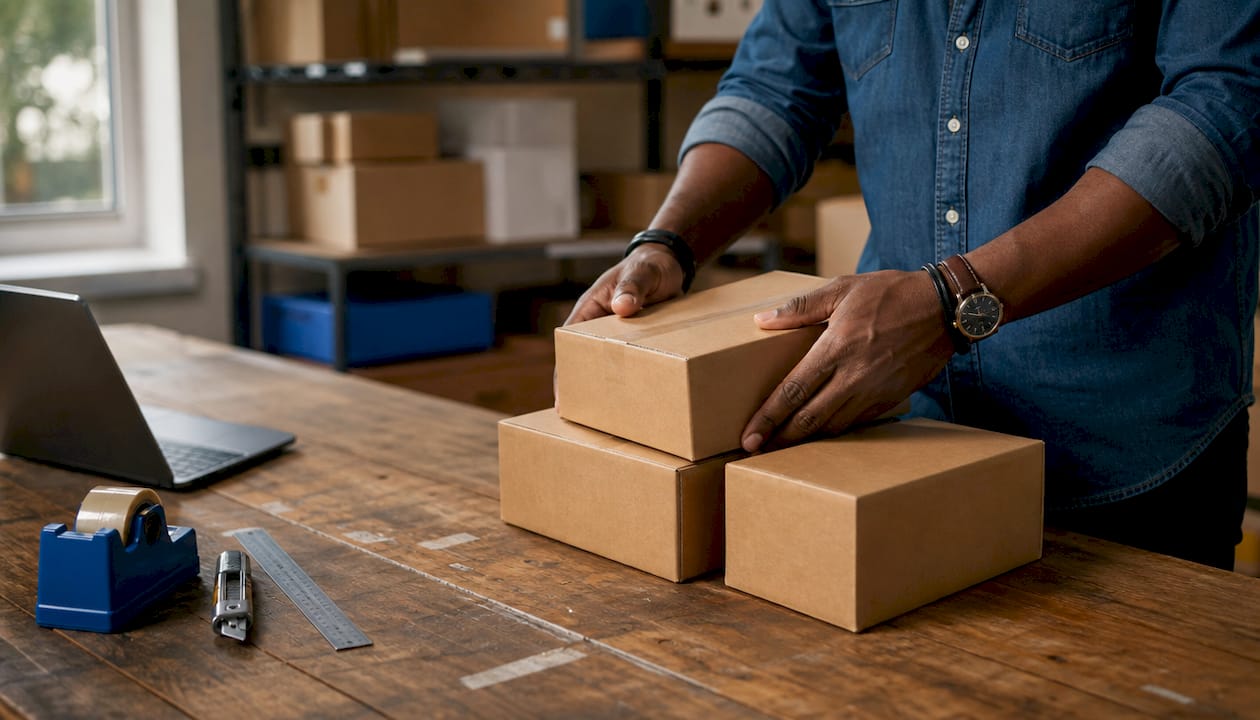
Sustainability is no longer a premium add-on. Customers across the UK and Ireland expect it, and regulators are moving in the same direction. FSC-certified kraft paper is the most widely available eco option. It is recyclable, cost-competitive with standard board, and carries a certification that customers recognise.
Eco-friendly formats worth considering:
- Compostable mailers: Made from plant-based films; certified to EN 13432 for home or industrial composting.
- Recycled kraft boxes: Use post-consumer waste board; often indistinguishable from virgin board in print quality.
- Biodegradable void fill: Replaces polystyrene chips with cornstarch pellets or shredded kraft paper.
- Soy-based inks: Lower VOC emissions than petroleum inks; compatible with most flexographic and digital print processes.
The key certifications to look for are FSC (forestry chain of custody), BPI (compostability in the US, increasingly referenced in UK procurement), and REACH compliance for any inks or coatings touching food-adjacent products. Balancing eco credentials with durability matters. A compostable mailer that splits in transit does more reputational damage than a standard poly bag. Test samples in real shipping conditions before committing to a full run.
Pro Tip: Reusable inserts, such as a branded tissue wrap or a fabric pouch, add perceived value and reduce single-use waste simultaneously. They also give customers a reason to share the unboxing on social media.
3. What is the typical custom packaging development process?
The development process follows a consistent sequence regardless of supplier or format. Knowing each stage prevents delays and avoids costly mistakes.
- Submit your product dimensions. Provide length, width, and height in millimetres, plus the weight of the filled product. Accurate dimensions prevent structural failures and wasted sampling rounds.
- Receive quotes and structural options. Most reputable suppliers return quotes and dieline options within 24–48 hours. Many suppliers provide 3D digital mockups and dieline engineering at no charge to reduce your upfront risk.
- Approve the digital mockup. Review the flat dieline and the 3D render. Check bleed areas, font sizes, and barcode placement at this stage, not after physical samples arrive.
- Request a physical sample. A physical sample reveals print colour accuracy, board rigidity, and assembly ease. Never skip this step for a first order.
- Approve and release to production. Once the sample is signed off, production begins. First orders typically take 2–6 weeks from sample approval to delivery. Reorders often complete in 10–14 business days.
- Plan your freight. For UK and Irish businesses sourcing from overseas manufacturers, factor in customs clearance and port delays. Build at least two weeks of buffer into your launch timeline.
Understanding this sequence helps you plan stock levels accurately and avoid the common trap of running out of packaging mid-campaign.
4. Which packaging types suit different small business needs?
Choosing the right format depends on your product category, order volume, and how the pack travels. The table below maps common formats against the criteria that matter most to small business owners.
| Format | Typical MOQ | Approx. cost per unit | Presentation | Eco options | Best for |
|---|---|---|---|---|---|
| Custom labels | 100 units | £0.04–£0.05 | Moderate | Yes | Stock box branding, tight budgets |
| Mailer box | 500 units | £0.90–£1.20 | High | Yes | E-commerce, gifts, apparel |
| Folding carton | 500 units | £0.30–£0.60 | High | Yes | Retail, cosmetics, food |
| Rigid box | 100–200 units | £3.00–£5.00 | Premium | Limited | Luxury goods, high-ticket gifts |
| Stand-up pouch | 500 units | £0.40–£0.80 | High | Yes | Food, supplements, coffee |
| Paper tube | 200 units | £0.60–£1.00 | Distinctive | Yes | Candles, spirits, beauty |
Low MOQ runs of 500–1,000 units allow small businesses to test market response before committing to larger inventory. That flexibility is one of the most underrated advantages of working with specialist packaging suppliers rather than general wholesalers. For businesses just launching, starting with custom labels on stock boxes and graduating to fully printed mailer boxes once sales volumes justify the investment is a proven path.
Shipping method also shapes format choice. Rigid boxes add weight and cubic volume, which increases courier costs. Mailer boxes are self-locking and lightweight, which reduces the need for additional outer cartons and keeps dimensional weight charges down.
5. Practical tips to control costs and improve packaging impact
The biggest cost savings in packaging come from decisions made before you place an order, not from negotiating unit prices after the fact. These tips apply directly to small business owners working with limited budgets and variable order volumes.
- Brand stock boxes with custom labels or tape. Custom printed tape costs roughly £0.05 per unit and transforms a plain brown box into a branded shipment. It is the fastest route to a professional look without custom tooling costs.
- Use inside-box branding. Printed tissue paper, a branded thank-you card, or a QR code insert costs very little per unit and creates a memorable unboxing moment. Research into packaging as a brand system shows that interior elements significantly affect customer perception and repeat purchase rates.
- Match your product to a stock die. New brands regularly overpay for custom structural design. Matching your product to existing templates saves hundreds of pounds in die fees on a first order.
- Plan freight around order size. Orders under 100 units typically ship via air express. Above 100–250 units, economy sea or truck freight cuts per-unit shipping costs significantly, though lead times extend. Build that time into your planning cycle.
- Avoid over-ordering. Excess packaging inventory ties up cash and takes up storage space. Order what you need for 60–90 days of sales, then reorder. Most suppliers process reorders in 10–14 business days.
Pro Tip: Ask your supplier for a packaging selection guide before requesting quotes. Knowing which formats they hold stock dies for will immediately narrow your options to the most cost-effective choices.
For a broader overview of what packaging supply actually covers in the UK market, the Subliblanks guide on what packaging supply includes is a useful starting point before approaching suppliers.
Key takeaways
The most cost-effective packaging solutions for small businesses combine low minimum order quantities, stock die formats, and interior branding to deliver professional results without large upfront costs.
| Point | Details |
|---|---|
| Start with labels or tape | Custom labels at £0.04–£0.05 per unit are the lowest-cost branded packaging option available. |
| Match stock dies to save money | Avoiding new cutting dies saves £950–£1,200 on a first order. |
| Low MOQ reduces risk | Orders of 500–1,000 units allow market testing before large inventory commitments. |
| Plan freight by volume | Switching to economy freight above 100 units cuts per-unit shipping costs significantly. |
| Interior branding adds value | Tissue paper, inserts, and branded tape create a full brand experience at low cost per unit. |
What I’ve learned about packaging that most guides won’t tell you
The conventional advice is to invest in beautiful packaging from day one. I disagree with that, at least for most small businesses starting out in the UK and Ireland.
The businesses I have seen get packaging right are the ones who started cheap and specific. They used a stock mailer box, slapped on a well-designed label, and put a handwritten thank-you card inside. That combination costs almost nothing per unit and consistently outperforms a £3.00 rigid box with no interior thought. The unboxing moment is not about the box. It is about what is inside the box and how it makes the customer feel.
The second thing most guides miss is the freight calculation. A beautiful rigid box that costs £4.00 per unit and adds 300 grams to your shipment weight will quietly destroy your margins on every order. Run the full landed cost before you fall in love with a format.
Sustainability is genuinely reshaping buyer expectations, particularly for younger customers in urban UK markets. But do not let eco credentials become a marketing exercise. Choose materials that are actually recyclable in UK kerbside collections, not just technically compostable under industrial conditions. Your customers will notice the difference, and so will your returns rate.
The suppliers who offer free dieline engineering and 3D mockups are worth prioritising. That free service saves you real money and time on every new product launch. If a supplier charges for mockups on a first enquiry, look elsewhere.
— chris
Subliblanks and your packaging needs
Small businesses across the UK and Ireland need packaging supplies that work at low volumes without sacrificing quality. Subliblanks supplies a full range of packaging materials alongside sublimation blanks, sublimation printers, and custom branding equipment, all with no minimum order quantities.
Whether you are printing custom labels in-house using an Epson or Ricoh sublimation printer or sourcing ready-to-brand packaging supplies, Subliblanks has the equipment and stock to support you. Visit the Subliblanks store to see the full range of packaging supplies and printing equipment available for UK and Irish small businesses.
FAQ
What is the minimum order quantity for custom packaging?
Many specialist packaging suppliers offer custom packaging from as low as 100 units, though 500 units is the most common entry point for printed mailer boxes and folding cartons.
How long does custom packaging take to produce?
First orders typically take 2–6 weeks from sample approval to delivery. Reorders with the same specification usually complete within 10–14 business days.
What is the cheapest way to brand packaging for a small business?
Custom labels and printed tape are the most affordable options, costing approximately £0.04–£0.05 per unit. They can be applied to plain stock boxes for a professional branded result without custom tooling costs.
Which eco-friendly packaging certifications should I look for?
FSC certification covers paper and board sourcing. EN 13432 covers compostability for films and mailers. REACH compliance applies to inks and coatings on food-adjacent packaging. Check that certifications are relevant to UK kerbside recycling, not just industrial composting.
How do I reduce shipping costs on small packaging orders?
For orders above 100–250 units, switching from air express to economy sea or truck freight cuts per-unit costs significantly. Planning ahead and building extra lead time into your schedule makes economy freight a practical option for most small businesses.


