



How to select packaging supplies for your business
TL;DR:
- Choosing the right packaging supplies involves balancing product protection, cost, and brand messaging to support scalable business growth. Proper assessment of product sensitivities, shipping conditions, and supplier reliability ensures effective and sustainable packaging solutions. Building strong supplier relationships and treating packaging as a strategic system improves quality, reduces damage, and enhances brand perception.
Selecting the right packaging supplies is a strategic operational decision that balances product protection, cost, and brand impact. Get it wrong and you face damaged goods, inflated freight bills, and customers who question your professionalism before they even open the box. Get it right and your packaging becomes a silent salesman. This guide walks UK and Ireland business owners through how to select packaging supplies methodically, covering product sensitivity, supplier evaluation, material choice, and implementation, so every decision you make is grounded in function and commercial reality.
How to assess your product’s packaging needs
The first step in choosing packaging materials is categorising what your product actually needs protection from. Products face five core sensitivity types: impact, scuff, puncture, contamination, and moisture. A ceramic mug faces impact and scuff risk. A food product faces contamination and moisture risk. A printed garment faces scuff and puncture risk. Identifying which categories apply to your product determines every material decision that follows.
Once you know your sensitivities, apply the standard three-layer packaging framework:
- Primary packaging touches the product directly. Think tissue paper, poly bags, or foam inserts.
- Secondary packaging is the retail or presentation box the customer receives.
- Tertiary packaging is the outer shipping container, typically a corrugated shipper box.
Each layer serves a distinct purpose. Skipping or underspecifying any layer creates a weak point in your protection chain.
Shipping conditions matter as much as the product itself. A product shipped via Royal Mail standard post faces different handling than one palletised and sent via a freight carrier. High-frequency handling, long transit times, and multi-leg journeys all increase the likelihood of damage. Factor in whether your products are shipped domestically within the UK and Ireland or internationally, as international routes add humidity, temperature variation, and customs handling to the equation.

Right-sizing your packaging is one of the most overlooked decisions in this process. Oversized boxes increase freight costs and allow products to shift during transit, which raises damage rates. A box that fits your product snugly, with just enough room for protective fill, is always preferable to a box that leaves excessive void space.
Pro Tip: For fragile or high-value items, use the double-boxing technique. Place the product in a well-cushioned inner box, then place that box inside a larger outer shipper with at least 6 cm of cushioning on all sides. This method reduces damage risk significantly across varied transit environments.
What should you look for in a packaging supplier?
Price is the wrong starting point when evaluating packaging suppliers. The real question is whether a supplier can support your business consistently as it grows. Supplier capacity, repeat order reliability, and technical compliance are the criteria that matter most for scaling businesses.
Here are the key questions to ask any potential packaging supplier before committing:
- What are your standard lead times for repeat orders? A supplier who delivers in five days for your first order but takes three weeks on your fourth is a liability, not an asset.
- Can you maintain consistent quality across large volume increases? Quality drift between batches is a common problem with suppliers who are not audited for capacity.
- Do your materials meet UK and EU packaging regulations? Compliance with regulations such as the UK Packaging Waste Regulations 2007 is non-negotiable for businesses operating in this market.
- What technical documentation can you provide? Data sheets, material specifications, and test results tell you far more than a sales pitch.
- How do you handle supply issues during peak demand periods? Christmas, Valentine’s Day, and other peak periods stress supply chains. A supplier without contingency stock is a risk.
Many small business owners overlook long-term supplier capacity, and the consequences only become visible when order volumes increase and the supplier cannot keep pace. That is the worst possible time to discover the problem.
Supplier compatibility with your existing equipment also matters. If you use a specific tape dispenser, label printer, or void-fill machine, your packaging materials need to work with that equipment. A supplier who cannot match your operational setup creates friction and waste.
Pro Tip: Request a sample order before committing to volume. Assess not just the materials themselves but the supplier’s responsiveness, documentation quality, and delivery accuracy. These are the signals that predict long-term reliability. For further guidance on assessing supplier scalability, the same principles apply across product categories.
Which packaging materials protect products and reflect your brand?
Packaging materials deliver two functions simultaneously: physical protection and brand communication. Every packaging material conveys subconscious branding cues to customers before they read a single word of your messaging. Choosing the wrong material sends the wrong signal, regardless of how good your logo looks.
The four materials most commonly used by UK and Ireland product businesses are corrugated board, kraft paper, rigid greyboard, and expanded polyethylene (EPE) foam. Each has distinct properties and brand associations.
| Material | Protection level | Brand signal | Best use case | Recyclability |
|---|---|---|---|---|
| Corrugated board | High impact and crush resistance | Reliability, practicality | Shipping boxes, outer cartons | Widely recyclable |
| Kraft paper | Low to moderate | Authenticity, sustainability | Wrapping, void fill, mailers | Recyclable (uncoated) |
| Rigid greyboard | Moderate, excellent rigidity | Permanence, premium quality | Gift boxes, presentation packaging | Recyclable |
| EPE foam | Very high cushioning | Protection-focused, technical | Fragile and high-value items | Limited recyclability |
Corrugated board conveys reliability, kraft conveys authenticity, and rigid greyboard conveys permanence. These are not arbitrary associations. They are built from decades of consumer experience with these materials. A handmade jewellery brand using corrugated shippers without any secondary presentation layer is sending a mixed message to its customers.
The barrier factor is a critical but frequently ignored consideration. Matching packaging barrier properties to product shelf-life goals prevents quality loss from moisture, light, or oxygen exposure. A product with a six-month shelf life needs packaging that maintains an adequate barrier for that entire period, not just during transit.
Kraft paper is a good example of where trade-offs become real. Standard kraft paper offers no moisture barrier and degrades quickly in humid or wet conditions. Coated or poly-laminated kraft improves moisture resistance but reduces recyclability. If your brand positions itself on sustainability, that trade-off requires a deliberate decision, not an oversight.
For higher-value products, EPE foam provides superior protection compared to standard bubble wrap, absorbing impacts without losing cushioning performance over multiple compressions. It is the preferred choice for fragile items such as glass, ceramics, and electronics where the cost of a single damaged return outweighs the higher unit cost of the foam.
You can explore how different packaging materials communicate brand values in more detail to align your material choices with your market positioning.
How to implement your packaging solution step by step
Knowing what you need and actually implementing it effectively are two different things. A structured approach prevents the most common and costly mistakes.
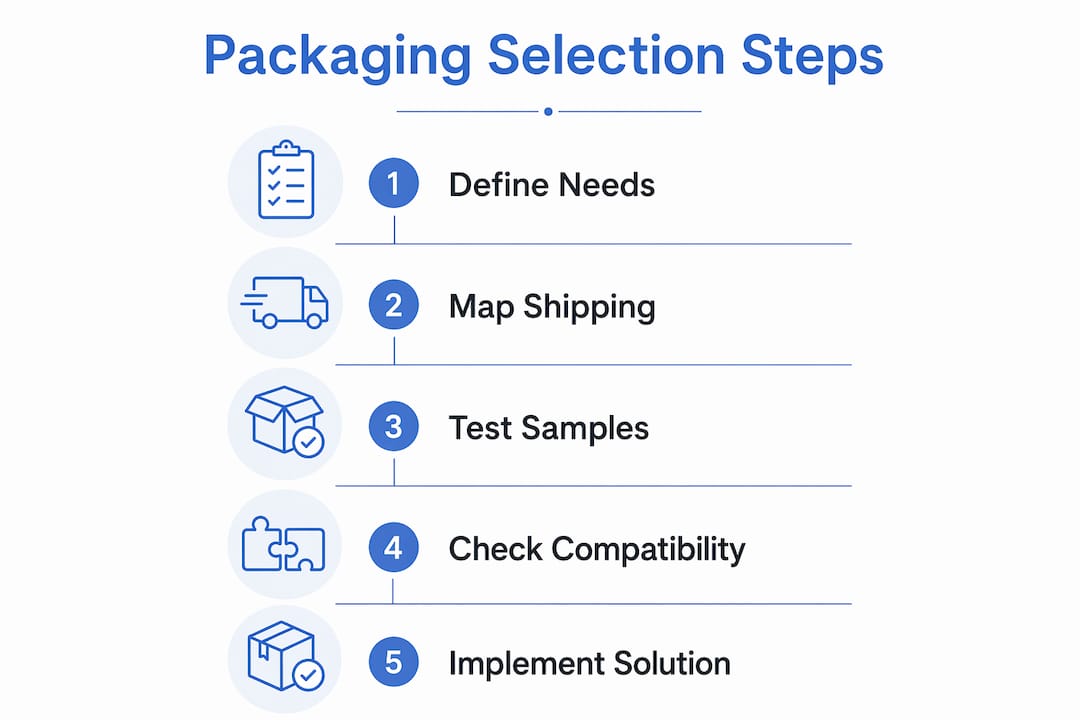
Step 1: Define your product requirements. List every sensitivity category that applies to your product. Note the weight, dimensions, and fragility level. Identify any regulatory requirements for labelling or material composition.
Step 2: Map your shipping environment. Document the transit methods your products travel through, the number of handling touchpoints, and the typical journey time. Include seasonal factors such as summer heat or winter moisture.
Step 3: Test packaging performance before committing. Order samples from your shortlisted suppliers and run real-world tests. Drop the packaged product from a height representative of typical handling. Expose it to humidity if moisture is a risk. Open and reclose it multiple times if it is a retail box. Evaluating total landed cost, including damage rates and handling efficiency, not just unit price, is the only way to make a genuinely informed decision.
Step 4: Check equipment compatibility. Confirm that your chosen materials work with your existing packing equipment, label applicators, and sealing machines.
Step 5: Review your void-fill strategy. Overusing protective fill is a common mistake. It adds weight, increases box size, and raises freight costs. Use only what is needed to prevent movement.
Before placing your first volume order, run through this checklist:
- Product sensitivity categories identified and documented
- Primary, secondary, and tertiary packaging layers specified
- Supplier lead times and repeat order capacity confirmed
- Material barrier properties matched to product shelf-life requirements
- Sample testing completed under real-world conditions
- Total landed cost calculated including damage rate assumptions
- Equipment compatibility verified
Pro Tip: Create a packaging right-sizing checklist for each product SKU. Record the ideal box dimensions, fill type, fill quantity, and total packed weight. This reduces waste, speeds up packing time, and gives you accurate data for freight cost negotiations.
Key takeaways
Selecting packaging supplies well means matching material properties to product needs, shipping conditions, and brand values before price enters the conversation.
| Point | Details |
|---|---|
| Categorise product sensitivity first | Identify impact, scuff, puncture, contamination, and moisture risks before choosing any material. |
| Use the three-layer framework | Primary, secondary, and tertiary packaging each serve a distinct protective function. |
| Evaluate suppliers on capacity, not price | Repeat order reliability and scalability matter more than unit cost for growing businesses. |
| Match materials to barrier requirements | Oxygen, moisture, and light barriers must align with your product’s shelf-life and transit conditions. |
| Calculate total landed cost | Include damage rates and returns in your cost model, not just the price per box. |
What I have learned about packaging decisions after years in trade supply
The most consistent mistake I see among small business owners in the UK and Ireland is treating packaging as a procurement task rather than a product decision. They find the cheapest box that fits, order in bulk, and then wonder why their damage rate is higher than expected or why customers comment that the unboxing experience feels cheap.
Supplier relationships are genuinely undervalued here. A supplier who knows your business, holds stock for you, and picks up the phone when something goes wrong is worth more than a marginally cheaper alternative who treats you as a one-off transaction. I have seen businesses lose weeks of trading capacity because their packaging supplier ran out of stock during a peak period and had no contingency to offer.
The sustainability question is becoming harder to ignore for UK and Ireland businesses. Customers notice when packaging is excessive or clearly non-recyclable. But the trade-offs are real. Switching to uncoated kraft for a product that needs moisture protection is not a responsible sustainability decision. It is a decision that will generate more returns and more waste overall. The right answer is always specific to your product and your supply chain, not a blanket policy.
My honest view is that the businesses who get packaging right are the ones who treat it as a system. They document their requirements, test their choices, and build supplier relationships that can scale with them. The ones who struggle are the ones who make packaging decisions reactively, usually after something has gone wrong.
— chris
How Subliblanks supports your packaging supply needs
Subliblanks supplies a comprehensive range of packaging supplies for UK and Ireland businesses, with no minimum order quantities. That means you can order exactly what you need to test new materials or fulfil a smaller run without committing to bulk volumes before you are ready.
Stock availability and reliable repeat ordering are central to how Subliblanks operates. Whether you are a start-up testing your first packaging configuration or an established business scaling up for peak season, you will find consistent product quality and responsive support. Explore the full range at Subliblanks to find packaging materials that match your product requirements, brand values, and budget without compromise.
FAQ
What are the main types of packaging supplies for shipping?
The main types are corrugated shipping boxes, void-fill materials such as EPE foam and kraft paper, protective wraps, mailer bags, and sealing tape. Each serves a specific protective or presentational function within the primary, secondary, or tertiary packaging layers.
How do I choose between corrugated and rigid greyboard packaging?
Corrugated board is best for outer shipping containers where impact and crush resistance are the priority. Rigid greyboard suits presentation and gift boxes where a premium, permanent feel is the goal. Your choice depends on whether the box is seen by the customer or only by the courier.
Why does right-sizing packaging matter for UK businesses?
Oversized packaging increases freight costs and raises damage risk by allowing products to shift in transit. Royal Mail, DPD, and other UK carriers price partly by volumetric weight, so a box that is too large costs more to send even if the product is light.
What questions should I ask a packaging supplier before ordering?
Ask about standard lead times, repeat order capacity, material compliance with UK Packaging Waste Regulations, available technical documentation, and how they manage supply during peak demand periods. These questions reveal whether a supplier can support your business long-term, not just for a first order.
How do packaging materials affect my brand perception?
Material choice influences customer perception before any brand messaging is read. Corrugated signals reliability, kraft signals authenticity, and rigid greyboard signals premium quality. Aligning your material choice with your brand positioning is as important as getting your logo right.


