



The role of stamp making in business explained
TL;DR:
- Custom stamps enhance branding, improve operational workflows, and support legal authenticity for small businesses.
- Advancements like flash stamp technology and self-inking stamps make professional-quality stamping accessible and efficient.
Stamp making in business is the practice of creating custom impression tools to brand products, authenticate documents, and accelerate administrative workflows. The role of stamp making in business extends well beyond a simple ink mark. For small business owners, a well-designed stamp is a cost-effective branding asset, a legal instrument, and a time-saving operational tool all at once. Technologies like self-inking stamps and flash stamp machines have made professional-grade stamping accessible to sole traders and growing enterprises alike. Brands such as Stampty and Creative Rubber Stamps have built entire product lines around this demand, reflecting just how central custom stamping has become to everyday business operations.
How custom stamps drive branding and marketing success
Custom stamps are one of the most cost-efficient branding tools available to small businesses. A single custom logo stamp can produce thousands of clean impressions at a fraction of the cost of bulk-printed packaging. That means a start-up with a tight budget can brand every parcel, envelope, and thank-you card without committing to a large print run.
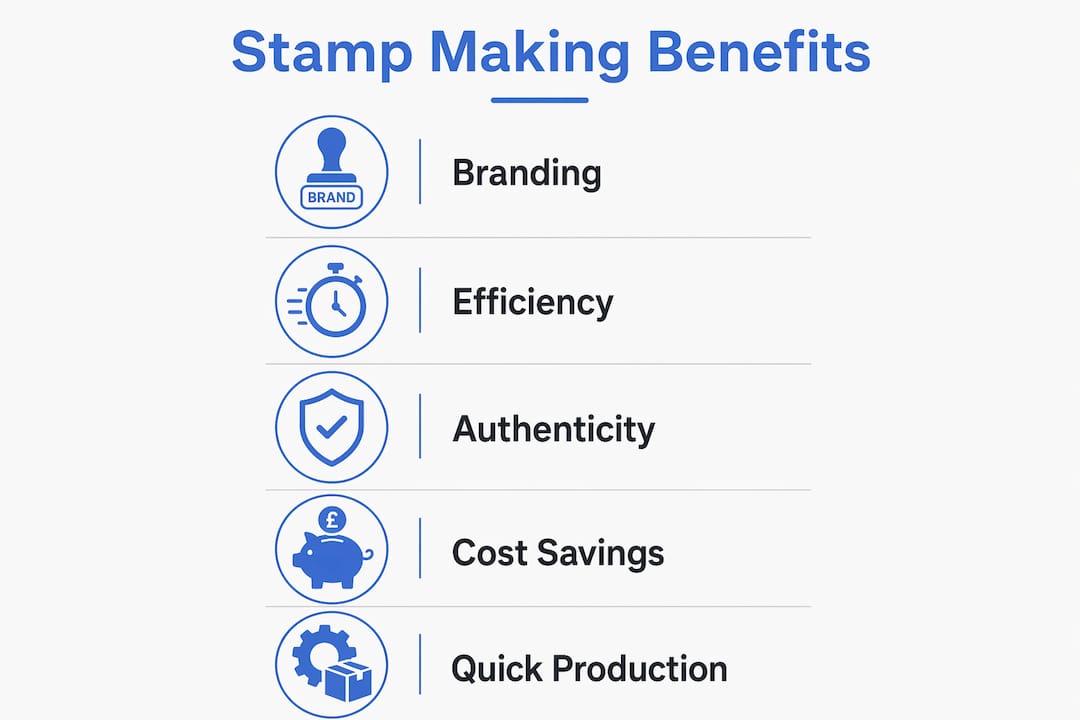
Pre-printed packaging creates a specific problem that stamps solve directly. Printers typically impose minimum order quantities, which forces small businesses to over-order and sit on stock that may become outdated as their branding evolves. On-demand stamping eliminates that waste entirely. You stamp only what you need, when you need it, using nothing beyond ink.
The unboxing experience has become a genuine marketing channel. Customers share packaging on social media, and a crisp logo stamp on kraft paper or tissue creates a handcrafted, considered aesthetic that resonates with buyers. Signature stamps, address stamps, and thank-you message stamps each add a layer of personality that pre-printed labels rarely achieve. For guidance on applying this to your own products, the Subliblanks article on custom stamping techniques covers practical applications in detail.
Here is where custom stamps deliver the most visible branding impact:
- Logo stamps on outer packaging, tissue paper, and mailer boxes
- Thank-you stamps on inserts and cards to personalise the post-purchase moment
- Address stamps on envelopes and parcels to reinforce brand identity at every touchpoint
- Social media handle stamps to encourage customers to tag and share
- “Handmade with love” or origin stamps to communicate craft and provenance
Pro Tip: Use a two-colour stamp design to separate your logo from your tagline. The visual contrast makes a stronger impression on plain kraft packaging than a single-colour block.
For small batch producers, custom stamps for branding also remove the dependency on external print suppliers. You control the output, the timing, and the quality. That independence is worth more than most business owners realise until they have experienced a last-minute rebranding or a supplier delay.
In what ways do stamps improve operational efficiency?
Stamps are workflow accelerators. They remove human error and deliver consistent impressions on repetitive tasks where handwriting or manual entry would introduce variability and slow everything down.

Self-inking stamps are the most practical choice for office environments. They carry an internal ink reservoir, which means no separate ink pad, no re-inking between uses, and no smudging from uneven pressure. Self-inking technology reduces friction and improves workflow speed significantly compared to traditional stamps or handwriting. For a small business processing dozens of invoices, purchase orders, or delivery notes each day, that speed compounds quickly.
The advantages of business stamps in document management are most visible in these common use cases:
- “Paid” stamps on invoices to confirm settlement and prevent duplicate processing
- “Approved” stamps on purchase orders to signal authorisation at a glance
- “Received” stamps on incoming deliveries to log arrival date and condition
- “Confidential” stamps on sensitive documents to flag handling requirements
- Signature stamps to maintain consistent, authenticated sign-off across high-volume paperwork
Consistent stamp application eliminates handwriting variations and prevents typos or format inconsistencies on approval and invoice documents. That consistency matters during audits, when a document trail needs to be clear and uniform. A stack of invoices marked by hand will always contain discrepancies. A stack marked by stamp will not.
Signature stamps deserve particular attention. Signing hundreds of documents per week creates what practitioners call signature fatigue, where the signature becomes rushed and inconsistent. A custom signature stamp solves this by producing an identical, authenticated impression every time. The Subliblanks guide on stamping machine types explains which machines suit different production volumes and business sizes.
Pro Tip: Keep a dedicated stamp log noting the date each stamp was last re-inked and inspected. A faded or misaligned impression on a legal document can cause delays that far outweigh the cost of a replacement pad.
Why does a physical company stamp matter for legal authenticity?
A physical company stamp signals operational discipline and document importance in ways that a digital signature alone cannot always replicate. Stamped documents are treated with higher legitimacy, particularly during audits or disputes, because the stamp represents a deliberate, traceable act of authorisation.
In many international markets, a physical stamp is not optional. It is mandatory.
“Physical company stamps remain mandatory or standard for authenticating contracts and official documents in many international markets.” — Printcraft UAE
The Gulf Cooperation Council region is a clear example. In the UAE, Saudi Arabia, and Qatar, contracts, banking documents, and government submissions routinely require a company stamp alongside a signature. Businesses operating across borders need to understand these requirements before assuming a digital workflow is sufficient. For UK manufacturers working to CE and UKCA marking standards, physical documentation and stamp authentication remain part of compliance processes.
| Context | Stamp requirement |
|---|---|
| UAE and GCC contracts | Mandatory company stamp alongside authorised signature |
| UK banking and legal documents | Stamp widely accepted as additional authentication |
| Government tenders and procurement | Stamped submissions often required or preferred |
| Internal audit trails | Stamped approvals provide clear, consistent records |
Beyond compliance, company stamps function as ceremonial tools that internalise a culture of high standards within an organisation. When a document receives a stamp, it signals to everyone handling it that the content has been reviewed and authorised. That signal shapes behaviour. Employees treat stamped documents differently from unsigned ones, and that difference matters in high-stakes situations.
What modern technologies are changing stamp making for entrepreneurs?
Flash stamp technology has fundamentally changed who can make a professional stamp and how quickly they can do it. Traditional stamp making required chemical etching, specialist equipment, and technical expertise. Flash stamp machines remove all three barriers.
Flash stamp machines enable stamp creation using just a laptop, a printer, and a compact device. The process takes minutes rather than hours. That speed means a small business owner can design, produce, and use a new stamp on the same day, without outsourcing to a print supplier or waiting for delivery.
The key advances driving this shift include:
- No chemicals required: Flash technology uses light exposure rather than chemical etching, making the process cleaner and safer for home or office use
- Compact equipment: Machines are small enough to sit on a desk, removing the need for dedicated workshop space
- Digital design integration: Designs created in software like Adobe Illustrator or Canva transfer directly to the stamp, enabling precise logo reproduction
- Fast iteration: Businesses can update stamp designs quickly as branding evolves, without significant cost or lead time
- Entrepreneurial opportunity: The low barrier to entry means stamp making itself has become a viable micro-business for crafters and entrepreneurs
| Feature | Traditional stamp making | Flash stamp technology |
|---|---|---|
| Production time | Hours to days | Minutes |
| Equipment required | Chemical etching tools, specialist kit | Laptop, printer, compact flash machine |
| Skill level needed | Specialist training | Minimal, learnable quickly |
| Design flexibility | Limited by physical tooling | High, digital design transfers directly |
| Cost per unit | Higher due to labour and materials | Lower at small volumes |
Flash stamp technology democratises stamp creation, allowing faster entrepreneurship and quality control for businesses of any size. For entrepreneurs who want to explore the full range of machine options, the Subliblanks guide on stamp making machines covers production and craft applications in practical detail.
Key takeaways
Custom stamps serve branding, operational efficiency, and legal authenticity simultaneously, making them one of the highest-value low-cost tools available to small businesses.
| Point | Details |
|---|---|
| Branding at low cost | Custom logo stamps produce thousands of impressions, replacing expensive pre-printed packaging. |
| Workflow acceleration | Self-inking stamps reduce errors and speed up repetitive document tasks significantly. |
| Legal and compliance value | Physical stamps remain mandatory in many international markets and strengthen audit trails. |
| Technology access | Flash stamp machines allow entrepreneurs to produce professional stamps in minutes with minimal equipment. |
| On-demand flexibility | Stamping removes minimum order constraints, giving small businesses full control over branded output. |
Why I think most small businesses underestimate their stamps
I have worked with hundreds of small business owners who treat their company stamp as an afterthought. They spend weeks agonising over logo colours and font choices, then order the cheapest self-inking stamp they can find and wonder why it looks unprofessional after three months.
The stamp is often the most frequently seen physical representation of your brand. It appears on every invoice, every parcel, every signed contract. A poorly made stamp with a blurred impression does more damage to perceived professionalism than an inconsistent social media feed ever could.
My honest advice is to treat stamp design with the same rigour you apply to your logo. Use a proper design file, choose a stamp machine suited to your volume, and maintain it. The Subliblanks resource on custom stamp design is a practical starting point if you are doing this for the first time.
The other thing I see businesses get wrong is ignoring the legal dimension entirely. If you work with international clients or submit tenders to public sector bodies, a missing stamp can hold up a contract for days. That is a preventable problem. Build the physical stamp into your document workflow from day one, not as a retrofit when something goes wrong.
The future of stamp making sits in a hybrid model. Digital signatures handle speed and remote workflows. Physical stamps handle authority, compliance, and brand presence. The businesses that use both intelligently will always look more credible than those that rely on one alone.
— chris
Explore stamp making solutions at Subliblanks
Subliblanks supplies stamp-making machines and equipment to small businesses and trade customers across the UK, with no minimum order quantities. Whether you are setting up your first branded stamp or scaling up document processing, the range covers flash stamp machines, self-inking options, and everything needed to get started quickly.
Subliblanks works directly with entrepreneurs and business owners who need reliable, affordable stamping solutions without the overhead of large print suppliers. Visit Subliblanks to browse the full catalogue and find the right stamp making setup for your business size and budget.
FAQ
What is the role of stamp making in business?
Stamp making in business provides a cost-effective method for branding products, authenticating documents, and accelerating repetitive administrative tasks. Custom stamps serve branding, legal, and operational functions simultaneously.
Are physical stamps still required for legal documents?
Physical company stamps remain mandatory or standard for authenticating contracts and official documents in many international markets, including the UAE and GCC region. In the UK, stamped documents carry additional weight in audits and disputes.
What are the advantages of self-inking stamps over traditional stamps?
Self-inking stamps carry an internal ink reservoir, which removes the need for a separate ink pad and delivers faster, cleaner impressions. They reduce errors, improve consistency, and are preferred for high-volume office use.
How does flash stamp technology benefit small businesses?
Flash stamp machines allow entrepreneurs to produce professional-quality stamps using just a laptop, printer, and compact device in minutes. This removes the need for specialist skills or chemical etching equipment.
How do custom stamps reduce packaging costs?
Custom stamps produce thousands of impressions at low cost and require no minimum order quantities, unlike pre-printed packaging. Businesses can brand on demand, cutting upfront spend and eliminating excess stock waste.


