



Badge making materials: a complete guide for crafters
TL;DR:
- Badge making materials include metal shells, printed inserts, protective films, and attachment backs that determine the durability and appearance of the finished badge. Zinc alloy shells are popular for detailed designs and shapes, while steel is more cost-effective for standard round badges, with each metal affecting the badge’s finish and function. Proper handling of films, paper, and organized workflow ensures high-quality, long-lasting badges suitable for UK and Ireland crafters at all skill levels.
Badge making materials are the physical components that combine to form a finished badge: metal shells, printed paper inserts, protective Mylar films, and pin or magnetic backs. Getting these components right determines whether your badge looks sharp and lasts for years or falls apart after a few wears. This guide covers every core material category, from metals and films to paper weights and backing types, with practical advice for UK and Ireland crafters at every skill level.
1. What are badge making materials and why do they matter?
Badge making materials are the building blocks of every custom badge. The term covers metal shells, printed inserts, protective films, and attachment backs. Each component plays a distinct role, and a weak choice in any one area affects the finished result. A beautiful printed design loses its impact under a scratched or poorly fitted Mylar film. A strong metal shell means nothing if the pin back fails on first use.
Understanding badge components before you buy saves money and frustration. Beginners often focus only on the machine and overlook the quality of the shells or the paper weight of their inserts. Experienced crafters know that consistent, quality materials are what separate a professional-looking badge from a disappointing one.
2. What are the best metals for badge shells?
Zinc alloy is the most popular base metal for badge shells and lapel pins. It is lightweight, durable, and holds fine detail well, making it ideal for complex shapes and intricate designs. Steel shells are heavier and more affordable, which suits high-volume button badges. Aluminium sits between the two: lighter than steel, less detailed than zinc alloy, but a good choice for large-format badges.
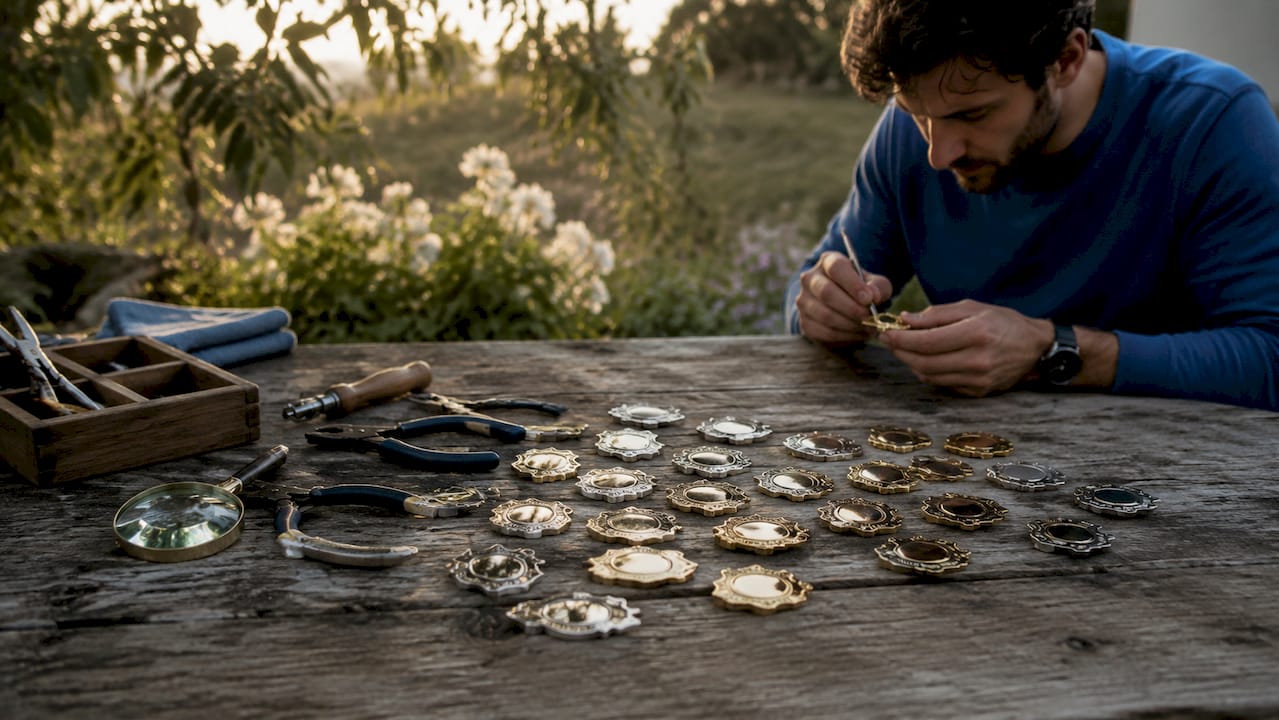
Comparing metals for badge shells
| Metal | Weight | Detail level | Best use |
|---|---|---|---|
| Zinc alloy | Light | High | Lapel pins, shaped badges |
| Steel | Medium | Moderate | Button badges, bulk runs |
| Aluminium | Very light | Moderate | Large-format badges |
The metal you choose also affects how enamel finishes behave. Soft enamel badges have a textured, recessed look that suits bold, colourful designs. Hard enamel produces a smooth, polished surface that feels premium and suits corporate or commemorative badges. Both finishes require a metal base with raised borders to hold the enamel in place, which is why zinc alloy dominates this category.
Pro Tip: If you are making shaped or die-cut badges, choose zinc alloy shells. Steel shells are harder to press into non-circular forms and can crack along sharp edges.
For UK crafters making steel badges, steel shells remain the most cost-effective option for standard 25mm, 38mm, and 58mm round button badges.
3. Which films and protective coatings are essential?
Mylar film is the clear protective layer pressed over the printed insert during badge assembly. It protects the design from scratches, moisture, and fading. Mylar film must be completely dust-free before pressing, because any trapped particle shows through the finished badge and cannot be removed afterwards.
Key properties to look for in badge film:
- Thickness: Standard Mylar for button badges is typically thin and flexible enough to crimp cleanly around the shell edge.
- Finish: Gloss Mylar gives a bright, vivid look. Matt Mylar reduces glare and suits photographic or text-heavy designs.
- Transparency: High-clarity film keeps colours accurate. Low-grade film can yellow or distort colours over time.
- Fit: Film circles must be cut slightly larger than the insert to wrap over the shell edge during pressing.
A specialist option worth knowing is 100-micron heat-dissolvable film for embroidered badges. This film provides rigidity during the satin stitch embroidery process, then dissolves completely after heating. It eliminates the need for tear-away stabilisers and leaves no ragged edges on the finished badge border. Madeira Badge Film is one well-known product in this category, sold by the metre.
Pro Tip: Store Mylar film flat in a sealed bag away from dust. Even a small amount of workshop dust on the film surface will ruin the finished badge.
4. What paper types and printing materials suit badge inserts?
The printed insert is what people actually see on a finished button badge, so paper choice and print quality matter enormously. 100–120 GSM coated or plain paper is the standard recommendation for 58mm badge makers. This weight crimps cleanly around the shell edge without tearing or bunching.
Thicker paper causes real problems. Photo paper and card stock above 120 GSM jam the die and prevent the shell from sealing correctly. The badge either pops open or the crimp looks uneven. Thinner paper below 100 GSM can wrinkle during pressing and distort the printed image.
Choosing your insert printing method
- Inkjet printing works well for small runs and full-colour designs. Use coated paper for sharper colour reproduction.
- Laser printing produces crisp text and line art. Laser-printed inserts resist smudging better than inkjet in humid conditions.
- Professional print services suit large runs where colour consistency across hundreds of badges matters.
- Pre-printed sheets from craft suppliers let beginners skip the printing step entirely and focus on assembly.
Pre-cut circles save time and reduce waste. A circle cutter, such as those made by VEVOR, cuts inserts to the exact diameter needed for your badge size. Cutting by hand with scissors introduces small size variations that affect how the badge presses. A clean, accurate cut is one of the simplest ways to improve your finished badge quality.
Pro Tip: Print a test sheet on plain 80 GSM paper before committing to your full run. Check the colour and sizing before using your coated stock.
5. What are the common badge backing types and how do you choose?
The backing is the attachment mechanism on the reverse of a finished badge. Pin backings are the most common choice: a simple steel pin with a clasp that fastens through fabric. They are reliable, inexpensive, and compatible with virtually every badge maker machine on the market.
Magnetic backs are the alternative for wearers who want to avoid pin holes in clothing. They use two magnetic discs, one inside the badge and one on the reverse of the fabric, to hold the badge in place. The magnet strength matters: a weak magnet lets the badge slide or fall off. Magnetic backs also require a slightly thicker badge shell to accommodate the internal disc.
Other backing options include:
- Keyring backs: Convert a badge into a keyring. Popular for promotional giveaways and event merchandise.
- Fridge magnet backs: A flat magnet bonded to the badge reverse. Suits larger badge sizes where pin attachment is impractical.
- Safety pin backs: A locking pin variant that reduces the risk of the badge falling off. Common for children’s events.
- Brooch backs: A heavier-duty pin with a locking clasp, used for premium or jewellery-style badges.
Choosing the right backing depends on the badge’s purpose. A badge for a school event needs a safety pin back. A badge for a corporate lanyard needs a pin back or clip. A badge sold as a gift or keepsake works well with a keyring or fridge magnet back.
6. How to organise badge making materials for efficient crafting
Pre-cutting graphics and sorting components before you start assembly is the single biggest factor in production speed. An experienced operator using a 58mm manual button badge maker and a circle cutter can produce between 200 and 300 pin badges per hour with this approach. That rate drops sharply when components are unsorted or inserts are cut during assembly.
A clean, organised workspace also reduces failure rates. Rushing assembly or using dirty components is the most common cause of failed badges among hobbyists. Dust on the Mylar film, misaligned inserts, and incorrectly sorted shell sizes all lead to wasted materials.
A reliable assembly workflow looks like this:
- Print all inserts and allow ink to dry fully before cutting.
- Cut all inserts to size using a circle cutter. Sort by badge size.
- Cut all Mylar film circles. Store in a sealed container until needed.
- Sort metal shells and pin backs into separate trays or compartments.
- Assemble in batches: place insert, add film, press shell, attach back.
- Inspect each badge before moving to the next batch.
Storage trays with compartments keep shells, backs, and films separated and within reach. A manual press with a consistent action reduces the physical effort of large runs and produces more even crimps than an inconsistent hand press.
Pro Tip: Keep a small lint-free cloth beside your press to wipe the die between batches. Residue from previous presses can mark the Mylar film on subsequent badges.
For crafters planning larger production runs, the bulk badge making guide from Subliblanks covers workflow and material planning in more detail.
Key takeaways
The best badge making materials combine the right metal shell, correct paper weight, clean Mylar film, and a suitable backing to produce durable, attractive badges every time.
| Point | Details |
|---|---|
| Metal shell choice | Zinc alloy suits detailed and shaped badges; steel works best for standard button badge runs. |
| Paper weight for inserts | Use 100–120 GSM paper for clean crimping; heavier stock jams the die and prevents sealing. |
| Mylar film quality | Keep film dust-free and choose gloss or matt finish based on your design type. |
| Backing selection | Match the backing to the badge’s purpose: pin for clothing, magnetic for delicate fabrics, keyring for gifts. |
| Workflow and organisation | Pre-cutting and sorting components before assembly reduces failure rates and increases output speed. |
What I have learned from years of working with badge materials
The most common mistake I see from new badge makers is treating all materials as interchangeable. They buy the cheapest shells, print on whatever paper is in the tray, and wonder why their badges look uneven or pop open after a few days. The materials are not interchangeable. Each component has a specific role, and cutting corners on any one of them shows in the finished badge.
My honest recommendation for anyone starting out in the UK or Ireland is to begin with steel shells and standard 58mm badge maker supplies. Steel is forgiving, widely available, and inexpensive enough to practise with. Once you understand how the press works and how the crimp should feel, you can move to zinc alloy for more detailed or shaped work.
On films, I cannot stress enough how much dust ruins badges. I have seen experienced crafters lose entire batches because they left Mylar film sitting open on a workbench. A sealed container costs almost nothing and saves a significant amount of waste.
For design, keeping pin badge artwork to 2–5 colours with no thin lines improves clarity at small badge sizes. A design that looks detailed on screen often loses definition at 25mm or 32mm. Simplify before you print.
The best badge makers I know are not the ones with the most expensive equipment. They are the ones who understand their materials, keep their workspace clean, and work methodically. That discipline is available to every crafter, regardless of budget.
— chris
Get your badge making supplies from Subliblanks
Subliblanks supplies a full range of badge making supplies for craft enthusiasts and hobbyists across the UK and Ireland, with no minimum order quantities. Whether you need metal shells, Mylar film, pin backs, or a complete DIY badge kit, Subliblanks stocks the components to match your project.
Subliblanks operates as a trade wholesaler, which means competitive pricing whether you are making ten badges for a school fair or hundreds for an event. Browse the full range of badge making machines, supplies, and accessories at Subliblanks and find everything you need in one place, delivered to your door across the UK and Ireland.
FAQ
What materials do I need to make a button badge?
Button badge making requires four components: a metal shell, a printed paper insert, a Mylar film circle, and a pin or magnetic back. A badge maker machine presses these together into a finished badge.
What is the best paper weight for badge inserts?
100–120 GSM coated or plain paper is the recommended weight for badge inserts. Heavier paper, such as photo paper, jams the die and prevents the shell from sealing correctly.
What is Mylar film used for in badge making?
Mylar film is the clear protective layer pressed over the printed insert. It protects the design from scratches and moisture and gives the badge a gloss or matt finish depending on the film type chosen.
What is the difference between soft and hard enamel badges?
Soft enamel produces a textured, recessed finish that suits bold, colourful designs. Hard enamel produces a smooth, polished surface and is typically used for premium or corporate badges.
Which badge backing is best for everyday wear?
Pin backings are the most reliable choice for everyday wear and are compatible with most badge maker machines. Magnetic backs are a good alternative for wearers who want to avoid pin holes in clothing, provided the magnet is strong enough to hold the badge securely.


