



What is a trade wholesaler? A guide for UK businesses
TL;DR:
- Trade wholesalers buy goods in bulk from manufacturers and sell smaller quantities to other businesses. They add value through functions like bulk breaking, warehousing, and financing, supporting supply chain efficiency. Modern models now offer flexible order sizes, making wholesale accessible to small businesses and sole traders.
A trade wholesaler is a business that buys goods in bulk from manufacturers and sells them in smaller quantities to retailers or other businesses, never to the end consumer. The standard industry term is merchant wholesaler, and understanding the distinction matters if you are sourcing stock, building a supply chain, or simply trying to make sense of how goods move from factory to shop floor. Wholesale trade sits at the centre of almost every product-based industry in the UK and Ireland, from sublimation printing supplies to food distribution, and the role is far more layered than simple bulk resale.
What does a trade wholesaler actually do?
A trade wholesaler is defined as an intermediary who purchases large volumes of goods and redistributes them in smaller lots to business buyers. Wholesale trade is formally classified as the resale of new and used goods to retailers, industrial, commercial, institutional, or professional users rather than to the final consumer. That single distinction, selling to businesses rather than individuals, shapes every aspect of how wholesalers operate, price, and structure their relationships.

The trade wholesaler definition extends well beyond simply buying cheap and selling slightly less cheap. Wholesalers perform six core functions that add genuine value to the supply chain: bulk breaking, warehousing, transportation, financing, market intelligence, and risk-bearing. These six core functions allow manufacturers to focus on production and retailers to focus on selling, rather than both parties managing the full complexity of distribution. That is why wholesalers are sometimes called the connective tissue of the economy.
Bulk breaking is the most visible function. A manufacturer produces 10,000 units of a product; a retailer needs 50. The wholesaler absorbs the full production run, stores it, and releases it in quantities that match buyer demand. Warehousing and transportation follow directly from this: the wholesaler holds stock, manages logistics, and delivers to multiple buyers from a single consolidated location. For UK and Ireland businesses, this removes the need to maintain large storage facilities or negotiate freight contracts with manufacturers based overseas.
The financing and risk-bearing functions are less obvious but equally important. Wholesalers buy on credit terms and extend credit to their own buyers, effectively bridging the cash flow gap between production and retail sale. They also absorb the risk of unsold stock, price fluctuations, and product obsolescence. That risk transfer has real value for small businesses that cannot afford to tie up capital in large inventory positions.
Pro Tip: When evaluating a wholesaler, ask specifically about their warehousing capacity and lead times. A wholesaler with local UK or Irish stock will almost always outperform one shipping direct from a manufacturer abroad, particularly for time-sensitive orders.
How does a merchant wholesaler differ from agents or brokers?
The three main types of wholesalers are merchant wholesalers, agents, and brokers. Each operates differently, and the distinction affects pricing, risk, and your relationship as a buyer.
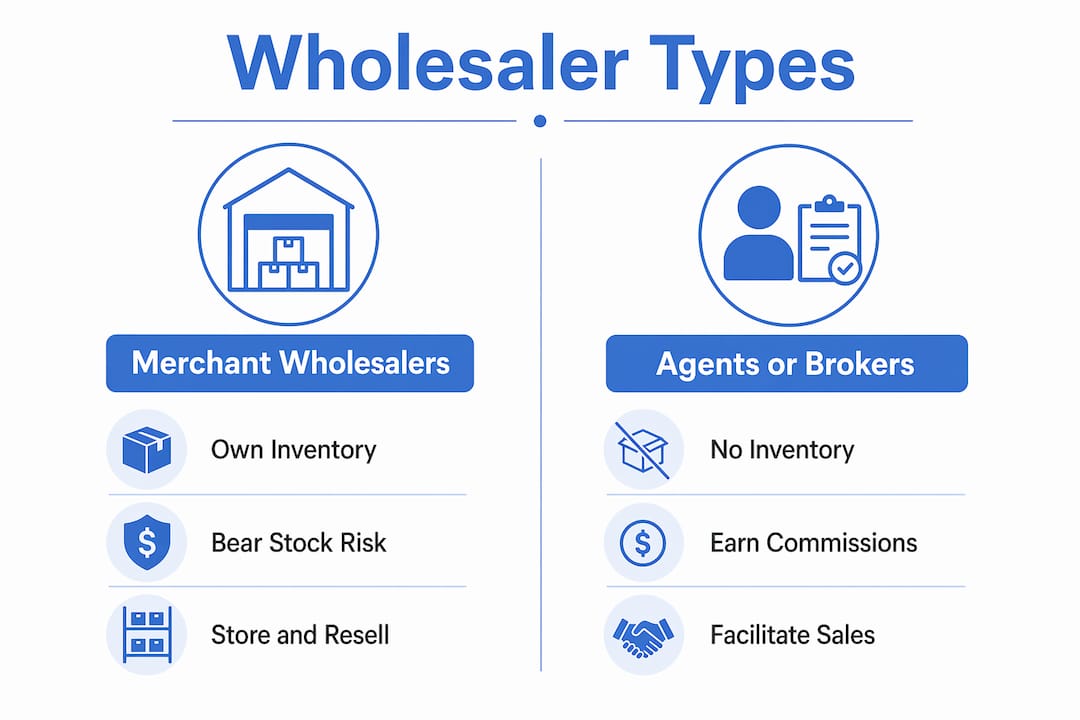
Agents and brokers do not take title or possession of merchandise. They earn a commission for facilitating a sale between a manufacturer and a buyer, then step aside. They have limited control over pricing, stock availability, or delivery terms because they never own the goods.
Merchant wholesalers own the inventory they sell. They buy stock outright, store it, and resell it at a margin. Merchant wholesalers handle over 60% of wholesale sales revenue globally. That dominance reflects the practical preference most businesses have for dealing with a single party who holds stock and can guarantee fulfilment.
| Feature | Merchant wholesaler | Agent or broker |
|---|---|---|
| Owns inventory | Yes | No |
| Bears stock risk | Yes | No |
| Sets own prices | Yes | Limited |
| Earns commission | No | Yes |
| Controls delivery | Yes | No |
| Best for | Regular stock purchasing | One-off or specialist deals |
The practical implication is straightforward. If you need reliable, repeatable supply with clear pricing and guaranteed stock, a merchant wholesaler is the right choice. If you are sourcing a specialist or one-off product and need someone to broker a deal with a specific manufacturer, an agent or broker may be appropriate.
Pro Tip: Always verify whether your supplier takes title to the goods before you place an order. A broker who cannot guarantee stock availability is a risk to your production schedule.
What are the benefits of trade wholesalers for UK and Ireland businesses?
The benefits of trade wholesalers are most visible when you compare the alternative: sourcing directly from multiple manufacturers. That route requires separate negotiations, separate logistics contracts, separate credit arrangements, and separate quality checks for every supplier. A wholesaler consolidates all of that.
Wholesalers enable clients to reduce material costs and increase profit margins by offering lower prices and simplified sourcing. The mechanism is straightforward: the wholesaler’s buying power secures lower unit costs from manufacturers, and those savings are passed on, at least in part, to business buyers. For a small print shop in Dublin or a craft business in Leeds, that price advantage can be the difference between a viable margin and a loss.
The consolidated sourcing benefit is equally significant. Wholesalers assemble goods from multiple manufacturers, sort, grade, break bulk, and repack to meet buyer requirements. A single wholesale account can give you access to sublimation blanks, DTF supplies, packaging, and equipment from dozens of original manufacturers, all invoiced and delivered through one relationship. That simplification has a real cost saving in time and administration.
The key benefits for UK and Ireland businesses include:
- Lower unit costs through the wholesaler’s bulk purchasing power with manufacturers
- Consolidated sourcing with access to diverse product ranges from a single supplier account
- Simplified logistics with one delivery relationship replacing multiple freight arrangements
- Account credit allowing businesses to manage cash flow without paying upfront for every order
- Local stock availability reducing lead times compared to ordering direct from overseas manufacturers
- Reduced minimum commitments as modern wholesalers increasingly offer flexible lot sizes
The credit and account structure of wholesale trade deserves particular attention. Wholesale trade is a B2B relationship that typically involves account set-up, verification of business credentials, credit terms, and private volume discounts not advertised publicly. This is fundamentally different from retail, where payment is immediate and terms are fixed. For growing businesses, access to credit terms from a trusted wholesaler can free up working capital for other investments.
For more on how these advantages play out in practice, the guide on buying wholesale in the UK covers the SME perspective in detail.
How are modern wholesale trade models evolving?
The traditional wholesale model assumed large minimum order quantities and long-term volume commitments. That model excluded many small businesses and sole traders who needed access to wholesale pricing but could not commit to buying in bulk. The modern wholesale trade model has shifted significantly.
-
No minimum order quantities. Many wholesalers now provide flexible lot sizes and technical expertise beyond traditional bulk sales. This removes the capital barrier that previously locked small businesses out of wholesale pricing. A sole trader running a personalised gifts business can now access the same product range and pricing as a larger print company.
-
Supply chain partnership. Modern trade wholesalers act as specialised supply chain partners, offering quality control, product knowledge, and technical support alongside stock. This is particularly relevant in sectors like sublimation printing and laser engraving, where equipment compatibility and consumable specifications matter as much as price.
-
Digital B2B platforms. Online wholesale ordering has replaced the traditional catalogue and telephone order model for most product categories. Businesses can browse stock levels, place orders, and track deliveries in real time. This transparency reduces errors and speeds up the replenishment cycle. The B2B apparel printing sector illustrates how digital wholesale platforms are reshaping supply relationships across creative industries.
-
Specialisation by sector. Wholesalers increasingly focus on specific product categories rather than general merchandise. A wholesaler specialising in sublimation blanks, xTool laser engraving machines, and DTF supplies will have deeper product knowledge, better stock reliability, and more relevant technical support than a generalist distributor.
Emerging flexible wholesale models help smaller businesses reduce material costs and increase profit margins without requiring large inventory commitments. That shift is particularly relevant in the UK and Ireland, where the small business sector accounts for the majority of registered enterprises. The ability to access wholesale pricing without a large upfront commitment changes the economics of starting and scaling a product-based business.
For a practical look at running a wholesale operation, the guide on how to run a wholesale trade business covers the operational side in depth.
Key takeaways
A trade wholesaler is the critical link between manufacturers and business buyers, adding value through bulk breaking, warehousing, financing, and risk-bearing rather than simply acting as a middleman.
| Point | Details |
|---|---|
| Core definition | A trade wholesaler buys in bulk from manufacturers and sells smaller quantities to businesses, not consumers. |
| Merchant vs agent | Merchant wholesalers own inventory and bear risk; agents earn commission without holding stock. |
| Six functions | Bulk breaking, warehousing, transportation, financing, market intelligence, and risk-bearing define the wholesaler’s role. |
| Business benefits | Consolidated sourcing, lower unit costs, account credit, and simplified logistics are the primary advantages. |
| Modern evolution | No minimum order quantities and digital platforms now make wholesale accessible to small businesses and sole traders. |
Why wholesalers are underrated partners, not just suppliers
The most common mistake I see businesses make is treating their wholesaler as a vending machine. You put an order in, stock comes out, and the relationship ends there. That approach leaves a significant amount of value on the table.
A good wholesaler carries product knowledge that took years to build. When I think about sectors like sublimation printing or laser engraving, the technical compatibility questions alone, which blanks work with which inks, which substrates suit which machines, are worth more than any volume discount. A wholesaler who specialises in those categories has already done the testing. You benefit from that without paying for it separately.
The other misconception is that wholesale trade is only for large businesses. The shift to no minimum order quantities has genuinely changed this. A small business in Cork or a sole trader in Manchester can now access the same product range, the same pricing structure, and the same account credit as a much larger operation. The barrier is not size any more. It is knowing where to look and asking the right questions when you set up your account.
My honest advice: treat your wholesaler as a supply chain partner from day one. Ask about new product lines before they are listed publicly. Ask about technical support. Ask about lead times during busy periods. The businesses that get the most from wholesale relationships are the ones that invest in them, not just the ones that place the largest orders.
— chris
Subliblanks: trade wholesaling with no minimum orders
Subliblanks is a UK trade wholesaler built specifically for businesses that need professional supply without the constraints of large minimum orders.
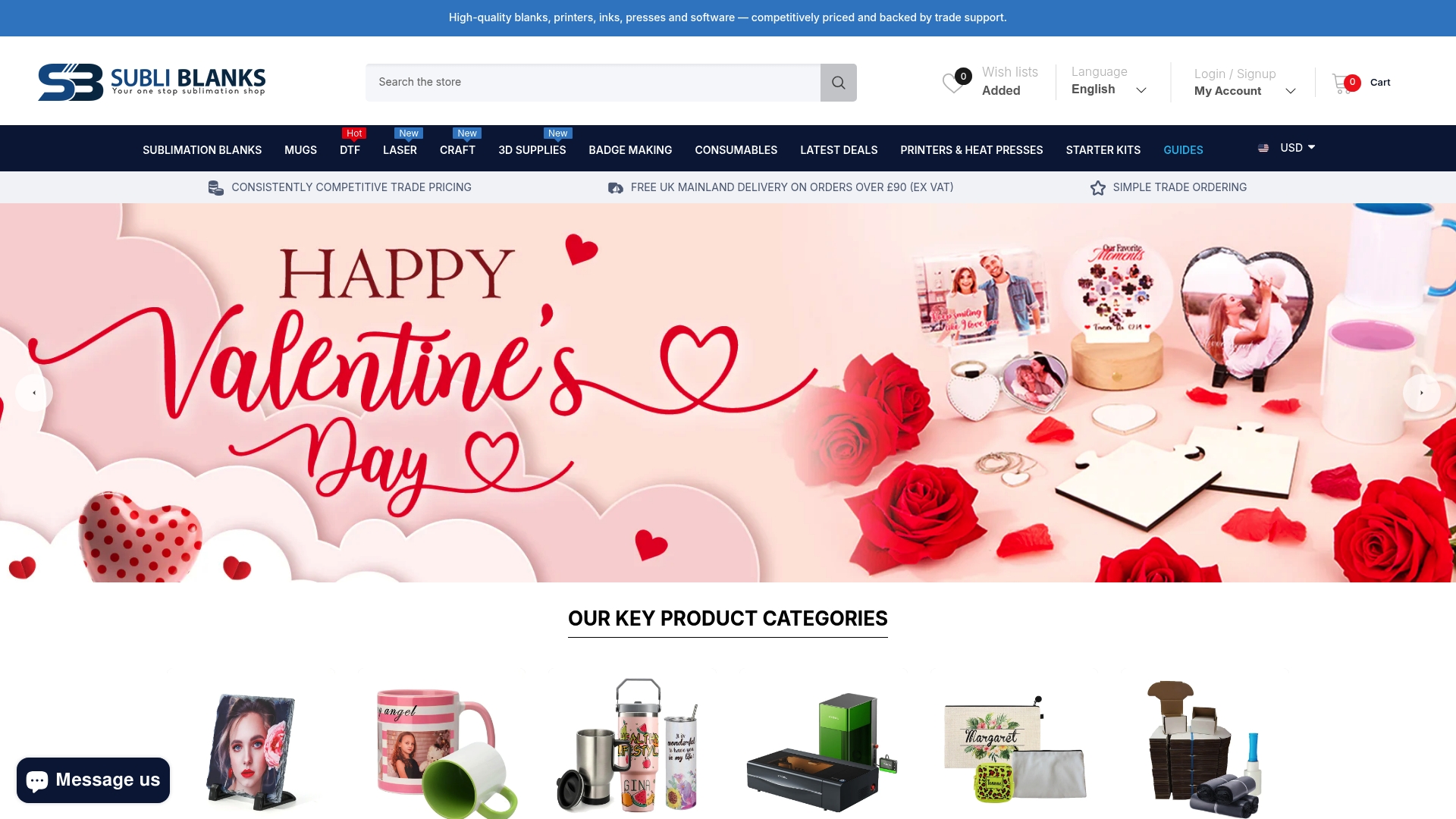
The product range covers sublimation blanks, sublimation printers and equipment, badge-making machines and supplies, DTF supplies, xTool laser engraving machines, laser-engraveable blanks, 3D printing filaments, stamp-making machines, and packaging supplies. Every product category is supported by genuine product knowledge, not just a catalogue listing. Whether you are setting up a new print business or scaling an existing one, Subliblanks provides the wholesale supply services that match how modern UK and Irish businesses actually operate. No minimum order quantities means you can start small, test products, and grow your orders as your business grows.
FAQ
What is the trade wholesaler definition in simple terms?
A trade wholesaler buys goods in bulk from manufacturers and sells them in smaller quantities to businesses rather than to individual consumers. The key distinction is that the sale is always business-to-business.
What is the difference between a wholesaler and a retailer?
A wholesaler sells to businesses; a retailer sells to the end consumer. Wholesalers typically offer lower unit prices, account credit terms, and bulk purchasing options that are not available through retail channels.
What types of trade wholesalers exist?
The main types are merchant wholesalers, who own and hold inventory, and agents or brokers, who facilitate sales without taking ownership of goods. Merchant wholesalers account for the majority of wholesale sales revenue.
How do you find wholesalers in the UK?
UK businesses can find wholesalers through trade directories, industry associations, and direct online searches by product category. Specialist wholesalers like Subliblanks operate directly online with account registration open to verified businesses.
Do trade wholesalers require minimum order quantities?
Traditional wholesalers often set minimum order quantities, but modern wholesale models increasingly offer no minimum order requirements. This makes wholesale pricing accessible to small businesses and sole traders without large upfront commitments.


