



Why use trade wholesaling: benefits for UK businesses
TL;DR:
- Trade wholesaling allows small businesses to buy goods at significantly lower prices while reducing supply chain complexity. It provides operational stability through buffer stocks, lower administrative overhead, and flexible purchasing options suitable for limited order volumes. Most small businesses benefit more from strategic supply chain management with no-minimum wholesalers than from direct manufacturer purchases.
Trade wholesaling is the practice of purchasing goods in bulk from manufacturers or distributors and reselling them in smaller quantities to other businesses, delivering cost savings and supply chain advantages that retail purchasing simply cannot match. For entrepreneurs and small business owners across the UK and Ireland, the question of why use trade wholesaling has a direct answer: it cuts your per-unit costs, simplifies your supplier relationships, and gives you access to product ranges that would otherwise require dealing with dozens of separate manufacturers. Subliblanks, a trade wholesaler supplying everything from sublimation blanks to xTool laser engraving machines, operates on exactly this model. Understanding how it works puts you in a stronger position to grow your business.
How does trade wholesaling reduce costs for small businesses?
The core financial logic of trade wholesaling is straightforward. Retailers can purchase goods at 30 to 50% below standard retail price through wholesale purchasing, which directly protects your margins when you resell. That gap exists because wholesalers buy in very large volumes from manufacturers, absorbing the economies of scale and passing a portion of those savings down the supply chain.
Bulk purchasing also reduces the cost of getting goods to you. Transport costs fall by 15 to 25% through consolidated shipping, because one delivery from a wholesaler replaces multiple separate shipments from individual manufacturers. For a small business in Belfast or Cork ordering across several product categories, that consolidation alone can represent a meaningful monthly saving.
The advantages of bulk buying extend beyond the unit price. Businesses using wholesale distribution can save 15 to 30% on inventory costs overall, factoring in lower transaction overhead and reduced administrative time spent managing multiple supplier accounts. Fewer invoices, fewer relationships to maintain, and fewer delivery windows to coordinate all reduce the hidden labour cost of procurement.
Wholesale distributors themselves profit through volume markups of 15 to 25%, focusing on turnover rather than high per-unit margin. This means the model is built for speed and volume, not for squeezing every penny from each transaction, which keeps the pricing competitive for buyers at your level.
- Per-unit costs drop 30 to 50% compared to retail purchasing
- Consolidated shipping reduces transport costs by 15 to 25%
- Fewer supplier relationships cut administrative overhead significantly
- Overall inventory cost savings of 15 to 30% are achievable
Pro Tip: Before committing to a wholesale supplier, calculate your total cost per unit including delivery, not just the catalogue price. A slightly higher unit price with free or low-cost delivery often beats a cheaper price with expensive freight.
What operational advantages does trade wholesaling offer beyond pricing?
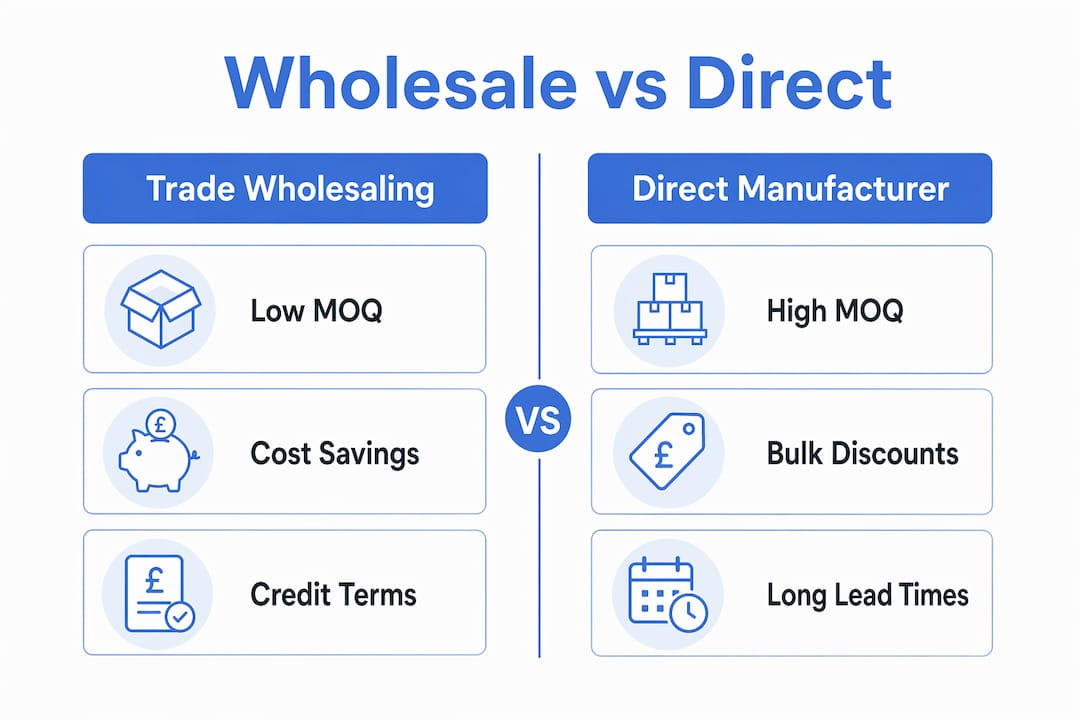
Price is the headline benefit, but the operational advantages of trade wholesaling are what make it genuinely strategic for small businesses. Wholesalers act as consolidation points providing what supply chain professionals call “utility of place and time.” One B2B relationship covers multiple products and manufacturers, which means you are not vetting, negotiating with, and managing a separate account for every product line you stock.

For small businesses that cannot meet manufacturer minimum order quantities, this is particularly significant. Wholesale models allow small businesses to buy manageable smaller lots, avoiding the restrictive minimums that manufacturers impose on direct buyers. A craft business in Dublin that needs 50 sublimation mugs and 30 badge-making blanks can order both from a single wholesaler without hitting the minimum thresholds that would apply if approaching each manufacturer separately.
Supply chain stability is another underappreciated benefit. Wholesalers maintain buffer stocks that absorb demand spikes and supply disruptions, which means your business is insulated from the kind of stock shortages that plagued direct buyers between 2020 and 2024. When a manufacturer runs short, your wholesaler’s existing inventory keeps your shelves stocked.
Beyond stock availability, many wholesalers offer value-added services that further reduce your operational burden:
- Warehousing and storage on your behalf, reducing your own storage requirements
- Repacking and labelling services that prepare goods for your specific retail format
- Credit terms that improve your cash flow by delaying payment until after you have sold the goods
- Supplier vetting, where wholesalers remove unreliable vendors and protect you from faulty or late deliveries
Pro Tip: Ask any prospective wholesaler directly whether they offer credit terms. Even 30-day payment terms can transform your cash flow if you are turning over stock quickly.
Trade wholesaling vs buying direct: which is better for your business?
The honest answer is that it depends on your order volume and operational capacity, but for most UK and Irish small businesses, trade wholesaling wins on nearly every practical measure. The comparison below sets out the key differences.
| Factor | Trade wholesaling | Direct from manufacturer |
|---|---|---|
| Minimum order quantities | Low to none | Often high, sometimes thousands of units |
| Per-unit price | 30 to 50% below retail | Potentially lower at very high volumes |
| Supplier relationships | One account, multiple products | Separate account per manufacturer |
| Supply chain risk | Absorbed by wholesaler’s buffer stock | Borne entirely by your business |
| Vendor quality assurance | Wholesaler vets and removes poor suppliers | Your responsibility to assess each manufacturer |
| Cash flow flexibility | Credit terms often available | Payment typically upfront or on delivery |
| Speed to market | New products reach market 20 to 40% faster via wholesalers | Slower due to direct negotiation and logistics |
Direct manufacturer purchasing becomes genuinely competitive only when your order volumes are large enough to justify the manufacturer’s minimum quantities and when you have the warehousing, logistics, and supplier management infrastructure to handle it. For most independent retailers, print-on-demand businesses, or craft entrepreneurs in the UK and Ireland, that threshold is far beyond current scale.
Retail purchasing, where you buy from another retailer rather than a wholesaler, is the least efficient model for a business. You are paying retail margin on top of wholesale margin, which leaves almost no room for your own markup. Trade wholesaling sits in the right position in the supply chain for businesses that need to buy at commercial prices without the complexity of direct manufacturer relationships. You can read more about how wholesale supplies power retail growth to understand why this model is so widely adopted.
How to get the most from trade wholesaling as a UK or Irish small business
Knowing the benefits of trade wholesaling is one thing. Extracting them reliably requires a disciplined approach to sourcing, forecasting, and inventory management.
Finding reliable wholesale suppliers starts with trade directories, industry associations, and platforms specific to your product category. In the UK, organisations like the Federation of Small Businesses and trade shows such as Spring Fair at the NEC Birmingham connect buyers with vetted wholesale suppliers. In Ireland, Enterprise Ireland maintains supplier databases that include wholesale distributors across multiple sectors.
Demand forecasting is non-negotiable. Poor planning causes excess inventory that raises storage costs and ties up cash flow, and this is the most common mistake new wholesale buyers make. Before placing a bulk order, review your sales data from the previous three to six months, account for seasonal variation, and order to your realistic sell-through rate rather than to the maximum discount tier.
Managing the total landed cost is where many small businesses underestimate the true value of a wholesale deal. Failing to account for storage, cash flow impacts, and inventory turnover can negate apparent unit price savings entirely. A product that sits in your storage for four months while you pay for the space and the tied-up capital may cost more in practice than a slightly more expensive product ordered in smaller quantities more frequently.
- Review sales data before every bulk order to avoid overstocking
- Calculate storage cost per unit per month as part of your total landed cost
- Use inventory management tools such as Shopify’s built-in stock tracking, Cin7, or Unleashed to monitor turnover rates
- Consider joining a local buying cooperative if your order volumes are too small to access the best wholesale tiers independently
Pro Tip: If you are new to wholesale buying, start with your fastest-moving product lines. Build your forecasting confidence on products you understand before extending bulk purchasing to slower-moving stock.
Technology makes this significantly more manageable. Platforms like Cin7 and Unleashed integrate with your sales channels and give you real-time visibility of stock levels, reorder points, and turnover rates. Subliblanks removes one common barrier entirely by operating with no minimum order quantities, which means you can test wholesale purchasing on a small scale before committing to larger volumes.
Key takeaways
Trade wholesaling delivers its greatest value when small businesses treat it as a supply chain strategy, not just a way to buy cheaper goods.
| Point | Details |
|---|---|
| Cost savings are substantial | Wholesale pricing sits 30 to 50% below retail, with additional savings from consolidated shipping. |
| Operational simplicity matters | One wholesaler relationship replaces multiple manufacturer accounts, cutting admin and logistics complexity. |
| Supply chain stability is the hidden benefit | Wholesaler buffer stocks protect your business from manufacturer shortages and demand spikes. |
| Total landed cost determines real value | Storage, cash flow, and turnover must be calculated alongside unit price to assess true savings. |
| No-minimum wholesalers reduce entry risk | Suppliers like Subliblanks allow small businesses to start wholesale buying without large upfront commitments. |
The part most guides leave out
Most articles about trade wholesaling focus almost entirely on the price discount, and while that matters, it is not where the real advantage lies for small businesses. The strategic value is in what you stop having to do.
When I look at small businesses that have genuinely benefited from wholesale procurement, the common thread is not that they found the cheapest price. It is that they simplified their operations. They went from managing eight supplier relationships to managing two. They stopped chasing deliveries from manufacturers who treated small orders as low priority. They gained access to credit terms that let them sell before they paid, which changed their cash flow position entirely.
The misconception I see most often is that wholesale is only worth it at high volumes. That was true twenty years ago, when minimum order quantities made it inaccessible to small operators. The B2B ecommerce shift has changed this. Wholesalers like Subliblanks now operate without minimum order requirements, which means a sole trader in Galway or a small print shop in Leeds can access the same pricing structure as a much larger buyer. The entry barrier has effectively disappeared.
The other thing worth saying plainly: do not treat wholesale as a set-and-forget arrangement. The businesses that get the most from it are the ones that review their supplier relationships regularly, negotiate on terms as their volumes grow, and stay alert to new product categories their wholesaler can supply. Wholesale is a relationship, and like any relationship, it rewards attention.
— chris
Start buying smarter with Subliblanks

Subliblanks is a UK-based trade wholesaler supplying sublimation blanks, DTF supplies, xTool laser engraving machines, badge-making equipment, 3D printing filaments, stamp-making machines, and packaging supplies, all with no minimum order quantities. Whether you are building out a new product range or looking to reduce costs on lines you already sell, the range is designed for entrepreneurs and small business owners who need commercial pricing without commercial-scale commitments. Browse the full wholesale product range and see how trade pricing can work for your business today.
FAQ
What is trade wholesaling?
Trade wholesaling is the purchase of goods in bulk from manufacturers or distributors for resale to other businesses at a profit. It sits between the manufacturer and the end retailer in the supply chain, offering lower per-unit prices in exchange for volume purchasing.
How much can a small business save through wholesale buying?
Retailers typically purchase goods at 30 to 50% below standard retail price through wholesale channels. Additional savings come from consolidated shipping, reduced transaction overhead, and fewer supplier management costs.
Do you need large order quantities to use a trade wholesaler?
Not always. Many modern trade wholesalers, including Subliblanks, operate with no minimum order quantities, making wholesale pricing accessible to sole traders and small businesses without requiring large upfront stock commitments.
When is buying direct from a manufacturer better than using a wholesaler?
Direct manufacturer purchasing becomes cost-effective only at very high volumes where you can meet minimum order requirements and manage your own logistics and supplier vetting. For most small businesses, the flexibility and simplicity of a wholesaler outweigh the marginal price difference at scale.
What is the biggest risk of wholesale buying for small businesses?
The biggest risk is poor demand forecasting, which leads to excess inventory that ties up cash and increases storage costs. Calculating your total landed cost, including storage and cash flow impact, before placing bulk orders is the most effective way to avoid this.


