



Understanding badge components: a practical guide
TL;DR:
- Badge components include a front surface, a base material, and a fastening mechanism, which together determine durability and appearance. Different badge types require specific configurations, such as magnetic backs for staff identification and pin backs for promotional giveaways. Modern materials and digital features like QR codes and NFC chips are shaping the future of badge component choices for enhanced functionality.
Badge components are the physical parts and design features that combine to create a functional identification, promotional, or event badge. Whether you are producing staff lanyards for a corporate office, name badges for a trade show, or promotional pins for a product launch, every badge is built from the same core elements: a front surface, a base material, and a fastening mechanism. Getting those elements right determines whether a badge looks professional, lasts the day, or falls off a lapel within the first hour. This guide covers every layer of badge anatomy so you can make informed choices from the start.
What are the core physical components of a badge?
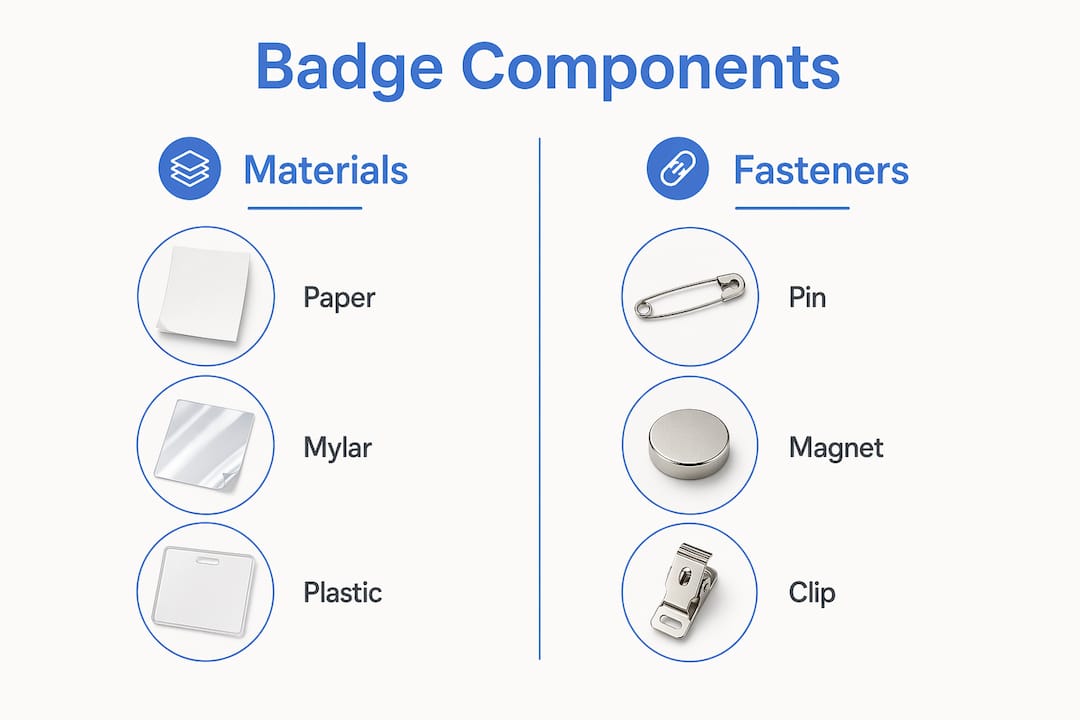
Badge construction follows a consistent three-layer logic: the front display, the base blank, and the backing mechanism. Badge fronts typically comprise paper artwork, a protective plastic dome or mylar layer, and the base blank, which may be metal, MDF, or plastic. Each layer serves a distinct purpose. The artwork carries the visual message, the dome or mylar protects it from scratching and moisture, and the base provides structural rigidity.
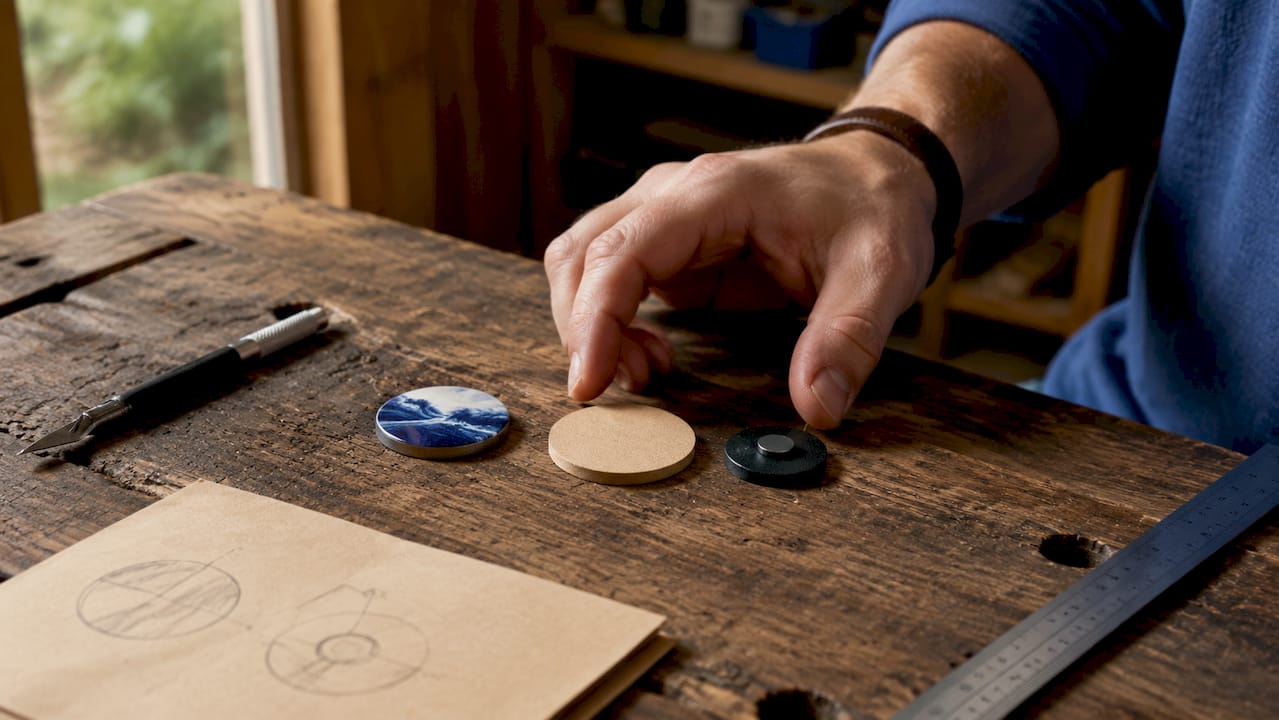
The base blank is the component most people overlook, yet it defines the badge’s weight, finish, and print compatibility. Metal blanks produce a premium feel and suit sublimation or laser engraving. MDF blanks are lightweight, cost-effective, and absorb sublimation dye with excellent colour fidelity. Plastic blanks are the most economical and work well for short-run event badges where longevity is not the priority.
Fastening types for badges include pins, magnets, clips, and safety pins, each suited for different uses and wearer preferences. Pin backs are the traditional choice and offer a secure hold on most fabrics. Magnetic fastenings are increasingly popular because they attach without piercing clothing, making them the preferred option for premium staff badges. Bulldog clips suit lanyards and card holders, while safety pins work well on fabric-heavy garments where a standard pin back would cause damage.
The table below summarises the main physical components, their typical materials, and their practical trade-offs.
| Component | Common materials | Key advantage | Limitation |
|---|---|---|---|
| Badge front | Paper, mylar, doming film | Protects artwork | Adds thickness |
| Base blank | Metal, MDF, plastic | Structural rigidity | Weight varies |
| Pin back | Steel, brass | Secure fastening | Pierces fabric |
| Magnetic back | Neodymium magnet | No fabric damage | Higher cost |
| Clip/bulldog | Steel | Lanyard compatible | Less secure on lapels |
Pro Tip: When ordering badge components for events, choose magnetic backs for staff and pin backs for promotional giveaways. Staff wear badges repeatedly, so fabric preservation matters. Promotional badges are typically worn once, making pin backs perfectly adequate.
How do design elements affect badge functionality and usability?
Badge shape is not purely aesthetic. It signals context and influences how quickly a viewer reads the information on it. In both physical badge production and digital UI design, the standard badge architecture supports at least six distinct styles: default, circle, pill, notification, ghost, and dot. Each style communicates a different level of urgency or category. Circular badges suit portrait-led identification formats. Pill shapes work well for short text labels. Dot and notification styles indicate status without requiring any text at all.
Colour coding is one of the most powerful tools in badge component design. A consistent colour system allows viewers to categorise badge wearers instantly, whether that means differentiating departments at a conference or distinguishing access levels at a secure facility. Accessibility must be part of this decision. Colour alone should never be the only differentiator, because roughly 8% of men have some form of colour vision deficiency. Pairing colour with a text label or icon removes that ambiguity.
Label conventions matter more than most badge makers realise. Labels within badge components should be kept concise, ideally limited to one or two words, and written in sentence case for readability. A badge that reads “Head of Operations” is clearer than one that reads “HEAD OF OPERATIONS, LONDON DIVISION.” The more text you add, the smaller each word becomes, and legibility drops fast at the distances people typically read badges.
Positioning and overlay are equally relevant in both physical and digital badge contexts. Notification badges are typically placed at the top-right corner of an icon or avatar to avoid obscuring the primary element. For physical badges, the equivalent principle is placement on the upper-left chest, which sits within the natural eyeline during a handshake or conversation.
- Use no more than two lines of text on any badge smaller than 55mm in diameter
- Pair colour coding with a text label to meet basic accessibility standards
- Reserve icon-only badges for contexts where the icon is universally understood
- Maintain consistent font sizing across a badge set to create a professional appearance
What are the common types of badges and their component requirements?
Different badge types demand different component configurations. Understanding those differences prevents costly reprints and component mismatches.
-
Identification badges prioritise durability and security. These badges are worn daily, often for months or years. The base blank should be metal or high-density MDF, the protective layer should be a hard dome rather than a soft mylar film, and the fastening should be a magnetic back or a locking pin to prevent accidental removal. Many organisations also add a laminate layer or a printed security feature such as a hologram.
-
Event badges favour ease of application and low cost. Event badges may favour easy-apply clips, while security badges often use pin backs with tamper-proof features. For a one-day conference, a plastic base with a safety pin back and a paper insert is entirely sufficient. Speed of production and cost per unit matter far more than longevity.
-
Promotional badges focus on visual impact and brand recall. The front surface should carry bold colour and a clear logo, which means a high-quality print process such as sublimation or full-colour digital printing is worth the investment. Pin backs are standard here because the badge is a gift or giveaway, not a permanent fixture.
-
Security and official badges require specialised components. Tamper-evident laminates, serialised numbering, and locking pin backs are common features. Some organisations use NFC-enabled badge blanks that link to a digital identity record, adding a layer of verification that a printed badge alone cannot provide.
-
Wearable promotional badges for campaigns or charity events often use lightweight plastic bases with safety pins. These are produced in high volumes at low cost, and the component simplicity is a feature rather than a compromise.
How do modern materials and technology shape badge component choices?
Material science and digital integration are changing what badge components can do. The shift is gradual but significant for anyone sourcing components at volume.
Eco-friendly materials are now a genuine option rather than a niche choice. Recycled plastic blanks, FSC-certified MDF, and water-based inks are available from several UK suppliers. For organisations with sustainability commitments, specifying these materials adds credibility to the badge itself as a branded object.
Digital integration is the more disruptive development. QR codes printed on badge fronts link wearers to digital profiles, event schedules, or access portals. NFC chips embedded in badge blanks go further, enabling contactless data exchange without requiring the viewer to open a camera app. These capabilities require a base blank with sufficient thickness to house the chip, typically 3mm or more, and a fastening that does not interfere with the NFC field.
Modern digital badge components increasingly integrate with software solutions, reflecting a trend towards physical-digital hybrid identification systems. This matters for event organisers and corporate security teams who want a single source of truth for attendee or staff identity. The badge becomes a node in a broader data system rather than a standalone printed object.
Lightweight miniaturisation is also relevant for wearability. Thinner magnetic backs and smaller base blanks reduce the overall badge weight without sacrificing hold strength. For long events where wearers are on their feet for hours, a lighter badge is a noticeably better experience.
Pro Tip: If you are adding a QR code to a badge, test the scan distance before finalising the badge size. A QR code smaller than 25mm square becomes unreliable at arm’s length, which is the typical scanning distance at a busy event.
Badges act as first points of notice and need consistent alignment and legibility across contexts, whether that is a physical event floor or a digital interface. That principle applies equally to a 58mm button badge and a notification indicator in a web application.
Key takeaways
Effective badge design depends on matching every physical component and design decision to the specific context in which the badge will be used.
| Point | Details |
|---|---|
| Layer logic matters | Every badge needs a front surface, a base blank, and a fastening chosen for its use case. |
| Fastening choice is functional | Magnetic backs protect clothing for repeat-wear badges; pin backs suit single-use promotional pieces. |
| Label brevity improves readability | Limit badge labels to one or two words in sentence case to maintain legibility at conversational distance. |
| Badge type drives component spec | Identification badges need durability; event badges need speed and low cost; security badges need tamper resistance. |
| Digital integration is now practical | QR codes and NFC chips extend badge functionality into hybrid identification systems without major cost increases. |
What I have learned from years of working with badge components
The most common mistake I see from first-time badge makers is treating the fastening as an afterthought. They spend time perfecting the artwork and choosing the right blank, then grab whatever pin back is cheapest. That decision undermines everything else. A badge that droops, rotates, or falls off does not do its job, regardless of how good it looks flat on a desk.
The second misconception is that more detail equals a better badge. It does not. Understanding component compatibility and supplier quality is vital for durable badge production, and that includes knowing when to simplify. A badge with a clean logo, a name in a legible font, and a well-chosen colour will outperform a cluttered design every time.
For professionals upgrading their badge supplies, I would focus on two things: the base material and the backing mechanism. Those two components account for the majority of quality variation between a badge that looks cheap and one that looks considered. The artwork can always be improved at the design stage, but a flimsy blank or a loose pin back cannot be fixed after production.
— chris
How Subliblanks supplies badge components for every application
Subliblanks supplies a full range of badge-making components with no minimum order quantities, making it practical to test new configurations before committing to volume.
For identification and event use, the sublimation round MDF name badge with pin combines a durable MDF base with a secure pin back, ready for sublimation printing. If a rectangular format suits your application better, the rectangular MDF pin badge offers the same material quality in a format that accommodates longer name and title combinations. Both products are available in single units or bulk packs, so whether you are equipping a team of five or a conference of five hundred, Subliblanks has the component configuration to match.
FAQ
What are the main physical components of a badge?
Every badge consists of three core elements: a front surface (artwork protected by a dome or mylar layer), a base blank (metal, MDF, or plastic), and a fastening mechanism (pin back, magnetic back, or clip). The combination of these components determines the badge’s durability, appearance, and wearability.
Which fastening type is best for staff identification badges?
Magnetic backs are the preferred fastening for staff identification badges because they attach securely without piercing clothing. Pin backs are better suited to promotional or single-use event badges where fabric preservation is less of a concern.
How many words should a badge label contain?
Badge labels should be limited to one or two words wherever possible, written in sentence case. Concise labels maintain legibility at the distances people typically read badges during conversations or at events.
Do digital features like QR codes require different badge components?
Yes. QR codes require a base blank large enough to print a scannable code, typically with a minimum QR module size of 25mm square. NFC-enabled badges require a thicker blank, usually 3mm or more, to house the chip without affecting the fastening or the printed surface.
What is the difference between event badges and identification badges?
Event badges prioritise low cost and fast production, typically using plastic bases, paper inserts, and safety pin backs. Identification badges prioritise durability and security, using metal or MDF bases, hard dome protection, and locking or magnetic fastenings designed for repeated daily wear.


