



What is bulk badge making? A practical guide
TL;DR:
- Bulk badge making involves producing 50 or more badges per order, offering volume discounts and consistent branding. The professional process takes 2 to 4 weeks, but DIY options are viable for mid-scale projects using badge presses or pneumatic machines. Material choices like brass, nickel alloy, or MDF significantly impact cost, quality, and durability for large-scale badge production.
Whether you’re planning a corporate event, school fundraiser, or product launch, the idea of ordering hundreds of badges can feel overwhelming before you understand how it actually works. What is bulk badge making, exactly, and does it have to be complicated or expensive? The short answer is no. Bulk badge production is a well-established process with clear steps, predictable costs, and plenty of options to suit different budgets and scales. This guide breaks down everything you need to know, from the badge making process itself to materials, ordering logistics, and when it makes sense to go DIY.
Table of Contents
- Key takeaways
- What is bulk badge making?
- The bulk badge production process
- Materials, finishes, and what they cost
- Best practices for ordering bulk badges
- DIY bulk badge making for small groups
- My honest take on bulk badge projects
- Get your bulk badge project started with Subliblanks
- FAQ
Key takeaways
| Point | Details |
|---|---|
| Bulk starts at 50+ units | Orders from 50 badges upward unlock volume discounts and lower per-unit costs significantly. |
| Production takes 2 to 4 weeks | Professional metal badge manufacturing follows a multi-stage process from design approval to quality control. |
| Material choice affects cost and quality | Brass, nickel alloy, hard enamel, and MDF each offer different finishes, durability levels, and price points. |
| Clean data submission saves money | Supplying attendee or member details in CSV or Excel format prevents errors and avoids manual processing fees. |
| DIY is viable for smaller volumes | Pneumatic badge machines can produce around 500 badges per hour, making self-production practical for mid-scale projects. |
What is bulk badge making?
Bulk badge making is the production of large quantities of badges, typically 50 or more units, in a single order or production run. Rather than producing badges one at a time, the process scales up through shared setup costs, batch manufacturing, and volume-based pricing that rewards larger orders.
The most common applications include:
- Corporate events and conferences where every attendee needs a name badge
- Promotional campaigns requiring branded pin badges or button badges
- Schools and universities for student ID badges or achievement awards
- Charities and community groups producing fundraising or campaign badges
- Retail merchandise such as fan badges for bands, clubs, or sports teams
The economics of bulk badge production are straightforward. Volume pricing tiers reward larger orders with lower per-unit costs. Typical discounts work as follows:
| Order quantity | Typical discount |
|---|---|
| 1 to 49 units | Standard price |
| 50 to 99 units | 10% off |
| 100 to 499 units | 15% off |
| 500 to 999 units | 25% off |
| 1,000+ units | Custom wholesale pricing |
The advantages of ordering in bulk go beyond the cost saving. You get consistent branding across every badge, a single quality control check covering the whole batch, and reduced administrative work compared to placing multiple small orders. For events or campaigns with tight deadlines, having everything arrive in one shipment also simplifies logistics considerably.
The bulk badge production process
Understanding the badge making process helps you plan timelines and set realistic expectations. Professional metal badge manufacturing follows a defined sequence of steps.
- Design approval. You submit artwork in vector format. The manufacturer reviews it for production suitability and sends a proof for sign-off.
- Die creation. A precision-engineered metal die is made from your approved design. Die creation is a major upfront cost but the die becomes a reusable asset, reducing costs on any future reorders significantly.
- Stamping and cutting. The die presses your design into the chosen base material, typically a metal sheet, producing the raw badge shape.
- Engraving and plating. Fine details are added through engraving, and a plating process applies the surface finish such as gold, silver, or antique brass.
- Enamel filling. If your design includes colour, enamel is applied in layers and cured.
- Quality control. Inspection covers visual defects, dimensional accuracy, and durability. Badges that fail are remade.
- Assembly and despatch. Fasteners are attached, badges are packaged, and the order is shipped.
Professional metal badge manufacturing typically takes 2 to 4 weeks from design approval to finished product. If you are working to a fixed event date, factor that lead time in from the start and avoid the premium charges that come with rush orders.
Pro Tip: Always request a physical sample before approving a full production run. A digital proof cannot fully represent how enamel colours will appear once cured and polished.
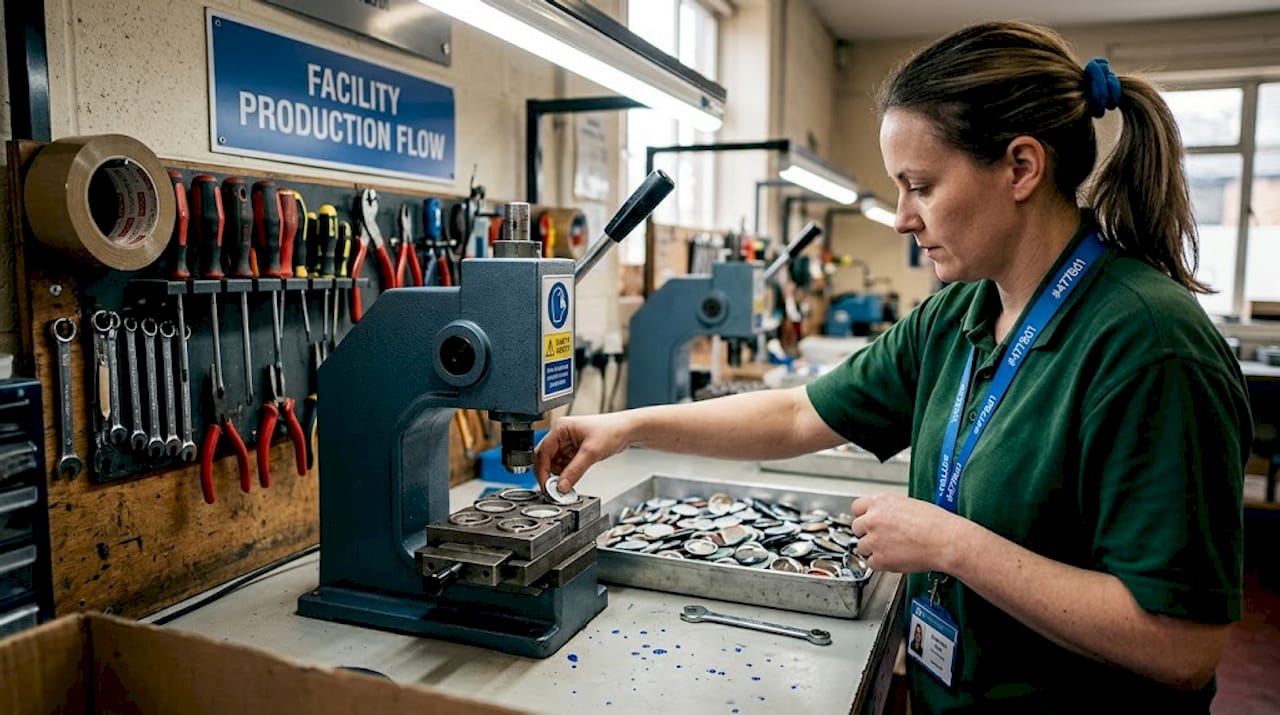
For smaller operations or community groups producing badges in-house, the process is much simpler. Manual badge presses work by placing a graphic disc, a metal shell, and a pin back into the press and applying pressure. For higher volumes, a pneumatic badge machine connected to an air compressor can produce around 500 badges per hour, making self-production a realistic option for mid-scale projects.
Materials, finishes, and what they cost
The materials used in bulk badge production have the biggest single impact on cost, appearance, and longevity. Choosing the wrong material for your application is one of the most common and avoidable mistakes.
Metal options
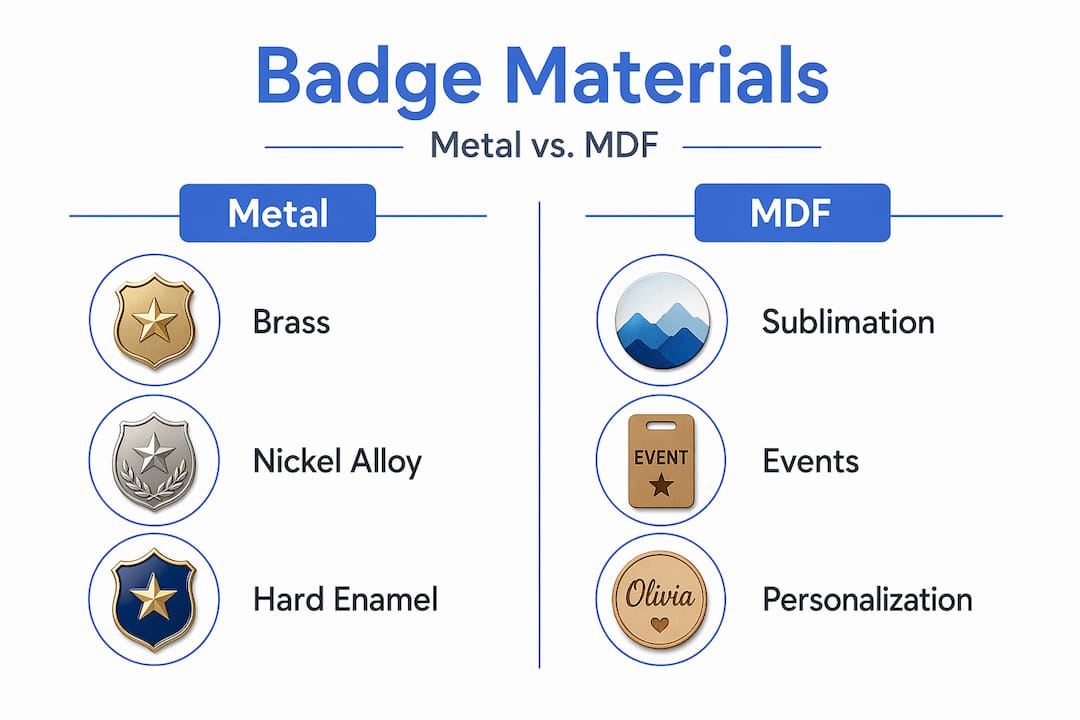
Metal badges use brass or nickel alloy as the base material in most professional applications. Brass is heavier and holds fine detail extremely well. Nickel alloy is more affordable and still provides a high-quality stamped finish. Tinplate is the most budget-friendly metal option and is widely used for button badges and promotional pin badges, though it offers less detail than brass.
| Material | Best for | Cost level | Durability |
|---|---|---|---|
| Brass | High-detail corporate or award badges | High | Excellent |
| Nickel alloy | Mid-range branded badges | Medium | Very good |
| Tinplate | Button badges, promotional pins | Low | Good for short-term use |
| MDF | Sublimation name badges | Low to medium | Good indoors |
Enamel choices
This is where many buyers get caught out. Hard enamel produces a jewellery-like polished flat finish and is the right choice for intricate logos or corporate branding where fine detail must be preserved. Soft enamel is more affordable and quicker to produce, but the recessed colour areas can cast shadows and obscure very fine lines in a design.
Pro Tip: If your badge design includes text smaller than 6pt or very fine line work, specify hard enamel in your brief. The extra cost per unit is usually far smaller than the disappointment of a soft enamel version that loses the detail.
MDF sublimation badges are a separate and genuinely useful option for events where you need personalised name badges rather than branded pin badges. Products like MDF sublimation name badges allow full-colour photo-quality printing via a heat press, making them ideal for short runs of personalised badges without tooling costs.
Best practices for ordering bulk badges
Placing a bulk badge order is straightforward when you approach it methodically. Cutting corners in the planning stage almost always creates problems later, whether that means errors in print, delays, or unexpected costs.
Key practices to follow:
- Prepare your artwork correctly. Submit vector files (AI, EPS, or PDF) rather than JPEGs. Raster images lose quality when scaled for production, which causes blurred or jagged edges in the finished badge.
- Submit attendee data in a structured format. Supplying variable data in CSV or Excel for name badges prevents manual data entry by the supplier, reduces errors, and avoids additional processing fees.
- Ask about setup fees upfront. Die creation, screen setup, and template fees are often charged separately from the per-unit cost. Understanding the full cost of custom badge creation before you commit prevents budget surprises.
- Consider split shipping for large events. If your event runs across multiple venues or dates, arranging split shipments to different locations is often possible and prevents logistical headaches on site.
- Plan for reorders early. Once a die or template is created, subsequent orders are significantly cheaper and faster. If you anticipate repeat badge production, factor that into your initial budget and ask the supplier to retain your files.
- Avoid rush orders where possible. Premium charges for expedited production can add 20% or more to your total cost, and quality control is sometimes less thorough under time pressure.
A read through our guide to custom badges for events is worth your time if you are co-ordinating badge design alongside other event elements.
DIY bulk badge making for small groups
Not every project needs a professional manufacturer. If you are producing badges for a school fair, a local campaign, or a community club, doing it yourself with a badge-making machine is often the most practical and cost-effective route.
The key decisions are:
- Manual vs pneumatic machine. A manual badge press is inexpensive and portable, but output is slow at roughly 60 to 80 badges per hour with consistent effort. Pneumatic badge machines use an air compressor and foot switch to do most of the work for you, increasing output to around 500 badges per hour and significantly reducing operator fatigue.
- Sourcing components in bulk. Button badge shells, mylar covers, and pin backs are all available as bulk supplies. Buying badge making supplies in larger quantities reduces your cost per badge and avoids the frustration of running out mid-production.
- Organising your workflow. Set up separate stations for printing, cutting, and pressing. Batch each stage rather than completing one badge at a time. This small change in workflow roughly doubles your output rate.
- Quality control in a DIY environment. Check every 20th badge for centring, even pressure, and clean edges. Catching a machine alignment issue early saves remaking dozens of finished pieces.
Pro Tip: Print your badge graphics on sublimation paper rather than standard inkjet paper when using MDF badge blanks. The colours are visibly richer and the print is far more resistant to fading and handling.
Our badge making supplies guide covers which materials work best for different machines and print methods if you are setting up a DIY production line for the first time.
My honest take on bulk badge projects
I’ve seen a lot of bulk badge projects go sideways, and in almost every case the problem starts before a single badge is made. The most common issue is treating badge ordering as an afterthought. Someone decides three weeks before an event that they need 400 personalised name badges and then discovers that professional production takes two to four weeks minimum. Suddenly they are either paying rush premiums or compromising on quality.
What I’ve found actually works is treating the badge order as you would any other event-critical element. Lock down your design early. Get a physical sample approved. Submit your attendee data in a clean spreadsheet, not a forwarded email chain. These are not complicated things, but they are consistently the difference between a smooth order and a stressful one.
On materials, my experience is that buyers consistently underestimate the value of hard enamel for anything involving a detailed logo. The cost difference per badge is often pennies, but the visual difference is significant. If the badge represents your brand or your event, that matters.
And on the DIY question: it genuinely makes sense for groups producing under 300 badges with simple designs. Beyond that volume, or with any design complexity, the economics of professional production usually win. A supplier who has made ten thousand badges is going to deliver consistency that a first-time press operator simply cannot match.
The one thing I would always recommend regardless of route: talk to your supplier early and treat their expertise as part of the service you are paying for.
— chris
Get your bulk badge project started with Subliblanks
At Subliblanks, we stock everything you need to produce professional-quality badges in bulk, whether you are running a sublimation setup or sourcing components for a badge press. Our wholesale badge supplies include MDF sublimation badge blanks in both pin and magnet fittings, available with no minimum order quantity so you can order exactly the volume your project requires. We also carry a full range of sublimation papers suited to badge production, from A4 packs ideal for smaller batches to larger A3 sheets for higher-volume runs. If you are setting up a DIY production line or simply topping up your stock, you will find our round MDF name badge with magnet a particularly popular choice for event and corporate use. Browse the full product range at Subliblanks and get your bulk badge order moving today.
FAQ
What is bulk badge making?
Bulk badge making is the production of large quantities of badges, typically 50 or more units, in a single run using shared setup costs and volume pricing. It covers both professional manufacturing and DIY production using badge presses.
How long does bulk badge production take?
Professional metal badge manufacturing takes 2 to 4 weeks from design approval to finished product. DIY production using a pneumatic machine can be completed in hours depending on quantity.
What is the minimum order for bulk badge discounts?
Bulk order discounts typically start at 50 units, with savings ranging from 10% at 50 units up to 25% or more at 500 units.
Which badge material is best for detailed logos?
Hard enamel is the best choice for intricate logos because it produces a flat, polished finish that preserves fine lines and small text. Soft enamel is more affordable but can obscure fine design detail.
Can I make badges in bulk myself?
Yes. A pneumatic badge machine can produce around 500 badges per hour, making DIY bulk badge production practical for groups producing up to several hundred badges with straightforward designs.


