



What is badge making? A guide for craft enthusiasts
TL;DR:
- Badge making involves assembling printed inserts, Mylar film, shells, and pin backs with a press to create wearable items. Success depends on precise component matching, lightweight paper, and careful artwork preparation for consistent results. Handmade badges are ideal for small runs and bold designs, while professional manufacturing suits intricate details and larger quantities.
Badge making is the craft of assembling personalised badges by combining a printed artwork insert, a protective Mylar film, a metal or plastic shell, and a pin back, then pressing all components together using a dedicated badge-making machine. The process suits everyone from hobbyists creating one-off gifts to small businesses producing branded merchandise. Common badge sizes include 25mm, 38mm, and 58mm, each requiring its own matched die and circle cutter. Whether you use a manual lever press or explore professional enamel pin methods, understanding the full workflow transforms a simple idea into a finished, wearable piece.
What materials and tools do you need for badge making?
Badge making relies on four core components working together: the metal front shell, the printed paper insert, the Mylar protective film, and the pin back. Each part must match the chosen badge diameter precisely. Mixing components from different size ranges causes misalignment, poor crimping, and wasted materials. A badge making supplies guide is the fastest way to confirm you have the right combination before you start.
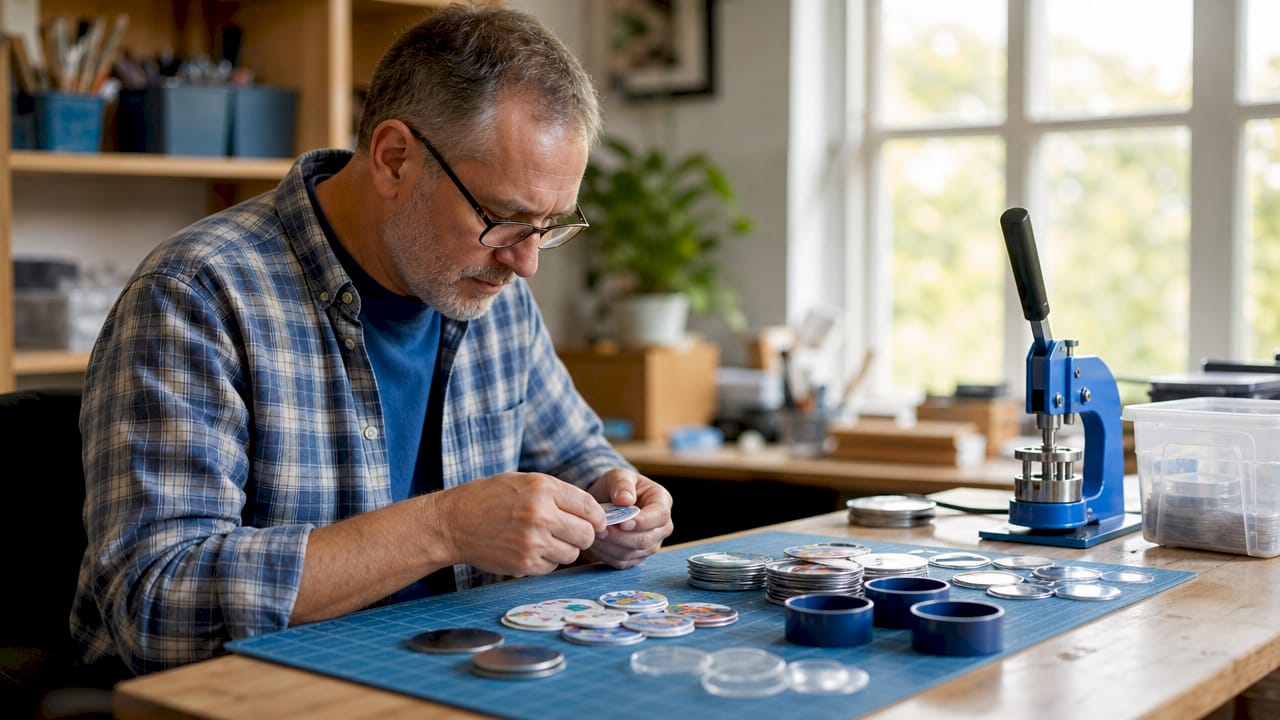
The badge press itself is the centrepiece of your toolkit. Manual presses accommodate badge sizes from 25mm up to 75mm, but each machine model is fixed to specific die sizes. This matters because badge machines are not universally compatible; mixing brands or sizes causes jamming and failed badges. Buy your machine and component packs together, or verify die compatibility before ordering separately.
Paper choice is less obvious but equally important. Lightweight 80 to 90 gsm paper performs better than thick cardstock for button badges because it conforms smoothly under the Mylar film and crimps cleanly around the metal shell. Thick paper creates uneven pressure and increases the rate of failed presses. Print your artwork on standard inkjet or laser paper at the highest quality setting your printer allows.
Here is a quick checklist of supplies you need before your first press:
- Metal front shells matched to your chosen badge diameter
- Printed paper inserts cut to the correct circle size
- Mylar protective film circles, same diameter as the inserts
- Pin backs (standard butterfly clutch or safety pin style)
- A badge press with the correct die for your size
- A circle cutter matched to your badge diameter
Pro Tip: Never buy a circle cutter by approximate size. Measure your badge die precisely and match the cutter to that exact diameter. A matched circle cutter produces clean edges that wrap smoothly around the shell, while irregular cuts cause wonky edges and poor alignment every time.
How does the badge making process work step by step?
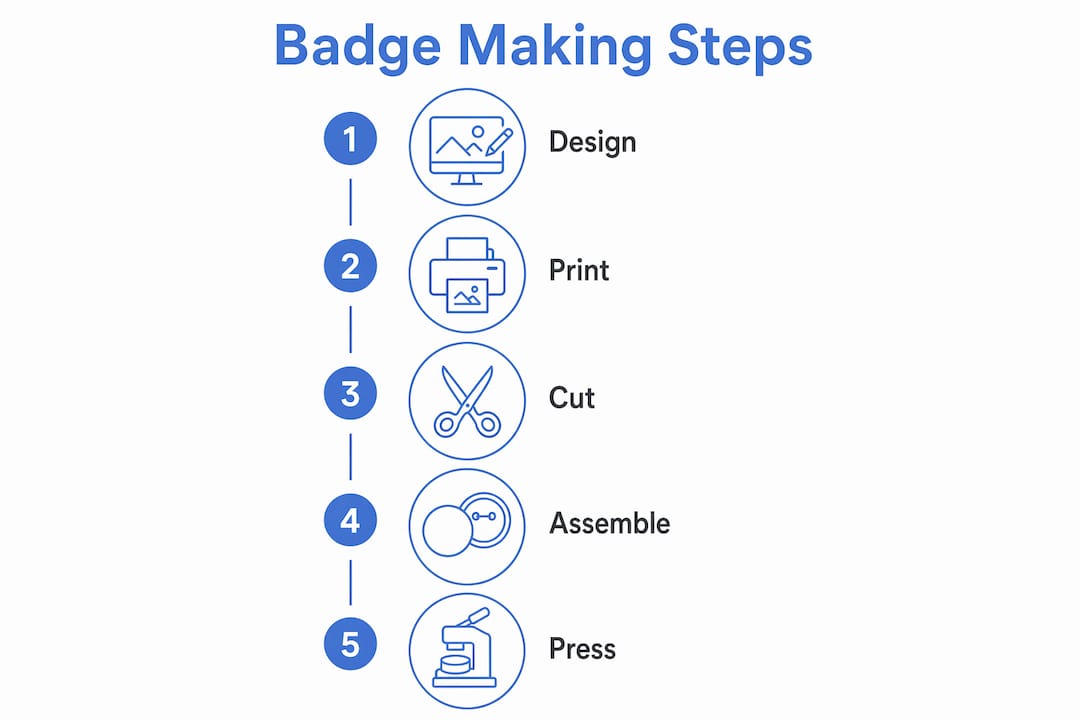
The badge making workflow moves from artwork preparation through to final assembly, and each stage affects the quality of the finished badge. Skipping steps or rushing the sequence is the most common reason beginners get poor results. Follow this order consistently and your output will improve quickly.
-
Prepare your artwork. Design your badge graphic at the correct diameter plus a bleed margin of at least 2mm around the edge. Correct artwork bleed ensures the printed image wraps fully around the badge edges without leaving a white gap. Use software such as Adobe Illustrator, Canva, or Affinity Designer to set up your file. Export at a minimum of 300 dpi for sharp results.
-
Print your inserts. Print onto 80 to 90 gsm paper and allow the ink to dry fully before cutting. Wet ink smears under the Mylar film and ruins the finish. Print a test sheet first to check colour accuracy before committing to a full run.
-
Cut your artwork circles. Use a circle cutter set to your badge diameter. Place the cutter over the centre of each printed design and press firmly for a clean cut. Consistency here is everything. Uneven circles produce badges with off-centre graphics and visible white edges.
-
Load the badge press. Place the metal front shell face-down into the lower die of the press. Lay your printed insert on top, graphic side up. Place the Mylar film over the insert. Lower the upper die and apply firm, even pressure using the lever. The front shell and insert will crimp together.
-
Add the pin back. Place the pin back component into the upper die of the press. Position the crimped front shell assembly on top, then press again to lock the pin back into place. Some machines complete both steps in one action; others require two separate presses.
-
Inspect the finished badge. Check the edge crimp is even all the way around, the graphic is centred, and the pin back opens and closes freely. Reject any badge with a visible gap at the edge or a wrinkled Mylar surface.
Pro Tip: Organise your components into separate trays before you start pressing. Pre-sorting components allows experienced operators to produce 200 to 300 badges per hour on a 58mm manual press. That throughput is impossible if you are searching for parts between each press.
For a detailed walkthrough tailored to events and branded runs, the step-by-step badge guide from Subliblanks covers artwork file preparation in depth.
DIY button badges vs professional pin badges: what is the difference?
Beginners often confuse DIY button badge making with professional pin manufacturing, which leads to unrealistic expectations about the level of detail and finish achievable at home. The two processes are fundamentally different in equipment, cost, and output quality.
| Feature | DIY button badges | Professional enamel pin badges |
|---|---|---|
| Equipment needed | Manual lever press, circle cutter | Metal moulds, enamelling equipment, plating tanks |
| Minimum quantity | 1 badge | Typically 50 to 100 units minimum |
| Cost per unit | Low at small quantities | Higher upfront due to mould costs |
| Design complexity | Bold, simple graphics work best | Fine detail, gradients, and textures possible |
| Finish options | Printed graphic under Mylar | Hard enamel, soft enamel, screen printing |
| Skill level required | Beginner friendly | Requires specialist manufacturing |
DIY button badges use a manual press to sandwich a printed graphic between a metal shell and a Mylar cover. Professional enamel pins require moulds and enamelling, which adds significant upfront cost. Professional manufacturing becomes cost-effective from around 50 to 100 units, once the mould cost is spread across the run. Below that threshold, DIY button badges almost always deliver better value.
For hobbyists, the DIY route offers complete creative control with no minimum order and no lead time. The trade-off is that fine detail, metallic finishes, and raised textures are not achievable with a manual press. If your design uses bold shapes, clear text, and two to five colours, a button badge press will produce excellent results. If your design requires intricate linework or a premium metal finish, professional manufacturing is the right choice. You can explore the technical differences further in this guide to making steel badges.
Creative badge design ideas and tips for better results
Custom badge creation opens up a wide range of projects beyond simple name tags. Personalised gifts, event lanyards, band merchandise, school fundraisers, and decorative flair for bags and jackets are all achievable with a basic badge press and a little design thought.
Design is where most hobbyists either succeed or struggle. Simple designs with two to five colours and clear, bold lines produce the most recognisable results at small scales. Fine text below 8pt and intricate patterns lose definition at 25mm or 38mm diameters. Test your design by printing it at actual badge size before cutting any components.
Here are practical ideas and tips to get more from your badge making projects:
- Personalised gifts: Print a photo, a name, or an inside joke onto a 58mm badge for a unique, low-cost present.
- Event badges: Create colour-coded badges for different attendee roles at workshops, markets, or community events.
- Brand merchandise: Small businesses can produce branded badges as giveaways or add-ons to product orders.
- Wearable art: Use illustrated designs, hand-drawn lettering, or watercolour prints for a distinctive aesthetic.
- Recyclable paper inserts: Printing on FSC-certified or recycled paper adds an eco-friendly angle to your badges without affecting press performance.
Material choices beyond paper are worth exploring too. Fabric inserts create a textile badge effect, though they require a slightly looser die fit. Foil paper adds a metallic sheen under the Mylar. Both options work with standard badge presses as long as the material is not too thick. For brand-focused projects, the guide on badges that build your brand covers artwork and colour selection in practical detail.
Pro Tip: Set up a dedicated badge-making workspace with component trays, a cutting mat, and your press bolted or clamped to the table. A stable press produces more consistent crimps, and an organised surface means you spend time making badges rather than hunting for Mylar circles.
Key takeaways
Badge making produces the best results when artwork preparation, component matching, and press technique are treated as equally important stages rather than afterthoughts.
| Point | Details |
|---|---|
| Match components to die size | Always buy metal shells, Mylar, and circle cutters in the same diameter as your badge press die. |
| Use lightweight paper | 80 to 90 gsm paper crimps cleanly and reduces failed presses compared to thick cardstock. |
| Keep designs simple | Limit designs to two to five colours and avoid fine text below 8pt for small badge sizes. |
| Separate DIY from professional methods | DIY button presses suit small runs and bold designs; professional enamel pins are cost-effective only above 50 to 100 units. |
| Organise before you press | Pre-sorting components into trays significantly increases output speed and reduces errors. |
Why badge making is worth taking seriously as a craft
I have watched a lot of crafters pick up a badge press, make three badges, and then leave it on a shelf. The reason is almost always the same: they expected the machine to do all the work, and they skipped the design and preparation stage entirely. The press is just a tool. The quality lives in the artwork file, the paper choice, and the circle cut.
What surprises most beginners is how quickly the skill compounds. Your first ten badges will have off-centre graphics and uneven crimps. Your fiftieth will look genuinely professional. That learning curve is short compared to most crafts, and the materials cost per badge is low enough that practising is not expensive.
The craft also has real practical value beyond personal projects. I have seen badge making used at school fairs, community events, and market stalls where the ability to produce custom badges on demand creates genuine excitement. There is something about a physical, wearable object that digital personalisation cannot replicate.
My honest advice to anyone starting out: buy one size of press, master it completely, and resist the urge to buy every diameter at once. A 38mm or 58mm press covers the majority of projects. Once you understand how artwork bleed, paper weight, and component alignment interact, scaling up to other sizes takes minutes rather than days.
— chris
Start making badges with Subliblanks supplies
Subliblanks stocks a full range of badge making components and blanks with no minimum order quantities, so you can start with a single test run or scale up to a commercial production batch without committing to bulk stock upfront.
The round MDF pin badge is a popular choice for hobbyists and small businesses alike, offering a clean sublimation-ready surface and a reliable pin back. For projects that need a different shape, the rectangular MDF pin badge delivers the same quality in a format that suits name badges and event passes. Browse the full range at Subliblanks to find components matched to your press size and project requirements.
FAQ
What is badge making in simple terms?
Badge making is the process of assembling a printed artwork insert, a Mylar protective film, a metal or plastic shell, and a pin back using a badge press to create a wearable badge. The process is straightforward enough for complete beginners with the right components and a matched die size.
What sizes do DIY badge presses come in?
Standard manual badge presses accommodate sizes from 25mm up to 75mm, with common sizes being 25mm, 38mm, 58mm, and 75mm. Each machine is designed for specific die sizes, so components must match the press exactly to avoid jamming or poor crimping.
What paper should I use for badge making?
Lightweight 80 to 90 gsm standard printer paper produces the best results for button badges. Thick cardstock creates uneven pressure during crimping and increases the rate of failed or misaligned badges.
Can I make professional-quality badges at home?
DIY button badge presses produce clean, professional-looking badges for bold, simple designs. Fine detail, metallic finishes, and raised textures require professional enamel pin manufacturing, which becomes cost-effective only from around 50 to 100 units due to mould costs.
How many badges can I make per hour?
An organised operator using a 58mm manual badge press with pre-cut and pre-sorted components can produce between 200 and 300 badges per hour. Preparation and component organisation are the biggest factors in achieving that output rate.


