



What does packaging supply include: a UK guide
TL;DR:
- Packaging supply comprises materials at four levels: primary, secondary, tertiary, and ancillary, each serving a distinct function in protecting and transporting products. Small businesses should focus on five core categories, including shipping boxes, void fill, seals, labels, and protective wrapping, to manage costs effectively. Regular audits of packaging supplies help prevent waste and ensure proper protection and brand communication across shipments.
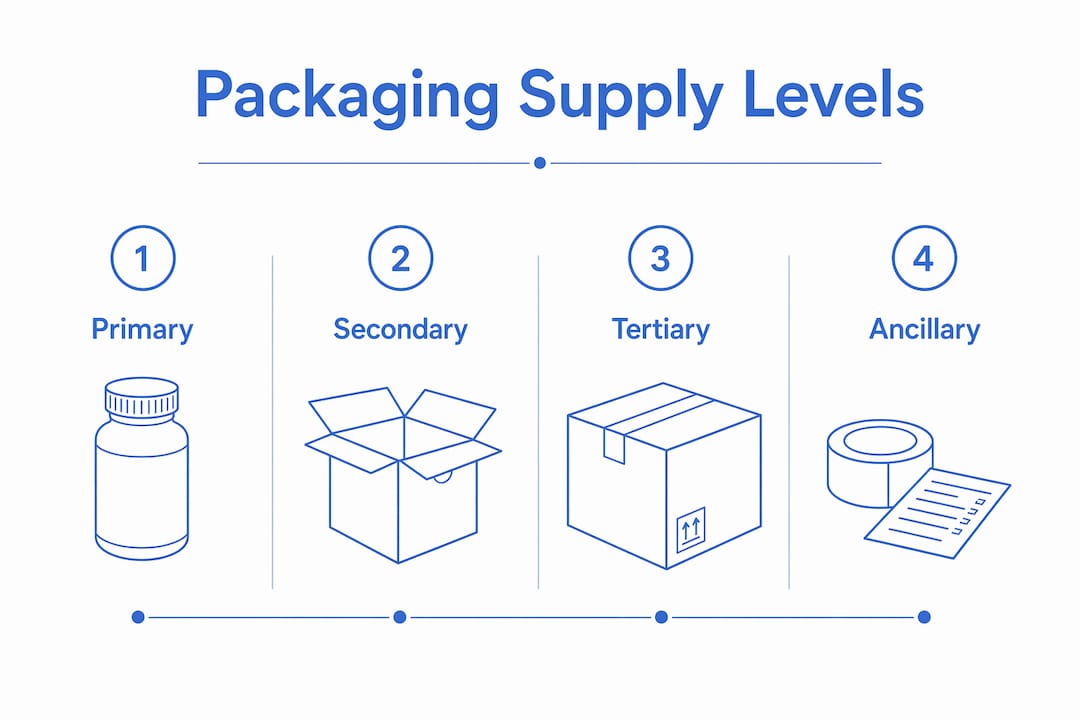
Packaging supply is the complete collection of materials used to contain, protect, identify, and transport products from production to end customer. The industry standard divides packaging supply into four distinct levels: primary, secondary, tertiary, and ancillary. Understanding what does packaging supply include at each level is the difference between a business that controls its distribution costs and one that haemorrhages money on damage claims and wasted materials. For businesses across the UK and Ireland, getting this right in 2026 is not optional. It is a direct driver of margin, customer satisfaction, and brand reputation.
What does packaging supply include across its four levels?
Packaging supplies are classified into four levels, each with a distinct function in the supply chain. Treating them as a single undifferentiated category is one of the most common and costly mistakes businesses make.
Primary packaging
Primary packaging is the material that makes direct contact with the product. It is the innermost layer and the one customers interact with first. Examples include glass bottles, blister packs, shrink wrap applied directly to a product, and individual cardboard sleeves. The primary layer defines the product’s shelf presence and must meet any relevant regulatory requirements for labelling and safety.

Secondary packaging
Secondary packaging groups primary units together for retail display or storage. A cardboard tray holding six individually wrapped items is secondary packaging. So is the outer box that contains multiple blister packs. This level protects primary packaging from damage during handling and serves as the primary vehicle for brand communication on the shelf.
Tertiary packaging
Tertiary packaging handles bulk transit. Pallets, stretch wrap, corrugated transit cases, and wooden crates all fall into this category. Neglecting tertiary packaging increases logistics costs and vulnerability to damage. Experienced operators treat tertiary supplies as a critical component of the overall cost of goods sold, not an afterthought.
Ancillary packaging
Ancillary supplies are the functional components that hold everything together. Tape, labels, protective films, void fill, strapping, and desiccants all belong here. These items rarely appear on a headline budget line, yet they are present in every single shipment.
| Level | Function | Common examples |
|---|---|---|
| Primary | Direct product contact and containment | Bottles, blister packs, shrink wrap |
| Secondary | Grouping and retail display | Outer boxes, cardboard trays, retail cartons |
| Tertiary | Bulk transit and logistics | Pallets, stretch wrap, transit cases |
| Ancillary | Sealing, identification, and protection | Tape, labels, void fill, desiccants |
Which packaging supplies are essential for small businesses?
Small businesses do not need every category of packaging material from day one. Focusing on five core categories prevents overspending on unnecessary specialised materials and keeps procurement manageable.
The five categories are:
- Shipping boxes and mailers. Corrugated boxes are the workhorse of e-commerce fulfilment. Poly mailers suit lightweight, non-fragile items and reduce postage costs compared with boxes.
- Protective void fill. Bubble wrap, foam inserts, kraft paper, and air pillows prevent products from shifting during transit. Choosing the right fill material depends on product weight and fragility.
- Sealing materials. Packing tape is the most common choice. Reinforced tape suits heavier boxes. Water-activated tape creates a tamper-evident bond and is increasingly favoured for premium shipments.
- Labels and identification. Address labels, fragile stickers, and return labels are non-negotiable for any dispatched order. Thermal labels printed on demand reduce waste compared with pre-printed sheets.
- Protective wrapping. Tissue paper, foam wrap, and polythene sheeting protect surfaces and add a perceived quality to unboxing.
Selecting appropriate supplies for your actual product range avoids the trap of over-engineering packaging. A business shipping printed T-shirts needs poly mailers and tissue paper, not double-walled corrugated boxes designed for ceramics. Matching material to product weight, fragility, and transit distance is the fastest way to cut packaging costs without increasing damage rates.
Pro Tip: Order a small quantity of several box sizes before committing to bulk. Testing real shipments reveals which sizes minimise void fill use and reduce dimensional weight charges from couriers.
For a practical breakdown of what UK businesses typically stock, the packaging supply examples guide at Subliblanks covers common configurations by product type.
How do packaging supplies protect products and communicate your brand?
Packaging serves two distinct functions: protection against physical and environmental damage, and communication of brand identity, safety information, and usage instructions. Most businesses focus on one at the expense of the other.
The protection function addresses four threats:
- Physical impact. Drops, compression, and vibration during transit cause the majority of product damage claims. Corrugated board, foam inserts, and bubble wrap absorb and distribute impact energy.
- Moisture and humidity. Desiccant sachets, moisture-barrier bags, and waterproof outer packaging protect electronics, food products, and paper goods from humidity damage.
- Temperature. Insulated liners and thermal packaging protect temperature-sensitive products such as cosmetics, pharmaceuticals, and food items during seasonal extremes.
- Contamination. Sealed primary packaging prevents contact with dust, bacteria, and other contaminants, which is particularly critical for food and medical products.
The communication function is equally important. Secondary packaging carries brand colours, logos, product descriptions, and regulatory information. Material selection balances cost, sustainability, and product needs, and the choice of substrate sends a clear signal about brand values. A business using recycled kraft board communicates environmental responsibility. A business using glossy laminated cartons signals premium positioning.
Eco-friendly packaging is increasingly standard rather than a costly exception. Businesses that treat sustainable materials as a premium add-on are already behind the market expectation in 2026.
A common misconception is that sustainable packaging always costs more. Eco-friendly materials increasingly meet regulatory and consumer expectations without prohibitively increased costs. Recycled corrugated board, for instance, is widely available at comparable prices to virgin board and meets the expectations of UK and Irish consumers who actively consider environmental impact in purchasing decisions.
For guidance on balancing protection and brand communication in your material choices, the packaging selection guide at Subliblanks covers the practical trade-offs in detail.
What are the common pitfalls in managing packaging supplies?
Most packaging problems are not caused by choosing the wrong box. They are caused by misunderstanding the difference between packaging and packing, ignoring tertiary supplies, and failing to track ancillary costs.
Packaging and packing are distinct: packaging is the strategic design and material choice, packing is the operational act of securing products for transit. Businesses that confuse the two often invest heavily in attractive outer packaging but use inadequate void fill or sealing tape. The result is a beautiful box that arrives damaged. That outcome destroys the brand impression the packaging was designed to create.
The most overlooked area is tertiary packaging. Many small businesses ship in corrugated boxes but never consider how those boxes are palletised or consolidated for freight. Without adequate stretch wrap, strapping, or pallet boards, individual shipments shift and compress during long-haul transit. The damage rate rises and so do insurance claims.
Tracking ancillary supplies is equally critical. Tape, labels, and protective film are frequently overlooked during budget planning. They appear as minor line items individually but accumulate into a significant cost across thousands of shipments. Businesses that do not track ancillary consumption cannot accurately calculate their true cost per shipment.
Pro Tip: Conduct a quarterly packaging audit. List every material used in a single shipment, including tape, labels, and void fill, and cost each item. The total often surprises businesses that thought their packaging costs were under control.
Regular audits of packaging supplies help avoid feature creep, where businesses gradually add specialised or custom materials that increase costs without improving protection or brand perception. Standard, versatile packaging almost always outperforms bespoke solutions on cost per unit.
- Review your packing materials list every quarter, not just when placing orders.
- Separate ancillary supply costs from primary and secondary packaging in your accounts.
- Test tertiary packaging under realistic freight conditions before scaling shipment volumes.
- Standardise box sizes to reduce the number of SKUs you need to stock.
Key takeaways
A packaging supply system that covers all four levels, primary, secondary, tertiary, and ancillary, is the most cost-effective way to protect products and manage distribution costs across UK and Ireland operations.
| Point | Details |
|---|---|
| Four levels cover everything | Primary, secondary, tertiary, and ancillary supplies each serve a distinct role in the supply chain. |
| Small businesses need five core categories | Boxes, mailers, void fill, sealing tape, and labels cover the vast majority of fulfilment needs. |
| Packaging and packing are different | Packaging is strategic material choice; packing is the operational act of securing goods for transit. |
| Ancillary costs add up fast | Tape, labels, and film are frequently underbudgeted and erode profit margins when untracked. |
| Audits prevent overspending | Quarterly supply reviews stop feature creep and keep procurement aligned with actual needs. |
Why the four-level framework changed how I think about packaging costs
When I first started advising businesses on packaging procurement, almost every client had the same blind spot. They had thought carefully about their box design and their branded tissue paper. They had not thought at all about their pallet wrap or their tape consumption. The ancillary and tertiary levels were invisible to them, right up until a freight claim landed on their desk.
The four-level classification is not just a tidy academic framework. It is a practical tool for identifying where money is leaking. Once a business maps every material it uses to one of the four levels, the gaps become obvious. A business might have excellent primary and secondary packaging and virtually no tertiary provision. That gap shows up as damage in transit, not as a packaging decision.
The other thing I have noticed consistently is that new businesses underestimate how much the packing process itself affects outcomes. You can specify the right box and the right void fill, but if the person packing the order uses half the recommended tape or skips the desiccant, the protection fails. Packaging strategy and packing practice have to be aligned. The wholesale packaging cost guide at Subliblanks covers this alignment well, and I recommend it to anyone trying to get both sides right.
My honest recommendation: start with the four-level audit before you buy anything new. Map what you have, identify what is missing, and only then make purchasing decisions. Buying more packaging without that clarity is how businesses end up with a warehouse full of materials that do not actually solve their problem.
— chris
Packaging supplies and sublimation blanks at Subliblanks
Subliblanks supplies a full range of packaging materials to businesses across the UK and Ireland, with no minimum order quantities. Whether you need corrugated boxes, poly mailers, void fill, or ancillary supplies like tape and labels, the catalogue covers all four packaging levels.
Subliblanks is a trade wholesaler, which means competitive pricing without the commitment of large minimum orders. That makes it practical for small businesses to stock the right materials without tying up cash in excess inventory. Beyond packaging, Subliblanks supplies sublimation blanks, DTF supplies, xTool laser engraving machines, and badge-making equipment, making it a single source for businesses that produce and ship custom printed products. Visit the Subliblanks wholesale store to browse the full range and request trade pricing.
FAQ
What does a packaging supply include at its most basic level?
At its most basic, a packaging supply includes the materials needed to contain, protect, and identify a product. This covers primary packaging in direct contact with the product, sealing materials, and identification labels.
What is the difference between packaging and packing?
Packaging is the strategic selection and design of materials used to present and protect a product. Packing is the operational process of securing those materials around a product ready for transit.
Which packaging materials are most important for e-commerce businesses?
Corrugated shipping boxes, poly mailers, bubble wrap or void fill, packing tape, and address labels form the core packing materials list for most e-commerce operations in the UK and Ireland.
Are eco-friendly packaging materials more expensive?
Eco-friendly materials such as recycled corrugated board are increasingly available at prices comparable to standard materials. The cost gap has narrowed significantly as demand has grown and production volumes have scaled.
How often should a business review its packaging supplies?
A quarterly audit is the recommended frequency. Regular reviews prevent ancillary supply costs from accumulating unnoticed and stop feature creep from inflating procurement budgets with unnecessary specialised materials.


