



Packaging supplies: how to choose the right ones
TL;DR:
- Selecting packaging supplies requires understanding product protection needs, compliance requirements, and supplier documentation. Small businesses must gather detailed product data and ensure suppliers provide accurate material classification and recyclability documentation to meet UK and Irish EPR regulations. Properly testing materials and maintaining a thorough packaging record can prevent costly errors and ensure compliance and sustainability.
Packaging supplies selection is the process of matching materials, formats, and vendors to your product’s protection needs, presentation goals, and legal obligations. For small businesses in the UK and Ireland, that last factor now carries real financial weight. UK EPR regulations require producers to submit packaging waste data including material composition and packaging types, meaning the packaging you choose directly affects your compliance costs. Get the selection process right and you protect your products, impress your customers, and avoid modulated fee penalties. Get it wrong and you pay for it twice.
What data do you need before choosing packaging supplies?

The biggest mistake small businesses make is treating packaging as a last-minute decision. Choosing packaging options without first gathering product and regulatory data leads to costly changes later.
Start with your product profile. You need to know:
- Dimensions and weight of the product and its expected shipping configuration
- Fragility rating — whether the product is rigid, flexible, or breakable under transit stress
- Shipping method — Royal Mail, courier networks like DPD or Evri, or pallet freight
- Temperature sensitivity — relevant for food, cosmetics, or candles
- Branding requirements — whether the outer packaging needs to carry print or remain plain
Once you have that profile, move to compliance. UK EPR data categories require you to classify packaging as household, shipment, or drinks container, among other types. Each classification carries different reporting obligations. Ireland adds another layer: EU material identification codes must appear on packaging, and deposit labels are mandatory on beverage containers under PPWR 2026 rules.
Pro Tip: Build a simple spreadsheet before you speak to any supplier. List every SKU, its dimensions, weight, fragility, and intended shipping method. This single document will save hours when requesting quotes and completing EPR reports.
Supplier documentation matters as much as the materials themselves. Packaging suppliers must provide technical documentation for materials so you can correctly map SKUs to packaging categories for EPR reporting. If a supplier cannot provide material codes and composition data, walk away.
How do packaging materials compare for protection, branding, and sustainability?
No single packaging material suits all needs. Selection depends on product fragility, shipping mode, branding ambition, cost, and recyclability. The table below gives you a direct comparison of the four main material families.
| Material | Protection | Printability | Recyclability | Best for |
|---|---|---|---|---|
| Corrugated cardboard | High | Good with liners | Widely recyclable | Fragile goods, e-commerce shipping |
| Paperboard | Medium | Excellent | Widely recyclable | Retail boxes, cosmetics, gifts |
| Plastic (rigid or flexible) | High | Limited without labels | Variable, often lower | Food, liquids, heavy items |
| Glass | Very high | Low without labels | Fully recyclable | Premium food, cosmetics, candles |
Corrugated cardboard is the workhorse of e-commerce packaging in the UK. It absorbs impact, stacks well on pallets, and accepts print on inner liners for a branded unboxing experience. Paperboard sits at the other end of the spectrum: thinner, lighter, and ideal for retail shelf presentation where print quality matters most.
Plastic is where the compliance picture gets complicated. UK recyclability assessment rules from 2025 affect 2026 and 2027 modulated fees. Packaging that only appears recyclable based on marketing claims but fails the formal PackUK assessment will attract higher fees. That is a direct cost to your business, not an abstract environmental concern.
Glass carries a premium feel that works well for candles, artisan food, and cosmetics. Its weight increases shipping costs, so factor that into your total cost per unit before committing.
Pro Tip: Request a recyclability assessment certificate from your supplier before finalising any plastic or composite packaging. A supplier who cannot produce one is a compliance risk.
Sustainable options are expanding. Kraft paper mailers, mushroom-based void fill, and recycled-content corrugated are all commercially available in the UK market. European-made protective films offer an example of how material origin and manufacturing standards affect both quality and compliance documentation quality. Sourcing from suppliers with clear material provenance makes EPR reporting significantly easier.
How do you evaluate and verify packaging suppliers?
Supplier quality is not just about price per unit. For UK and Ireland businesses operating under EPR, a supplier’s ability to provide accurate, timely compliance data is as important as the material itself.
Evaluate suppliers against these criteria in order:
- Certification and reputation. Look for ISO 9001 certification or equivalent quality management credentials. Check reviews from other small business owners, not just large-volume clients.
- Material documentation. Ask directly: can they provide material composition data, weight per unit, and packaging classification codes? If they hesitate, that is your answer.
- Compliance support. Do they understand UK EPR and Ireland’s PPWR requirements? Suppliers who work regularly with small UK businesses will already have this documentation prepared.
- Testing validation. ISTA package testing simulates transit hazards and drop tests to validate protective performance. Ask whether the supplier’s materials have been tested to ISTA standards, or request samples to test yourself before committing to volume.
- Delivery reliability. Late deliveries disrupt production. Ask for lead times in writing and check whether they hold UK or Ireland stock.
- Data reporting support. Aggregated UK packaging waste data is published monthly, which means delays in supplier data can push you into late or incomplete submissions. A good supplier will provide material data proactively, not only when chased.
Avoid suppliers who offer only generic product descriptions without material breakdowns. That gap will surface at reporting time and create unnecessary pressure on your compliance team or, if you are a sole trader, on you personally.
A step-by-step framework for selecting packaging supplies
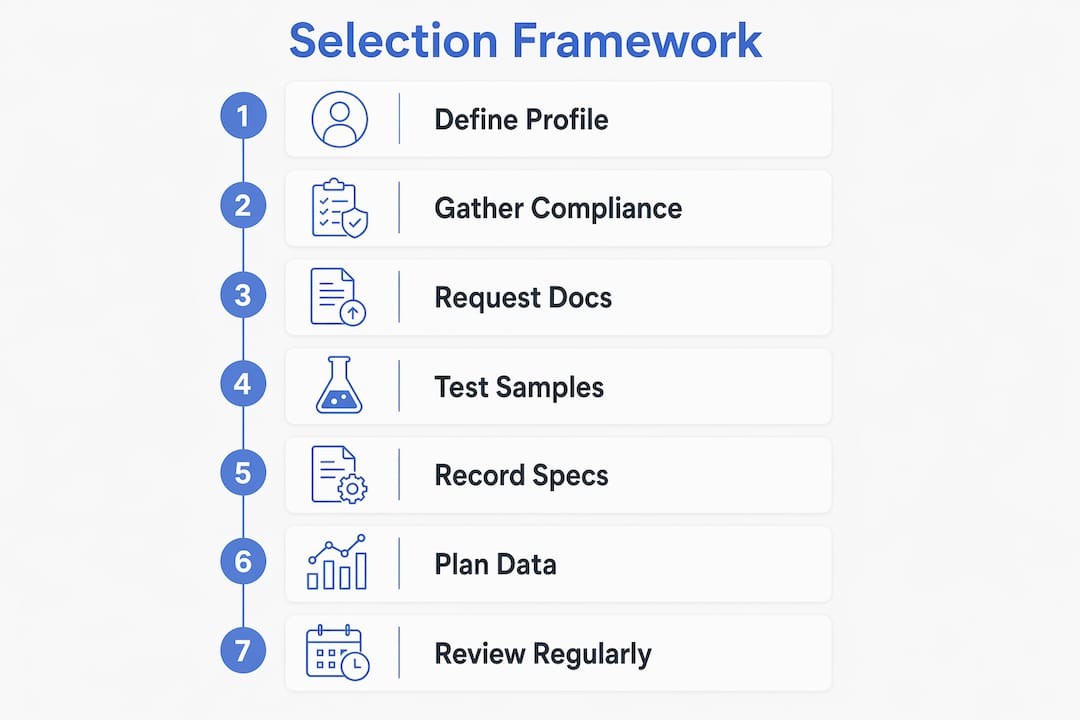
A structured approach removes guesswork and makes your choices defensible if you are ever audited under EPR. Follow these steps in sequence.
Step 1: Define your product and shipping profile. Use the SKU spreadsheet from the prerequisites stage. Confirm dimensions, weight, fragility, and shipping method for every product line.
Step 2: Collect your compliance requirements. Identify whether you are a UK producer, an Ireland producer, or both. Note which EPR data categories apply to your packaging types. If you sell drinks containers in Ireland, confirm deposit label requirements under PPWR 2026.
Step 3: Request and review supplier documentation. Ask every shortlisted supplier for material composition sheets, packaging classification codes, and any recyclability assessment certificates. Compare these against your compliance requirements before requesting samples.
Step 4: Validate materials through testing or samples. Do not rely solely on material specifications. Order samples and subject them to realistic transit conditions. For higher-volume products, commission ISTA-standard drop and vibration tests. Relying only on specs is insufficient for e-commerce and parcel shipping.
Step 5: Build your packaging specification record. Practitioners who create packaging spec binders storing SKU dimensions, weight, closure methods, and material composition documentation for each product avoid last-minute errors in EPR reports. This is not bureaucracy. It is protection against supplier changes, audits, and fee disputes.
Step 6: Plan your data capture process. Decide how you will record packaging data at the point of purchase or production. A simple spreadsheet linked to your order management system is sufficient for most small businesses. The goal is to have accurate data ready when reporting deadlines arrive, not to reconstruct it under pressure.
Pro Tip: Review your packaging specification record every time you change a supplier or reformulate a product. A single undocumented material change can invalidate an entire quarter’s EPR data.
For businesses selling sublimation products or personalised gifts, the packaging guide for sublimation products covers material choices specific to that product category, including how to balance presentation quality with shipping protection.
Key takeaways
Choosing packaging supplies correctly requires matching materials to product needs, verifying supplier compliance documentation, and building a data capture process before you need it.
| Point | Details |
|---|---|
| Gather product data first | Map every SKU’s dimensions, weight, fragility, and shipping method before approaching suppliers. |
| Compliance shapes material choice | UK EPR and Ireland PPWR rules mean recyclability and material classification directly affect your fees. |
| Demand supplier documentation | Suppliers must provide material codes and composition data; without these, EPR reporting becomes unreliable. |
| Test before committing | ISTA-standard testing validates protective performance beyond what material specs alone can confirm. |
| Build a specification record | A packaging spec binder for each product prevents errors during EPR submissions and supplier changes. |
What I have learned about packaging decisions in the UK market
The packaging conversations I see go wrong almost always follow the same pattern. A business owner picks packaging based on price and appearance, then discovers six months later that their supplier cannot provide the material composition data needed for EPR reporting. By that point, they are either reconstructing records from incomplete invoices or paying a compliance consultant to sort it out.
The uncomfortable truth is that packaging choice is now a compliance decision as much as a commercial one. The EPR framework has changed the stakes. Choosing packaging that looks recyclable but fails the PackUK assessment costs you money in modulated fees. Choosing a supplier who cannot provide documentation costs you time and credibility with your scheme operator.
What actually works is treating supplier documentation as a non-negotiable from the first conversation. Ask for material codes before you ask for prices. It filters out unsuitable suppliers immediately and signals to good ones that you are a serious buyer.
The other thing I would push back on is the idea that sustainable packaging always costs more. Kraft mailers and recycled-content corrugated are often price-competitive with virgin alternatives, and they carry lower modulated fee risk. The cost saving is not always on the invoice. Sometimes it shows up in your compliance bill.
For businesses sourcing from Subliblanks, the wholesale packaging approach covers how to balance cost, presentation, and compliance without minimum order commitments getting in the way.
— chris
Packaging supplies from Subliblanks for UK and Ireland businesses
Subliblanks supplies packaging materials to small businesses and entrepreneurs across the UK and Ireland, with no minimum order quantities. That matters when you are testing new packaging formats or validating samples before committing to volume.
The Subliblanks product range covers packaging supplies alongside sublimation blanks, DTF supplies, xTool laser engraving equipment, and badge-making materials. If your business produces personalised or printed products, you can source both the production materials and the packaging from a single trade supplier. The team understands the compliance context for UK and Ireland producers and can point you toward materials with the documentation your EPR reporting requires.
FAQ
What does EPR mean for packaging choices in the UK?
UK EPR requires producers to classify and report packaging by material type and category. Your choice of material directly affects your modulated fees, so recyclability and accurate classification matter from the moment you select a supplier.
How do I know if my packaging is recyclable enough under UK rules?
The PackUK 2025 recyclability assessment sets the formal criteria, not marketing claims. Ask your supplier for a recyclability assessment certificate that references PackUK standards before finalising any material.
What packaging tests should I run before launching a new product?
ISTA-standard drop and vibration tests are the benchmark for e-commerce and parcel shipping. They simulate real transit conditions and reveal weaknesses that material specifications alone will not show.
Do Ireland packaging rules differ from UK rules?
Yes. Ireland requires EU material identification codes on packaging and deposit labels on beverage containers under PPWR 2026. Suppliers serving the Irish market must support correct labelling and eco-contribution documentation.
What is a packaging specification record and do I need one?
A packaging specification record is a document storing each product’s SKU dimensions, weight, closure method, and material composition. It prevents errors in EPR reports and makes supplier changes far less disruptive.


