



3D printing materials list: FDM, resin and SLS guide
Your first decision is not which material to buy. It is which printer technology you are using, because that choice determines your entire materials list before you consider a single property. FDM printers use thermoplastic filaments; resin machines (SLA, DLP, PolyJet) use UV-curable photopolymers; and powder-bed fusion systems (SLS, SAF) use fine polymer or metal powders. Get that mapping right first, and the rest of the selection process becomes straightforward.
Here is the quick technology-to-material map:
- FDM → thermoplastic filaments: PLA, PETG, ABS, ASA, Nylon, TPU/TPE, Polycarbonate, PP, HIPS, PVA, and composites
- SLA/DLP/PolyJet → photopolymer resins: standard, tough, flexible, castable, dental, water-washable, high-temp/engineering
- SLS/SAF → polymer powders: Nylon PA12, PA11, TPU powders, glass-filled nylons
- Metal 3D printing → metal powders (stainless steel, titanium, Inconel) on specialist industrial systems
Material selection is the primary determinant of both manufacturability and final mechanical performance. Printer type alone is an incomplete decision criterion. The sections below cover each technology group in depth, with settings, storage guidance, and a full comparison table to help you shortlist quickly.
Table of Contents
- How do common 3D printing materials compare?
- FDM filament types: properties, settings and storage
- What resin options work best for SLA and DLP printers?
- Powder-bed fusion materials: SLS, SAF and metal powders
- How do you choose the right material for your project?
- Storage, drying and safe handling: what actually matters
- Quick glossary of terms and abbreviations
- Key takeaways
- A practical perspective on choosing materials
- Stock up on 3D printing filaments with no minimum order
- Useful sources and further reading
How do common 3D printing materials compare?
The table below covers the materials most UK makers and small businesses will actually encounter, mapped against the axes that matter most at the selection stage.
| Material | Ease of printing | Tensile/impact strength | Heat resistance (HDT) | Flexibility | Moisture sensitivity | Surface finish | Common uses | Printer type |
|---|---|---|---|---|---|---|---|---|
| PLA | ★★★★★ Beginner | Low–medium tensile; brittle | Low (~60°C) | Rigid | Low | Excellent; smooth | Prototypes, display models, educational | FDM |
| PETG | ★★★★ Easy | Medium; good impact | Medium (~80°C) | Slight flex | Medium | Good; minor stringing | Functional parts, food-safe containers, signage | FDM |
| ABS | ★★★ Moderate | Medium–high | Medium–high (~100°C) | Moderate | Low–medium | Good; sandable | Enclosures, automotive trim, tooling | FDM (enclosed) |
| ASA | ★★★ Moderate | Medium–high | High (~100°C) | Moderate | Low | Good; UV-stable | Outdoor fixtures, signage, automotive | FDM (enclosed) |
| Nylon (PA) | ★★ Intermediate | High; excellent fatigue | Medium (~90°C) | Moderate | Very high | Fair; requires post-processing | Gears, hinges, functional prototypes | FDM / SLS |
| Polycarbonate | ★★ Intermediate | Very high; tough | Very high (~130°C) | Low | Medium | Good | Mechanical parts, automotive, lighting | FDM (high-temp) |
| TPU/TPE | ★★★ Moderate | Medium; high elongation | Low–medium | Highly flexible | Low–medium | Good | Phone cases, gaskets, wearables | FDM |
| PP | ★★ Intermediate | Medium; fatigue-resistant | Medium (~100°C) | Semi-flexible | Low | Fair; waxy | Living hinges, containers, medical | FDM |
| HIPS | ★★★★ Easy | Medium | Medium (~90°C) | Moderate | Low | Good; sandable | Support material for ABS; display models | FDM |
| PVA | ★★★ Moderate | Low | Low | Low | Extreme | Fair | Soluble supports for complex geometry | FDM (dual extrusion) |
| Carbon-fibre filled | ★★ Intermediate | Very high (stiff) | High | Very low | Medium | Rough; matte | Lightweight structural parts, jigs | FDM (hardened nozzle) |
| Wood/metal filled | ★★★ Moderate | Low–medium | Low–medium | Low | Medium | Decorative; sandable/polishable | Decorative objects, props, jewellery | FDM |
| Standard resin | ★★★★ Easy | Medium; brittle | Low–medium | Low | Low (sealed) | Excellent; high detail | Miniatures, jewellery masters, display | SLA/DLP |
| Engineering/high-temp resin | ★★ Intermediate | High | High (>150°C) | Low–medium | Low (sealed) | Very good | Functional prototypes, tooling inserts | SLA/DLP |
| SLS Nylon (PA12/PA11) | N/A (bureau) | High; isotropic | Medium–high | PA11 more flexible | Low (powder) | Good; slightly grainy | Production parts, complex geometry, end-use | SLS/SAF |
Quick selection guide:
- PLA: prototype it first. If the part survives, move on; if it fails, you know exactly which property to upgrade.
- PETG: the sensible default for functional indoor parts. Tougher than PLA, easier than ABS, and safer to print in open-frame machines.
- ABS/ASA: choose ABS for indoor mechanical parts in an enclosure; switch to ASA the moment the part goes outdoors.
- Nylon: when you need genuine fatigue resistance and can commit to drying the filament properly.
- TPU/TPE: the only sensible choice for anything that needs to flex, compress, or absorb impact repeatedly.
- Resin: when surface detail matters more than toughness. Engineering resins close the gap on mechanical properties.
- SLS Nylon: for production-grade isotropic parts without support marks. Typically outsourced in the UK.
FDM filament types: properties, settings and storage
FDM is where most makers start, and the range of filament types available has expanded considerably. Here is what each material actually does, and where it falls short.
PLA
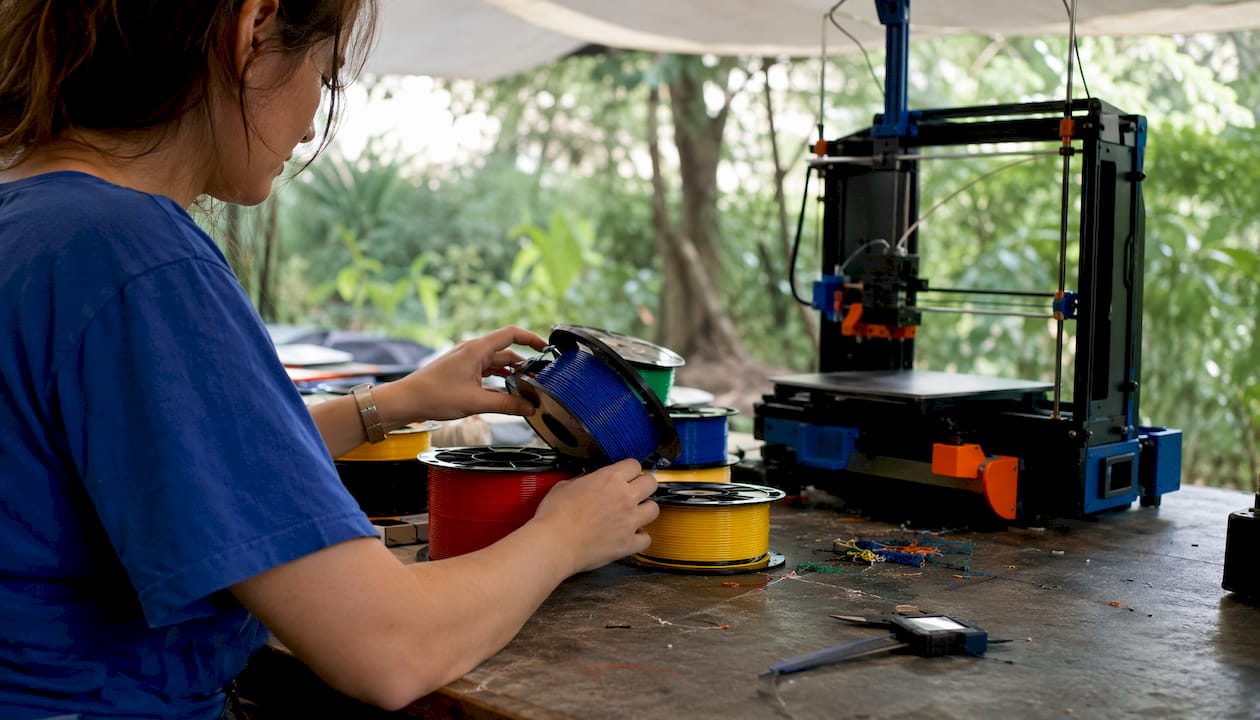
PLA is the go-to for prototyping: dimensionally accurate, low cost, and forgiving on almost any open-frame machine. It prints at 190–220°C nozzle and 20–60°C bed, needs no enclosure, and produces minimal fumes. The catch is brittleness and a heat deflection temperature around 60°C, which rules it out for anything left in a car, near a heat source, or exposed to sustained mechanical stress outdoors.
Common failure modes: layer splitting from too-low temperatures; stringing from retraction settings that are too loose.
Storage: PLA is relatively tolerant of ambient humidity but benefits from a sealed bag with desiccant for long-term storage.
PETG
PETG sits between PLA and ABS in almost every property. It prints at 230–250°C nozzle and 70–85°C bed, bonds well to glass and PEI surfaces, and handles moderate heat and impact better than PLA. Stringing is its main nuisance; tighten retraction and drop print speed slightly to manage it. Food-contact grades exist but always verify the specific manufacturer’s datasheet before using any printed part with food.
Common failure modes: stringing; poor layer adhesion if the bed is too cold.
Storage: PETG is hygroscopic. Vacuum-seal with desiccant between sessions.
ABS
ABS prints at 230–250°C nozzle and 100–110°C bed and genuinely needs an enclosure. ABS emits styrene during printing, so ventilation is non-negotiable. The payoff is a tough, machinable part that sands and acetone-smooths beautifully. Warping is the persistent challenge; a brim, high bed temperature, and a draught-free enclosure address most of it.
Common failure modes: warping and delamination from temperature fluctuations; layer cracking in cold rooms.
ASA
ASA is essentially UV-stabilised ABS. Same print settings, same enclosure requirement, but the finished part resists UV degradation and weathering far better. If you are printing anything that will live outdoors, ASA is the correct choice over ABS.
Nylon (PA6 / PA12)
Nylon is genuinely strong, flexible enough to resist fatigue cracking, and highly abrasion-resistant. Those properties make it excellent for gears, hinges, and functional prototypes. The problem is moisture: nylon absorbs it aggressively from the air, and wet nylon prints with bubbling, poor layer adhesion, and inconsistent diameter. Dry it at 70–80°C for 4–8 hours before printing and store it vacuum-sealed with desiccant.
Print settings: 240–270°C nozzle, 70–90°C bed, slow speeds, enclosure recommended.
Polycarbonate (PC)
Polycarbonate is the toughest common FDM filament, with a heat deflection temperature around 130°C and impact resistance that most other filaments cannot approach. It demands a high-temperature hot end (260–310°C), a heated bed at 100–120°C, and an enclosure. Cheap brass nozzles wear quickly with PC; a hardened steel nozzle is worth the investment.
TPU / TPE (flexible filaments)
TPU and TPE are the flexible filament family. Shore hardness varies by grade (typically 85A–98A for TPU), which determines how soft and stretchy the finished part feels. Print slowly (20–30 mm/s) to avoid the filament buckling in the extruder. Direct-drive extruders handle flexible filaments far more reliably than Bowden setups.
Applications: phone cases, gaskets, shoe insoles, cable strain reliefs, wearable components.
Polypropylene (PP)
PP is chemically resistant, fatigue-tolerant, and semi-flexible, which makes it useful for living hinges and containers. It is also notoriously difficult to adhere to standard print surfaces. PP-specific build plates or a thin layer of PP tape on the bed gives the best results. Expect some warping.
HIPS
HIPS (High Impact Polystyrene) is most useful as a dissolvable support material for ABS. It dissolves in limonene, leaving clean complex geometry without manual support removal. As a standalone material, it is easy to print, sandable, and paintable. Print settings are close to ABS: 230–240°C nozzle, 100°C bed.
Pro Tip: When printing ABS with HIPS supports, keep both spools in a dry box. HIPS absorbs moisture more readily than ABS, and wet HIPS supports can delaminate mid-print.
PVA
PVA dissolves in water, which makes it the cleanest support option for complex PLA or PETG geometries on dual-extrusion machines. It is extremely hygroscopic and will absorb enough moisture from the air within hours to jam a nozzle. Store it in a sealed container with desiccant and load it directly from a dry box during printing.
Composite filaments
Carbon-fibre filled, glass-filled, wood-filled, and metal-filled filaments blend a base polymer (usually PLA or Nylon) with chopped fibres or particles. Carbon-fibre and glass-filled variants increase stiffness significantly but reduce elongation to near zero. They require hardened steel nozzles; standard brass nozzles wear out within a few hundred grams. Wood and metal fills are primarily decorative, producing parts that can be sanded, stained, or polished to resemble the fill material.
High-temperature engineering filaments (PEEK, PEI/ULTEM)
PEEK and PEI sit at the top of the FDM performance ladder: continuous service temperatures above 150°C, chemical resistance, and mechanical properties that approach injection-moulded parts. They require nozzle temperatures above 350°C, bed temperatures of 120–160°C, and a fully enclosed, temperature-controlled chamber. These are not beginner materials and not cheap. For most UK small businesses, outsourcing PEEK parts to a bureau is more practical than investing in the hardware.
Recommended FDM print settings (typical ranges):
| Material | Nozzle temp (°C) | Bed temp (°C) | Enclosure | Nozzle type |
|---|---|---|---|---|
| PLA | 190–220 | 20–60 | Not required | Brass |
| PETG | 230–250 | 70–85 | Optional | Brass |
| ABS | 230–250 | 100–110 | Required | Brass |
| ASA | 230–250 | 100–110 | Required | Brass |
| Nylon | 240–270 | 70–90 | Recommended | Brass/steel |
| Polycarbonate | 260–310 | 100–120 | Required | Hardened steel |
| TPU/TPE (85A–98A) | 220–240 | 30–60 | Not required | Brass |
| HIPS | 230–240 | 100 | Recommended | Brass |
| PVA | 190–220 | 45–60 | Not required | Brass |
| Carbon-fibre fill | 220–260 | 45–100 | Optional | Hardened steel |
| PEEK | 350+ | 120–160 | Required | Hardened steel |
Filament diameters: 1.75 mm is the dominant standard for desktop FDM printers. 2.85 mm (sometimes labelled 3 mm) is used by certain professional machines, including some Ultimaker and older Lulzbot models. Always confirm your printer’s specification before ordering. Filament comes on spools, typically 1 kg, though 250 g and 2.25 kg spools are available for some materials.
Pro Tip: A cheap food dehydrator set to 45–65°C makes an effective filament dryer for PLA, PETG, and Nylon. Run it for 4–8 hours before a long print and you will notice the difference in surface quality immediately.
What resin options work best for SLA and DLP printers?
Resin printing produces surface detail and dimensional accuracy that FDM cannot match at the same scale. The trade-off is handling: uncured resin is a skin and respiratory irritant, and post-processing requires care.

Resin categories
Resin categories span a wide range of mechanical and chemical properties:
- Standard/visual resin: low cost, high detail, brittle. Best for display models, miniatures, and jewellery masters.
- Tough/ABS-like resin: engineered to mimic some ABS properties. Stronger and less brittle than standard resin. The label “ABS-like” is shorthand for a thermoset photopolymer; it is not thermoplastic ABS and does not guarantee equivalent thermal or chemical resistance. Always check the technical datasheet for critical applications.
- Flexible/rubber-like resin: produces parts with Shore A hardness in the 40A–80A range. Useful for gaskets, grips, and anatomical models.
- Castable/burnout resin: burns out cleanly in a kiln for investment casting. Used in jewellery and dental prosthetics.
- Dental resin: biocompatible grades certified for intraoral use. Requires validated workflows and specific post-cure protocols.
- Water-washable resin: eliminates the need for IPA in the washing stage. Convenient for hobbyists but generally lower mechanical performance than standard grades.
- High-temperature/engineering resin: HDT values above 150°C, suitable for tooling inserts and functional prototypes. SLA suits fine detail; DLP and P3 suit precision throughput; PolyJet suits multi-material realism.
- ESD-safe and biocompatible resins: specialist grades for electronics handling and medical applications respectively.
Safety and ventilation
Uncured resin contains photoinitiators and reactive monomers that are harmful with skin contact and inhalation. In the UK, the Control of Substances Hazardous to Health (COSHH) regulations apply to any workplace use.
- Wear nitrile gloves (not latex) and safety glasses when handling uncured resin or IPA wash solutions.
- Print in a ventilated space or use a printer with a built-in activated-carbon filter.
- Dispose of IPA wash waste and cured resin scraps as chemical waste, not general refuse. Your local council’s hazardous waste service or a licensed waste contractor handles this.
- Never pour uncured resin down a drain.
Pro Tip: Cure your IPA wash solution under UV light before disposal. The photoinitiators polymerise, making the waste significantly safer to handle and easier to dispose of responsibly.
Post-processing checklist
- Wash the print in IPA (or water for water-washable resins) for the time specified in the resin datasheet, typically 2–5 minutes.
- Allow the part to dry fully before UV curing. Wet surfaces cure unevenly.
- Post-cure under a UV curing station at the manufacturer’s recommended wavelength and duration. Under-cured parts remain brittle and tacky.
- Remove supports after washing but before final curing, when the resin is slightly more flexible.
- Sand with wet-and-dry paper (400–2000 grit) for a smooth finish; prime before painting for best adhesion.
For guidance on choosing a resin kit that matches your project type, including specialist and multi-material options, Remerlinds has a useful breakdown for hobbyists.
Powder-bed fusion materials: SLS, SAF and metal powders
Powder-bed fusion covers SLS (Selective Laser Sintering) and SAF (High Speed Sintering / SAF by HP). Both fuse fine polymer powder layer by layer without support structures, which is why the parts they produce have isotropic mechanical properties and complex internal geometry that FDM cannot replicate.
Powder-bed fusion is the dominant route for production-grade nylon parts, and the most common powders in UK bureau services are:
- PA12 (Nylon 12): the workhorse SLS material. Excellent chemical resistance, good surface finish after bead-blasting, and consistent mechanical properties across the build volume. Used for functional end-use parts, snap fits, and complex assemblies.
- PA11 (Nylon 11): bio-based (derived from castor oil), slightly more flexible and impact-resistant than PA12. Preferred for parts that need ductility, such as living hinges and prosthetics.
- TPU powder: elastomeric SLS material for flexible, lattice-structure parts. Produces results that FDM TPU cannot match in geometric complexity.
- Glass-filled Nylon (PA12-GF): higher stiffness and heat resistance than unfilled PA12. Used for structural and semi-structural components.
Metal powders
Metal powders (stainless steel 316L, titanium Ti-6Al-4V, Inconel 625/718) are processed on Selective Laser Melting (SLM) or Direct Metal Laser Sintering (DMLS) machines. These are industrial systems costing hundreds of thousands of pounds, requiring inert-gas atmospheres, specialist post-processing (HIP, heat treatment, machining), and rigorous safety controls for reactive powders. For the vast majority of UK makers and small businesses, metal parts are outsourced to a bureau.
When to use a bureau for SLS or metal parts:
- You need isotropic mechanical properties that FDM cannot deliver.
- The geometry includes internal channels, lattice structures, or undercuts that would require extensive supports in FDM.
- You need a certified material grade (e.g. medical-grade PA12, aerospace titanium).
- The volume is too low to justify machine investment but too high for hand-finishing FDM parts.
Questions to ask a bureau: What material grade and powder batch are you using? What post-processing is included (bead-blasting, dyeing, HIP)? Do you provide a material certificate or mechanical test report?
How do you choose the right material for your project?
Start with requirements, not materials. A part’s function, environment, and the regulations it must meet narrow the field quickly.
Decision flow:
- Printer compatibility: what technology do you have access to? FDM, resin, or SLS? This eliminates most of the list immediately.
- Mechanical needs: does the part carry load, flex repeatedly, or need impact resistance? PLA fails here; Nylon, PC, or PETG are better candidates.
- Environmental exposure: UV, moisture, heat above 60°C, or chemical contact? ASA for UV; Nylon or PP for chemical resistance; PC for sustained heat.
- Regulatory requirements: food contact, medical, or electrical safety? Verify the specific material grade against the relevant standard (e.g. FDA, EU 10/2011 for food contact, RoHS for electronics).
- Post-processing and finish: does the part need painting, plating, or a smooth surface out of the printer? Resin wins on out-of-printer finish; ABS and HIPS are easiest to sand and paint among FDM materials.
- Cost and UK availability: PLA, PETG, and ABS are widely stocked by UK suppliers with next-day delivery. Specialty filaments (PEEK, carbon-fibre Nylon) may require longer lead times or import from EU suppliers. Post-Brexit import duties and VAT apply to goods from outside the UK, so factor that into total cost.
Practical checklist before ordering:
- Confirm filament diameter (1.75 mm or 2.85 mm) matches your printer.
- Check whether your hot end can reach the required nozzle temperature.
- Confirm bed surface compatibility (glass, PEI, BuildTak, PP sheet for PP filament).
- Download the manufacturer’s technical datasheet and note the recommended print profile.
- For regulated applications, request a material certificate from the supplier.
Pro Tip: Print a single-wall calibration cube in your chosen material before committing to a long print. It uses minimal filament and immediately reveals temperature, retraction, and adhesion issues.
Storage, drying and safe handling: what actually matters
Poor storage is the most common cause of print failures that makers blame on the printer or slicer. Hygroscopic materials absorb moisture from the air and print with bubbling, stringing, and poor layer adhesion as a result.
Hygroscopic materials that must be dried and sealed:
- Nylon (PA6, PA12): very high moisture absorption; dry at 70–80°C for 4–8 hours before printing
- PETG: moderate; dry at 65°C for 4–6 hours if stored open
- PVA: extreme; absorb enough moisture within hours to jam a nozzle; always print from a sealed dry box
- TPU: moderate; dry at 45–55°C for 4 hours if stringing increases
- Polycarbonate: moderate; dry at 80–100°C for 4–6 hours
Vacuum-seal hygroscopic filaments with desiccant packs when not in use. Silica gel is effective; colour-indicating silica gel shows when it needs regenerating in an oven. A sealed container with a hygrometer inside is a low-cost way to monitor storage conditions.
Bed adhesion and warping:
- PLA: glass or PEI with a light clean; no adhesive usually needed
- PETG: PEI sheet works well; avoid glue stick as PETG bonds too strongly to bare glass
- ABS/ASA: ABS slurry (ABS dissolved in acetone) or hairspray on a heated glass bed; enclosure is more important than the adhesive
- Nylon: PEI or garolite (G10) sheet; glue stick on glass as a release agent
- PP: PP-specific sheet or PP tape on the bed surface
Fume safety:
ABS and ASA produce styrene and other volatile organic compounds during printing. A study of desktop FDM emissions found that ABS generates significantly higher particle and VOC concentrations than PLA. Print ABS and ASA in a ventilated room or with an enclosure fitted with an activated-carbon exhaust filter. Resin printing also requires ventilation; see the resin safety section above.
For a step-by-step approach to removing supports cleanly from both FDM and resin prints, Remerlinds covers the technique in detail.
Pro Tip: Keep a small hygrometer inside your filament storage box. Aim for below 15% relative humidity for Nylon and PVA, and below 25% for PETG and TPU. If the reading climbs, regenerate your desiccant before the next print session.
Quick glossary of terms and abbreviations
Understanding a material datasheet requires knowing what the numbers actually measure. Here are the terms that appear most often:
- HDT (Heat Deflection Temperature): the temperature at which a material deforms under a specified load. A PLA part with an HDT of 60°C will soften in a hot car; PC at 130°C will not.
- Tg (Glass Transition Temperature): the temperature at which an amorphous polymer transitions from rigid to rubbery. Related to HDT but measured differently; both appear on datasheets.
- Tensile strength: the maximum stress a material withstands before breaking under tension, measured in MPa. Higher is stronger.
- Elongation at break: how much a material stretches before it fractures, expressed as a percentage. PLA: ~3–6%; TPU: 300–600%.
- Shore hardness: measures the resistance of flexible materials to indentation. Shore A is used for soft/flexible materials (TPU, flexible resin); Shore D for harder plastics.
- Hygroscopic: absorbs moisture from the atmosphere. Nylon, PETG, and PVA are hygroscopic; PLA and ABS are less so. See the storage section for drying guidance.
- Infill: the internal structure of an FDM print, expressed as a percentage. 15–20% is typical for non-structural parts; 50–100% for load-bearing applications.
- Retraction: the backward movement of filament in the extruder to prevent stringing between features. Too little causes stringing; too much causes clogs.
- Nozzle size: standard is 0.4 mm. Larger nozzles (0.6–1.0 mm) print faster with less detail; smaller (0.2–0.25 mm) print finer detail more slowly.
- 1.75 mm vs 2.85/3 mm: the two standard filament diameters. 1.75 mm is the most common for desktop printers. Check your machine’s specification before ordering. See the filament guide for a full breakdown of diameters and spool formats.
- Spool weight: typically 1 kg net filament weight. Tare weight (the empty spool) varies; factor this in when estimating remaining material.
- Resin bottle volume: typically 500 ml or 1 litre. Shelf life after opening is usually 6–12 months if stored sealed and away from UV light.
- Support: temporary structure printed alongside the model to support overhangs. Removed after printing; soluble supports (PVA, HIPS) dissolve rather than requiring manual removal.
Key takeaways
The single most important rule in any 3D printing materials list is this: match the material to the printer technology first, then to the mechanical and environmental demands of the part.
| Point | Details |
|---|---|
| Technology determines your materials list | FDM uses filaments, resin printers use photopolymers, and SLS uses polymer powders. Confirm your technology before selecting any material. |
| PLA for prototyping, PETG or ASA for function | PLA is the easiest starting point; move to PETG for indoor functional parts and ASA for anything outdoors or UV-exposed. |
| Dry hygroscopic materials before every print | Nylon, PETG, PVA, and TPU absorb moisture and print poorly if stored open. Vacuum-seal with desiccant and dry before use. |
| Outsource SLS and metal parts | Powder-bed fusion and metal printing require specialist machines. UK bureau services deliver isotropic PA12 and metal parts without capital investment. |
| Subliblanks stocks FDM filaments for UK trade buyers | Subliblanks supplies 3D printing filaments with no minimum order quantity, available to UK print shops, makers, and small businesses. |
A practical perspective on choosing materials
The conversation around 3D printing materials tends to focus on the exotic end: PEEK, carbon-fibre composites, metal powders. Those materials are genuinely impressive, but they are also genuinely irrelevant for most projects that land on a maker’s bench or a small print shop’s order list.
The more useful observation is that the gap between “easy” and “durable” is where most projects go wrong. PLA is easy, and it is right for a surprising number of applications. But the moment a part needs to survive a summer in a car, a garden, or a mechanical load cycle, PLA fails in a way that feels sudden and complete. The fix is not always to jump to Nylon or PC. PETG handles a large proportion of those cases with far less fuss, and ASA handles the outdoor ones. The upgrade path is incremental, not a leap.
The other thing that gets underplayed is storage. Professionals treat filament drying as routine maintenance, not an optional step. A spool of Nylon left open for a week in a UK workshop in November will print noticeably worse than one stored in a sealed box with fresh desiccant. The printer has not changed; the material has. Getting that right costs almost nothing and eliminates a large category of print failures that beginners spend hours blaming on their slicer settings.
For anyone building out a materials workflow, the 3D printing workflow guide on the Subliblanks blog covers the end-to-end process from design to finished part, which is a useful companion to the material-selection decisions covered here.
Stock up on 3D printing filaments with no minimum order
Subliblanks supplies 3D printing filaments directly to UK trade customers, print shops, and makers, with no minimum order quantity and stock held in the UK for fast dispatch.
Whether you are running through PLA on a busy prototype schedule or sourcing PETG and TPU for functional production runs, Subliblanks carries the materials you need without the bulk-buy commitment that most wholesalers impose. Alongside filaments, the range covers sublimation, DTF, laser engraving, and packaging supplies, so trade customers can consolidate orders rather than managing multiple suppliers. The Subliblanks blog also carries setup guides and material resources to support your printing decisions.
Browse the full range and place a trade order at Subliblanks.
Useful sources and further reading
These sources are worth bookmarking for datasheets, technology comparisons, and safety guidance:
- 3D printing filament — Wikipedia: a solid reference for filament chemistry, diameter standards, and material properties with citations to primary sources.
- Complete guide to 3D printing materials — HP: covers material families by technology (FDM, SLS, MJF) with HP’s own engineering context; useful for understanding powder-bed materials.
- Ultimate 3D printing materials guide — Simplify3D: practical print settings, troubleshooting, and material comparisons for FDM; one of the most referenced community guides.
- What materials are used in 3D printing? — Autodesk: broad overview of material families with emphasis on functional and engineering applications; good for Nylon and hygroscopic material guidance.
- Advancements and limitations in 3D printing materials — MDPI Polymers: peer-reviewed academic paper covering engineering filaments (PC, PEEK) and metal powder processes; use for technical datasheet cross-referencing.
- Different types of resins for 3D printing — 3Dnatives: covers all major resin categories including dental, castable, and water-washable grades with application examples.
- Resin 3D printing explained — Stratasys: technology-level comparison of SLA, DLP, P3, and PolyJet with guidance on matching technology to application.
- 3D printing materials guide — 3D-Printed.org: accessible guide to common FDM materials with safety notes on ABS fumes and ventilation recommendations.
For regulated applications (food contact, medical, electrical safety), always consult the manufacturer’s technical datasheet and, where required, seek independent material certification. This article provides general guidance and does not constitute professional engineering or regulatory advice; confirm material suitability with your supplier or a qualified engineer for your specific application.


