



Advantages of stamp making for crafters and small businesses
TL;DR:
- Stamp making creates reusable tools that transfer ink impressions onto various surfaces and is a cost-effective branding solution. It provides consistent, rapid impressions for office tasks, crafts, and branding, offering creative flexibility and operational efficiency for small businesses.
Stamp making is defined as the process of creating reusable tools that transfer ink impressions onto surfaces, from paper and fabric to cardboard and packaging. The advantages of stamp making are broad: crafters gain a hands-on creative medium, and small businesses gain a cost-effective branding tool that scales without bulk print orders. Self-inking stamps produce around 10,000 impressions before needing a refill, and pre-inked versions extend that to 50,000. Those numbers make stamps one of the most economical repeat-use tools in any crafter’s or business owner’s kit.
1. What are the cost advantages of stamp making?
Stamps deliver a low initial investment with long-term savings that few other tools can match. A single custom stamp replaces repeated spending on printed labels, stickers, or outsourced packaging design. The savings compound quickly for anyone producing goods in volume.
- No minimum order quantities: Unlike printed packaging, stamps let you brand one box or one thousand without waste.
- Reduced label spend: A stamp applied directly to kraft paper or tissue eliminates the need for adhesive labels entirely.
- Eco-friendly output: Fewer printed materials means less plastic and paper waste in your supply chain.
Self-inking stamps last approximately 10,000 impressions before a refill is needed. That lifespan makes the cost per impression negligible compared to outsourced print runs. A custom logo stamp lets you imprint your brand on various packaging materials without ordering expensive pre-printed packaging in bulk, reducing both cost and waste.
Pro Tip: Choose a pre-inked stamp for fine detail work. Its longer ink life and sharper output mean fewer reprints and less wasted material over time.
2. How stamps improve efficiency and consistency
Stamps deliver consistent impressions rapidly, removing the repetitive effort of handwriting or manual label printing. In office environments, this matters for invoices, approval marks, return addresses, and date stamps. Every impression looks identical, which removes the risk of illegible handwriting or formatting errors.
“Custom stamps streamline workflows by enabling instant application on multiple surfaces, reducing processing time and compounding into significant time savings for busy office and retail environments.”
Physical stamping remains essential in legal and administrative fields because certain authorisations require a tangible mark as proof. Digital workflows cannot replicate that requirement. For crafters, consistency means every card, tag, or package in a batch looks professionally finished rather than hand-varied.
Self-inking and pre-inked stamps are the best choices for high-volume tasks. Both reload automatically between impressions, so there is no separate ink pad to manage during a long run. The result is faster throughput with no drop in quality from the first impression to the last.
3. What creative benefits does stamp making offer crafters?
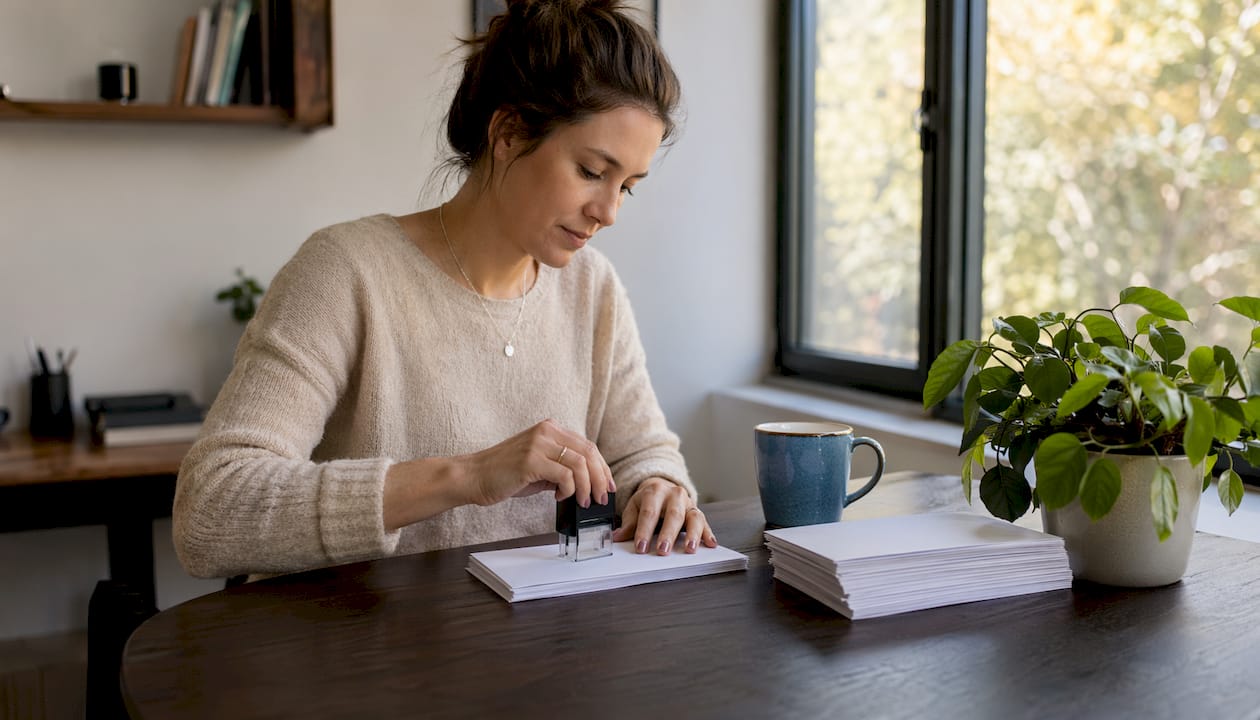
Stamp making gives crafters a medium that digital tools simply cannot replicate. The tactile quality of a stamped impression, with its slight texture and ink variation, carries a handmade character that printed graphics do not. That quality is why stamped designs remain popular in scrapbooking, journalling, and handmade card communities.
The versatility of stamp making allows multi-layer colour applications, special effect inks, and varied techniques to achieve bespoke artistic outcomes. A crafter can layer a background texture stamp, add a focal image stamp, and finish with a sentiment stamp, all in different ink colours, to build a composition that feels entirely original.
- Scrapbooking: Stamps add borders, titles, and decorative motifs without cutting or sticking.
- Journalling: Date stamps, habit trackers, and decorative headers keep layouts consistent.
- Handmade cards: Custom stamps personalise greetings in a way printed cards never achieve.
- Gift wrapping: A simple pattern stamp on plain paper creates bespoke wrapping at minimal cost.
Pro Tip: Test the stamp multiple times during carving to identify necessary adjustments early. A clean test impression confirms the design is ready before you commit to a final project.
The handcrafted quality of stamped impressions continues to appeal strongly to crafters and consumers who value originality and authenticity. That sustained demand is not nostalgia. It reflects a genuine preference for objects that carry a human mark.
4. What stamp types suit different needs?
Selecting the right stamp type is the single most important decision for both crafters and business owners. Each type has a distinct set of strengths, and choosing the wrong one costs time and money.
| Stamp type | Best for | Ink longevity | Detail level | Cost range |
|---|---|---|---|---|
| Wood handle | Artistic projects, specialty inks | Depends on pad | High | Low |
| Self-inking | Office tasks, high-volume labelling | ~10,000 impressions | Medium | Medium |
| Pre-inked | Logos, fine detail, professional use | ~50,000 impressions | Very high | Medium to high |
Different stamp types suit different uses: wood handle stamps provide artistic control and accept specialty inks; self-inking stamps offer speed and volume efficiency; pre-inked stamps provide the finest detail and the longest lifespan. Selecting the correct type improves cost, quality, and ease of use across the board.
For stamp making for beginners, a wood handle stamp carved from an eraser or rubber block is the lowest-barrier entry point. It requires no mechanical parts and accepts any ink pad colour. As skill and volume grow, upgrading to a self-inking or pre-inked body makes practical sense.
You can read more about stamp making techniques and applications to understand which method fits your specific project type before investing in equipment.
5. How stamp making supports small business branding
Custom stamps are one of the most cost-effective branding tools available to small businesses. They replace printed materials for return addresses, thank-you notes, product tags, and packaging without requiring a minimum order or a graphic design budget. A single stamp can cover every touchpoint a customer sees from the moment they receive a parcel.
Custom rubber stamps help small businesses achieve a professional appearance with minimal ongoing costs, nurturing brand recognition over time. That recognition builds trust, and trust drives repeat purchases. The stamp becomes a consistent visual signature that customers associate with quality.
- Unboxing experience: A logo stamp on tissue paper or a box flap adds a premium feel at almost no cost.
- Return address stamps: Faster than handwriting and more professional than a printed label.
- Thank-you notes: A stamped card feels personal in a way a printed insert does not.
- Product tags: Kraft tags stamped with a logo and product name look considered and on-brand.
Stamps also give small businesses flexibility that pre-printed packaging cannot. If your address changes or your logo evolves, you replace one stamp rather than disposing of an entire stock of printed materials. That agility is a genuine operational advantage for growing businesses.
Thinking about branding on physical products more broadly? The same principles that make stamp branding effective on packaging apply across apparel, accessories, and other tangible goods. Consistency of mark and placement is what builds recognition.
For a deeper look at how stamps fit into a wider business context, the Subliblanks guide on stamp making in business covers the practical and professional case in detail.
6. Stamp making for beginners: where to start
Starting with stamp making requires very little equipment. A rubber carving block, a set of linocut tools, a pencil, and an ink pad are enough to produce a working stamp on the first attempt. The barrier to entry is genuinely low, which is one of the clearest pros of DIY stamps as a craft.
The learning curve is short. Most beginners produce a usable stamp within an hour of their first attempt. The skill ceiling, however, is high. Experienced stamp makers produce intricate multi-element designs with fine lines and negative space that rival professionally manufactured stamps.
The crafter’s guide to creating custom stamps from Subliblanks walks through the process step by step, from transferring a design to carving and testing. It is a practical starting point for anyone new to the craft. Once the basics are in place, experimenting with different rubber densities, carving tools, and ink types opens up a wide range of creative uses for stamps.
Key takeaways
Stamp making is one of the most cost-effective and versatile tools available to crafters and small businesses, combining low running costs, creative freedom, and professional consistency in a single reusable instrument.
| Point | Details |
|---|---|
| Cost efficiency | Self-inking stamps last ~10,000 impressions, making the cost per use negligible. |
| Consistency and speed | Stamps remove handwriting errors and speed up repetitive tasks in office and craft workflows. |
| Creative versatility | Multi-layer techniques and specialty inks allow bespoke artistic outcomes no digital tool replicates. |
| Stamp type selection | Matching stamp type to task (wood, self-inking, or pre-inked) directly improves quality and cost. |
| Small business branding | Custom logo stamps replace bulk-printed packaging and build brand recognition at minimal ongoing cost. |
Why stamps still matter more than people realise
People often underestimate stamps because they look simple. That simplicity is the point. A well-made stamp does one thing perfectly, every single time, without a screen, a subscription, or a power source.
What I find most interesting is how stamps hold their ground in a world that has moved almost entirely to digital. Legal documents still require physical marks. Handmade goods still command a premium precisely because they carry evidence of human involvement. A stamped impression is that evidence. It is not a workaround for not having a printer. It is a deliberate choice that signals care.
For small business owners, the branding argument is stronger than most realise. Consistent stamping across every piece of packaging creates a visual rhythm that customers notice without knowing they notice it. That is how brand recognition actually works. It is not about a logo being beautiful. It is about it appearing reliably, in the same place, in the same ink, on every order.
My honest recommendation is to start with a wood handle stamp and a single ink pad. Carve something simple. Use it on twenty envelopes or twenty boxes. You will immediately see how a repeated mark changes the feel of the whole batch. After that, the case for investing in a self-inking or pre-inked stamp for volume work makes itself.
— chris
Subliblanks: your starting point for stamp making supplies
Subliblanks supplies stamp-making machines and a full range of crafting equipment with no minimum order quantities, making it straightforward to start small and scale as your projects grow.
Whether you are setting up a home craft studio or adding a professional stamp to your small business packaging workflow, Subliblanks stocks the equipment and supplies to get you there. From stamp-making machines to sublimation blanks and packaging supplies, everything is available through the Subliblanks product range without the pressure of bulk buying. Browse the full catalogue and find the tools that fit your next project.
FAQ
What are the main advantages of stamp making?
Stamp making offers cost savings, creative freedom, and consistent output. Self-inking stamps produce around 10,000 impressions per refill, making them highly economical for repeat use.
Is stamp making suitable for beginners?
Stamp making for beginners is accessible with minimal equipment. A rubber carving block, basic linocut tools, and an ink pad are enough to produce a working stamp on the first attempt.
What stamp type is best for small business branding?
Pre-inked stamps are best for logos and fine detail, lasting up to 50,000 impressions. Self-inking stamps suit high-volume address or approval tasks where speed matters more than fine line detail.
Can stamps replace printed packaging for small businesses?
A custom logo stamp applied directly to plain packaging replaces the need for pre-printed boxes or adhesive labels, reducing both cost and minimum order constraints.
Why do physical stamps remain relevant despite digital tools?
Physical stamps remain essential in legal and administrative contexts where a tangible mark serves as proof of authorisation. In craft and retail, the tactile quality of a stamped impression carries authenticity that digital printing does not replicate.


