



Role of packaging supplies in retail: a trade buyer's guide
TL;DR:
- Packaging supplies influence consumer purchase decisions by shaping first impressions and conveying brand value.
- Proper specification and testing of packaging functions are essential to maximize retail and online sales.
Packaging supplies are the primary retail salespeople. They drive first impressions, protect goods in transit, and encode brand value at the moment a customer decides whether to buy. 72% of consumers say packaging design influences their purchase decisions, and 82% factor environmental impact into what they buy. For wholesale print and customisation businesses supplying personalised products, getting packaging right is not a finishing touch. It is a conversion lever. Subliblanks supplies trade packaging alongside its full range of personalised product supplies, with no minimum order quantities, so you can proof and scale without committing to a full pallet before you know the design works.
Table of Contents
- Why packaging supplies shape retail outcomes
- What core functions must your packaging deliver?
- What wholesale buyers must specify when sourcing packaging
- Sustainability expectations and legal considerations for UK retailers
- How to measure ROI from packaging investment
- How to integrate packaging into print and fulfilment workflows
- Key takeaways
- Why late packaging decisions cost more than the packaging itself
- Subliblanks packaging supplies for personalised retail products
- Sources and further reading
Why packaging supplies shape retail outcomes
A shopper forms a first impression in as little as 7 seconds. That window is not enough to read copy or assess quality. It is enough to register colour, structure, and finish. Packaging that disrupts the visual pattern on a shelf earns attention; packaging that blends in loses the sale before a hand reaches out.
Three commercial effects follow from that reality:
- Attention: Distinct colour blocks, high-contrast typography, and tactile finishes separate a product from adjacent cartons under fluorescent aisle lighting.
- Perceived quality: Weight, board thickness, and print finish signal product value before the item is touched. Premium packaging can raise willingness to pay by 25–40%.
- Social amplification: Approximately 52% of online shoppers share unboxing experiences on social media, turning the package itself into earned marketing.
Retailers increasingly treat packaging as a strategic asset that must be specified alongside pricing and distribution, not handed to marketing as an afterthought. There is also a legal dimension: packaging carries the consumer information, allergen declarations, and compliance marks that UK consumer protection expectations require. Getting that wrong costs more than a redesign.
What core functions must your packaging deliver?
Every packaging brief for a personalised retail product needs to satisfy four functions simultaneously.
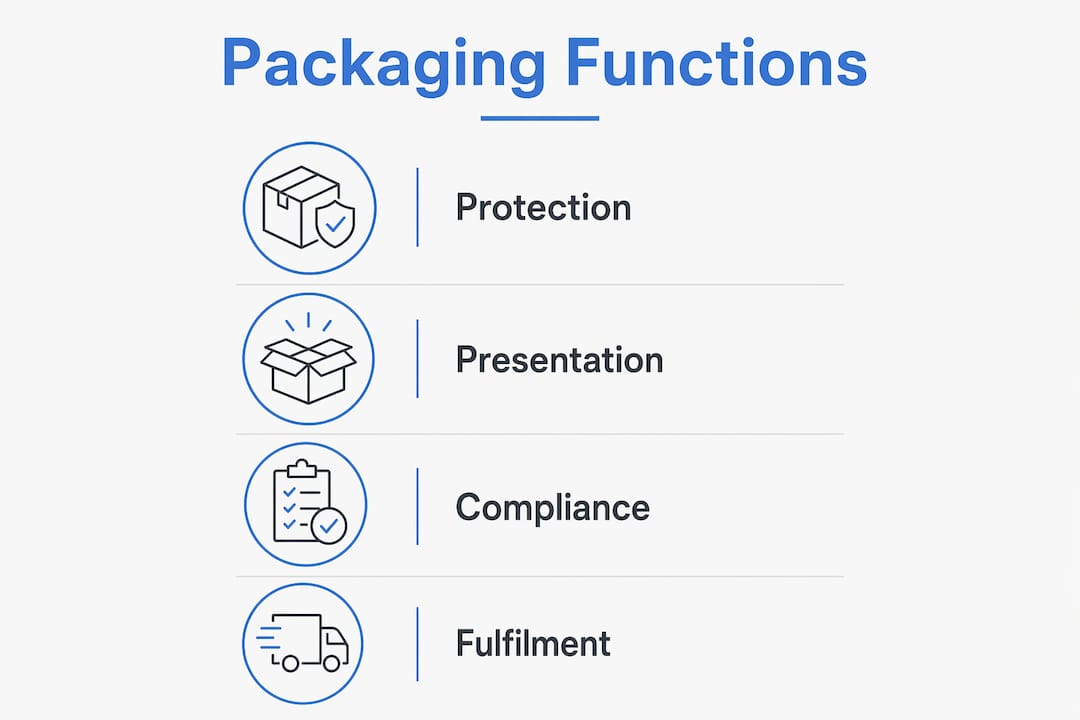
Protection is the baseline. Board caliper, internal padding, and right-sized construction determine whether a product arrives intact. For personalised items, damage means a replacement that cannot be reprinted in five minutes.
Presentation and brand is where packaging creates the physical stage for the product. The outer surface is the first real touchpoint between your brand and the buyer. Tissue paper, ribbon, and printed inserts extend that impression inside the box.

Compliance and information covers ingredient declarations, care instructions, country of origin, and any statutory marks. For personalised products sold through retail channels, the outer packaging must carry this information even when the product itself cannot.
Fulfilment and experience means the pack must survive a carrier network and still look good on arrival. Right-sizing reduces postage costs and prevents the product rattling inside an oversized box. A well-designed unboxing sequence, with a printed insert or a tissue wrap, adds the tactile cue that drives repeat purchases.
When evaluating a supplier, confirm each function is covered: ask for a filled prototype, check the board caliper against your heaviest SKU, and open the box the way a customer would.
What wholesale buyers must specify when sourcing packaging
A vague brief produces a vague quote. Before you approach a supplier, lock down these fields:
| Specification field | What to confirm |
|---|---|
| Material type and GSM/thickness | Board caliper matched to product weight and stacking requirements |
| Print method and colour profile | CMYK or Pantone; whether the supplier can match your brand colours |
| Finishing options | Matte or gloss laminate, spot UV, foil, emboss |
| Inner protection | Tissue, foam inserts, void fill, dividers |
| Right-sizing tolerances | Internal dimensions within ±2 mm of product dimensions |
| MOQ and cost-per-unit breaks | At what volume does the per-unit cost drop meaningfully? |
| Lead times | Standard and express; lead time for bespoke printed runs |
| Sample and proof terms | Can you receive a physical proof before committing to a run? |
| Return and defect policy | What happens if a batch arrives with colour shift or structural failure? |
Red flags to watch for: vague lead-time estimates (“around 2–4 weeks” with no commitment), no physical proof policy, recycling claims with no certification number, and MOQs that make small personalised runs uneconomical. A supplier who cannot answer the sustainability question with a document number is telling you something.
Questions to ask directly:
- Can you supply a physical sample proof before the production run?
- What is your colour tolerancing process and how do you handle out-of-tolerance batches?
- How do you certify recycled content, and can you provide chain-of-custody documentation?
- What are your typical fulfilment turnaround times for bespoke printed orders?
For a practical selection framework, the packaging supplies buyer’s guide at Subliblanks covers material trade-offs and print method compatibility in detail.
Sustainability expectations and legal considerations for UK retailers
Environmental impact has become a key factor in consumers’ purchase decisions. That is not a trend. It is a baseline expectation, and UK retailers are passing that expectation upstream to their suppliers.
Credible sustainability signals to request from any packaging supplier:
- FSC certification with a valid chain-of-custody number
- Post-consumer recycled content declarations with percentage stated
- Third-party compostability verification (not a self-declared claim)
- Supplier declarations confirming no virgin plastic in primary packaging
Do not use “eco”, “biodegradable”, or “sustainable” on pack without documentation to back the claim. The UK Competition and Markets Authority’s Green Claims Code requires that environmental claims be accurate, clear, and substantiated. Vague greenwashing exposes your retail customers to enforcement risk.
Do request supplier PDFs and retain them in your procurement files. If a claim appears on the outer packaging or in an online listing, you need the certification documentation to substantiate it.
Pro Tip: The best balance for personalised products is right-sized recycled board with a targeted finish. A matte laminate on recycled kraft board reads as premium and sustainable simultaneously, without the cost of a full foil run. Reserve spot UV or foil for the logo only.
How to measure ROI from packaging investment
Premium packaging typically adds approximately £0.50–£2.00 per unit, yet case examples report very high ROI when it improves conversion and repeat purchase rates. The maths only works if you measure it.
A practical test plan:
- Run an A/B shelf or thumbnail test. Produce two variants: your current packaging and the new design. Place both in the same retail environment or as ecommerce product images. Track sell-through over 30 days.
- Test at thumbnail scale. Shrink your design to a one-inch mobile image. If the brand name and core benefit are not legible, the design loses ecommerce sales before a click happens.
- Track unboxing shares. Monitor social mentions for the product name plus the packaging variant. A measurable uplift in shares indicates the design is earning organic reach.
- Measure the key metrics. Sell-through rate, average order value, repeat purchase rate, units returned or damaged, and social shares. Run the test for 30–60 days before drawing conclusions.
- Calculate per-unit ROI. Take the incremental margin uplift (higher sell-through or AOV) and divide by the additional packaging cost per unit. Present this as a simple investment case to your brand customers.
The business case for packaging investment is easier to make when you have a 30-day sell-through comparison in hand.
How to integrate packaging into print and fulfilment workflows
Packaging decisions made late cause the most expensive problems: reprints, delays, and carrier surcharges for oversized parcels.
- Follow the proof-to-scale sequence. Proof, then short run, then full production. Never skip the physical sample stage for a new packaging format.
- Get dieline and artwork templates early. Confirm the supplier’s dieline before artwork is finalised. A 2 mm discrepancy in a dieline wastes a full design round.
- Map plate and setup lead times. Bespoke printed runs carry setup costs and lead times that stock packaging does not. Build these into your production schedule, not your contingency.
- Right-size for Royal Mail and courier constraints. UK carrier pricing is dimensional. A box 1 cm too tall can push a parcel into the next price band. Check dimensions against Royal Mail’s large letter and small parcel thresholds before finalising the structural spec.
- Use modular SKU strategies for personalised variants. Pre-printed outer shells with variable inserts or labels let you hold one box SKU and swap the insert per customer. This cuts lead times and reduces dead stock when a personalised variant is discontinued.
- Store packaging flat and close to the packing station. Kitting time adds up. A well-organised packing area with packaging stored by SKU reduces fulfilment time per order.
For more on managing bulk packaging economics, the bulk packaging and supply chain guide at Subliblanks covers reorder triggers and storage trade-offs.
Key takeaways
Packaging supplies are a direct conversion lever: specify them early, test them rigorously, and treat sustainability documentation as non-negotiable.
| Point | Details |
|---|---|
| Packaging drives purchase decisions | 72% of consumers say design influences buying; first impressions form in as little as 7 seconds. |
| Sustainability is a baseline requirement | 82% of consumers factor environmental impact into purchases; request FSC and recycled-content documentation from every supplier. |
| Specify before you brief | Lock down material, GSM, print method, MOQ, lead times, and proof terms before issuing any supplier RFQ. |
| Test at thumbnail scale | Shrink your design to one inch on a mobile screen; if the brand and benefit are not legible, fix the design before production. |
| Subliblanks for trade packaging | Subliblanks supplies trade packaging with no minimum order quantities, suitable for personalised product runs of any size. |
Why late packaging decisions cost more than the packaging itself
The most consistent mistake I see from trade buyers is treating packaging as the last item on the production checklist. By the time a brief lands with a packaging supplier, the product dimensions are fixed, the launch date is immovable, and there is no time for a proper proof cycle. The result is an oversized box, a rushed print job, and a product that looks cheaper than it is.
The second mistake is conflating “sustainable” with “brown kraft.” Recycled board with a targeted finish can look genuinely premium. The buyers who get this right are the ones who request samples early, test the design at thumbnail scale, and build the packaging cost into the unit economics from day one rather than absorbing it as a margin hit at the end.
Subliblanks operates with no minimum order quantities precisely because small-run proofing is where the real decisions get made. Order a sample, test it, then scale.
Subliblanks packaging supplies for personalised retail products
Trade print businesses need packaging that works at every scale: a short proof run of 10 units and a wholesale reorder of 500. Subliblanks supplies both, with no minimum order quantities and a range that covers boxes, mailers, labels, tissue, and protective padding suited to sublimation-printed and laser-engraved personalised products.
Every order can be accompanied by a request for sustainability documentation. Ask for FSC certification numbers and recycled-content declarations when you place your order, and retain them for your own compliance files. If you need a specification checklist or want to discuss a bespoke packaging brief, the Subliblanks trade team is the right starting point.
Browse the full packaging range and place a sample order at Subliblanks, or explore custom packaging options to see what is available for personalised product lines.
Sources and further reading
- Why retail packaging is as important as the product itself — Cubit Packaging. Backs the 72% purchase influence, 82% sustainability, 7-second impression, a substantial percentage willingness-to-pay uplift, 52% unboxing share, and a moderate amount premium cost figures used throughout this guide.
- Retail perspectives on packaging: A strategic asset — Packaging Gateway. Supports the argument that packaging should be treated as a strategic retail asset integrated into pricing and distribution planning.
- Packaging is your most underrated revenue driver — Modern Marketing Today. Backs the structural split between marketing and sales as a cause of under-optimised packaging.
- How great packaging wins attention — ASD Online. Source for the three-environment test (shelf, thumbnail, in-hand) and the mobile thumbnail testing recommendation.
- Creating value through packaging and labelling — OpenStax Principles of Marketing. Covers core packaging functions (protection, presentation, compliance) and the importance of chain-of-custody certification documentation.
- Retail Packaging Guide: Types, Structure, and Shelf Presence — DN Packaging. Practical reference for structural types, board caliper selection, and shelf-readability principles.


