



Personalised packaging: a UK business guide
Personalised packaging is packaging that carries unique, individual, or variable content specific to a customer, occasion, or market segment, rather than a single static design printed identically across every unit. At its simplest, that means a customer’s name on a box. At its most sophisticated, it means a different design on every single unit rolling off the press, driven by a live data feed. The immediate business payoff is threefold: stronger brand recognition, a more memorable unboxing experience, and measurably higher customer loyalty.
The concrete elements that qualify as personalisation include:
- Names or personal messages printed directly on the pack
- Variable-data imagery, where each unit carries a different photograph, illustration, or graphic
- Regional or seasonal editions tailored to a geography, event, or time of year
- Interactive technology, including QR codes, NFC chips, and augmented reality (AR) triggers
- Finish, texture, or scent choices selected per order or per customer segment
Key takeaways
Personalised packaging is a commercially proven tool for improving brand recognition, customer loyalty, and unboxing shareability, and digital printing has made it accessible to UK businesses at short-run volumes.
| Point | Details |
|---|---|
| Definition | Personalised packaging carries unique or variable content per unit, customer, or segment, rather than a single static design. |
| Core technologies | Digital printing and variable-data printing (VDP) are the primary enablers; AI analytics and QR/NFC/AR extend the capability. |
| Cost structure | Unit costs depend on print technology, finishing, run size, and material; right-sizing packs also reduces UK shipping costs. |
| Start small | Test with a short run of 50–200 units against a matched control group before committing to volume. |
| Subliblanks | Subliblanks supplies printers, packaging supplies, and print blanks with no minimum order quantities, suited to UK businesses testing personalised formats. |
Table of Contents
- What types of personalised packaging exist, and what do real brands do?
- How is personalised packaging actually produced?
- Which technologies make personalised packaging possible at scale?
- What are the real commercial benefits of personalised packaging?
- What does personalised packaging cost, and when does it make financial sense?
- What materials work best, and how do you handle sustainability?
- Which industries and business sizes benefit most from personalised packaging?
- How do UK businesses get started with personalised packaging?
- How do you measure whether personalised packaging is working?
- Personalised packaging as a strategic lever, not a tactical add-on
- Subliblanks supplies what you need to start testing personalised packaging
- Sources
What types of personalised packaging exist, and what do real brands do?
Personalisation is not one thing. It sits on a spectrum from a single swapped element to a fully unique unit, and the right type depends on your production volume, budget, and marketing goal.
The main forms it takes
- Single-element personalisation replaces one fixed field, typically a name or short message, while the rest of the design stays constant. Low complexity, fast to set up, and the easiest entry point for most brands.
- Variable-data printing (VDP) generates a different design, image, or text block on every unit from a single print run. A run of 10,000 boxes can carry 10,000 distinct graphics with no manual intervention.
- Regional and seasonal editions swap colour palettes, language, or imagery for a specific market or calendar moment. Supermarkets use this constantly for Christmas and Easter lines.
- Interactive packaging embeds QR codes, NFC tags, or AR markers so the physical pack triggers a digital experience: a product tutorial, a loyalty reward, or exclusive content. Smart packaging elements like these extend the brand interaction well beyond the moment of unboxing.
- Finish and texture personalisation lets customers choose between matte, gloss, soft-touch laminate, or embossed finishes, making the physical feel of the pack part of the product experience.
Brand examples worth studying
The campaigns that have shaped how marketers think about personalised packaging all share one trait: they made the customer the subject of the packaging, not just the recipient.
Coca-Cola’s Share a Coke replaced the brand logo with 150 of the UK’s most popular first names. The campaign drove a measurable sales uplift and generated enormous earned media as consumers photographed and shared their named bottles. The lesson: name-based personalisation at mass scale works when the mechanic is simple and the emotional trigger is personal identity.
Oreo’s Colourfilled campaign invited consumers to submit artwork that was then printed on limited-edition tins. Mondelez turned customers into co-creators, which deepened emotional investment far beyond what a standard promotional pack achieves.
Nutella Unica by Ferrero took VDP to its logical extreme: seven million jars, each carrying a unique label design generated algorithmically. No two jars were identical. The campaign sold out in a month in Italy and demonstrated that scarcity through uniqueness is a genuine commercial lever.
Frito-Lay’s Snackable Notes let US consumers send personalised crisp packets as gifts, complete with a custom message. Kellogg’s ran a comparable initiative with a Braille Love Note campaign, printing Braille messages on cereal boxes to reach visually impaired consumers. Both show that personalisation can serve inclusion and emotional resonance simultaneously.
Pro Tip: The lesson from Nutella Unica is not “print seven million unique labels.” It is that algorithmic design generation, paired with digital printing, removes the traditional cost barrier between mass production and genuine uniqueness. Even a run of 500 units can carry 500 distinct designs today.
How is personalised packaging actually produced?
The production workflow has five distinct stages, and understanding where each one sits tells you where costs accumulate and where errors are most expensive to fix.
- Data collection and segmentation. Before a single design is created, the personalisation data must be clean, structured, and mapped to the correct field in the artwork template. Customer names, regional codes, order IDs, or preference flags all need to arrive in a format the print software can read. Errors here propagate across every unit.
- Artwork and variable-data template creation. A designer builds a master template with locked elements (brand colours, logo, legal copy) and variable zones (name field, image placeholder, QR code position). The template is then linked to the data source so each record populates the correct zone automatically.
- Digital printing or print-on-demand. The merged file goes to a digital press, which prints each unit sequentially without plates or set-up changes between designs. For very short runs or single units, print-on-demand platforms handle fulfilment directly. Digital printing and AI analytics have reduced the cost and complexity of this stage to the point where variable runs are economically viable at scales that would have been impractical a decade ago.
- Finishing and embellishment. Foiling, embossing, die-cutting, and lamination are applied after printing. These steps add cost and lead time, and some finishes (UV spot varnish, metallic foil) can complicate downstream recycling.
- Quality control and fulfilment. Each unit is checked for data accuracy, print quality, and structural integrity before despatch. For variable-data runs, automated vision systems scan barcodes or printed fields to confirm each unit matches its intended record. The step-by-step workflow for product packaging matters here: a missed QC step on a personalised run is harder to catch post-despatch than on a static design.
Pro Tip: Always request both a digital proof and a physical prototype before committing to a full personalised run. A digital mock confirms the template mapping looks correct on screen; a physical prototype catches colour shift, registration errors, and barcode readability issues that screens cannot replicate. Catching a template error at proof stage costs almost nothing. Catching it after 2,000 units are printed costs everything.
Which technologies make personalised packaging possible at scale?
Three technology layers work together to make personalisation affordable and repeatable.
- Digital printing and variable-data printing (VDP). Digital presses print directly from a digital file, with no plates, no make-ready waste, and no minimum run length. VDP extends this by merging a live data source with the artwork at print time, so each sheet or label carries unique content. This is the core enabler: without it, personalisation at any meaningful volume requires manual intervention.
- AI and predictive analytics. AI tools analyse purchase history, browsing behaviour, and demographic data to recommend which design variant a customer segment is most likely to respond to. At the campaign level, this means fewer wasted variants; at the individual level, it means the right design reaches the right person. Industry analysis confirms that AI-powered data analytics are a primary driver of the shift toward region-specific and individually tailored packaging designs.
- Print-on-demand and e-commerce integration. Print-on-demand platforms connect directly to Shopify, WooCommerce, or an ERP system, triggering a unique print job the moment an order is placed. No inventory is held; each unit is produced and despatched to order. This model suits direct-to-consumer brands and subscription boxes particularly well.
- Smart packaging: QR, NFC, and AR. A QR code costs almost nothing to add to a design and can link to a personalised landing page, a loyalty reward, or a video message. NFC chips go further, enabling tap-to-authenticate or tap-to-reorder interactions. AR markers, scanned through a smartphone camera, can overlay animations or product information onto the physical pack. Personalisation increasingly includes these AR, NFC, and QR experiences to link the physical package to exclusive digital content.
Pro Tip: If you are adding a QR code to personalised packaging, generate a unique code per SKU or per customer rather than a single static URL. A unique code lets you track scan rates, attribute conversions, and personalise the landing page the customer reaches, turning a passive print element into a live data source.
What are the real commercial benefits of personalised packaging?
The business case for personalised packaging rests on three pillars: brand differentiation, customer experience, and repeat purchase.
Personalised packaging creates stronger emotional connections and higher levels of customer loyalty compared with standard approaches, and it frequently drives social sharing. That social dimension matters because an unboxing video or a photograph of a named pack is earned media: the customer is doing the marketing, and the audience trusts it more than a paid advertisement.
The commercial benefits break down as follows:
- Higher perceived value. A pack that feels made for the recipient signals quality and care, which supports premium pricing and reduces price sensitivity.
- Improved brand recall. Distinctive, personalised packaging is remembered longer than generic alternatives, which matters at the point of repurchase.
- Social sharing and referral traffic. Unboxing content on Instagram, TikTok, and YouTube drives organic reach. A pack worth photographing is a pack worth sharing.
- Reduced return rates. When packaging fits the product precisely and communicates clearly, customers are less likely to be disappointed on opening, which lowers return rates.
- Loyalty and repeat purchase. The emotional attachment created by a personalised experience raises the probability of a second order. For subscription businesses, this directly affects churn.
The biggest ROI tends to come from premium products, gifting occasions, and limited editions, where the packaging is part of the product’s perceived value rather than merely its container. For a practical breakdown of the business case for packaging supplies, the commercial logic extends well beyond aesthetics.
What does personalised packaging cost, and when does it make financial sense?
Cost is the question most buyers ask first, and the honest answer is: it depends on more variables than most guides admit.
Key cost drivers
- Artwork complexity and number of unique SKUs. A single variable field (name only) costs far less to template than a fully unique design per unit.
- Print technology. Digital printing carries a higher per-unit cost than offset at large volumes but has no plate costs, making it cheaper for short runs.
- Finishing choices. Foiling, embossing, soft-touch laminate, and die-cutting each add cost and lead time. A plain matte box is a fraction of the price of a foiled rigid box.
- Materials. Corrugated board is cheaper than rigid board; uncoated recycled stock is cheaper than coated virgin fibre.
- Run size. Unit costs fall as volume rises, but the break-even point between digital and offset shifts depending on the number of unique designs in the run.
- Fulfilment complexity. Matching a unique pack to a specific order at despatch adds labour or automation cost.
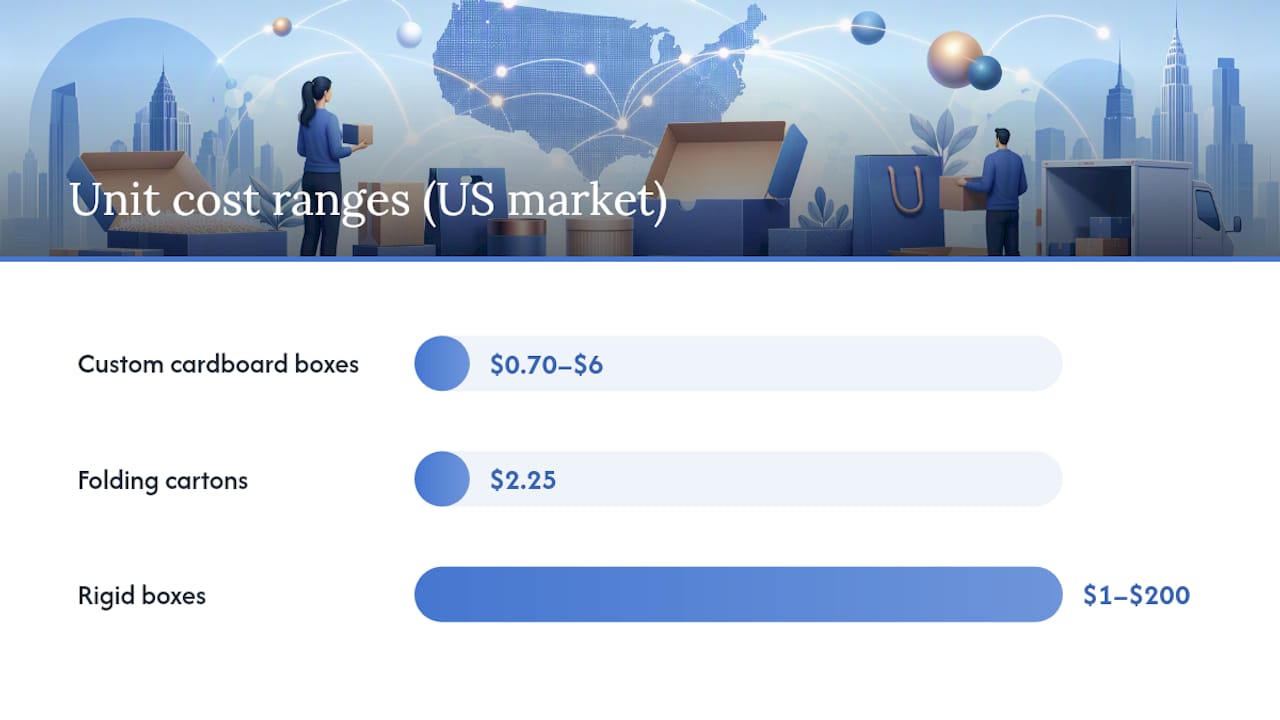
For reference, Packhit’s industry cost data lists illustrative US ranges: custom cardboard boxes from roughly $0.70 to $6 per unit, rigid boxes from around $1 to $200 per unit, and folding cartons from approximately $2.25 per unit. These are US-market figures and vary by size, finish, and run size. UK buyers should treat them as directional only and obtain quotes from UK suppliers.
Right-sizing packaging to the product reduces dimensional weight shipping costs and eliminates the need for bulky void-fill materials, which can meaningfully offset the premium paid for personalisation, particularly for UK e-commerce businesses where carriers charge on volumetric weight.
| Cost factor | Lower cost route | Higher cost route |
|---|---|---|
| Print technology | Digital (short run, no plates) | Offset (long run, plate cost) |
| Finishing | Plain print, no laminate | Foiling, embossing, soft-touch |
| Material | Corrugated board, recycled stock | Rigid board, coated virgin fibre |
| Design complexity | Single variable field | Fully unique design per unit |
| Fulfilment | Standard pick-and-pack | Order-matched variable despatch |
Lead times typically run from five to fifteen working days for a standard digital short run, longer when bespoke finishing or physical proofs are required. Build proof time into any campaign timeline.
What materials work best, and how do you handle sustainability?
Material choice in personalised packaging involves a genuine trade-off between print performance, sustainability, and end-of-life recyclability.
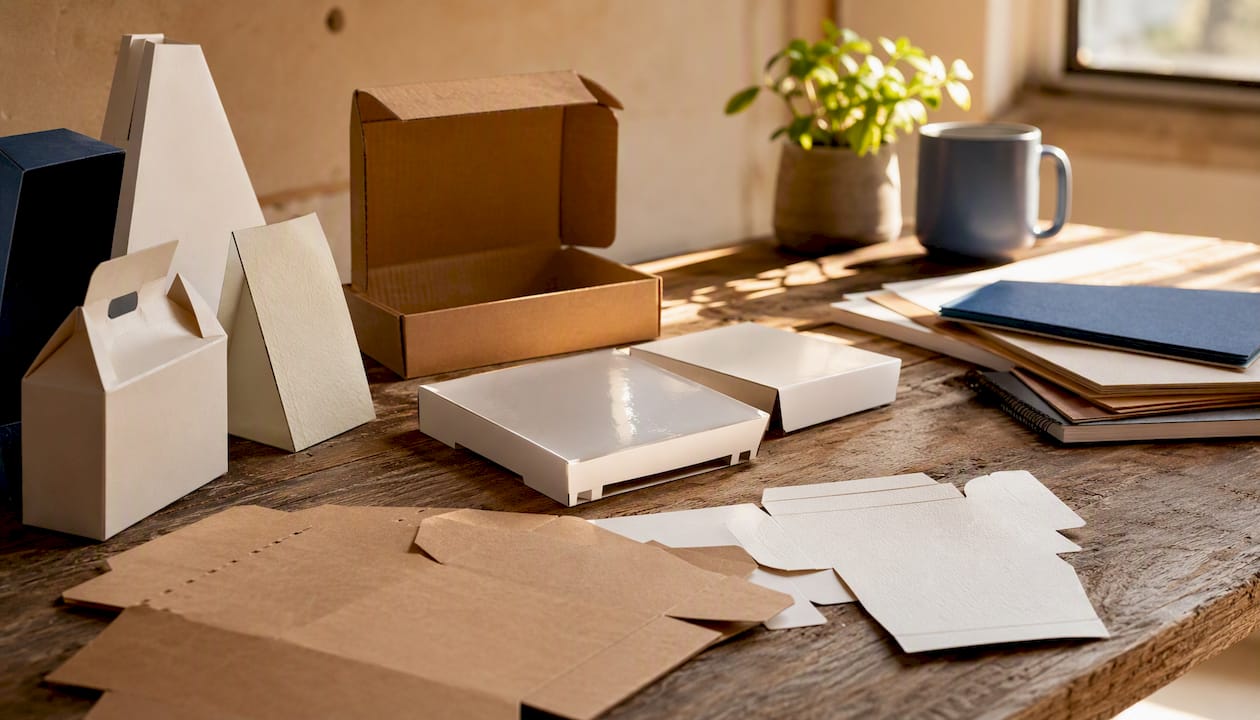
Corrugated board is the workhorse: strong, widely recyclable, and compatible with digital printing. It suits e-commerce despatch boxes and outer packaging well. Folding carton (coated paperboard) gives a cleaner print surface for retail-facing packs and works with most digital presses. Coated papers and labels offer flexibility for wrap-around or sleeve applications.
The sustainability picture is more nuanced than it first appears. Digital printing reduces waste by eliminating plates and enabling short runs, which means fewer overruns and less material discarded. However, certain coatings, UV varnishes, and metallic finishes can make a pack harder to recycle, even when the substrate itself is recyclable. A matte water-based ink on uncoated board is far easier for UK recycling streams to handle than a UV-spot-varnished, foil-blocked carton.
Pro Tip: Before committing to a finish, ask your supplier for the recycling classification of the finished pack. A pack that carries a “widely recyclable” claim must meet the threshold set by OPRL (On-Pack Recycling Label) guidance. Misclassifying a pack as recyclable when it is not exposes you to CMA enforcement under the Green Claims Code.
For sustainable material options, Expleco’s sustainable packaging range covers inputs worth reviewing alongside your standard supplier quotes. A practical overview of packaging supply options for UK businesses can also help narrow material choices before you approach a printer.
Which industries and business sizes benefit most from personalised packaging?
Personalised packaging is not exclusively a luxury-brand tool. The use cases span sectors and business sizes, and the right application depends on whether personalisation is serving a marketing goal or a functional one.
- Direct-to-consumer e-commerce brands use personalised outer boxes and inserts to create a branded unboxing moment that justifies a premium price point and encourages social sharing.
- Subscription box businesses use variable inserts and personalised outer sleeves to make each monthly delivery feel curated rather than generic, which directly affects renewal rates.
- Corporate gifting and B2B use personalised packaging to carry a recipient’s name, company logo, or event branding, turning a standard gift into a relationship-building touchpoint.
- Food and drink brands use limited-edition seasonal or regional designs to drive trial, create urgency, and generate earned media, as the Coca-Cola and Nutella campaigns demonstrated.
- Beauty and wellness brands use finish and texture personalisation to signal quality and align the pack with the product’s positioning.
- Print shops and trade buyers use short-run digital personalisation to offer value-added services to their own retail clients without large capital investment.
When personalisation is a marketing tactic, the goal is differentiation and shareability. When it is a functional requirement, as in pharmaceutical track-and-trace or regulated food labelling, the driver is compliance and accuracy. Both are valid, but they require different supplier capabilities and different QC processes. For retail-focused trade buyers, the role of packaging in retail environments covers the selection logic in more detail.
How do UK businesses get started with personalised packaging?
The checklist below is sequenced to avoid the most common mistakes: committing to a material before testing a design, or ordering a full run before proofing a variable template.
- Define your objective and success metric. Are you trying to increase repeat purchase rate, generate social shares, reduce return rates, or support a product launch? The metric shapes every subsequent decision.
- Choose your personalisation type. Start with the simplest type that achieves your objective. A name-and-message insert is faster and cheaper to test than a fully variable outer box.
- Select materials and set sustainability criteria. Decide whether the pack needs to be widely recyclable, plastic-free, or certified (FSC, PEFC). Lock this before approaching suppliers, not after.
- Shortlist suppliers and ask the right questions. Key questions: minimum order quantities (or lack thereof), variable-data capability, proof process, lead times, UK fulfilment options, and EPR compliance support.
- Request a digital proof, then a physical prototype. Never skip the physical prototype for a variable-data run. Colour, registration, and barcode readability issues only become visible in print.
- Run a small test batch. A short run of 50 to 200 units against a matched cohort of standard-packaged orders gives you real data on uplift before you scale.
- Plan fulfilment and returns. Personalised packs often cannot be restocked or reused if returned. Factor this into your returns policy and warehouse process before launch.
What to ask suppliers
- Do you have a minimum order quantity? (For testing, no-minimum wholesale suppliers are significantly more practical.)
- Can you handle variable-data printing, or only static designs?
- What is your standard proof process, and what does a physical prototype cost?
- What are your standard lead times for a short digital run versus a finished embellished pack?
- Do you offer UK fulfilment, or do packs ship from overseas?
Budgeting and procurement notes for UK buyers
For businesses registered for VAT, this is reclaimable as input tax. Shipping costs from overseas suppliers can erode the apparent price advantage of lower unit costs, particularly for bulky corrugated stock. Packaging solutions for small businesses covers the procurement logic for smaller buyers in more detail.
Pro Tip: Ask any supplier whether they can supply a no-minimum short run for proofing purposes. A supplier who requires a minimum of 1,000 units before they will produce a proof is not the right partner for testing a new personalised format. Subliblanks operates with no minimum order quantities, which makes it practical to test sublimation-printed packaging and supplies before committing to volume.
How do you measure whether personalised packaging is working?
Measurement is where most personalised packaging campaigns fall short. The pack goes out; the brand feels good about it; nobody checks the numbers.
The metrics that actually tell you whether personalisation is delivering commercial value:
- Repeat purchase rate in the cohort that received personalised packaging versus a matched control group receiving standard packaging.
- Average order value at second purchase, to test whether the emotional uplift from the first personalised experience raises spend.
- Social shares and referral traffic attributed to unboxing content, tracked via UTM parameters on QR codes or unique landing page URLs.
- Net Promoter Score (NPS) or CSAT changes measured in post-purchase surveys, segmented by packaging type.
- Return rates compared between personalised and standard pack cohorts.
The cleanest test format is a matched-cohort A/B split: send personalised packaging to one segment of new customers and standard packaging to a comparable segment, then track the metrics above over 60 to 90 days. Keep the product, price, and fulfilment speed identical between cohorts so packaging is the only variable.
Qualitative signals, such as unboxing posts and tagged social content, are harder to attribute but worth monitoring. A spike in organic brand mentions in the week after a personalised campaign despatch is a directional signal even without a clean causal link.
Personalised packaging as a strategic lever, not a tactical add-on
Most brands treat personalised packaging as a campaign tool: something you do for Christmas, for a product launch, or when a competitor does something interesting. That framing undersells it.
The brands that get the most from personalisation treat the pack as a permanent channel, not a seasonal decoration. Coca-Cola did not run Share a Coke once and move on. The mechanic became part of how the brand thinks about consumer connection. Nutella Unica was not a one-off stunt; it demonstrated a production capability that Ferrero could return to.
For UK trade buyers and print shops, the practical implication is this: the technology and supply chain to do this well now exist at a price point that suits short runs and test-and-learn approaches. The barrier is not cost or technology. It is the willingness to define a clear objective, run a small test, and measure the outcome honestly. Brands that do that consistently find personalisation compounds: each campaign teaches them something about what their customers respond to, and the next run is better for it.
Subliblanks supplies what you need to start testing personalised packaging
Short-run personalised packaging does not require a large capital commitment if you have the right supply partner. Subliblanks is a UK-based trade wholesaler with no minimum order quantities, supplying sublimation printers, DTF equipment, packaging supplies, and a full range of print blanks to businesses, print shops, and makers across the UK and Ireland.
For businesses testing personalised packaging for the first time, the no-minimum model means you can order a small quantity of packaging supplies or print equipment, run a proof batch, measure the results, and scale only when the numbers support it. No commitment to a pallet of stock before you know the format works.
Subliblanks stocks sublimation printers and equipment suited to short-run personalised printing, alongside packaging supplies and accessories. Browse the full range at Subliblanks and contact the team to discuss which equipment suits your production volume and personalisation goals.
Sources
The following sources informed this guide and are worth consulting for deeper research:
- Packaging Personalization and Customization - Packaging Technology Today
- Personalized Packaging for Unique Consumer Experiences
- Personalised packaging for consumers
- The advantages of custom packaging - Blog - Mail Boxes Etc.
- Packhit


