



How 3D filaments shape manufacturing and prototyping
3D filaments are the physical feedstock that determines a printed part’s mechanical performance, thermal resistance, and suitability for prototyping or low-volume production. The filament you load into a Fused Deposition Modelling (FDM) machine is not a neutral carrier; it is the primary variable controlling strength, heat resistance, flexibility, surface finish, and electrical or chemical behaviour in the finished part. As additive manufacturing has moved from a rapid-prototyping curiosity into a recognised Industry 4.0 production tool, filament selection has become an engineering decision in its own right.
Three core functions define the role of 3D filaments in manufacturing:
- Prototyping (form and fit): Cheap, fast iterations to validate geometry before committing to tooling.
- Functional testing: Material-appropriate validation of load paths, thermal exposure, and chemical contact.
- Low-volume production and spare parts: End-use components where FDM properties meet in-service requirements and volumes are too low to justify injection moulding.
Key takeaways
Filament selection is the single most consequential decision in FDM manufacturing: the material you choose sets the ceiling on every mechanical, thermal, and chemical property the part can achieve.
| Point | Details |
|---|---|
| Match material to worst-case condition | Choose filament based on peak service temperature, load, and chemical exposure, not average conditions. |
| Stage your material progression | Prototype in PLA for geometry, move to PETG for function, and use Nylon or ABS for engineering validation. |
| Verify batch tolerance and storage | For hygroscopic materials, confirm vacuum-sealed packaging and request a certificate of analysis with diameter data. |
| Know the FDM limits | Typical dimensional accuracy is ±0.2 mm; Z-axis strength is lower than X/Y; surface finish requires post-processing for critical surfaces. |
| Subliblanks for filament supply | Subliblanks offers wholesale 3D printing filaments with no minimum order, sample kits, and technical datasheets for production teams. |
Table of Contents
- What is a 3D filament and how does FDM turn it into a part?
- How filaments are manufactured and what datasheet specs actually matter
- Which filament families should you know for manufacturing?
- Where does filament-based printing fit in product development?
- How do you choose the right filament for a manufacturing job?
- What causes common print faults and how do you fix them?
- Where does filament printing fall short?
- What are the advanced filaments and research directions worth watching?
- How are filaments used across different industries?
- What do filament prototyping and small-series production actually cost?
- What should you ask a filament supplier before committing to a production run?
- A supplier’s perspective on what manufacturing customers actually need
- Filament supply without the minimum order headache
- Sources
What is a 3D filament and how does FDM turn it into a part?
A 3D printing filament is a continuous thermoplastic thread, typically 1.75 mm or 2.85 mm in diameter, wound onto a spool. The defining characteristic is reversible melt behaviour: heat the polymer above its glass transition temperature (Tg) or melting point ™, and it flows; cool it, and it solidifies. That cycle is what FDM exploits, and it is also why filament choice controls so much of the outcome.
The FDM process follows a straightforward chain. A CAD model is sliced into layers by software such as PrusaSlicer or Ultimaker Cura, generating toolpaths. The printer’s extruder feeds filament into a heated nozzle, melting it and depositing it along those paths. Each deposited bead bonds to the layer below through thermal fusion, then cools and contracts. Repeat for every layer until the part is complete.
Layer bonding and anisotropy both trace back to filament properties. A semi-crystalline polymer like Nylon bonds differently from an amorphous one like ABS: crystallinity affects shrinkage, warp tendency, and the strength of the interlayer weld line. Melt viscosity, controlled by molecular weight and print temperature, determines how well the extrudate wets the previous layer. Get those parameters wrong and the part’s Z-axis strength drops sharply, which is the core anisotropy problem in FDM.
Other additive manufacturing families exist and are worth knowing about. Stereolithography (SLA) and Digital Light Processing (DLP) cure liquid resin with light, producing finer detail and smoother surfaces. Selective Laser Sintering (SLS) fuses powder, enabling complex geometries without support structures. Both outperform FDM on surface quality and thin-wall resolution, but filament systems win on material cost and ease of use.
How filaments are manufactured and what datasheet specs actually matter
Filament manufacture starts with raw polymer pellets, which are compounded with additives (stabilisers, colourants, reinforcing particles, or lubricants) in a twin-screw extruder. The melt is then drawn through a precision die, cooled in a water bath, measured by laser diameter gauges, and wound onto spools. Diameter consistency across the spool length is the single most important quality variable: a filament that wanders from 1.75 mm to 1.80 mm will cause inconsistent extrusion and dimensional error.
When reading a datasheet, these are the fields that matter for purchasing and repeatability:
- Nominal diameter and tolerance: ±0.02 mm is a reasonable benchmark for engineering-grade filament; ±0.05 mm is acceptable for visual prototyping only.
- Roundness: An oval cross-section causes feed variation even when the average diameter is correct.
- Glass transition temperature (Tg) and melting point ™: Sets the upper service temperature and the print temperature window.
- Moisture sensitivity: Hygroscopic materials (Nylon, PVA, TPU) absorb atmospheric moisture and produce bubbling, stringing, and weak layer bonds during printing.
- Recommended print and bed temperatures: These are starting points; actual tuning depends on your specific machine and environment.
- Melt flow index (MFI): A proxy for viscosity at a given temperature; higher MFI means lower viscosity and faster flow, which affects retraction settings and stringing.
Storage matters as much as specification. Hygroscopic filaments should be kept vacuum-sealed with desiccant until use, and dried in a filament dryer or low-temperature oven before printing if they have been exposed to air. Nylon and PVA are the worst offenders; even a few hours of open-air exposure can degrade print quality noticeably.
Pro Tip: When evaluating a new supplier, request a certificate of analysis (CoA) for the batch. A credible CoA will include diameter measurements at multiple points along the spool, Tg/Tm data from DSC testing, and particle contamination results for filled filaments. If a supplier cannot provide batch-level traceability, that is a sourcing risk for any production run.
Which filament families should you know for manufacturing?
The common filament families span a wide range of mechanical, thermal, and chemical properties. The table below gives a quick-reference overview; the notes beneath it explain where each family fits in a manufacturing or prototyping workflow.
Use-case notes by family:
- PLA is the right choice for early concept models where geometry validation matters more than mechanical performance. It prints easily, costs less than most alternatives, and is biodegradable under industrial composting conditions.
- PETG hits a useful middle ground: better chemical resistance than PLA, less warp than ABS, and sufficient strength for functional prototypes that will be handled or lightly loaded.
- Nylon is the go-to for wear-resistant parts, living hinges, and anything that will see repeated mechanical stress. Its high moisture absorption means storage and drying discipline is non-negotiable.
- TPU handles applications where flexibility, compression, or vibration damping is required — gaskets, cable management clips, and ergonomic grips.
- PC and ASA step up for parts needing high heat resistance or outdoor UV stability, respectively.
- Carbon-fibre and glass-fibre filled filaments deliver stiffness-to-weight ratios that approach aluminium in some orientations, making them attractive for tooling fixtures and lightweight structural brackets. Processing constraints are real: particle size and viscosity must be controlled to avoid nozzle clogging, and hardened-steel nozzles are mandatory.
- PVA and HIPS are support materials, not structural ones. PVA dissolves in water; HIPS dissolves in limonene. Both enable complex overhangs on dual-extrusion machines.
Where does filament-based printing fit in product development?
FDM has progressed from rapid prototyping into tooling and pilot production roles, and the stage of development determines which filament and which level of process rigour is appropriate. Treating every prototype as a production part wastes material and time; treating a production part as a prototype risks failure in service.
A practical stage map looks like this:
- Concept model: Print in PLA. The goal is geometry, not performance. Fast, cheap, and disposable.
- Fit and assembly check: Still PLA or PETG. Verify clearances, fastener positions, and ergonomics. Typical FDM dimensional accuracy on a well-calibrated machine is around ±0.2 mm, so design clearances of 0.2–0.4 mm per side for snug-fit assemblies.
- Functional prototype: Move to PETG, ABS, or Nylon depending on the load and temperature the part will see. This is where material choice starts to matter for test validity.
- Engineering validation: ABS, Nylon, ASA, or PC for thermal and mechanical testing. The prototype should replicate in-service conditions as closely as possible.
- Environmental and regulatory testing: High-performance polymers or certified biocompatible grades where required.
- Bridge and pilot production: FDM can serve as a bridge-to-production for 1–50 units while injection mould tooling is being cut, or as the permanent production method for low-volume, high-complexity parts.
Tooling and jigs are one of the most underused applications. Printed fixtures, drill guides, and assembly jigs can be produced in hours, iterated cheaply, and replaced when worn. For small-batch production of end-use parts, the economics work when complexity is high and volumes are low.
How do you choose the right filament for a manufacturing job?
Selection starts with the highest in-use requirement, not the average one. A part that sees 80°C peak temperature needs a material with a Tg comfortably above that, even if most of its life is at room temperature.
Selection checklist:
- Mechanical requirements: tensile strength, impact resistance, fatigue life, creep resistance.
- Thermal demands: peak service temperature, thermal cycling, proximity to heat sources.
- Chemical exposure: solvents, oils, cleaning agents, UV radiation.
- Surface finish: as-printed FDM finish is typically Ra 10–30 µm; post-processing (sanding, priming, vapour smoothing) can improve this.
- Dimensional tolerance: ±0.2 mm is typical; tighter tolerances require post-machining or resin printing.
- Post-processing: some materials (ABS) respond well to acetone smoothing; others do not.
- Cost and availability: PLA and PETG are commodity materials; high-performance polymers (PEEK, PEI) cost significantly more and require specialist hardware.
- Regulatory and biocompatibility needs: medical and food-contact applications require certified grades with documented compliance.
Decision flow:
- Define functional requirements (load, temperature, chemical, regulatory).
- Shortlist candidate filament families that meet the highest requirement.
- Run trial prints to tune process parameters and verify dimensional output.
- Test printed samples under representative conditions.
- Scale or change material based on test results.
For a practical guide to setting up and optimising prints across these material families, the Subliblanks 3D filament printing guide covers machine setup and parameter tuning in detail.
What causes common print faults and how do you fix them?
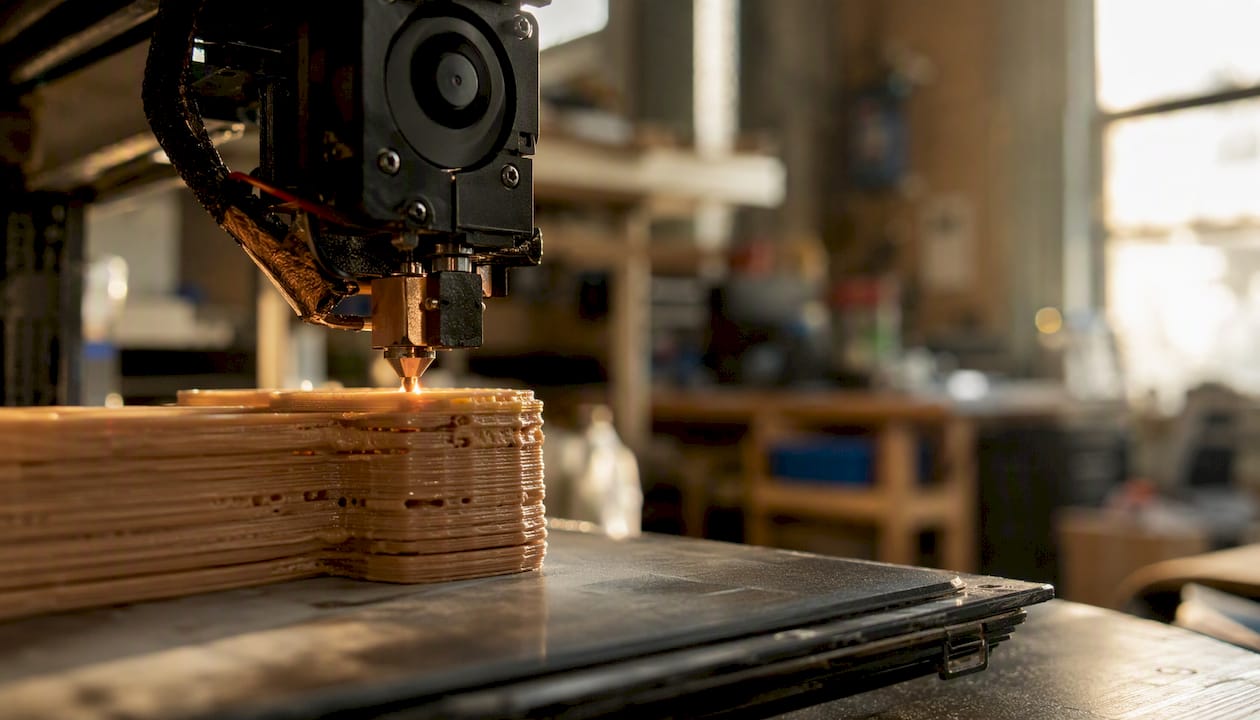
Filament properties drive print behaviour more than any other single variable. A glassy amorphous polymer like ABS shrinks differently from a semi-crystalline one like Nylon, and hygroscopic materials that have absorbed moisture will produce audible popping and visible bubbling at the nozzle.
| Fault | Probable cause | Corrective action |
|---|---|---|
| Warping | High shrinkage (ABS, PC, Nylon); cold bed or ambient | Raise bed temperature; use enclosure; apply adhesion aid (PEI sheet, glue stick) |
| Delamination / layer separation | Print temperature too low; cooling too aggressive | Increase nozzle temperature by 5°C increments; reduce part cooling fan speed |
| Stringing | Retraction too low; temperature too high; wet filament | Increase retraction distance/speed; lower temperature; dry filament before printing |
| Nozzle clogging | Filled/composite filament; temperature too low; contamination | Use hardened nozzle; increase temperature; cold pull to clear; check filament quality |
| Poor interlayer adhesion | Low temperature; high print speed; incompatible material | Slow print speed; raise temperature; check filament diameter consistency |
| Dimensional inaccuracy | Filament diameter variation; flow rate miscalibrated; thermal expansion | Measure filament diameter; calibrate e-steps and flow rate; account for material shrinkage |
Parameter guidance by material family:
- PLA: 190–220°C nozzle, 50–60°C bed, moderate cooling. Forgiving and consistent.
- ABS: 230–250°C nozzle, 100–110°C bed, enclosure required, minimal cooling. Prone to warping without enclosure.
- PETG: 230–245°C nozzle, 70–85°C bed, reduced cooling. Sticks aggressively to some surfaces; use release agent.
- Nylon: 240–270°C nozzle, 70–90°C bed, dry filament mandatory. Absorbs moisture rapidly.
- TPU: 220–240°C nozzle, 30–60°C bed, slow print speed, direct-drive extruder preferred.
- PC: 260–310°C nozzle, 100–120°C bed, enclosure essential.
Pro Tip: Abrasive and filled filaments (carbon-fibre, metal-filled, glow-in-the-dark) wear brass nozzles quickly. Switch to a hardened-steel or ruby-tipped nozzle before your first spool is finished, and reduce feeder tension slightly to avoid filament grinding at the drive gear.
Where does filament printing fall short?
Filament-based AM has real limits, and knowing them prevents expensive mistakes. The surface quality and thin-wall capability of FDM are lower than SLA, SLS, or metal AM, and anisotropy means Z-axis strength is always lower than X/Y strength in standard layer orientations.
Key limitations:
- Anisotropy: Interlayer bond strength is typically 50–80% of in-plane strength, depending on material and process. Parts loaded in Z must be designed with this in mind or reoriented for printing.
- Surface finish: As-printed Ra is rarely below 10 µm without post-processing. For optical or sealing surfaces, FDM is usually not the final process.
- Thin walls: Features below approximately 0.8 mm (two nozzle widths) are unreliable. SLA or SLS handles fine detail better.
- Throughput: FDM is slow per part for high volumes. Above roughly 50 identical units, injection moulding or urethane casting usually wins on cost per part.
- Mechanical parity: FDM parts rarely match injection-moulded equivalents in isotropic strength, even with the same base polymer.
Decision rules for when to switch process:
- Tolerances tighter than ±0.1 mm: consider SLA, DLP, or post-machining.
- Surface finish Ra below 3 µm: SLA or DLP.
- Volumes above 50–100 units of identical geometry: urethane casting or injection moulding.
- Full isotropy required: SLS or metal AM.
Hybrid strategies often make sense. Print an FDM master for urethane casting when you need 20–50 flexible or rigid parts with better surface finish. Use FDM for the structural core and overmould or insert-mould for critical surfaces. For a broader comparison of filament-based and other AM material systems, the 3D printing materials list at Subliblanks covers FDM, resin, and SLS side by side.
What are the advanced filaments and research directions worth watching?
The spectrum of FFF filament research now runs from commodity thermoplastics to composite blends incorporating carbon and glass fibres, graphene, metallic particles, and bioplastics. Each class extends the functional range of printed parts but brings processing constraints that commodity filaments do not.
Advanced filament classes currently in industrial or near-industrial use:
- Continuous carbon-fibre reinforced filaments: Dramatically higher stiffness and strength than short-fibre blends; require specialist printers with fibre-cutting mechanisms.
- Conductive and graphene-blended filaments: Enable printed circuit traces, ESD-safe enclosures, and resistive heating elements within printed structures.
- High-performance polymers (PEEK, PEI/ULTEM): Service temperatures above 150°C, chemical resistance comparable to metals, and biocompatibility for implant-adjacent applications. Require nozzle temperatures above 350°C and actively heated enclosures.
- Metal-filled and sinterable filaments: Print like thermoplastics, then debind and sinter in a furnace to produce near-fully-dense metal parts. Shrinkage of 15–20% must be accounted for in design.
On the process control side, closed-loop monitoring and machine-learning fault detection are moving from research into commercial systems. Camera-based layer inspection, acoustic emission monitoring for nozzle clogs, and filament run-out sensors with automatic recovery are all available on current-generation industrial FDM machines.
Composite filament formulations are expanding what FDM can deliver structurally and functionally, but the processing window narrows with every reinforcement added. Particle size, dispersion quality, and filament rheology must all be controlled simultaneously — which is why batch-level quality data from your filament supplier is not optional when you move into composite territory.
Robot-assisted deposition, where a 6-axis arm replaces the gantry, removes the layer-orientation constraint and enables continuous-fibre placement along load paths. Several aerospace and automotive programmes are already using this for non-structural brackets and ducting.
How are filaments used across different industries?
Engineers across automotive, aerospace, and consumer-product development favour filament-based systems for rapid iteration because of speed, material versatility, and low per-iteration cost. The specific filament choices vary sharply by sector.
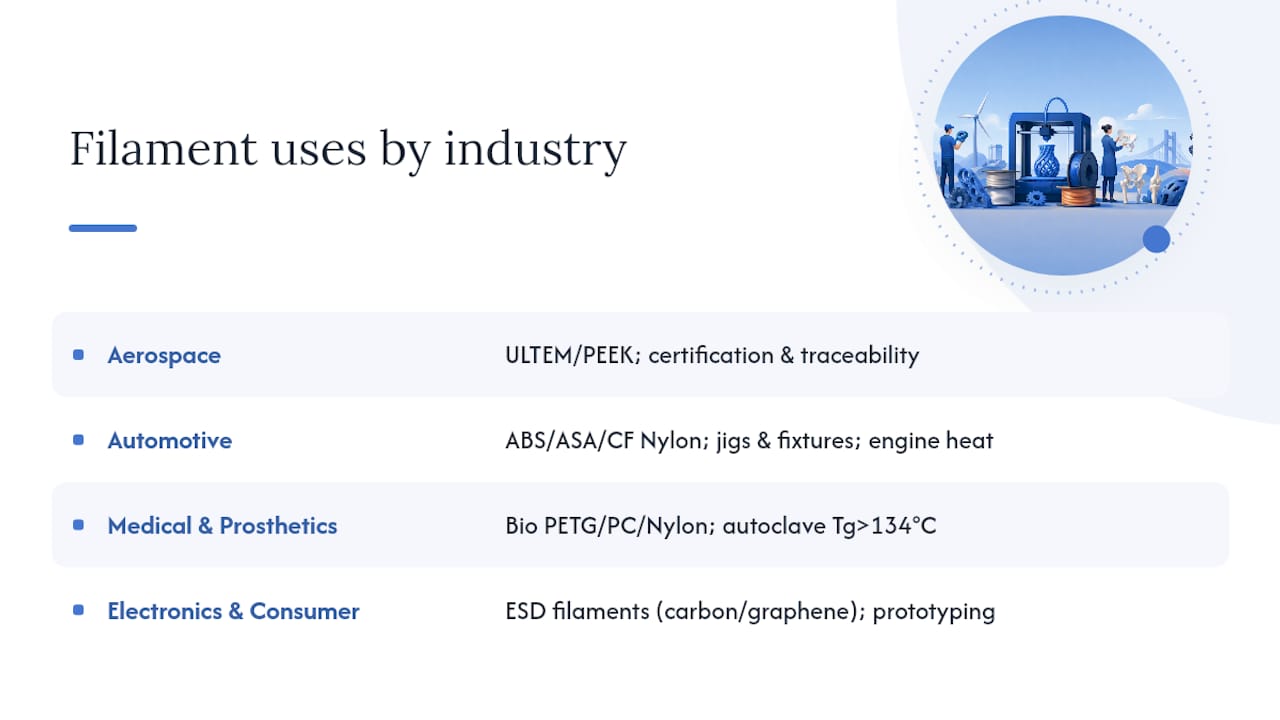
Aerospace: Non-structural interior brackets, cable management clips, and tooling fixtures are printed in ULTEM (PEI) or PEEK for their heat resistance and certified material properties. Traceability is mandatory; aerospace programmes require material certification and batch-level documentation for any part that goes near a flight vehicle, even if it is not load-bearing.
Automotive: Prototyping dominates, but printed tooling is a genuine production application. Jigs, assembly fixtures, and checking gauges are printed in ABS, ASA, or carbon-fibre-filled Nylon. Some low-volume interior trim components are produced in ASA for UV stability. Heat resistance is the primary selection driver for anything near the engine bay.
Medical and prosthetics: Biocompatible grades of PETG, PC, and Nylon are used for prosthetic sockets, surgical guides, and anatomical models. Sterilisation method matters: autoclave sterilisation requires materials with Tg well above 134°C, which rules out PLA and standard PETG. Regulatory compliance (FDA 510(k) or EU MDR) requires documented material biocompatibility testing.
Electronics and consumer goods: ESD-dissipative filaments (carbon-loaded or graphene-blended) protect sensitive components during assembly and testing. Consumer products prioritise surface finish and colour consistency, which often means FDM is used for prototyping only, with injection moulding for production.
What do filament prototyping and small-series production actually cost?
Filament systems offer lower acquisition and material costs than resin or powder systems, which is a genuine advantage at the prototyping stage. The cost picture changes as volumes rise.
Material cost by family (qualitative ranges, relative to commodity PLA):
- PLA, ABS, PETG: Commodity pricing; widely available from multiple suppliers.
- Nylon, ASA, TPU: Moderate premium over commodity materials.
- PC, carbon-fibre filled: Significant premium; specialist hardware often required.
- PEEK, PEI/ULTEM: High cost per kilogram; industrial-grade printers mandatory.
Timeline anchors for small parts (palm-sized, moderate complexity):
- Concept model in PLA: 2–6 hours print time, same-day iteration possible.
- Functional prototype in PETG or ABS: 4–12 hours, including drying time for hygroscopic materials.
- Engineering validation part in Nylon or PC: add drying, enclosure warm-up, and slower print speeds; allow a full day per part.
For low-volume production, filament printing is usually the fastest and cheapest route to physical parts. At higher volumes, alternative manufacturing methods like urethane casting or injection moulding may become more cost-effective. The crossover point depends on part complexity and material, but the 50-unit threshold is a useful planning anchor.
What should you ask a filament supplier before committing to a production run?
Supplier quality directly affects print consistency, especially for production runs where batch-to-batch variation translates into dimensional scatter in finished parts. A thorough supplier checklist covers:
- Diameter tolerance specification and measurement method (laser gauge vs. manual spot-check).
- Roundness specification (not just average diameter).
- Batch control: is each spool traceable to a specific production batch?
- Storage and packaging: vacuum-sealed with desiccant for hygroscopic materials?
- Certificate of analysis: DSC data for Tg/Tm, diameter measurements, contamination testing.
- Material safety data sheet (MSDS/SDS) for workplace safety compliance.
- Lead times and minimum order quantities (MOQ): critical for production planning.
- Custom compounding options: can the supplier produce a specific colour, additive package, or reinforcement level?
Trial evaluation sequence:
- Request a sample spool (at least 250 g) and the corresponding CoA.
- Print a calibration cube and measure all three axes against nominal dimensions.
- Print a functional test piece representative of your actual geometry.
- Test under representative conditions (load, temperature, chemical exposure).
- Compare results against your functional requirements before placing a volume order.
Wholesalers like Subliblanks typically support this process with sample kits, technical datasheets, and repeat-order traceability, so production teams can validate materials without committing to full pallet quantities upfront. For regional supply considerations and how filament sourcing works in practice, the Subliblanks guide on 3D filaments covers availability and material choice in detail.
On logistics: high-performance polymers such as PEEK and PEI may be subject to import controls or hazardous materials shipping restrictions depending on their additive package. Always verify with your supplier before ordering internationally.
A supplier’s perspective on what manufacturing customers actually need
The most common request we see from manufacturing customers is some version of “heat-resistant and low-cost at the same time.” It is a reasonable ask, but it almost always signals that the functional requirement has not been fully defined yet. Heat-resistant to 80°C is a very different brief from heat-resistant to 150°C, and the material cost difference between those two targets is substantial.
The most useful thing a production engineer can do before contacting a filament supplier is to write down the single worst-case condition the part will face, not the average condition. That one number narrows the candidate materials from a dozen to two or three, and the conversation becomes much more productive.
From a supplier’s side, the requests that move fastest to a usable sample are the ones that come with a clear functional brief, a target print temperature range (which tells us what hardware the customer is running), and a willingness to run a structured trial rather than expecting the first spool to be production-ready. No filament, regardless of quality, skips the calibration step on a new machine or a new geometry.
Filament supply without the minimum order headache
Sourcing filament for manufacturing and prototyping means balancing material quality, batch consistency, and the practical reality that development runs rarely need a full pallet of any single material.
Subliblanks supplies 3D printing filaments wholesale with no minimum order quantities, which means you can trial a new material family, validate a batch with a sample spool, and scale your order as your production run grows. Technical datasheets and sample kits are available for engineering-grade materials, so your team can run the structured trial evaluation described above without committing to volume upfront. Whether you need commodity PLA for concept modelling or a higher-performance material for functional validation, the range covers the full prototyping-to-production spectrum. Visit the Subliblanks wholesale supply page to request samples or discuss your filament requirements directly.
Sources
The following sources were used in preparing this article and are recommended for further reading:
- Review: additive manufacturing technologies and configurations (PMC)
- State-of-the-art materials for FFF filaments (MDPI)
- Ultimate 3D Printing Materials Guide (Simplify3D)
- 3D printing for prototyping: a practical guide (Get3DPrints)
- Additive manufacturing with filaments — ProductionToGo


