



Why use 3D filaments in Ireland: benefits and how to choose
Use 3D filaments in Ireland because they let you match material performance to the job — from cheap PLA prototypes to engineering-grade nylon for functional parts — without committing to large stock orders or long lead times.
The practical case for filament printing in Ireland comes down to five things:
- Material variety maps to function. PLA suits quick models and educational work; PETG handles functional indoor parts; ASA survives the Irish weather outdoors.
- Rapid prototyping at low cost. Small runs that would cost hundreds through a traditional manufacturer can be printed overnight for a fraction of the price.
- No minimum order pressure. Filament spools are affordable entry points, and suppliers such as Subliblanks carry stock with no minimum order quantity.
- Local sourcing cuts lead times. UK and Irish-stocked suppliers ship within days rather than weeks from continental Europe or Asia.
- Design freedom for one-offs. Custom jigs, replacement parts, and bespoke enclosures are practical at any scale.
One local qualifier worth stating upfront: Ireland’s damp Atlantic climate means moisture management is not optional for hygroscopic filaments. Buy sealed, store sealed, and dry before printing.
Key takeaways
Matching filament to the job — rather than defaulting to the cheapest or most familiar material — is the single decision that most improves print quality and part performance for Irish makers and small businesses.
| Point | Details |
|---|---|
| Match material to function | Use PLA for prototypes, PETG for functional indoor parts, ASA for outdoor use, nylon for engineering loads. |
| Check printer compatibility first | Confirm nozzle max temp, heated bed, enclosure, and extruder type before buying any engineering-grade filament. |
| Dry and seal in Ireland’s climate | Nylon, PVA, and TPU absorb moisture quickly; dry at 70–80 °C before printing and store sealed with desiccant. |
| PLA recycling needs specialist routes | PLA is industrially compostable but not accepted in most Irish kerbside collections; check your local council or maker space. |
| Subliblanks for Irish supply | Subliblanks stocks 3D printing filaments with no minimum order and UK-based stock for fast delivery to Ireland. |
Table of Contents
- What exactly is 3D filament, and does it work with your printer?
- Common filament types and when to use each
- How do you choose the right filament for a project?
- Practical Ireland-specific considerations: availability, cost and recycling
- Ventilation, emissions and sustainability: what the evidence says
- How to store and dry filament in Ireland’s damp climate
- Where to buy filament in Ireland and what to look for from suppliers
- Why Subliblanks recommends filament solutions for Irish makers
- Filament stock from Subliblanks: view the range
- Sources
What exactly is 3D filament, and does it work with your printer?
3D printer filament is a thermoplastic material wound onto a spool and fed through a Fused Filament Fabrication (FFF) or Fused Deposition Modelling (FDM) printer. The printer melts it, extrudes it layer by layer, and builds up a solid object. It covers everything from decorative models to engineering-grade functional parts and is the backbone of desktop additive manufacturing.
Two diameters dominate the market: 1.75 mm and 2.85 mm (sometimes labelled 3 mm). Most hobby and small-business machines use 1.75 mm because it gives finer extrusion control and suits the lighter extruder motors common on desktop printers. The 2.85 mm format appears mainly on professional-grade machines from specific manufacturers. Check your printer’s documentation before ordering — using the wrong diameter will jam the feed system.
Beyond diameter, run through four quick compatibility checks before buying any filament:
- Maximum nozzle temperature. Engineering materials such as nylon and polycarbonate need 250–300 °C or above. A budget printer capped at 220 °C cannot run them safely.
- Heated bed. ABS and ASA require a heated bed (typically 90–110 °C) to prevent warping. PLA and PETG are more forgiving.
- Enclosure. ABS in particular benefits from a fully enclosed build chamber to maintain ambient temperature and reduce cracking.
- Extruder type. Flexible filaments like TPU print far more reliably on a direct-drive extruder than on a Bowden setup.
For a deeper walkthrough on printer setup and material parameters, the Subliblanks guide to 3D filament printing covers the full process from first spool to finished part.
Common filament types and when to use each
Choosing the right material is the single biggest factor in whether a print succeeds or fails. The table below gives a quick reference across the main filament families; the notes beneath it explain the practical trade-offs.
PLA
PLA prints at around 180–230 °C, warps very little, and needs no heated bed. That combination makes it the right starting point for beginners and for any project where heat resistance and outdoor durability are not requirements. Think architectural models, product mock-ups, and school projects. Its main weakness is a low heat deflection temperature — leave a PLA part on a car dashboard in summer and it will deform.

PETG
PETG sits between PLA and ABS in almost every dimension: stronger than PLA, easier to print than ABS, and resistant to moisture and mild chemicals. Typical nozzle temperatures run 230–250 °C with a bed at 25–60 °C. Many experienced makers move from PLA to PETG or PCTG for functional indoor parts because PCTG in particular reduces stringing and handles impact better in daily workshop use. If you are printing brackets, tool holders, or enclosure panels, PETG is usually the sensible choice.
ABS and ASA
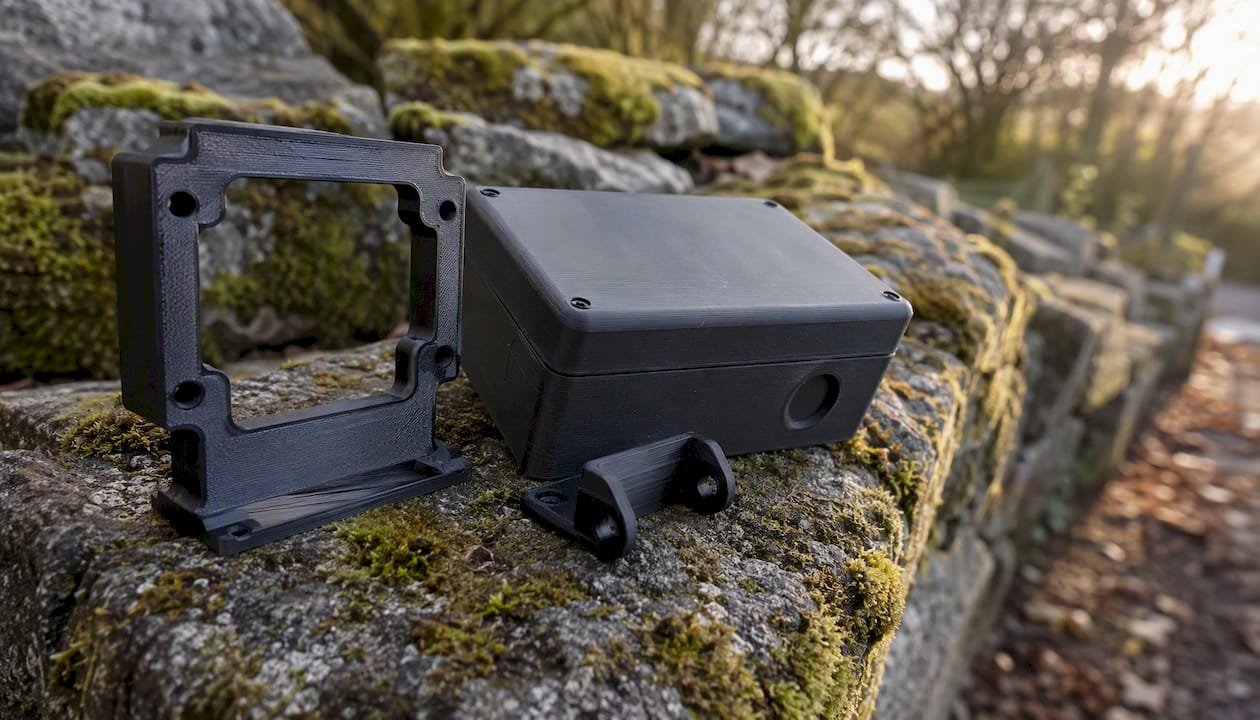
Both materials offer higher heat and impact resistance than PLA. The key difference is UV stability: ASA adds UV resistance that makes it the preferred choice for outdoor-use parts, while ABS degrades and yellows in sunlight. For anything that will live outside in Ireland — garden fixtures, outdoor signage brackets, equipment housings — ASA is the better call. Both need an enclosed printer and a heated bed, and both emit more fumes than PLA, so ventilation matters.
TPU
TPU is a flexible elastomer with good abrasion resistance and layer adhesion, useful for seals, vibration-damping mounts, phone cases, and flexible hinges. The catch is print speed: TPU needs to run slowly, and a Bowden extruder often struggles to push it consistently. A direct-drive setup is strongly preferred.
Nylon
Nylon delivers genuine engineering performance — good fatigue resistance, impact toughness, and a higher service temperature than PETG. It is the right material for gears, structural brackets, and jigs. The trade-off is that nylon is highly hygroscopic: absorb enough moisture and the filament bubbles, strings, and loses mechanical strength. In Ireland’s climate, this is not a theoretical concern. Dry it before every print run.
Polycarbonate (PC)
PC handles the highest loads and temperatures of any common desktop filament, with nozzle temperatures typically above 260 °C and bed temperatures around 100–120 °C. Few budget printers can reach those parameters reliably. If your application genuinely needs PC-level performance, check your printer’s hotend rating before ordering a spool.
Carbon- and glass-filled composites
These blends add stiffness and heat performance to a base polymer (usually nylon or PETG). They are abrasive, and a standard brass nozzle will wear noticeably within a few hundred grams of material. A hardened steel nozzle is the practical minimum; slower print speeds help too.
Pro Tip: If you are printing carbon- or glass-filled filament for the first time, weigh your nozzle before and after a 500 g spool. The difference will tell you whether your current nozzle is surviving the abrasion or quietly degrading your print quality.
How do you choose the right filament for a project?
Property matching is the most reliable method: filter by what the part actually needs rather than by brand or price. A flow of five filters covers most decisions.
1. Service temperature. What is the highest temperature the part will experience in use? PLA is safe to roughly 50–60 °C. PETG handles around 74 °C HDT. ABS and ASA push to 90–100 °C. Nylon and PC go higher still. If the answer is “a hot car interior” or “near an engine”, PLA is immediately eliminated.
2. Mechanical load. Will the part bear sustained stress, repeated flexing, or impact? PLA is brittle under shock. PETG and nylon absorb impact far better. For gears or load-bearing brackets, nylon or a carbon-filled base polymer is the realistic choice.
3. Flexibility requirement. Does the part need to bend, compress, or return to shape? TPU is the answer. No other common filament family matches its elasticity.
4. Environment. Outdoor, UV-exposed, or chemically exposed? ASA for outdoor UV. PETG for mild chemical resistance. Nylon for abrasion-heavy environments.
5. Budget and print difficulty. PLA is cheapest and easiest. Engineering grades cost more per spool and demand a capable printer. For a first functional prototype, PETG often hits the best balance of cost, printability, and performance.
Once you have a shortlist, ask the supplier these questions before checkout:
- What are the recommended nozzle and bed temperature ranges?
- Is the filament food-contact certified (if relevant)?
- What is the heat deflection temperature (HDT)?
- What is the return or exchange policy if the spool is defective?
- What is the lead time from stock?
The Subliblanks 3D printing workflow guide walks through the full decision process from design file to finished part and is worth bookmarking alongside any datasheet.
Practical Ireland-specific considerations: availability, cost and recycling
Availability and lead times
Most filament sold in Ireland ships from UK or EU warehouses. UK-stocked suppliers typically deliver in two to three working days; EU-based suppliers can take five to ten days depending on customs processing. For time-sensitive projects, confirming stock levels before ordering is worth the extra minute.
Spool sizes vary: 500 g spools suit sampling and short runs; 1 kg spools are the standard for regular printing; 2.5 kg and 5 kg spools reduce cost per gram for high-volume users. Check the spool inner diameter and outer dimensions against your printer’s spool holder before ordering a non-standard size.
Local Irish 3D printing services can also advise on material selection for specific projects and sometimes offer sample prints before you commit to a material.
Price bands
PLA is the cheapest filament category, typically the most affordable per kilogram. PETG and ABS sit in a mid range. Engineering grades (nylon, PC, carbon-filled) cost considerably more per spool and often require more failed test prints to dial in settings. Factor that learning cost into your material budget, especially for a first run with an unfamiliar material.
Recycling and end-of-life
PLA is industrially compostable and technically recyclable, but it requires separate processing and will contaminate conventional plastic recycling streams if mixed in. Most Irish council kerbside collections do not accept PLA. Check your local council’s recycling guidance directly. Some maker spaces and specialist recyclers accept failed PLA prints; a few run filament take-back or grinding schemes. PETG is closer to standard PET recycling but still requires confirmation from your local facility.
Quick checks before ordering:
- Confirm the supplier lists a technical data sheet (TDS) for the specific filament.
- Note the spool weight (gross vs. net filament weight) to avoid overpaying for a heavy spool core.
- Check whether the supplier provides lot or batch numbers for traceability.
Ventilation, emissions and sustainability: what the evidence says
Some filaments emit volatile organic compounds (VOCs) and ultrafine particles during printing. The risk level varies by material. Industry guidance consistently identifies ABS and some engineering filaments as higher-emission materials that require ventilation or active filtration, while PLA and PETG are generally lower-emission choices for indoor and home workshop use.
Health note: Academic research on the lifecycle and environmental impact of 3D printing highlights particulate emissions and end-of-life handling as significant considerations, particularly in industrial printing workflows where print volumes are high.
Practical mitigations for Irish workshops and home users:
- Ventilate the print space. Open a window or run an extraction fan whenever printing ABS, ASA, nylon, or any composite. A cross-draught is better than stagnant air.
- Use an enclosure with filtration. A HEPA and activated-carbon filter combination captures both particles and VOCs. Several printer enclosure kits include integrated filtration.
- Choose lower-emission materials for indoor printing. PLA and PETG are the sensible defaults when the application allows it.
- Dispose of failed prints responsibly. Do not mix PLA with general plastic recycling. Check local council guidance or contact a maker space with a take-back scheme.
The PMC academic review also notes that raw-material production and process waste contribute to the overall environmental footprint of filament printing. Buying only what you need, storing correctly to avoid waste, and choosing recyclable materials where possible all reduce that footprint meaningfully.
How to store and dry filament in Ireland’s damp climate
Drying and sealed storage are not optional for nylon, PVA, and other hygroscopic filaments in Ireland. The Atlantic climate delivers enough ambient humidity to degrade an open spool within days.
- Reseal every spool immediately after use. Zip-lock bags with a silica gel desiccant packet are the minimum. Vacuum-sealed bags are better.
- Use a dedicated dry box or filament dryer. Passive dry boxes (airtight containers with desiccant) work for PLA and PETG. Active dryers that maintain a set temperature are worth the investment for nylon, PC, and TPU.
- Dry nylon before every print run at around 70–80 °C for several hours. Wet nylon causes bubbling, stringing, and measurable loss of mechanical strength — the degradation is audible as a faint crackling at the nozzle.
- Dry PETG if it has been open for more than a week in humid conditions. A few hours at 65 °C is usually sufficient.
- Store PLA in a sealed container even though it is less hygroscopic than nylon. Long-term exposure to moisture causes brittleness and surface blemishes.
- Label spools with the date opened. Filament that has been open for months in a damp garage is a candidate for drying before any critical print.
Pro Tip: Print directly from a dry box by feeding the filament through a PTFE tube into the extruder. For long production runs or critical engineering parts, an inline filament dryer that maintains temperature during printing removes the moisture variable entirely.
Where to buy filament in Ireland and what to look for from suppliers
Local versus UK or EU suppliers is a trade-off between speed and range. UK-stocked suppliers offer the fastest delivery to Ireland and typically carry the widest range of standard filaments. EU suppliers may have specialist engineering grades or regional brands not available in the UK. For urgent orders, a supplier with confirmed Irish or UK stock is the safer choice.
When evaluating any supplier, work through this checklist:
- Technical data sheet (TDS) available. A supplier that cannot provide a TDS for a filament is selling on brand alone. The TDS should list nozzle and bed temperature ranges, HDT, tensile strength, and drying guidance.
- Spool weight stated clearly. Net filament weight (not gross spool weight) is what you are paying for. Reputable suppliers state both.
- Batch or lot number traceability. Useful if a spool produces consistent defects — you can identify whether it is an isolated batch issue.
- Lead time confirmed at checkout. “In stock” and “ships in 24 hours” are different claims. Confirm which applies.
- No minimum order quantity. For small businesses and hobbyists testing a new material, the ability to order a single spool without hitting a minimum is a practical advantage.
- Return or exchange policy for defective spools. A supplier confident in their product quality will offer a clear returns process.
- Drying and storage advice provided. A supplier that includes handling guidance with the product is investing in your success, not just the sale.
Buyer questions to ask at checkout: Does the listing state HDT? Is tensile strength listed? Are recommended nozzle and bed temperatures specific to this product, not just the material family? Is drying advice included?
For a broader view of the publisher’s supply range and how it supports Irish print businesses, the Subliblanks hobbyist’s guide to 3D printer filament is a useful starting point.
Why Subliblanks recommends filament solutions for Irish makers
Filament printing is not a niche add-on to what Subliblanks does — it sits alongside sublimation, DTF, and laser engraving as a core part of the product range because the same customers who run a print shop or maker business often need all of these capabilities. Stocking filaments alongside the rest of the supply chain means customers can consolidate orders, reduce shipping costs, and deal with one supplier who understands the full workflow.
Subliblanks carries a range of 3D printing filaments with no minimum order quantity, which matters for small Irish businesses testing a new material or running low volumes. The blog includes practical workflow guides and material selection resources to help customers get usable results from the first spool, not just the tenth. For Irish customers, UK-based stock means delivery times that make same-week project turnarounds realistic.
Filament stock from Subliblanks: view the range
Subliblanks supplies 3D printing filaments to trade customers across Ireland and the UK, with no minimum order and practical material guidance built into the buying process.
Whether you are starting with PLA for prototyping or moving into PETG and engineering grades for functional parts, the range covers the materials most Irish makers and small businesses actually need. No long-term contracts, no bulk commitments — order what you need, when you need it.
Browse the full Subliblanks range and contact the team directly if you need a material recommendation or want to request a sample spool before committing to a full order.
Sources
- 3D printer filament types and uses: Full guide
- Types Of 3D Printer Filament: 13 Materials & Specs
- 3D printing: Balancing innovation for sustainability with emerging … - PMC
- What is 3D Printer Filament? - Raise 3D


