



Examples of branded merchandise that actually work
The branded merchandise that performs best falls into eight categories: apparel, drinkware, bags, tech accessories, stickers and stationery, home and kitchen goods, giveaway staples, and limited-edition collectibles. Apparel and bags win on reach. Drinkware and tech win on daily visibility. Collectibles win on revenue, and giveaway staples win on cost-per-impression when you need volume fast.
The rule of thumb is simple: give away what’s cheap enough to hand out by the hundred, sell what’s good enough that people would buy it without your logo, and reserve premium tech or apparel for the relationship stages that deserve it, like a new client or a five-year employee.
The most memorable branded merchandise doesn’t look like merchandise at all. It looks like something the recipient chose for themselves.
One recent charity campaign proves the revenue potential isn’t theoretical: a limited T-shirt run tied to The Last Show with Stephen Colbert sold tens of thousands of units and raised nearly $2 million in under three months.
Key Takeaways
Effective branded merchandise matches item quality and cost to the relationship stage, using cheap giveaways for reach and premium goods for retention and revenue.
| Point | Details |
|---|---|
| Match category to goal | Use apparel and bags for reach, tech and drinkware for daily visibility, collectibles for revenue. |
| Quality protects brand perception | Cheap, low-quality giveaways damage brand perception more than giving nothing at all. |
| Cause campaigns can scale fast | A single charity T-shirt drop sold 66,193 units and raised close to $2 million in under three months. |
| Test before scaling | Order sample runs of five to ten units before committing to full production. |
| Source blanks wholesale | Subliblanks offers sublimation blanks, printers, and DTF supplies with no minimum order quantity for cost-effective sampling and production. |
Table of Contents
- What are the best examples of branded merchandise by category?
- How have real brands used merchandise to build revenue?
- How do you choose the right branded merchandise for your goals?
- When should you sell merchandise instead of giving it away?
- Which production methods suit which merchandise types?
- What production options work for makers and small brands?
- What’s a practical pre-production checklist?
- How much should you budget for branded merchandise?
- How long does it take from design to delivery?
- How Subliblanks supports your merchandise production
- Frequently asked questions
- Sources
What are the best examples of branded merchandise by category?
Every strong merchandise programme mixes categories rather than betting everything on one item. Here’s how the main types break down, along with the production method that suits each.
Apparel remains the reach champion. T-shirts, hoodies, and caps get worn in public, repeatedly, for years if the fit is decent. The trick is logo restraint: a small embroidered mark on the chest or sleeve gets worn far more often than a chest-sized print, because people don’t want to feel like a walking billboard. Screen printing suits large runs of simple designs; embroidery suits caps and polos where you want a premium, retail feel.
Drinkware earns its place through sheer frequency of use. A mug sits on a desk for two years. An insulated tumbler travels to the gym, the office, and the school run. Sublimation printing is the natural fit here because it produces a permanent, dishwasher-safe, full-colour finish rather than a sticker that peels after six washes.
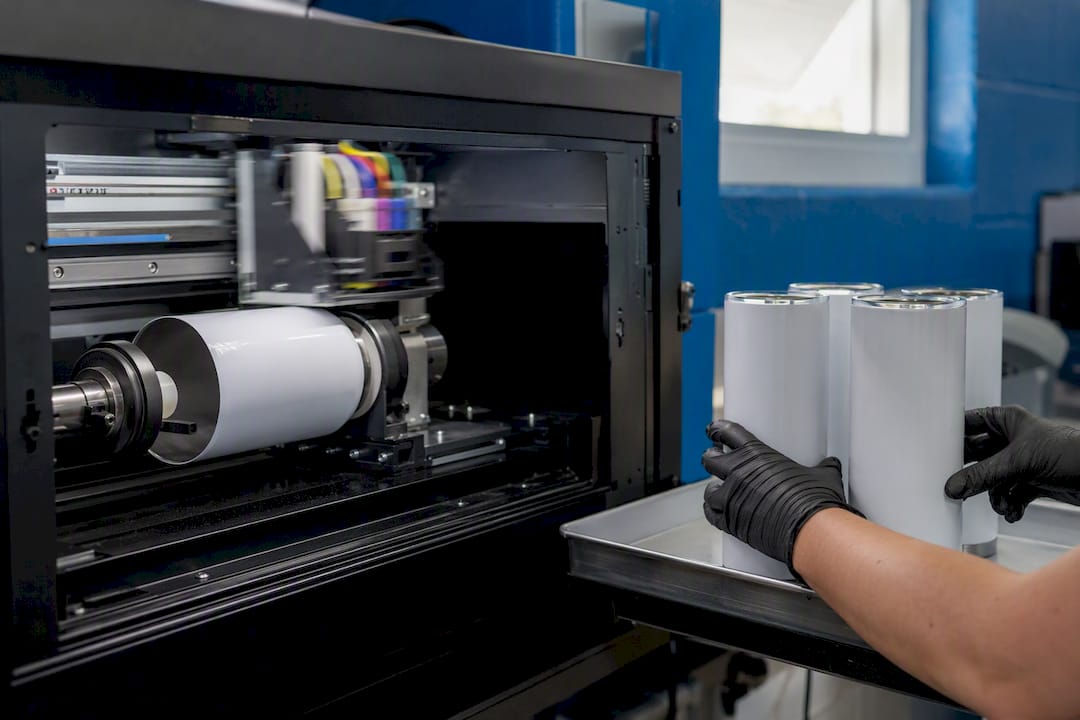
Bags and totes double as both giveaways and retail items. Canvas totes are cheap enough to hand out at trade shows by the crate, yet a well-made canvas or waxed-cotton tote can also retail for £15 to £25 without feeling like a stretch. Backpacks and duffels work best as premium client or employee gifts rather than mass giveaways, given the unit cost.
Tech accessories — power banks, phone cases, wireless chargers — carry high perceived value relative to their cost, which makes them ideal for VIP tiers: top clients, conference speakers, or new hires. Cheap tech is the fastest way to damage a brand, though. Research from Tilburg University found that low-quality giveaways actively harm brand perception rather than sitting neutrally, so a power bank that dies in three weeks costs you more in goodwill than it ever saved in unit price.
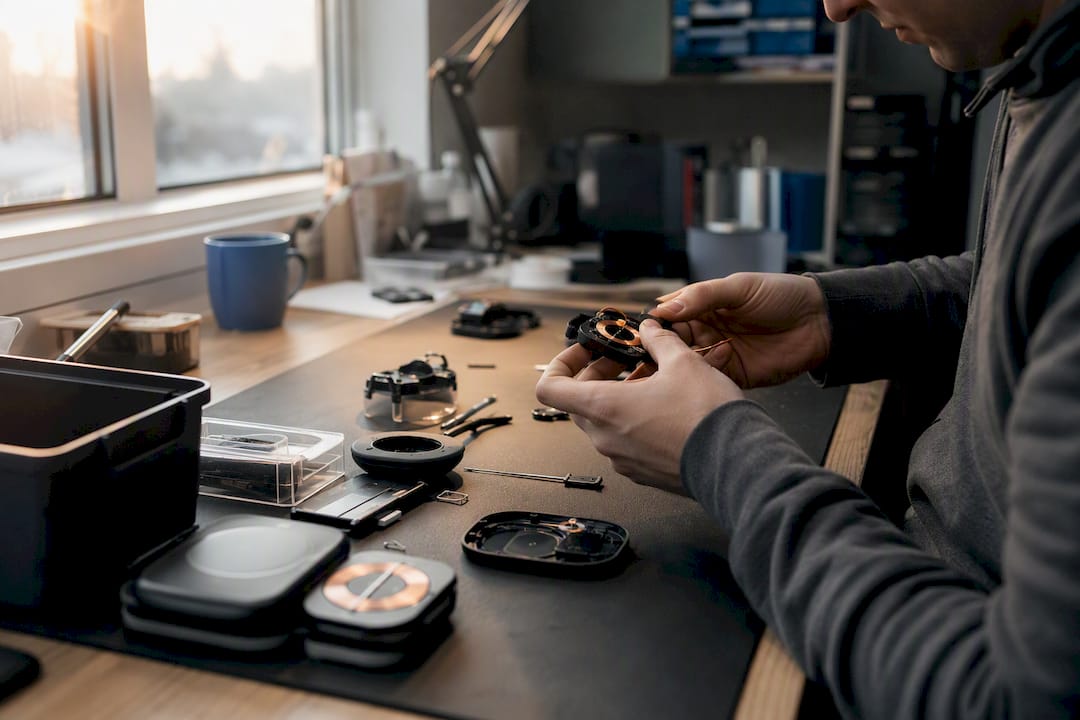
Stickers and stationery are the cheapest category to produce and the easiest to over-order. Die-cut stickers, notebooks, and enamel pins cost pennies at scale and get passed around, stuck on laptops, and photographed for social media, which makes them disproportionately shareable for their cost.
Home and kitchen goods — branded towels, glassware, throws — extend a brand into spaces that logo apparel never reaches. These work best as premium gifts rather than mass giveaways, since production costs run higher.
Giveaway staples like pens, lanyards, and koozies exist purely for reach. Nobody expects quality here, so the goal is volume and cost-per-unit, not craftsmanship.
Collectibles and limited drops — vinyl records, art prints, seasonal capsule releases — create demand through scarcity rather than utility. Shopify’s merchandise guide points to this category as the one most likely to sell out and resell above face value.
How have real brands used merchandise to build revenue?
The clearest revenue proof point is still the Colbert campaign. A small apparel business partnered with the show for a farewell T-shirt run tied to a cause, moved 66,193 units, and raised nearly $2 million in under three months. The lesson isn’t just the number. It’s that cause alignment plus a hard deadline plus an existing audience turns merchandise into an event people rush to join, rather than a product they browse at leisure.
Retail-focused coffee brands show a quieter but steadier model. Starbucks has spent years building a secondary market around seasonal cups, where limited colourways and holiday designs sell out and get resold online for multiples of retail price. Blue Bottle Coffee takes a slower, higher-margin approach with ceramics and glassware that read as home goods first and branding second, which is exactly why people display them. Hard Rock Cafe pioneered destination apparel decades before “travel merch” was a marketing term, turning a city-specific T-shirt into a souvenir people actively sought rather than a giveaway they tolerated.
Beauty brands have pushed this furthest into product-line territory. Glossier turned its pink bubble wrap pouches and logo stickers into recognisable brand assets before it ever sold merchandise as a category, then followed with actual apparel drops that sold out fast. Rhode, Hailey Bieber’s skincare line, applies the same logic: phone cases and branded accessories that function as lifestyle objects, not afterthought swag.
Scarcity does more for perceived value than quality alone ever could.
Entertainment brands run the purest collectible playbook. Disney’s mouse ears headbands generate a constant cycle of limited colourways and character tie-ins that fans collect across multiple park visits. A24, the film studio, sells vinyl soundtracks and art prints tied to specific releases that routinely sell out within hours, because the audience is buying a piece of a film they already love, not a random branded object.
The production note across all of these: retail-grade merchandise uses retail-grade materials and finishing. A screen-printed tee on a heavyweight blank reads differently to a thin promotional shirt, even at a glance.
How do you choose the right branded merchandise for your goals?
Work through five questions in order, and the right SKU tends to fall out the other end.
- What’s the objective? Brand awareness calls for high-visibility, low-cost items distributed widely. Retention calls for utility items your best customers will actually use.
- Who’s the audience? A trade-show crowd wants something light and free. A VIP client list wants something considered and useful.
- What’s the distribution channel? Handed out at a booth, mailed to a home address, or sold through an online store? Each channel has a different cost ceiling.
- What’s the budget per recipient? Set a number before you browse a catalogue, not after.
- What quality signal does this relationship need? A first-touch prospect and a ten-year client should never receive the same gift.
Before committing to a SKU, run it against a short checklist:
- Does the item match how the audience actually spends their day, or does it just look good in a product photo?
- What’s the realistic number of impressions this item generates over its lifespan? Category data on promotional products shows drinkware and bags consistently outperform novelty items on this metric.
- How complex is production, and does the timeline match your launch date?
- Does the item’s footprint (packaging, material, shipping weight) fit your sustainability commitments?
Watch for three red flags. Cheap tech accessories that fail within weeks do more brand damage than no gift at all. Oversized logos that turn a wearable item into a walking advert get left in a drawer. And mismatched gift value, sending a £2 pen to a client who just signed a six-figure contract, signals carelessness rather than generosity. If reach is the goal, score items on cost-per-unit and distribution ease. If revenue or loyalty is the goal, score them on perceived value and how well they hold up after twenty uses.
When should you sell merchandise instead of giving it away?
Sell when scarcity, fandom, or cause alignment can carry the price. Give away when reach and low-friction acquisition matter more than margin.
- Sell limited editions and collector items. A24’s vinyl drops and Disney’s seasonal ear releases work because the audience already wants in. Co-branded retail lines, like the collaboration model behind the Dunkin’ x E.L.F. Cosmetics makeup range, borrow two fanbases at once.
- Give away trade-show and first-touch items. Anything meant to introduce a stranger to your brand should be free, light, and cheap to produce in bulk.
- Price retail merch with a real margin. A common approach is pricing at two to three times production cost, leaving room for shipping and returns without eroding the “this feels premium” impression.
- Remove friction at checkout. A slow or clunky ordering process kills a limited-drop campaign faster than a mediocre design does.
Bundle formats worth copying: pre-orders that build hype before stock exists, a physical item paired with a digital perk (an early-access code, a companion playlist, a discount), and cause-aligned fundraising drops modelled on the Colbert campaign’s near-$2 million result.
Pro Tip: Bundle a lower-cost physical item with a digital perk, such as an exclusive download or early access code, rather than discounting the price. It lifts average order value without training customers to expect markdowns.
Which production methods suit which merchandise types?
Sublimation, DTF, screen printing, embroidery, and laser engraving each solve a different problem, and picking the wrong one is the fastest route to the “cheap swag” look that damages brand perception.
Sublimation dyes the print directly into polyester fabric or polymer-coated hard goods, producing a permanent, full-colour finish with no texture or peeling. It’s the standout choice for mugs, tumblers, and polyester apparel. DTF (direct-to-film) prints a design onto a film that’s then heat-pressed onto almost any fabric, including cotton, making it the flexible option for small-run apparel orders. Screen printing still wins on large runs of simple, one- to three-colour designs where unit cost matters more than colour complexity. Embroidery adds a retail-grade, tactile finish to caps, polos, and bags, and it’s genuinely one of the best ways to make merchandise feel premium rather than promotional. Laser engraving suits hard goods, wood, metal, and some plastics, giving tech accessories and drinkware a permanent mark with no ink to fade.
Wholesale blanks suppliers make small runs viable in a way that traditional bulk-order print shops can’t, which matters if you’re testing a new merchandise line before committing to hundreds of units. Sublimation blanks in particular give you retail-grade drinkware and apparel bases without the wash-out or peeling that ruins cheaper decoration methods over time.
What production options work for makers and small brands?
You have three realistic routes: buy wholesale blanks and decorate them yourself or through a local shop, use a print-on-demand partner for zero inventory risk, or partner with a vertical retailer for distribution at scale. Each trades control for convenience differently. Wholesale blanks give you the tightest quality control and the best margins once you’re past a few dozen units. Print-on-demand removes inventory risk entirely but caps your margin and your material options.
Sublimation, DTF, and laser engraving between them cover almost every product category in this article: drinkware and polyester apparel through sublimation, mixed-fabric apparel through DTF, and hard goods like phone cases or wooden coasters through laser engraving.
The businesses that build repeatable merchandise programmes are the ones that test on a small batch before they commit to a thousand units.
Order a sample run first, check print alignment and colour accuracy under real lighting, and only then place a production order. Suppliers like Subliblanks sell sublimation blanks, printers, and DTF supplies with no minimum order quantity, which makes that sampling step genuinely affordable rather than a luxury reserved for bigger budgets.
Pro Tip: Order five to ten sample units in your actual production batch before committing to the full run. A proof on a different substrate or printer setting can look nothing like the finished product.
What’s a practical pre-production checklist?
Run through this sequence before any merchandise order goes to full production:
- Finalise artwork at print resolution, not screen resolution, and confirm colour codes match your brand guidelines.
- Order a physical sample, never approve from a digital mock-up alone.
- Check print alignment, stitch density on embroidery, and engraving legibility on hard goods under normal light.
- Wash-test apparel samples at least twice to confirm the print or embroidery holds.
- Confirm packaging and labelling before the full run, since fixing this after production means reworking finished stock.
- Build a lead-time buffer of at least two weeks for seasonal drops, since decorators and suppliers get backed up in peak periods.
Check your artwork doesn’t infringe on trademarks or third-party licensing, particularly for anything referencing a character, celebrity, or another brand, since that liability sits with you, not your printer.
Pro Tip: Keep one sample from every production run in a labelled box. When a customer disputes quality months later, you’ll have a physical reference point instead of a memory.
How much should you budget for branded merchandise?
Budgeting for merchandise comes down to matching unit cost to purpose, not chasing the cheapest quote in your inbox. Giveaway staples like pens and stickers should sit under £1 per unit if you’re ordering in the hundreds, since volume is the entire point. Mid-tier items like tote bags and basic apparel typically run £3 to £15 per unit depending on decoration method and order size, with embroidery and multi-colour prints pushing costs toward the top of that range.
Premium categories, drinkware, tech accessories, and outerwear, generally land between £8 and £40 per unit, and this is where cutting corners backs up on you fastest. A £3 power bank that fails in a month costs more in reputation than a £15 one that lasts three years.
Beyond the unit cost, budget separately for setup fees (screen charges, embroidery digitising), sampling, packaging, and shipping, which together can add 15 to 30% to your total spend on a first-time order. Buying blanks wholesale rather than through a decorator who marks up both the blank and the print work is the single biggest lever for reducing cost per unit, particularly once you’re ordering beyond a hundred pieces. No minimum order quantity policies matter here too, since they let you test a design at ten units before scaling to five hundred, rather than gambling your entire budget on an unproven concept.
How long does it take from design to delivery?
A realistic merchandise timeline runs four to six weeks from a finished design to stock in hand, though rush options and simpler decoration methods can compress that.
Design finalisation and approval typically take three to five days if your brand guidelines are already set. Sourcing blanks and confirming a decoration method adds another few days, faster if you’re ordering from a wholesale supplier that holds stock rather than one that orders in from overseas. Sample production and approval is the stage most people underestimate, budget five to seven working days, since you’ll often need at least one revision round.
The main production run varies most by method: screen printing and embroidery runs typically need two to three weeks for larger quantities, while sublimation and DTF orders can often turn around in one to two weeks because there’s no screen setup involved. Add shipping time, three to five days for domestic delivery, longer for international orders, and a buffer of at least a week for anything tied to a fixed event date like a conference or product launch. Seasonal collections need the longest runway, since decorators and suppliers get booked solid in the run-up to major retail periods.
What advisors actually see on merchandise campaigns
The most common mistake isn’t a bad design. It’s ordering five hundred units of one item before testing fifty. Brands that succeed usually mix a handful of reach-focused giveaways with two or three premium retail items, rather than spreading one thin budget across ten categories. When trade customers ask where to start, the practical answer is almost always the same: pick one blank, one decoration method, and one small test run before scaling anything.
How Subliblanks supports your merchandise production
Whichever categories you’ve picked from this list, actually producing them comes down to reliable blanks and equipment, not just a good design file. Subliblanks supplies wholesale sublimation blanks, sublimation printers, DTF supplies, and laser-engraveable blanks with no minimum order quantity, which means you can sample a mug, a tote, or a phone case in single-digit quantities before committing budget to a full run.
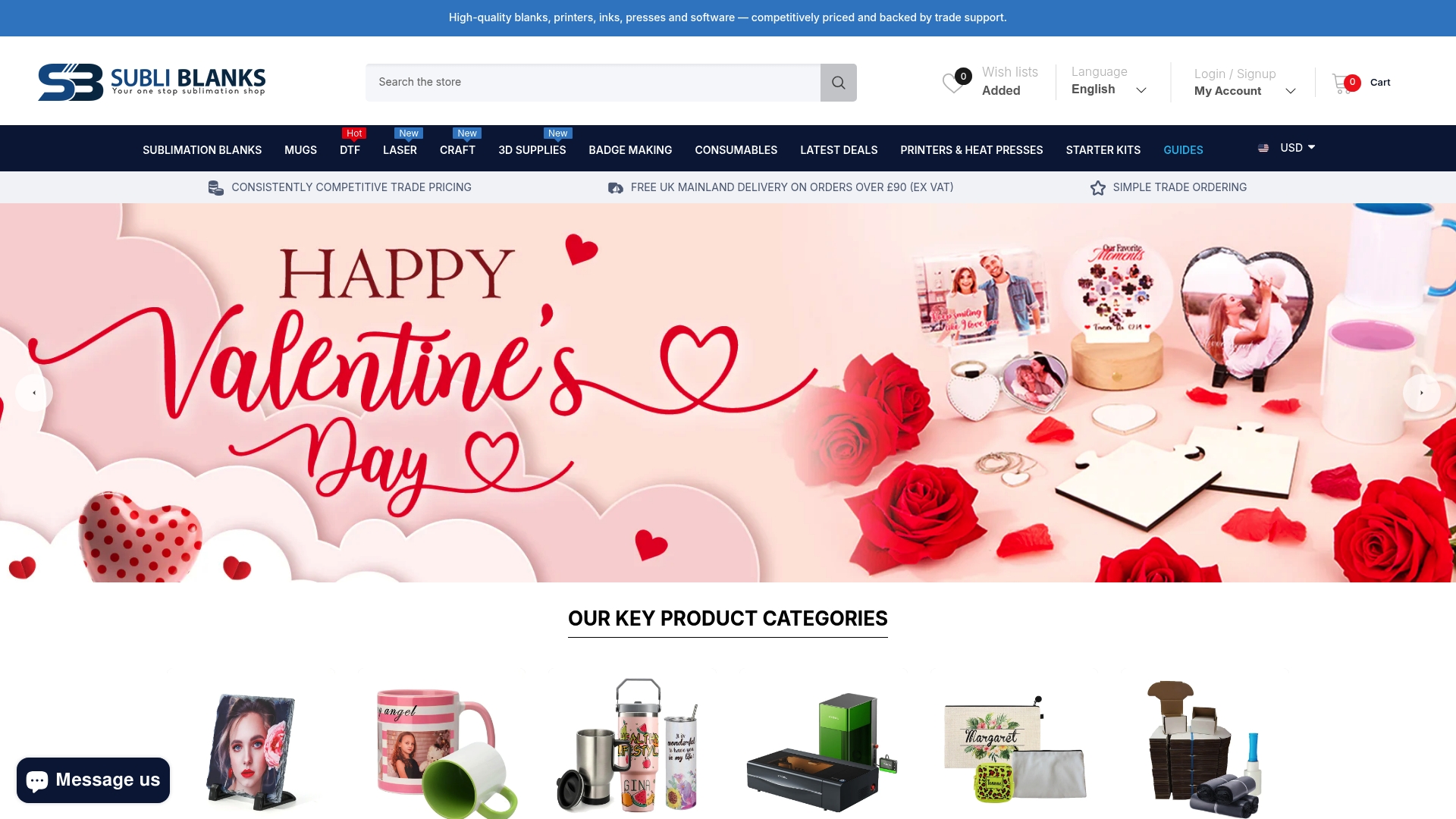
Trade customers get wholesale pricing whether they’re ordering ten units to test a design or scaling to hundreds once it proves out, and the catalogue spans the equipment side too, printers, inks, and finishing supplies, so you’re not sourcing from three different vendors for one product line. If you’re ready to sample the drinkware, apparel, or hard-goods categories covered here, browse the full catalogue of blanks and supplies or go straight to the sublimation printers collection if you’re ready to bring production in-house.
Frequently asked questions
What are the most effective examples of branded merchandise for small budgets? Stickers, pens, and simple tote bags deliver the lowest cost-per-impression, typically under £3 per unit even in modest order quantities. They work best as trade-show or first-touch giveaways rather than retail items.
What is branded merchandise, exactly? Branded merchandise is any physical product carrying a company’s logo or design, distributed either free as a marketing tool or sold as a revenue product in its own right, spanning everything from apparel to drinkware to collectible items.
Which branded merchandise items generate the most revenue? Limited-edition and collectible items tend to generate the strongest returns, since scarcity supports higher pricing. A24’s vinyl drops and cause-aligned campaigns like the Colbert T-shirt run, which raised nearly $2 million, show how scarcity and urgency together can outperform standard retail merchandise.
How do I choose between DTF, sublimation, and screen printing? Sublimation suits polyester apparel and hard goods like mugs and tumblers, DTF works across most fabrics including cotton for smaller runs, and screen printing remains most cost-effective for large runs of simple designs.
How long does it take to produce custom branded merchandise? Expect four to six weeks from finished design to delivered stock, including sample approval, though sublimation and DTF orders can often turn around faster than screen printing or embroidery for smaller runs.
Sources
For deeper category examples, the University at Buffalo’s branded merchandise list offers an institutional checklist covering scarves, notebooks, and tote bags. Shopify’s merch ideas guide covers dozens of creative categories beyond what fits in one article. For data on which categories perform best by impressions, see the PPAI/promotional products industry data and Custom Ink’s ROI-ranked list. For the quality research behind avoiding cheap giveaways, read the Tilburg University study. If your merchandise plans include durable workwear or uniform pieces, this guide to branded construction workwear covers material choices for long-term wear.
- Why cheap, low-quality giveaways are bad for brands — quality matters
- Merch ideas and examples
- What are the most effective promotional products in 2026? Backed by real consumer data


