



Coated tumblers for sublimation: what actually works
Yes: use sublimation-ready coated tumblers, not plain stainless steel, and test a sample before you commit to a bulk order. Uncoated metal has nothing for dye-sublimation ink to bond to, so the design will simply wipe off. The blanks that actually work are vacuum-insulated stainless tumblers finished with a polymer or ceramic-style coating, usually available in 14 oz or 20 oz sizes.
The fastest way to confirm a supplier’s coating performs is to order one unit, run your standard press settings, and inspect it before placing a production order. Suppliers with no minimum order quantity, such as Subliblanks, make this realistic for a small operation:
- Order a single sample tumbler rather than a case.
- Press it using your own transfer and note the exact temperature, time, and pressure.
- Inspect colour saturation and edge crispness before approving a pilot run.
- Only scale to bulk once the sample passes.
Key Takeaways
Coated, sublimation-ready tumblers succeed when the coating type is verified, press parameters are tested on a sample first, and suppliers are vetted for no-minimum ordering and QA transparency.
| Point | Details |
|---|---|
| Coating compatibility comes first | Confirm the technical coating name and cure method before assuming a tumbler is sublimation-ready. |
| Test before you scale | Press one sample at your standard settings, record the results, then run a small pilot batch. |
| Diagnose by symptom | Faded print means under-transfer; ghosting means movement; flaking means a coating fault, not a settings issue. |
| Set care expectations early | Recommend hand-washing and note that dishwasher heat can dull sublimated prints over time. |
| Choose suppliers without lock-in | Subliblanks offers no minimum order quantities, making single-sample testing and staggered bulk orders realistic for small businesses. |
Table of Contents
- What “coated” means and which coatings actually take sublimation ink
- How do you prepare and press a coated tumbler correctly?
- Why is my sublimation transfer peeling, ghosting, or fading?
- Caring for coated tumblers after the sale
- Choosing a supplier: what to ask before you order
- Is sublimation coating safe, and what’s the environmental impact?
- Internal product pages and partner references
- What crafters get wrong about coated tumblers
- Get coated tumbler samples without committing to a case
- Frequently asked questions
What “coated” means and which coatings actually take sublimation ink
Dye-sublimation ink needs a receptive surface to bond to. It doesn’t sit on top of the material the way screen-print ink does. It turns to gas under heat and pressure, then re-solidifies inside a polymer layer. Bare stainless steel has no polymer for it to grip, so the ink either beads off or wipes away the moment the tumbler cools.
That’s the entire reason “coated” tumblers exist as a category separate from plain drinkware. Manufacturers apply a polymer coating, sometimes described as a polyester coating, over the raw metal specifically so sublimation ink has something to embed into. Some suppliers market a ceramic-style finish instead, which behaves similarly under heat but can differ slightly in gloss and scratch resistance. “Sublimation-ready” on a spec sheet generally means the manufacturer has applied and cured this coating at the factory, ready for your press, not that you’ll need to coat it yourself.
Before you buy in any quantity, get four things confirmed in writing:
- The coating’s technical name (not just “sublimation-ready”) and whether it’s polymer or ceramic-style.
- The oven-cure temperature and duration used at manufacture.
- The recommended press temperature range for that specific coating.
- Any warranty or QA statement covering coating defects like flaking or uneven cure.
Pro Tip: Ask the supplier for the exact wording of their coating spec, not a marketing summary. “Sublimation-ready” can mean different things between manufacturers, and the cure method affects how forgiving the coating is if your press runs a few degrees hot.
How do you prepare and press a coated tumbler correctly?
Getting a clean, durable transfer on a coated tumbler comes down to four stages, and skipping the first one is the most common reason a print fails before it even reaches the press.
-
Prepare the surface. Wipe the coating with isopropyl alcohol to remove fingerprint oils and dust. Skip fabric softener sheets or household cleaners, since residue interferes with ink absorption. If the manufacturer recommends a pre-press to drive out moisture, give it 10 to 15 seconds before applying your transfer.
-
Print with the right consumables. Use genuine sublimation ink through a compatible printer, not pigment or dye-based inkjet cartridges, and match it to sublimation transfer paper rated for drinkware. Lay out artwork as a mirror image, sized to wrap the tumbler’s circumference with a small overlap allowance, typically around 9 inches wide by 4 to 4.5 inches tall for a 14 oz tumbler, scaling up for 20 oz.
-
Press with correct parameters. Most coated tumblers press well at high temperatures for moderate durations, though this varies by coating and press type. A dedicated tumbler press or a rotisserie-style rotator gives more even pressure across the curve than a flat clamshell adapted with a wrap. Secure the transfer with heat-resistant tape at the seam, and use a protective sheet or shrink wrap if your supplier recommends it to stop ink migration onto the press.
-
Run a test before you scale. Press one sample, record the exact settings you used, then run a small batch before committing to a full production order. This single habit is what separates crafters who catch a coating problem early from those who discover it after pressing fifty units.
According to publisher guidance on the sublimation workflow, skipping the sample stage is the most common reason small businesses see inconsistent results between supplier batches.
Why is my sublimation transfer peeling, ghosting, or fading?
Most tumbler problems trace back to one of three causes: heat, pressure, or the coating itself. Working through them in order saves time and wasted blanks.
- Faded or washed-out colour usually means under-transfer. Raise the temperature by 5 to 10 degrees or extend the time by 10 to 15 seconds, then retest on a fresh blank rather than repressing the same one.
- Ghosting or a blurred double image points to movement during the press. Check that your wrap is taped tightly at every seam and that pressure is even; loose paper shifts as the ink gasses.
- Ink coming off on a cloth or fading fast signals the coating didn’t cure properly or isn’t a genuine sublimation coating at all. This isn’t a settings problem; it’s a blank problem.
- Flaking or a cloudy patch after otherwise correct settings suggests inconsistent coating application from that production batch.
If adhesion failures or flaking persist across multiple units from the same batch, stop pressing that stock and contact the supplier’s QA team rather than adjusting your press further. A pattern across several tumblers is a coating issue, not a technique issue, and a supplier confident in their product will replace the batch or explain the discrepancy.
Caring for coated tumblers after the sale
Whether a finished tumbler is dishwasher-safe depends entirely on the coating, and this is worth stating clearly to your customers rather than leaving it ambiguous. Most polymer and ceramic-style coatings used for sublimation are rated hand-wash only; dishwasher heat and detergent can dull the print over repeated cycles even when the coating itself survives.
- Recommend hand-washing with a soft cloth and mild soap.
- Warn against abrasive sponges, bleach-based cleaners, and scouring pads.
- Note that extreme heat from liquids poured directly against the print area, plus drops or impacts, are the two most common causes of premature scratching or seal damage.
A short care line on your product listing, something like “hand wash recommended to preserve the print,” reduces confusion and pre-empts return requests. If your supplier provides a specific warranty or disclaimer on coating durability, pass that wording along rather than paraphrasing it.
Pro Tip: Print your care instructions on a small card or sticker included with the tumbler. Customers who never read the listing description will still see it in the box.
Choosing a supplier: what to ask before you order
Before committing to any tumbler supplier, request five things in writing: the coating’s technical data sheet, their sample ordering policy, typical lead times, pack and bulk pricing tiers, and their QA and returns policy for coating defects. A supplier that hesitates to provide any of these is telling you something.
The practical path from first sample to reliable supply chain looks like this:
- Order one sample tumbler and press it using your standard settings.
- Run the test protocol above and document the results.
- If it passes, order a small pilot batch (10 to 25 units) rather than jumping straight to a full case.
- Once the pilot performs consistently, place staggered bulk orders rather than one large one, so you catch batch-to-batch coating variation early.
SubliBlanks operates as a trade wholesaler with no minimum order quantities, which matters more than it sounds for a small business testing a new coating or size before scaling up. Its 14 oz stainless steel sublimation travel mug is a common starting point for sample orders, alongside multi-pack options for businesses ready to move past testing. The supplier’s own blog notes that switching to purpose-made sublimation blanks can cut material waste by 25% in 2026 compared with trial-and-error sourcing, a figure worth weighing against the cost of repeatedly reordering mismatched stock. Ordering single samples and running a standardised test protocol before switching suppliers is the single habit most likely to prevent a scale-up failure.
Small businesses that treat every new blank batch as untested, even from a familiar supplier, catch coating inconsistencies before they reach fifty finished units rather than after.
Pro Tip: Keep a simple log of press settings against supplier batch numbers. When something goes wrong six months from now, you’ll know instantly whether it’s your technique or their coating.
For in-house production, pairing coated blanks with a compatible printer matters as much as the blank itself; Subliblanks also stocks Epson and Ricoh printers built for sublimation alongside the coated blanks, which keeps ink and blank compatibility in one place rather than guessing across two vendors.
Is sublimation coating safe, and what’s the environmental impact?
Dye-sublimation itself produces no liquid waste and uses no water, unlike screen printing, which is one reason small businesses favour it for low-volume, made-to-order production. The ink transitions directly from solid to gas under heat, so there’s no rinse-off stage and minimal ink waste beyond the printed sheet itself.
The coatings themselves are polymer or ceramic-based finishes cured onto the metal at the factory, and reputable suppliers should be able to confirm the coating meets standard consumer product safety expectations for drinkware, including food-contact safety for the rim and interior surfaces that touch a drink. Ask for this confirmation directly rather than assuming it, particularly for tumblers sold to end customers rather than used internally.
On the waste side, choosing purpose-made sublimation blanks over generic stainless steel that you attempt to coat or adapt yourself avoids the failed batches that come from mismatched materials, which is where a genuine environmental saving shows up for a small operation. Ordering to test before bulk buying, and working with a supplier offering no minimum order quantities, also cuts down on unused stock sitting in a cupboard because a size or finish didn’t sell. For a home or small-studio setup, decent ventilation during pressing is worth having, since heat presses release warm vapour from the transfer paper, though this is a comfort consideration more than a hazard at typical craft-business volumes.
Internal product pages and partner references
For sizing and process reference, see the 14 oz travel mug page, Subliblanks’ merchandise guide, and WorkWearComfort’s finished tumbler example.
What crafters get wrong about coated tumblers
The advice most small businesses hear is to find “the best tumbler brand” and stick with it. That’s backwards. Coating consistency varies by production batch even within the same supplier, which means the habit that actually protects your business isn’t brand loyalty, it’s a testing routine you run every single time stock changes hands.
What’s genuinely underrated here is the sample order itself. Crafters treat it as a formality before the “real” purchase, when it’s actually the only checkpoint that catches a bad coating batch before it costs you fifty ruined blanks and an afternoon of confused troubleshooting. A supplier who makes that sample order easy, with no minimum quantity attached, is telling you something about how they expect to be tested.
Prioritise the coating data sheet and the sample test over price per unit. A tumbler that’s 10% cheaper but fails one in five presses costs more than one that’s slightly pricier and consistent. Sustainable sourcing and cost control turn out to be the same decision here, not competing priorities.
Get coated tumbler samples without committing to a case
There are other ways to source drinkware blanks, from generic wholesalers to marketplace bulk lots, but most force you into a minimum order before you’ve even confirmed the coating works with your press. Subliblanks takes the opposite approach: no minimum order quantities, so you can order a single 14 oz or 20 oz coated tumbler, run your test protocol, and only scale once it’s proven on your equipment.
That matters most for small businesses trying a new size or coating for the first time, where a failed bulk order is a real financial hit, not just an inconvenience. Alongside the blank tumblers themselves, Subliblanks stocks compatible Epson and Ricoh sublimation printers, so your ink, paper, and blank all come from a supplier that understands how they need to work together. Start with a single sample order, run it through your press, and confirm the coating before you commit to anything larger.
Frequently asked questions
Can you use any stainless steel tumbler for sublimation? No. Plain, uncoated stainless steel has no polymer layer for the ink to bond to, so the design won’t transfer. You need a tumbler specifically coated for dye-sublimation.
What temperature should I press a coated tumbler at? Most coated tumblers press well between 385°F and 400°F for 60 to 90 seconds, but always confirm the exact range with your specific supplier’s spec sheet, since coatings vary.
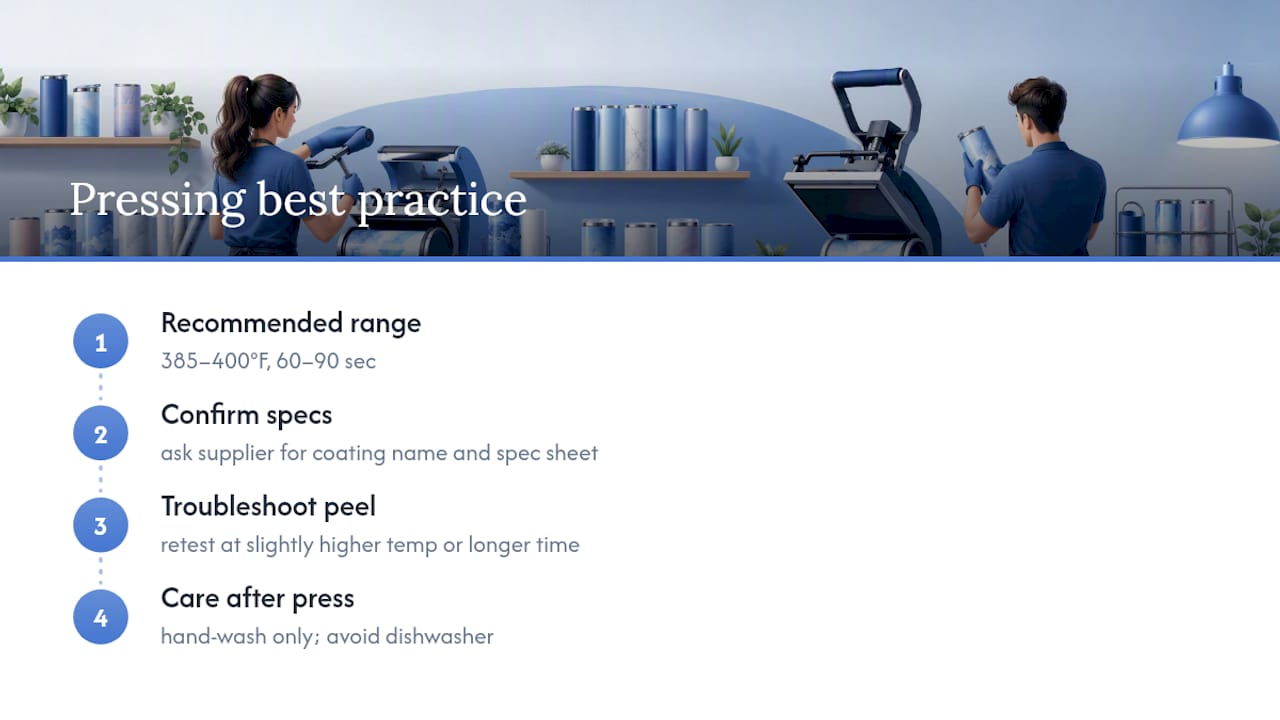
Are sublimation tumblers dishwasher-safe? Generally no. Most coatings are rated hand-wash only, and dishwasher heat and detergent can dull the printed design over repeated cycles even if the coating itself holds up.
How do I know if a tumbler is genuinely sublimation-ready? Ask the supplier for the coating’s technical name, oven-cure details, and recommended press temperature, rather than relying on “sublimation-ready” as a marketing term alone.
Why is my print peeling off after a few washes? This usually points to under-transfer during pressing or an improperly cured coating. Retest a fresh sample at a slightly higher temperature or longer press time, and if the problem persists across a whole batch, contact your supplier’s QA team.


